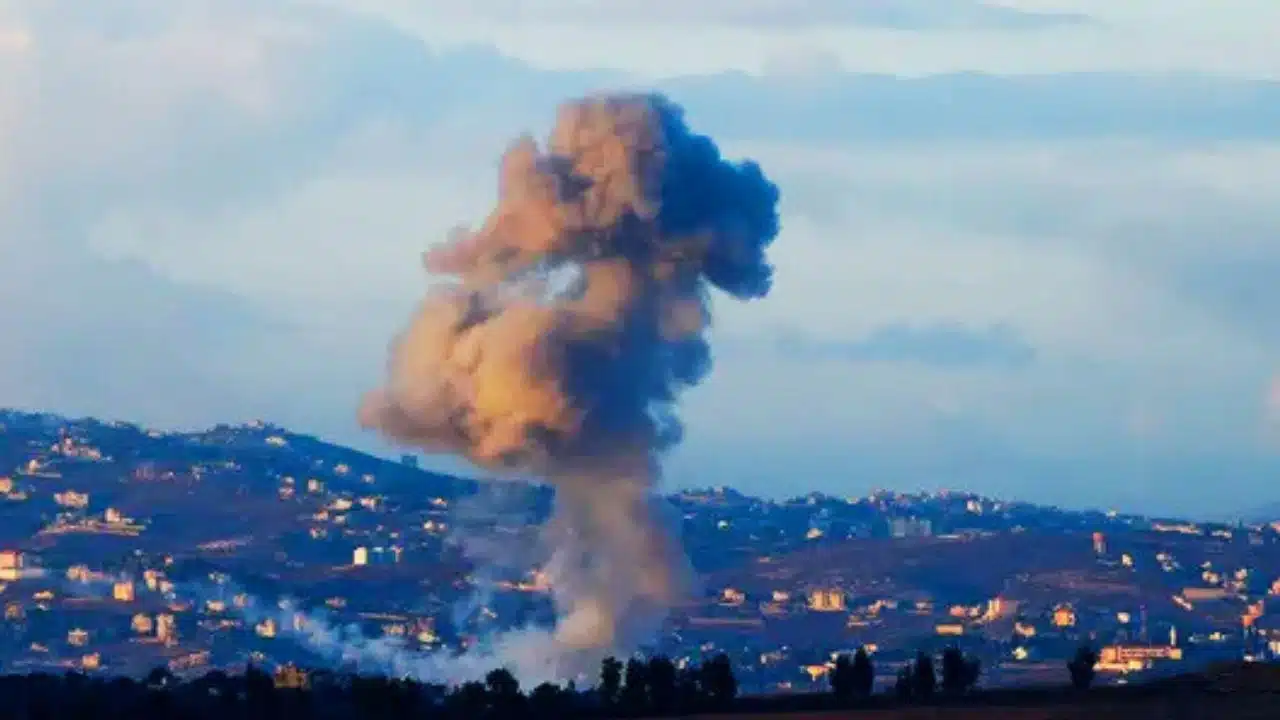
Tensions along the Israel-Lebanon border intensified on Friday, June 27, as Israeli air raids struck southern Lebanese territory, resulting in civilian casualties and reigniting concerns about a fragile ceasefire agreement between the two countries.
According to Lebanon’s Health Ministry, one woman was killed and at least 13 others were injured in an airstrike that targeted a residential apartment in the city of Nabatieh. Additionally, separate Israeli strikes on the outskirts of the city left another seven people wounded. The casualty figures were first reported by Lebanon’s state-run National News Agency and confirmed by local health authorities.
The attacks caused significant destruction to civilian infrastructure, particularly the upper floors of a multi-story residential building, which reportedly collapsed during the strikes. Videos shared on social media and verified by fact-checkers showed large plumes of smoke rising into the sky, as well as the distinct sound of fighter jets flying overhead. Many residents were seen fleeing the area, with emergency crews working through debris to assist those trapped or injured.
Israeli Military Targets Hezbollah Bunkers Near Nabatieh
The Israeli Defense Forces (IDF) confirmed that the air raids were part of a broader military operation targeting Hezbollah infrastructure in the Nabatieh Governorate. The Israeli military stated that fighter jets had conducted precision strikes on an underground military site near Beaufort (Belfort) Ridge—a well-known strategic hill in southern Lebanon that had been used previously by Hezbollah for its defense operations.
According to the IDF, the facility had served as a command center and storage site for weapons and was suspected of being reactivated by Hezbollah operatives in recent weeks. The site was reportedly taken out of use by Israel during previous military operations, but recent intelligence indicated that Hezbollah was attempting to restore it for offensive purposes.
Israel has maintained that this activity represents a violation of the ceasefire agreement reached in November 2024. That truce, brokered with U.S. involvement, called for a complete cessation of hostilities across the Lebanese-Israeli border and the removal of any non-state armed forces from the southern Lebanese region.
Conflicting Narratives on Civilian Damage
There are conflicting reports from both sides regarding the cause of civilian injuries in Nabatieh. Lebanese officials have stated that the casualties resulted directly from Israeli airstrikes on civilian zones, including residential buildings with no confirmed military presence.
On the other hand, the Israeli military offered a different explanation. According to its spokesperson, the explosion that damaged the apartment complex and led to civilian casualties was caused by a Hezbollah rocket stored at the targeted site. The Israeli claim is that the munition detonated during the strike, resulting in widespread collateral damage to the nearby civilian area. The military accused Hezbollah of deliberately storing weapons in close proximity to populated areas, thereby placing civilians at significant risk during any military engagement.
While this version of events could not be independently verified at the time of reporting, it highlights the increasingly dangerous proximity between military targets and civilian residences in Lebanon—a trend that has been documented in previous conflicts as well.
Lebanese Government Condemns Israeli Strikes
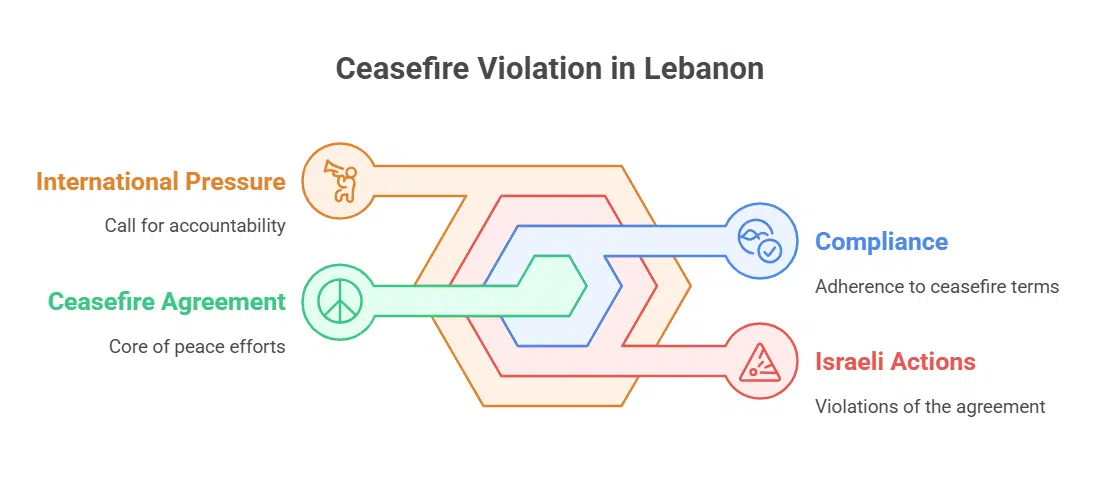
In the aftermath of the air raids, Lebanese President Joseph Aoun strongly condemned Israel’s actions, asserting that the continued strikes on Lebanese territory constitute a breach of the U.S.-mediated ceasefire. He reiterated that the agreement prohibits all forms of military aggression and mandates that both parties refrain from cross-border attacks.
Lebanese leadership also emphasized that Israel had failed to fully comply with the ceasefire terms by maintaining military outposts inside Lebanese territory. According to reports from international observers, at least five Israeli positions remain active on Lebanese soil. These positions were expected to be vacated as part of the truce agreement, which also requires Lebanese troops to assume control over southern Lebanon in areas vacated by Hezbollah and Israeli forces.
Prime Minister Najib Mikati echoed the president’s concerns, calling for immediate international pressure on Israel to stop its air campaigns and withdraw from all Lebanese territory. The Lebanese government has called upon the United Nations and the U.S. administration to hold Israel accountable for what they described as repeated violations of the agreement.
Ceasefire Under Severe Strain
The airstrikes represent one of the deadliest escalations in southern Lebanon since the ceasefire was declared in late 2024. The truce had been brokered after over a year of intermittent clashes and nearly two months of intense fighting along the border. It was designed to bring long-term calm to a region that has seen numerous rounds of conflict between Israel and Hezbollah over the past two decades.
However, tensions have remained high. Since the agreement, there have been numerous incidents involving cross-border fire, drone incursions, and targeted assassinations. Analysts have noted that the ceasefire, while preventing full-scale war, has failed to eliminate hostilities. According to data published by humanitarian organizations and verified by U.N. peacekeeping forces, there have been more than 170 fatalities and 400 injuries on both sides since the ceasefire came into effect—numbers that are steadily climbing.
The most recent airstrikes come amid growing fears that the border could once again erupt into a broader conflict. Many observers believe the situation remains volatile, especially given Hezbollah’s increasing arsenal and Israel’s heightened state of military readiness.
International Reactions and Regional Concerns
The airstrikes have drawn international concern, with calls from various governments and organizations urging restraint. The United Nations Interim Force in Lebanon (UNIFIL) issued a statement expressing deep concern over the renewed violence and calling on both parties to respect the rules of engagement set by the ceasefire agreement.
Meanwhile, regional analysts point out that the ongoing exchanges risk entangling Lebanon in the broader geopolitical struggle currently unfolding in the region, particularly as the war in Gaza continues to dominate headlines. There is concern that any further deterioration of the security situation in southern Lebanon could destabilize the wider Middle East and draw in additional actors.
A Tense Situation with High Stakes
The Israeli airstrikes on Nabatieh mark another dangerous escalation in a conflict that continues to test the limits of a fragile truce. With civilian lives increasingly caught in the crossfire and military actions on both sides testing the boundaries of ceasefire terms, the prospects for long-term peace remain uncertain. The international community faces mounting pressure to mediate more robust conflict resolution measures before another full-scale war erupts.