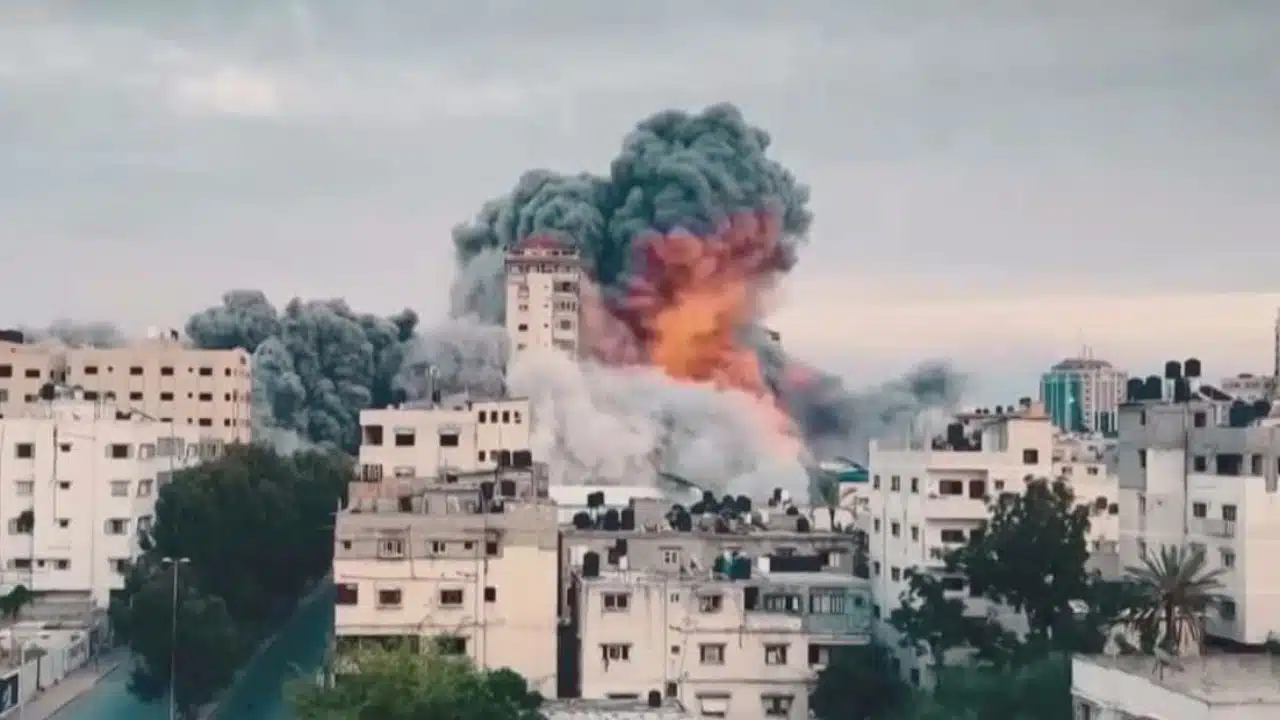
Key Facts: The Latest Escalation
- Ceasefire Broken: A 48-day ceasefire, brokered by Egypt and Qatar, was broken late Sunday, Oct. 19, 2025, by at least 11 rockets fired from northern Gaza towards Israeli communities.
- Israeli Response: The Israel Defense Forces (IDF) initiated “Operation Resolute Shield,” conducting over 30 airstrikes targeting what it identified as militant infrastructure in Jabalia and Khan Younis.
- Casualties: The Palestinian Ministry of Health in Gaza reports at least 14 fatalities, including three minors, and over 50 injuries as of 10:00 AM local time Monday. The IDF has reported no Israeli casualties from the initial rocket attack.
- Conditional Offer: Israel’s offer to return to the ceasefire is contingent on an immediate cessation of all hostile fire from Gaza and “verifiable actions” by Hamas to restrain other militant factions.
- Humanitarian Impact: The main goods crossing at Kerem Shalom has been closed, halting the entry of an estimated 150 aid trucks and deepening the humanitarian crisis, according to UN officials.
A Precarious Calm Unravels
The relative peace that had settled over the Gaza Strip and southern Israel for nearly seven weeks was a product of intense diplomatic efforts led by Cairo and Doha. This period of calm had allowed for a significant increase in humanitarian aid flow into the besieged territory and had permitted some reconstruction efforts to begin on infrastructure damaged in previous conflicts.
The ceasefire, which began in early September 2025, was never formalized into a permanent agreement but was understood to be a “calm-for-calm” arrangement. For residents on both sides of the border, it represented a welcome respite from the cycles of violence that have defined the region for decades. However, officials had privately warned that the truce remained vulnerable to “spoilers”—smaller, more radical militant factions operating in Gaza outside the direct control of Hamas.
What Happened: A Timeline of the Renewed Violence
The Initial Attack: Rockets Pierce the Night Sky
At approximately 10:45 PM on Sunday, October 19, 2025, air raid sirens blared across Israeli communities near the Gaza border, including Sderot and the Eshkol Regional Council. The IDF confirmed that a volley of at least 11 projectiles was launched from an area in northern Gaza.
Israel’s Iron Dome missile defense system intercepted nine of the projectiles, with two reportedly landing in open, unpopulated areas. There were no physical injuries reported, though several residents were treated for shock. Shortly after, the Al-Quds Brigades, the armed wing of the Palestinian Islamic Jihad (PIJ), claimed responsibility for the attack in a statement on their Telegram channel, calling it a response to “the ongoing siege and Zionist crimes in the West Bank.”
Israel’s Retaliation: ‘Operation Resolute Shield’
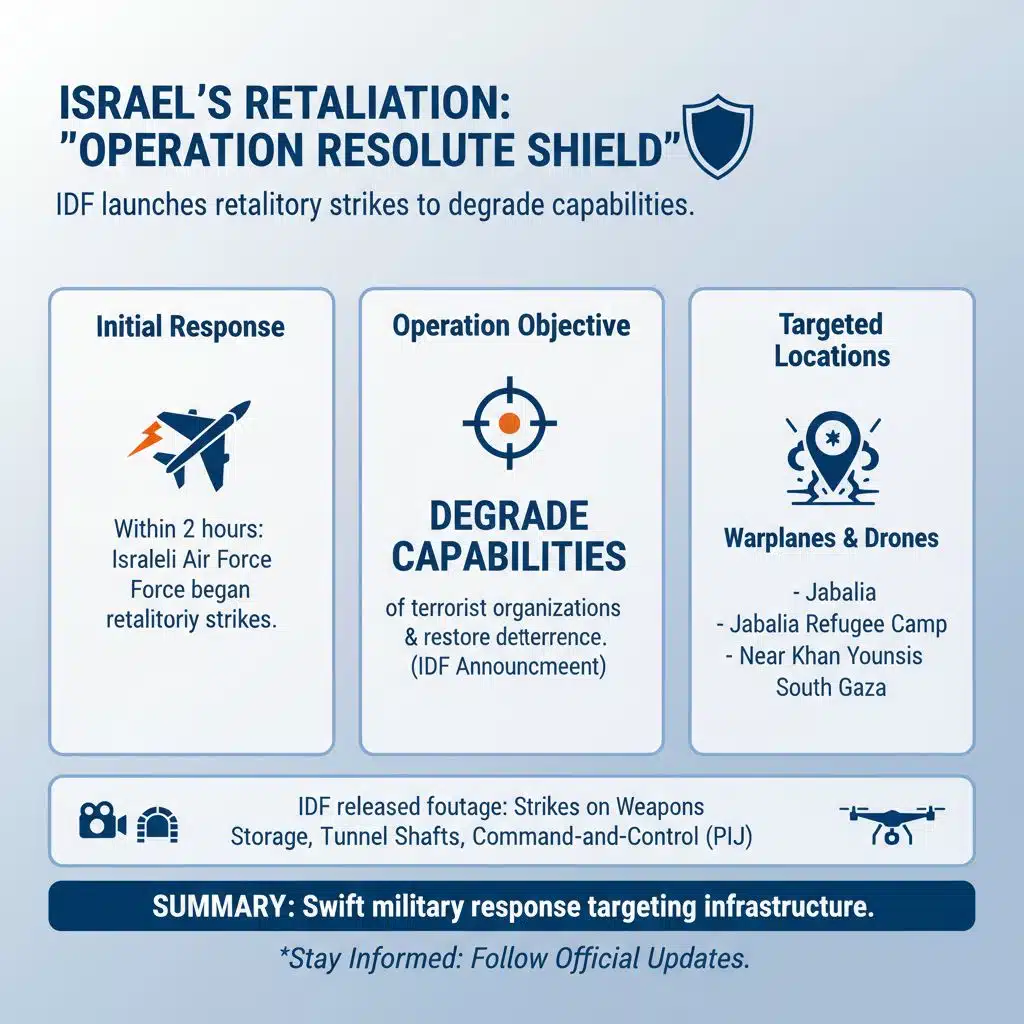
Within two hours, the Israeli Air Force began a series of retaliatory strikes. The IDF announced the launch of “Operation Resolute Shield,” stating its objective was to “degrade the capabilities of terrorist organizations and restore deterrence.”
Warplanes and drones targeted multiple locations. Loud explosions were reported by residents in the Jabalia refugee camp in northern Gaza and near Khan Younis in the south. The IDF released footage it claimed showed strikes on weapons storage facilities, underground tunnel shafts, and a command-and-control center belonging to PIJ.
Latest Data and Statistics
The human and material cost of this latest flare-up is already significant:
- Casualty Discrepancy (as of 10:00 AM, Oct 20, 2025):
- Palestinian Ministry of Health, Gaza: Reports 14 killed, including at least 5 identified militants and 9 civilians (3 of whom are minors), and 58 wounded.
- Israel Defense Forces (IDF): States its intelligence indicates approximately 10-12 militants were killed in targeted strikes on operational command centers. The IDF notes it is “reviewing reports of non-combatant casualties.
- Humanitarian Access Blocked: The UN Office for the Coordination of Humanitarian Affairs (UNOCHA) confirmed the closure of the Kerem Shalom crossing by Israeli authorities. Their flash update noted: “The closure, effective 6:00 AM today, has halted the entry of all goods, including fuel for Gaza’s power plant and critical medical supplies. An average of 150-170 trucks were crossing daily during the ceasefire.
- Displacement: Local sources in Gaza report that hundreds of families living near the border fence in the north have evacuated their homes, fearing an extended military operation. UNOCHA estimates an initial figure of over 2,500 people have been newly displaced internally.
Official Responses and Expert Analysis
Reaction from all sides has been swift. In a televised statement, IDF Spokesperson Rear Admiral Oren Geller stated:
“Hamas is the sovereign in Gaza and it is responsible for all acts of terror emanating from its territory. Our strikes were precise, targeting the infrastructure of the Islamic Jihad terrorists who sought to drag the entire region into violence. Israel is not interested in escalation, but we will not hesitate to act decisively to protect our citizens. If the rocket fire stops, and Hamas proves it is in control, a return to calm is possible.” (Source: Live press briefing via Kan News).
The Palestinian Authority in Ramallah condemned the “brutal Israeli aggression” and called for immediate international intervention to “stop the massacre.”
Hamas, the de facto ruling party in Gaza, is in a precarious position. It did not claim the rocket attacks but has not condemned them either. A statement from the group warned that “the resistance’s patience is wearing thin” but stopped short of declaring an end to the ceasefire from its side.
Dr. Khalil Shikaki, a political analyst at the Jerusalem-based think tank “Mada al-Carmel,” explained the dynamic. “This is a classic spoiler scenario,” he said via phone. “PIJ, potentially with external encouragement, acts to undermine the stability that benefits its rival, Hamas. For Israel, the challenge is to punish the perpetrators without triggering a full-scale war with Hamas, which would be far more devastating for everyone.”
Impact on People: ‘We Thought We Had a Chance to Breathe’
For civilians, the renewed violence is a terrifying return to a grim reality. “The explosions last night were the worst we have heard in months,” said Fatima Al-Masri, a 45-year-old mother of four from Jabalia, reached by phone. “My children were screaming. We all huddled in one room, away from the windows, just praying. We thought we had a chance to breathe, to live like normal people, but it was a lie. There is no safety here.”
What to Watch Next
The coming 24 to 48 hours will be critical. Key developments to monitor include:
- Egyptian Mediation: Diplomatic sources in Cairo have confirmed that Egyptian intelligence officials are in contact with all parties to de-escalate the situation and restore the ceasefire.
- Hamas’s Actions: Whether Hamas security forces actively move to prevent further rocket launches by PIJ or other groups will be a key signal for Israel.
- Humanitarian Corridor: The international community, particularly the UN and ICRC, will exert immense pressure on Israel to reopen the Kerem Shalom crossing for aid.
- Further Attacks: Any additional rocket fire from Gaza or further extensive airstrikes from Israel could quickly spiral into a prolonged and wider conflict.
The conditional offer by Israel to return to the Israel Gaza ceasefire provides a narrow window to avert a full-scale confrontation. However, the trust that had been slowly building over the past seven weeks has been shattered. The immediate future for the over two million residents of Gaza and the hundreds of thousands of Israelis living nearby now hangs precariously on the decisions of military commanders and political leaders, with international mediators racing against the clock to pull the region back from the brink.