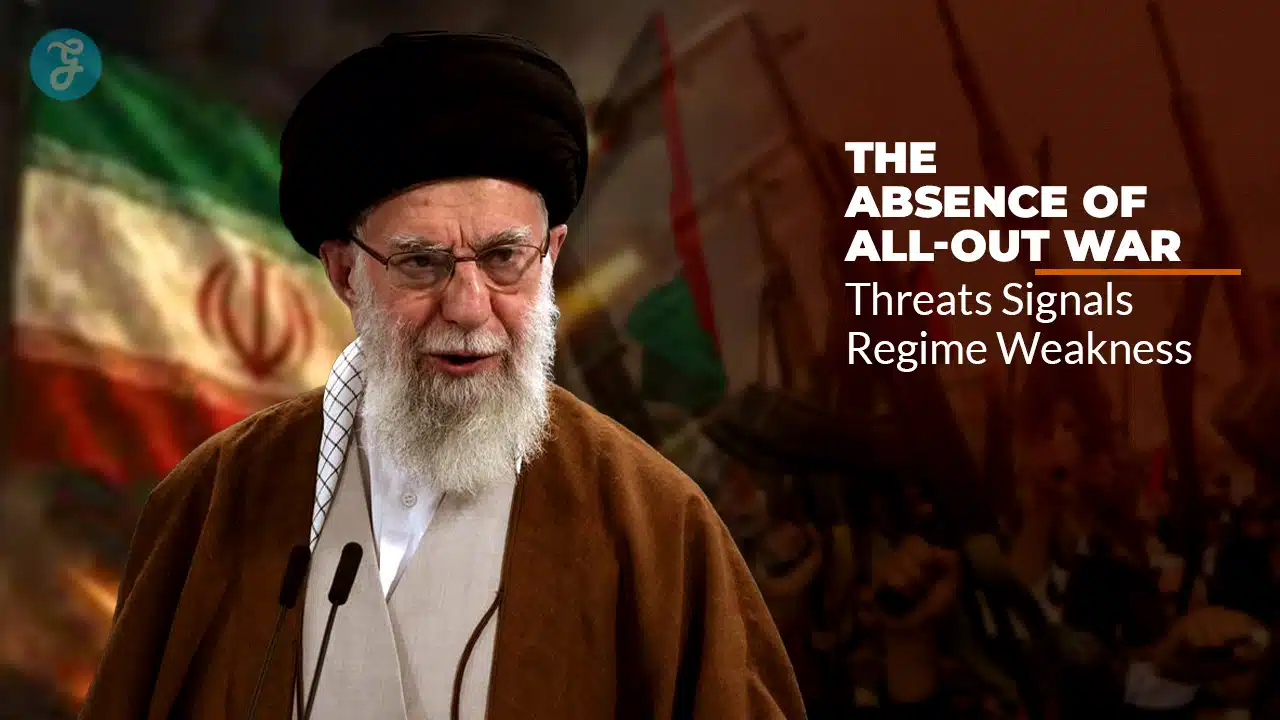
Iran regime weakness is no longer a subject of speculative academic debate; it is the screaming subtext behind the deafening silence currently emanating from Tehran. For decades, the Islamic Republic has operated on a doctrine of performative rage, threats of “all-out war,” promises to “flatten” enemy capitals, and the theatrical burning of flags. Yet, in the wake of the most catastrophic year in its history, the Mullahs have gone mute.
This silence is not the “strategic patience” that Western analysts have long ascribed to Iran’s leadership. It is not a pause for breath, nor is it a calm before the storm. It is the paralysis of a regime that has realized it is fighting for its own survival, not on the shores of the Mediterranean, but on the streets of Tehran itself. The geopolitical chessboard has been overturned. The “Axis of Resistance” is fractured, the treasury is empty, and the internal population is in open revolt.
To understand why the drums of war have stopped beating, we must look beyond the propaganda and dissect the three existential crises, military, economic, and domestic, that converged in January 2026 to force the regime into a humiliating yet necessary retreat.
The Myth of ‘Strategic Patience’ is Dead
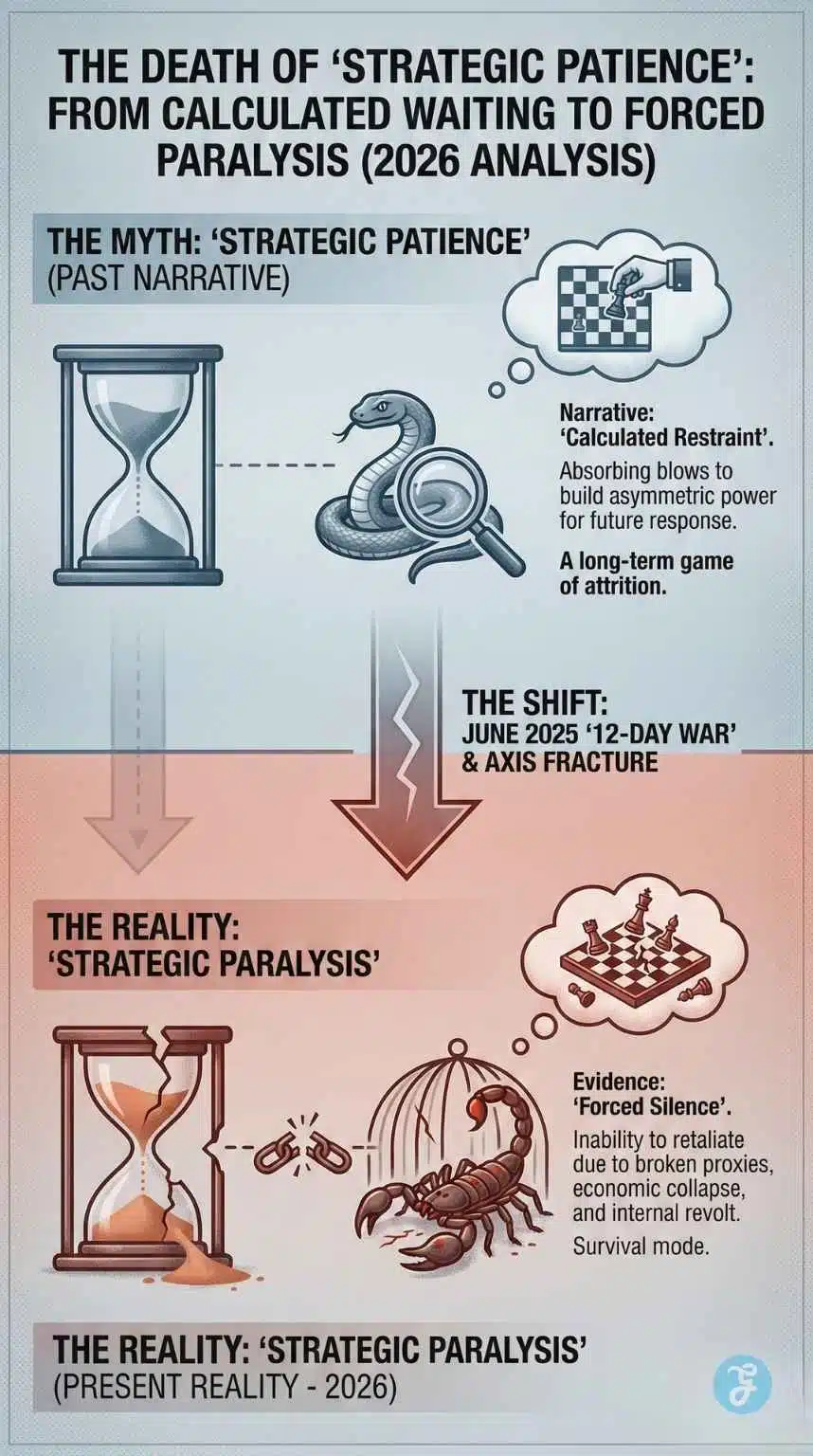
For years, whenever Iran failed to respond to an assassination or a strike, pundits would nod wisely and speak of “strategic patience.” The theory was that Tehran plays the long game, absorbing hits now to strike back asymmetrically later. That narrative died in June 2025.
The “12-Day War” was the litmus test, and the regime failed it. When the dust settled on the airstrikes that ravaged the nuclear facilities at Fordow and Natanz, the world waited for the promised apocalypse. We were told that any strike on Iranian soil would result in a “rain of fire” on Tel Aviv and US bases across the Gulf. Instead, we witnessed a handful of intercepted missiles and a hasty retreat into diplomatic obfuscation.
This was not patience. It was the realization of a terrifying new reality for the Supreme Leader: conventional deterrence is gone. The “Paper Tiger” has been singed, and the leadership knows that a full-scale war today would not end in a stalemate; it would end in a decapitation strike. The silence we hear today is the sound of a regime that has looked into the abyss of total war and blinked.
The Military Reality: The ‘Ring of Fire’ Has Been Extinguished
To understand Iran regime weakness in 2026, one must look at the map. For two decades, Qasem Soleimani’s grand strategy was to encircle Israel and Saudi Arabia with a “Ring of Fire”, a network of proxies in Lebanon, Syria, Iraq, and Yemen. That ring has been shattered.
The Collapse of the Land Bridge
The fall of the Assad regime in late 2024 was the first domino. When Bashar al-Assad fled Damascus, Iran lost more than a political ally; it lost its logistical spine. Syria was the “land bridge”, the secure highway through which Iranian ballistic missiles and guidance kits flowed to Hezbollah.
Today, that highway is closed. The new transitional government in Damascus, desperate for Western aid and reconstruction funds, has sealed the border. The IRGC (Islamic Revolutionary Guard Corps) can no longer truck heavy weaponry across the Levant. This has turned Hezbollah from a strategic asset into a stranded liability. Cut off from its supply lines, the organization is hoarding its dwindling missile stocks for its own survival, effectively removing itself from Tehran’s offensive calculus.
The Isolation of Hezbollah
Hezbollah’s reluctance to open a “Second Front” during the crises of 2025 wasn’t just cowardice; it was logistical necessity. Hassan Nasrallah’s successors understand that without the Syrian pipeline, every missile fired is a missile they cannot replace. Tehran can no longer order its favorite proxy to start a war because it can no longer guarantee the ability to sustain one. The “forward defense” doctrine, fighting enemies abroad so you don’t have to fight them at home, has collapsed. The enemy is now at the gates, and the proxies are too weak to intervene.
The ‘House of Glass’: Intelligence Paralysis
Perhaps the most crippling factor behind Tehran’s silence is not visible on satellite maps. It is the complete disintegration of trust within the regime’s own security apparatus. Following the assassinations of 2024 and the precision of the June 2025 airstrikes, the Iranian intelligence community (MOIS and the IRGC Intelligence Organization) has collapsed into a state of paranoid paralysis.
The “House of Glass” theory, now openly discussed by defectors, suggests that Israeli and Western intelligence penetration has reached the highest levels of the Supreme National Security Council. The leadership is silent because they are terrified to speak. They operate under the assumption that their secure communications are compromised, their safe houses are bugged, and their bodyguards are turned.
This is no longer just about counter-espionage; it is about command-and-control failure. General commanders are reportedly reverting to paper couriers to avoid electronic interception, slowing decision-making to a crawl. You cannot coordinate a complex multi-front war when you are afraid to pick up the phone. The regime’s silence is partly the result of a leadership that has gone dark to hide from its own shadows.
The Economic Front: An Army Marches on Its Stomach
While the military failures are stark, the economic indicators paint an even grimmer picture of Iran regime weakness. War is expensive. High-intensity modern warfare burns through billions of dollars a week in munitions, fuel, and logistics. In January 2026, Iran is a nation that cannot afford to pay its bus drivers, let alone finance a regional war.
The Currency Freefall
The statistics are damning. The Iranian Rial lost nearly 50% of its value in 2025 alone, driven by market panic following the destruction of infrastructure in the June war and the subsequent capital flight. Inflation has officially breached 60%, though independent economists suggest the real number for food staples is closer to 120%.
When a government cannot stabilize its currency, it loses the ability to project power. The IRGC operates a vast business empire, but even they are not immune to hyperinflation. The cost of importing components for drones and missiles has skyrocketed. The regime is currently facing a “guns or butter” dilemma, but in a much more acute form: it is “missiles or bread,” and the population is already screaming for bread.
The Snapback Trap
The diplomatic masterstroke of October 2025, the triggering of “Snapback” sanctions by the E3 (UK, France, Germany) at the UN, was the final nail in the economic coffin. This wasn’t just about US sanctions anymore; this was the return of the global embargo.
Oil exports to China, which had been the regime’s lifeline, have been complicated by new maritime enforcement measures. The “Gray Fleet” of tankers is shrinking, hunted by renewed international task forces. With oil revenues plummeting and access to foreign currency reserves blocked, Tehran’s war chest is empty. A regime that cannot feed its people knows it cannot afford to feed a war machine.
The Domestic Front: The ‘Proto-Revolution’ of 2026
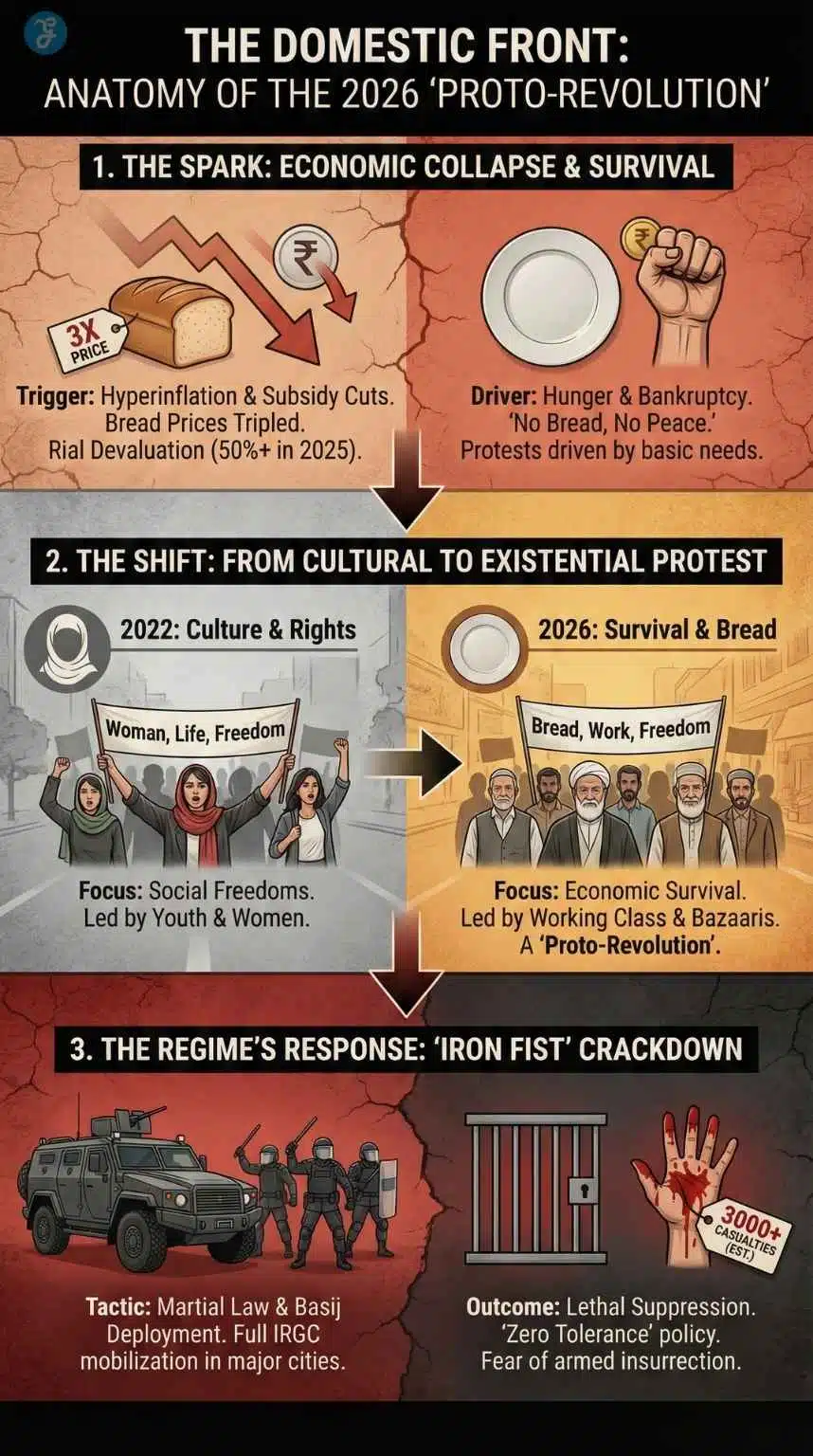
The most critical factor enforcing Tehran’s silence is not the American Navy or Israeli Air Force; it is the Iranian people. The regime is currently fighting a counter-insurgency against its own citizens, a conflict that analysts are increasingly calling a “Proto-Revolution.”
From Culture to Survival
The protests of 2022 were sparked by social issues, the hijab, personal freedom, and dignity. The uprising that began on December 28, 2025, is different. It is driven by hunger. When the price of bread tripled overnight due to the subsidy cuts necessitated by the military budget, the social contract snapped.
These protesters are not just students and intellectuals; they are the hungry poor, the working class, and, crucially, the “Bazaaris” (merchant class). Historically, the Bazaar has been the kingmaker in Iranian politics. Their participation in the general strikes of January 2026 signals a fundamental rupture between the regime and its traditional conservative base.
The Blood Debt
The crackdown has been brutal. Reports indicate over 3,000 casualties in the first three weeks of January. The IRGC and the Basij militia are fully deployed in cities like Tabriz, Mashhad, and Isfahan.
This domestic siege creates a zero-sum game for military resources. Every Basij member patrolling a neighborhood in Tehran is one less soldier available for a foreign adventure. The regime is terrified that an external war would trigger a “1917 moment”, where military failure abroad catalyzes a revolution at home. They know that if they distribute weapons for a “people’s war” against an invader, those weapons would likely be turned against the Supreme Leader within hours.
The Ideological Bankruptcy: The Death of the ‘Martyr’ Myth
For forty years, the Islamic Republic relied on a “culture of martyrdom” to mobilize the masses for war. That emotional reservoir has run dry. The regime’s silence today is a tacit admission that they can no longer sell the narrative of “Resistance” to a population that views them as the occupier.
In the 1980s, millions of Iranians volunteered to fight Saddam Hussein. Today, the regime struggles to recruit even for the Basij militia. The younger generation, the “Generation Z” of the uprising, views the “Axis of Resistance” not as a holy duty, but as a theft of national wealth. The slogan heard on the streets of Isfahan in January, “No Gaza, No Lebanon, My Life for Iran,” is the death knell of the regime’s foreign policy.
Tehran knows that if it declares war on Israel or the US today, it will not get a “rally ’round the flag” effect. Instead, they risk handing the protesters the ultimate weapon: chaos. They are silent because they know that the first Iranian soldier to die in a new foreign war will not be mourned as a martyr, but mourned as a victim of the mullahs’ hubris.
The Political Vacuum: The Succession Shadow
Hovering over this entire landscape of failure is the biological clock of the Supreme Leader. At 86, Ali Khamenei’s health is the state’s most guarded secret, but the political maneuvering in Tehran suggests the end is near.
Iran regime weakness is exacerbated by a vicious, silent war for succession. The political elite are fractured. On one side, the “Pragmatists” argue for a deal with the West to save the economy. On the other hand, the “Super-Hardliners” in the newly formed “Defense Council” want to double down on nuclear breakout capabilities.
However, neither faction wants a war right now.
- The Pragmatists know war would destroy the last remnants of the economy.
- The Hardliners know war would disrupt their plans to seize power during the transition.
They are paralyzed by their own ambitions. The regime has turned inward, resembling a scorpion stinging itself. The formation of the “Defense Council” in August 2025 was a signal that the state was shifting from exporting the revolution to bunkering it. The priority is no longer liberating Jerusalem; it is ensuring the survival of the velayat-e faqih (Guardianship of the Islamic Jurist) through the turbulent transition of power.
The Nuclear Paradox: The Silent ‘Dash’
There is a darker interpretation of the silence that must be considered. In game theory, when a player realizes they cannot win with conventional pieces, they stop moving them and focus entirely on the one move that flips the board: the Nuclear Breakout.
The destruction of the “Ring of Fire” and the failure of conventional deterrence may have convinced the “Defense Council” that their only guarantee of survival is the Bomb. The silence we are witnessing could be the “holding breath” phase of a covert nuclear sprint.
However, this is a gamble of existential proportions. With their air defenses degraded from the June war, a “Dash to the Bomb” leaves them incredibly vulnerable. If they are caught sprinting before they cross the finish line, they invite the very annihilation they are trying to avoid. Thus, the silence serves a dual purpose: it masks their weakness to the public, while hopefully buying time for their centrifuges to spin in the dark. It is the quiet desperation of a regime that has realized it has only one card left to play.
The Geopolitical Checkmate: No Friends Left
Finally, Tehran is silent because it is alone. The illusion of a “Great Power” alliance with Russia and China dissolved when the bombs started falling in June 2025.
Russia, bogged down in its own endless attrition and internal reshuffles, offered nothing but “concerns.” The S-400 systems promised to Iran never materialized in sufficient numbers, and those that did were overwhelmed. China, ever the pragmatist, prioritized its energy security and trade routes over its relationship with a destabilizing pariah. Beijing has quietly signaled that it will not underwrite an Iranian war that closes the Strait of Hormuz.
Without a superpower patron to provide diplomatic cover or military resupply, Iran is naked on the world stage. The “Look to the East” policy has failed to yield security guarantees.
Final Words: The Sound of Retreat
The silence from Tehran is not a mystery; it is a confession. It is an admission that the era of expansionist zeal is over, replaced by a desperate, clawing struggle for existence. Iran regime weakness has been exposed by the converging storms of military defeat, economic collapse, and domestic insurrection.
We are witnessing the retreat of the Mullahs. They have withdrawn into their fortress, pulling up the drawbridges in a frantic attempt to keep the modern world, and their own people, at bay. The West should not mistake this silence for peace. It is the quiet of a pressure cooker moments before it explodes. But for now, the threat of “all-out war” has been shelved, not because they found morality, but because they lost the capacity. The regime is no longer fighting for regional dominance; it is fighting for the right to exist for one more day.