
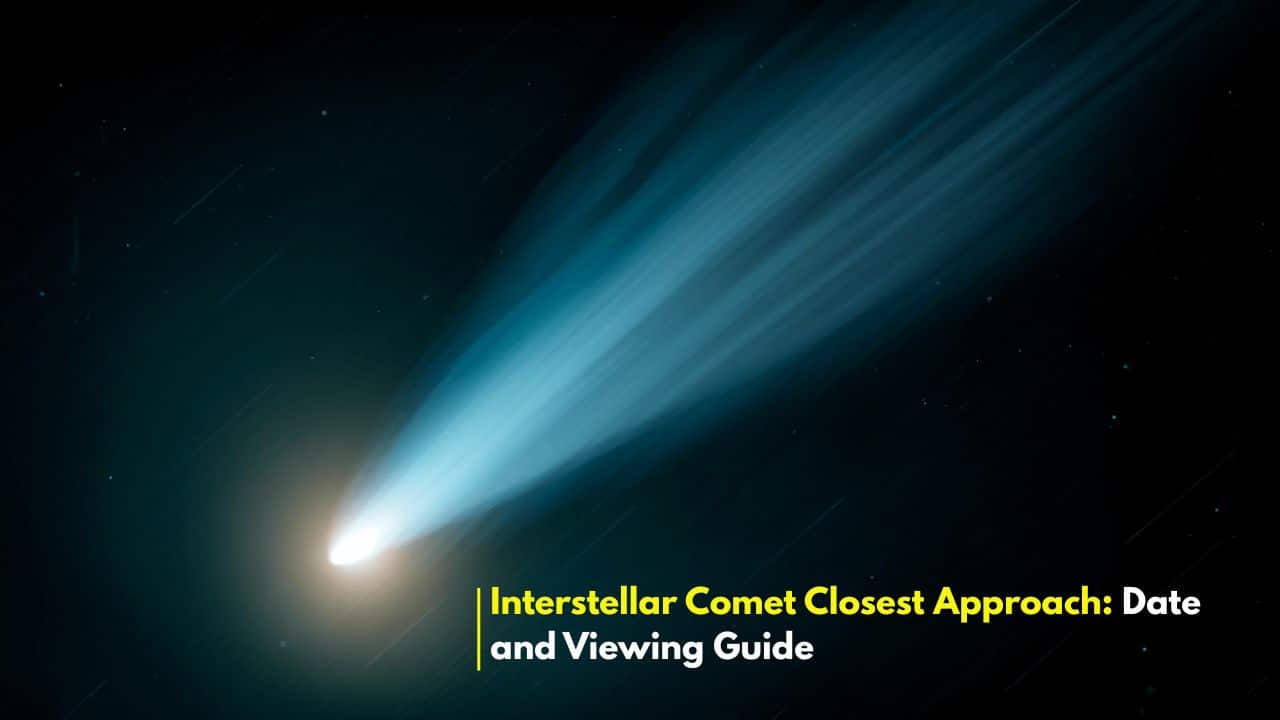
In a celestial event that has captivated astronomers and stargazers alike, the interstellar comet 3I/ATLAS (C/2025 N1) is hurtling toward its closest approach to Earth, scheduled for next Friday, December 19. This marks a pivotal moment in modern astronomy, as humanity gets its third-ever confirmed glimpse of a visitor originating from outside our own Solar System.
While the comet poses absolutely no threat to our planet—passing at a safe distance of approximately 270 million kilometers (167 million miles)—its arrival has ignited a firestorm of scientific curiosity, debates over extraterrestrial origins, and a global campaign to unlock the secrets held within its icy, alien heart.
A Messenger from the Deep Void
Discovered just over five months ago on July 1, 2025, by the NASA-funded Asteroid Terrestrial-impact Last Alert System (ATLAS) telescope in Río Hurtado, Chile, the object was initially flagged for its unusual velocity and trajectory. Unlike the billions of comets bound to our Sun’s gravity, 3I/ATLAS is traveling on a “hyperbolic” path—a one-way ticket through the cosmos. It entered our neighborhood from the direction of the constellation Sagittarius, plunged toward the Sun, and is now on its way out, never to return.
It joins an exclusive club of interstellar interlopers. The first, 1I/‘Oumuamua, baffled scientists in 2017 with its cigar-like shape and lack of a visible coma. The second, 2I/Borisov, discovered in 2019, appeared more like a traditional rogue comet. Now, 3I/ATLAS offers a third data point, and early observations suggest it may be the most chemically complex of the trio.
“We are looking at a time capsule from another star system,” said Dr. Elena Puzia, a lead researcher monitoring the comet’s trajectory. “It’s telling us that the chemical recipe of the Milky Way is far more varied than we ever imagined. This isn’t just a rock; it’s a sample return mission delivered right to our doorstep.“
The Dec. 19 Encounter: What to Expect
On December 19, 3I/ATLAS will reach perigee (its closest point to Earth). While “close” in astronomical terms, the gap is substantial—roughly 1.8 Astronomical Units (AU), or nearly twice the distance between the Earth and the Sun.
Despite this safety margin, the flyby is close enough for powerful telescopes to conduct unprecedented spectroscopic analysis. The comet has already survived its perilous perihelion (closest approach to the Sun) on October 29, where it passed within 130 million miles of our star.
Astronomers feared the intense solar heat might disintegrate the visitor, a fate common to fragile comets. Instead, 3I/ATLAS flared with activity. Solar heating triggered massive jets of gas and dust, creating a “teardrop-shaped” halo and a distinct anti-tail that points toward the Sun—a phenomenon caused by larger dust particles being left behind in the comet’s wake.
Visibility Guide
For amateur astronomers hoping to catch a glimpse, expectations must be managed. 3I/ATLAS is not a naked-eye object.
-
Magnitude: Currently hovering around magnitude 10 to 11.5.
-
Equipment: Binoculars will not suffice. NASA recommends a telescope with an aperture of at least 30 centimeters (12 inches).
-
Location: Observers in the Northern Hemisphere should look to the east-northeast horizon in the pre-dawn hours.
-
Marker: The comet is currently traversing the constellation Leo, situated just below the bright star Regulus.
“It’s a ghost in the eyepiece,” notes amateur astrophotographer Gerald Rhemann, who captured the comet’s greenish hue last week. “You need dark skies, patience, and serious glass. But knowing that photon traveled from another star to hit your retina? That’s worth the cold.“
The Chemistry of Life?
Perhaps the most startling revelation regarding 3I/ATLAS comes from its chemical composition. Last week, a team using the Atacama Large Millimeter/submillimeter Array (ALMA) in Chile reported the detection of unusually high levels of methanol and hydrogen cyanide (HCN) in the comet’s coma.
While these compounds are found in Solar System comets, their abundance in 3I/ATLAS is striking.
-
Methanol: Accounting for roughly 8% of the vapor shedding from the comet (compared to ~2% in local comets).
-
Implications: Methanol is a prebiotic molecule—a building block for amino acids and, potentially, life itself.
“The high methanol count suggests this object formed in a protoplanetary disk rich in oxygen and carbon, likely in the frigid outer reaches of its home system,” explained Martin Cordiner of NASA’s Goddard Space Flight Center. “It supports the theory of panspermia—the idea that comets act as cosmic seeders, transporting the ingredients for life across the galaxy.”
The presence of these volatile organic compounds has reignited the scientific debate: Could Earth’s early oceans have been seeded by visitors like 3I/ATLAS billions of years ago?
The “Artificial” Controversy
No modern discussion of interstellar objects is complete without the input of Harvard astrophysicist Avi Loeb. Known for his controversial hypothesis that ‘Oumuamua may have been alien technology, Loeb has turned his gaze toward 3I/ATLAS.
In a Medium post published earlier this month, Loeb pointed to the comet’s non-gravitational acceleration—changes in speed not explained by the Sun’s gravity alone. While standard comets accelerate due to “outgassing” (jets of gas pushing them like a rocket), Loeb argues the math doesn’t fully add up for 3I/ATLAS.
“The object is exhibiting a ‘heartbeat-like’ pulse in its light curve and a rotation that defies simple tumbling,” Loeb stated. “We must remain open to the possibility that this is not a natural comet, but a manufactured probe, or perhaps a piece of space debris from a broken Dyson sphere.“
Mainstream consensus currently leans toward the natural explanation. The visible tail and confirmed outgassing of methanol and water vapor provide a strong case for a “dirty snowball” composition. However, Loeb’s Galileo Project is currently training its sensors on the object, searching for any signs of radio transmissions or anomalous spectral signatures as it makes its Dec. 19 pass.
A History of Interstellar Visitors
To understand the magnitude of the 3I/ATLAS event, one must look at its predecessors.
1. 1I/‘Oumuamua (2017)
The “Scout.” Discovered as it was already leaving, ‘Oumuamua was a reddish, cigar-shaped tumbler that lacked a coma. It accelerated inexplicably, leading to the “solar sail” theories. It remains the most mysterious of the three.
2. 2I/Borisov (2019)
The “Comet.” Borisov looked and acted like a standard solar system comet, just with a hyperbolic orbit. It reassured scientists that ‘Oumuamua might be the exception, not the rule. It disintegrated significantly near the Sun, revealing a pristine, primitive interior.
3. 3I/ATLAS (2025)
The “Hybrid.” 3I/ATLAS shares the cometary activity of Borisov (tail, gas) but some of the strange chemical ratios and orbital quirks that made ‘Oumuamua famous. Its survival past the Sun and high carbon content suggest it may be a dense, metal-rich body covered in volatile ices.
The Encounter with Mars
Before reaching Earth, 3I/ATLAS paid a visit to the Red Planet. On October 3, 2025, it passed within 29 million kilometers (18 million miles) of Mars. This close shave allowed humanity’s robotic ambassadors—NASA’s Perseverance rover and the ESA’s Trace Gas Orbiter (TGO)—to capture images from a completely different angle.
The ESA reported that triangulating the comet’s position from both Earth and Mars improved the accuracy of its trajectory prediction by tenfold. “We essentially used the Solar System as a giant stereo camera,” said an ESA spokesperson. “The data from Mars confirmed the comet’s hyperbolic eccentricity is 1.0095, proving beyond a shadow of a doubt it is unbound to our Sun.“
Future Trajectory: The Long Goodbye
After December 19, 3I/ATLAS will continue its journey outward, fading rapidly as it distances itself from the Sun’s warming rays.
-
March 2026: It will pass near Jupiter’s orbit.
-
Late 2026: It will vanish from the view of even the most powerful amateur telescopes.
-
2030 and beyond: It will cross the Kuiper Belt and re-enter the interstellar medium.
It is heading toward the constellation Hydra, though it will take tens of thousands of years to reach the nearest star in that direction.
“We have a window of about eight weeks,” said Dr. Puzia. “After that, it’s gone forever. We have to throw everything we have at it—Hubble, James Webb, ground-based radio telescopes. We need to know if this object carries the same water isotope ratio as Earth. If it does, it changes the history of our planet.“
Summary of Key Facts
| Feature | Details |
| Official Name | 3I/ATLAS (C/2025 N1) |
| Discovery Date | July 1, 2025 |
| Closest Approach (Earth) | December 19, 2025 |
| Distance | 1.8 AU (~270 million km) |
| Origin | Interstellar (Direction of Sagittarius) |
| Composition | High Methanol, Hydrogen Cyanide, Carbon-rich |
| Current Magnitude | ~10.5 (Telescope Required) |
| Best Viewing | Pre-dawn, Constellation Leo |
As the world prepares for the holiday season, the universe has gifted us a fleeting, frozen ornament from a distant star. Whether it is a seed-bearer of life, an alien artifact, or simply a rock from the great beyond, 3I/ATLAS reminds us that our Solar System is not an island, but a harbor in a vast, trafficking ocean of stars.