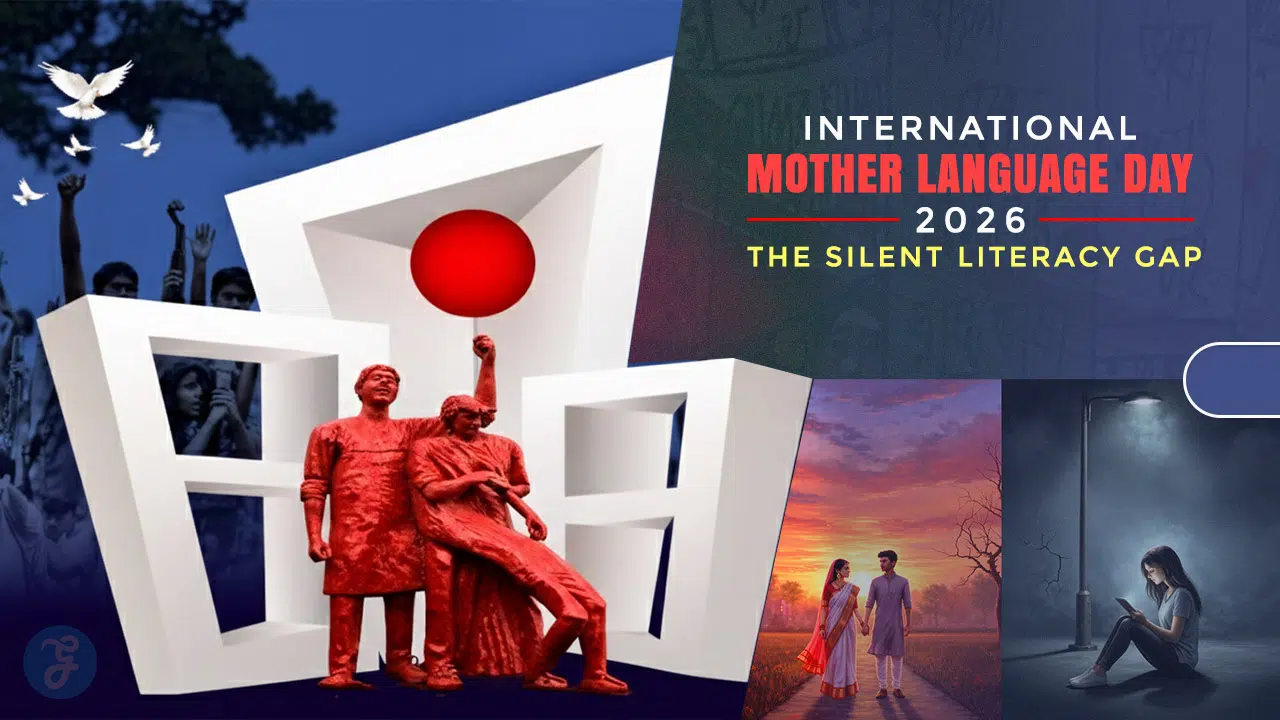
The streets of Dhaka ran red on February 21, 1952. Students did not march for better wages, shorter hours, or political office; they marched for the right to use their own alphabet in the classroom and the courtroom. Seventy-four years later, as we mark International Mother Language Day 2026, that physical struggle has shifted into a digital one. This movement, which transformed a linguistic identity into a sovereign nation, now faces a new frontier. Today, the fight for linguistic survival is not just about the air in our lungs but the code in our chips. We are witnessing a deepening Linguistic Digital Divide in AI, where the sacrifice of the martyrs serves as a reminder that a language is more than a tool for talk. It is the very foundation of political and social freedom.
The 2026 Mandate: Youth Voices on Multilingual Education
UNESCO has set the theme for this year as “Youth voices on multilingual education.” It is a fitting choice for a world at a crossroads. While the world is more connected than ever, our youngest generations are falling into a “hollow” linguistic trap. They speak their mother tongue at home, yet they cannot read its literature or write its script. They have become “alphabetically orphaned.” When blood is spilled for a script, it signals that the written word is a vessel for the soul of a people. If our youth cannot navigate their own written history, they become tourists in their own heritage.
International Mother Language Day 2026: The Digital Erasure of the Written Word

This is the Silent Literacy Gap. It is a slow, quiet erosion of identity. In cities across the globe, a child might gossip in Bengali, Yoruba, or Quechua, but they search for information in English. When a person can speak but not write their language, they lose their historical anchor. They cannot read the land titles of their ancestors or the poetry of their poets. The battlefield is no longer just the classroom. It is the algorithm. We are entering an era defined by the Linguistic Digital Divide in AI. If a language is not encoded, it does not exist in the eyes of modern technology. Our youth are standing at a crossroads. They must choose between a global digital monoculture and the complex, beautiful scripts of their forefathers.
Education systems often treat native languages as a hurdle to be cleared rather than a bridge to be built. This narrow view ignores the cognitive power of thinking in one’s own tongue. To truly honour the 2026 theme of “Youth voices on multilingual education,” we must recognise that amplifying those voices requires looking beyond oral tradition. We must ensure that every child has the right to see their thoughts reflected in the written word. True multilingual education requires more than just a nod to heritage. It requires a commitment to literacy that survives the digital age. If we do not close this gap now, we are not just losing words. We are losing the unique ways we understand the world.
| Dimension of Erosion | Oral Fluency (The Sound) | Written Literacy (The Shield) | Strategic Impact by 2030 |
| Historical Access | Limited to immediate memory and folklore. | Direct access to primary archives and legal deeds. | Loss of ancestral land rights and historical sovereignty. |
| Cognitive Growth | Functional for daily household tasks. | Essential for complex scientific and logical reasoning. | Reduced academic performance in STEM for native speakers. |
| Digital Presence | Invisible to voice recognition without text data. | Required for training high accuracy AI models. | Exclusion from the $15 trillion AI global economy. |
| Cultural Depth | Contextual and fleeting. | Preserves “untranslatables” and deep philosophy. | Homogenization of thought into a global monoculture. |
The Linguistic Digital Divide in AI
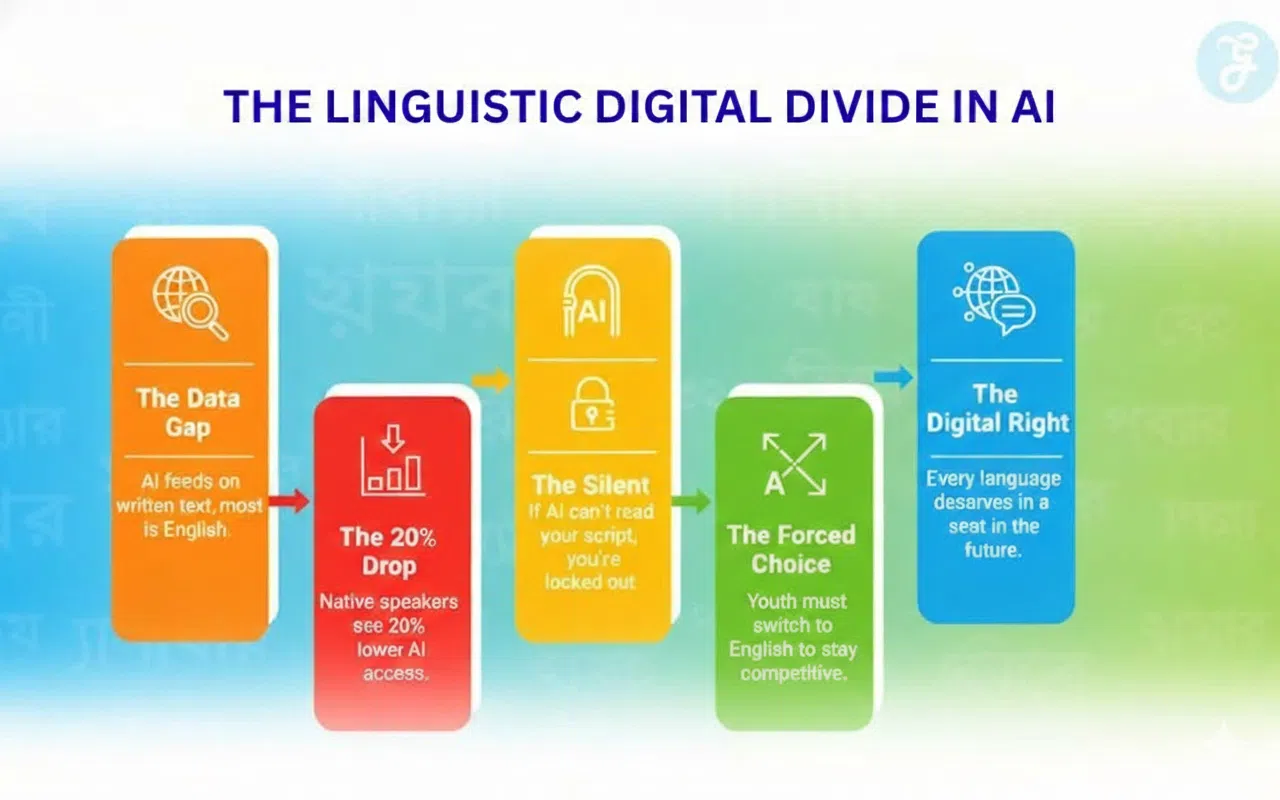
The threat to our mother tongues is no longer just a lack of funding in schools or the social pressure of a globalised world. It has become structural. We are currently facing a Linguistic Digital Divide in AI that threatens to render thousands of languages invisible.
Recent data from the Microsoft AI Diffusion Report highlights a structural crisis. Even when controlling for wealth and internet access, countries where low-resource languages dominate exhibit an AI adoption rate 20% lower than English-speaking nations. This is no coincidence; it is a direct consequence of current technological architecture.
Large Language Models are hungry. They feed on massive datasets of written text. Because the internet is overwhelmingly English, the “brains” of AI are being wired with a Western, English-centric worldview. If your mother tongue lacks a massive digital footprint of books, articles, and websites, the AI simply cannot understand you. It fabricates information. It stumbles. It fails to provide the same utility it offers a student in London or New York.
For the youth mentioned in the International Mother Language Day 2026 theme, this is a gate they cannot unlock. This digital exclusion creates a generation of silent voices, forced to abandon their native script to remain competitive in a world that refuses to read it. When AI cannot process your language accurately, you are pushed to use a dominant one to stay competitive. This creates a cycle of abandonment. Why write in your native script if the most powerful tools of the century cannot read it?
This digital invisibility is a new form of erasure. It suggests that some cultures are “compatible” with the future while others are relics of the past. We must reject this. Linguistic accessibility is not a luxury; it is a fundamental digital right. If we do not act to digitise and encode our mother tongues today, we are effectively hitting the “delete” key on our collective human heritage.
The Vow and the Void: A Tale of Two Generations
Thirty years ago, a young freelance journalist made a choice that felt like a quiet revolution. She did not want a wedding defined by auspicious stars or social status. Instead, she asked her father to arrange her marriage on February 21. For her, the date was sacred. It was a day to anchor her new life in the soil of her mother tongue, a tribute to the students who had once bled for the right to speak. In her world, the language was the oxygen of identity. To marry on that day was to vow that her future household would always be a sanctuary for her heritage.
 But the clocks have turned, the seasons have shifted and the sanctuary has grown quiet. Today, the fiery significance of February 21 has faded into a historical footnote for many. The struggle that once defined a nation’s soul is often invisible to a generation raised in the digital slipstream of a global monoculture.
Pride in the Silence: The Diaspora Dilemma
This shift is perhaps most visible in the stories of the diaspora. Take Sreetama (name changed), a successful doctor based in the UK. She speaks of her family life with a modern kind of pride, yet it is a pride shadowed by a profound loss. She shares, almost as a badge of integration, that her son cannot read or write a single word of Bengali. He can navigate a few spoken phrases to get by with his grandparents, but the script, the beautiful, intricate curves of his mother tongue, is a closed book to him.
This is the face of the scriptless void. Sreetama’s son belongs to a growing cohort who possess a “hollow” linguistic identity. They have the sound, but they lack the key to the vault. When a child loses the ability to read their own language, they lose the ability to speak back to history. They cannot read the letters their ancestors wrote in times of war or the poems they composed in times of love.
What the journalist celebrated as a foundation thirty years ago, the modern professional often views as an optional extra. We are witnessing a transition from language as a lived reality to language as a decorative relic. On this International Mother Language Day 2026, we must ask ourselves: if we lose the script, do we lose the story?
The Educational Failure: The Hollow Identity
Modern schooling has a blind spot. In our rush to be global, we have forgotten how to be local. The “English First” model is now a default setting in many nations. We tell parents that English is the only ticket to a career. We tell children that their home language is for the kitchen, while English is for the laboratory. This is a false choice. It is also a pedagogical disaster.
The numbers back this up. UNESCO data from 2025 reveals a striking truth. Children who begin their education in their mother tongue are 30% more likely to read with understanding by the time they reach grade 5. When you teach a child in a language they do not speak at home, you are asking them to climb two mountains at once. They must learn a new code while trying to grasp a new concept. Most simply fall behind.
This failure creates a “Hollow Identity.” We are raising a generation that can speak to their grandparents but cannot read their letters. They can sing folk songs but cannot write the lyrics. This gap is where cultural shame takes root. When a child sees that “serious” subjects like science or math only exist in English, they make a subconscious map. They place their mother tongue in the category of the “primitive” or the “past.” They view English as the language of intelligence and the future.
This is a psychological wound. It severs the link between the heart and the brain. Literacy is the glue that holds a culture together over centuries. Without the ability to read and write their own script, the youth lose their gatekeeper status. They cannot verify their history. They cannot defend their legal rights in their own words. They become dependent on translators to tell them who they are.
As we listen to the Youth voices on multilingual education this year, we must hear the silences too. We must hear the frustration of a student who is brilliant in their native tongue but made to feel small in a colonial one. Education should be an expansion of the self, not a replacement of it. If we want a world that is truly multilingual, we must stop treating the mother tongue as a secondary guest in the classroom.
The Script as a Cultural Fortress
A spoken word is a moment. A written word is a monument. When we talk about saving a language, we often focus on the sounds. We forget that the script is the fortress that protects the soul of a people. Literature is not just entertainment. It is the record of how a culture survived its darkest winters and celebrated its brightest springs. Without the ability to read their own script, a community loses its shield.
Consider the legal weight of the written word. If you cannot read the land deeds of your ancestors, you cannot defend your soil. If you cannot draft a contract in your native tongue, you are at the mercy of the translator. Justice should not require a second language. When we lose our literacy, we lose our sovereignty. We become observers in the very systems designed to govern us.
The most profound loss, however, is philosophical. Every mother tongue contains “untranslatables.” These are concepts that simply evaporate when forced into English or French. Take the Japanese concept of Kintsugi, the beauty of repairing what is broken. Or the African philosophy of Ubuntu, which suggests a person is only a person through other people. These are not just words. They are entire ways of being.
When we translate these ideas into dominant global languages, they lose their texture. They become flat. They become definitions instead of experiences. We see this most clearly in our relationship with nature. Many indigenous languages have specific words for the way a certain leaf moves in the wind or the exact smell of the earth before a storm. English often lacks the precision to capture this. If we lose the script, we lose the science of the elders.
We are currently burning the libraries of human wisdom. We do it every time we allow a written tradition to die. To protect these mother tongues, we must view the script as more than just a set of symbols. It is a vessel for peace and community. If we want a future where the next generation can lead, they must be able to consult the maps left by those who came before them.
The Roadmap to 2030: Practical Solutions
Awareness is only the first step. To bridge the Linguistic Digital Divide in AI by 2030, we need a shift in how we build and teach. The fix is not found in more translation apps. It is found in ownership. We must invest in “Small Language Models.” These are streamlined AI systems trained specifically on local datasets. Instead of relying on a distant, English-dominated cloud, communities can build digital brains that truly understand their own syntax and slang.
Education must also return to its roots. The Mother Tongue Based Multilingual Education (MTB MLE) model is the gold standard. We see a blueprint for this in India’s National Education Policy 2020. It prioritises the home language as the medium of instruction. This should be a global mandate. When a child learns to read in the same language they use to dream, their capacity for logic and creativity triples.
Technology can also be a bridge between generations. We should encourage “Intergenerational Coding.” This involves young people using digital tools to record and archive the oral histories of their elders. They can turn spoken stories into searchable text. They can tag ancient wisdom with modern metadata. This turns the smartphone from a tool of distraction into a digital library. It gives the youth a reason to master their script while honing their technical skills.
Echoes of 1952: Writing the Future
As we reach the milestone of International Mother Language Day 2026, the stakes are clear. We are not just fighting for a holiday or a hobby. We are fighting for the survival of human thought. The martyrs of 1952 gave their lives for a script. Our task today is less bloody but just as urgent. We must ensure that our digital future has room for every voice and every alphabet.
We must refuse to let our mother tongues become museum pieces. They are living, breathing systems of knowledge. They deserve to be written in code just as much as they deserve to be written on paper. If we allow the Linguistic Digital Divide in AI to widen, we effectively erase the wisdom of the majority.
The choice belongs to us. We can accept a world of one or two dominant languages, or we can build a world where every child can read their own history. We do not just lose words when a language dies. We lose a world. Saving a language begins with the simple, radical courage to write it down.