When Pakistan’s defense ministry declared open war against the Taliban led Afghan government in late February 2026, the world focused on the immediate bloodshed. Airstrikes flattened targets in Kabul and Kandahar. Retaliatory artillery fire from Afghan forces scorched military outposts along the disputed Durand Line. Mainstream analysts rushed to blame the Tehreek e Taliban Pakistan and their cross-border sanctuaries. Yet the true catalyst for this historic regional collapse lies hundreds of miles to the east. A quiet but aggressive India-Taliban Rapprochement has fundamentally rewritten the security architecture of South Asia.
New Delhi has successfully transformed Islamabad’s decades-old dream of strategic depth into a suffocating nightmare of strategic encirclement. For years, the international community watched Pakistan play a dangerous double game. They funded and sheltered the Afghan Taliban while pretending to align with global counterterrorism efforts. The goal was always to secure a pliant proxy state in Kabul. This was supposed to guarantee that Pakistan would never face a threat from its western flank. Instead, the exact opposite has happened. The chickens have finally come home to roost in the most violent way imaginable.
Operation Ghazab Lil Haqq is not merely a counterterrorism operation. It is a desperate flailing reaction to a profound geopolitical defeat. The Pakistani military establishment is watching its prized asset turn against it. Worse still, they are watching that asset openly court their arch nemesis. The bombs falling on Afghan cities are the tragic punctuation marks on a failed foreign policy. To understand how we arrived at this explosive juncture, we must look beyond the immediate border clashes. We have to examine the quiet diplomatic overtures, the strategic investments, and the sheer realpolitik that brought New Delhi and Kabul together.
The February 2026 Escalation: The Collapse of a Proxy
The sheer scale of the February 2026 escalation caught many international observers completely off guard. On February 22, the Pakistan Air Force launched devastating strikes across multiple Afghan provinces. Operation Ghazab Lil Haqq, or Wrath for the Truth, was officially underway. Pakistani jets targeted alleged militant hideouts in Nangarhar, Paktika, and Khost. They claimed to have eliminated dozens of fighters linked to the Tehreek e Taliban Pakistan and the Islamic State Khorasan Province. The official justification pointed to a string of horrific attacks inside Pakistan. These included the devastating February 6 bombing of a Shia mosque in Islamabad that killed 31 worshippers and a massive assault on a security convoy in Bannu district.
The Ground Reality and the Taliban Response
However, the reality on the ground in Afghanistan painted a much grimmer picture. Afghan officials and independent UN observers reported catastrophic civilian casualties. Entire families were wiped out in their sleep. Homes and religious seminaries were reduced to rubble. The Afghan Taliban did not simply absorb the blow. They responded with a ferocity that stunned Islamabad. Afghan defense forces launched coordinated ground offensives and artillery barrages against Pakistani border outposts.
The heavily fortified Durand Line transformed into a blazing warzone overnight. The Taliban claimed to have destroyed multiple Pakistani military bases and captured dozens of soldiers. While Islamabad denied the extent of these losses, the panic was palpable. A state of emergency was declared in border districts. The conflict rapidly spiraled into the worst violence the region has seen since the American withdrawal.
The TTP and the Failure of Strategic Depth
To grasp the magnitude of this collapse, one must understand the role of the Tehreek e Taliban Pakistan. The TTP is a militant organization explicitly dedicated to overthrowing the Pakistani state. For years, they waged a bloody insurgency across the tribal areas. When the Afghan Taliban seized Kabul in 2021, Islamabad celebrated. They assumed their erstwhile proxies would immediately crush the TTP and secure the border.
This assumption proved fatally flawed. The Afghan Taliban and the TTP share deep ethnic Pashtun ties and a rigid ideological framework. Blood and brotherhood proved thicker than the transactional loyalty Pakistan demanded. Instead of neutralizing the TTP, the Afghan Taliban provided them with safe havens. They allowed the militants to regroup, rearm, and launch increasingly brazen attacks into Pakistani territory.
The Border Paradox: The Durand Line Dispute
Furthermore, the fundamental dispute over the Durand Line remains unresolved. This colonial-era boundary, drawn by the British in 1893, artificially divides the Pashtun heartland. No Afghan government has ever recognized it. The Taliban are no exception. They view the fencing and militarization of this border by Pakistan as an aggressive encroachment on their historical lands. This territorial grievance provides a constant backdrop of hostility. It ensures that any minor skirmish can quickly escalate into a massive confrontation. Pakistan expected a subservient neighbor. They got a fiercely independent and heavily armed adversary. The proxy they nurtured for decades has metamorphosed into a formidable existential threat.
Decoding the Drivers Behind the India-Taliban Rapprochement
The shift in South Asian power dynamics in 2026 is not an accident; it is the result of a calculated, multi-layered strategy by New Delhi to secure its borders and bypass its rivals. To understand why the India-Taliban Rapprochement has become the defining geopolitical event of the decade, we must look beyond simple diplomacy. This realignment is driven by a fusion of critical security imperatives, the pursuit of vast mineral wealth, and a bold move to strip Islamabad of its traditional geographic leverage. By examining the following pillars, we can see how India transformed a hostile regime into a pragmatic partner.
The Diplomatic Milestone of October 2025
The turning point in this geopolitical saga occurred largely behind closed doors. The diplomatic milestone of October 2025 set the stage for a radical realignment. Taliban Acting Foreign Minister Amir Khan Muttaqi traveled to New Delhi for a series of high-stakes meetings. This visit was unprecedented. It shattered the long-held assumption that India would permanently boycott the fundamentalist regime. Muttaqi sat down with External Affairs Minister S. Jaishankar. Together, they laid the groundwork for a pragmatic working relationship.
India recognized that moral outrage was a poor substitute for strategic presence. By refusing to engage with Kabul, New Delhi was essentially ceding the entire region to Pakistani influence. That was an unacceptable security risk. The October meetings focused on mutual interests rather than ideological differences. India wanted security guarantees. The Taliban desperately needed economic assistance and international legitimacy.
Muttaqi assured Indian officials that Afghan soil would never be used by militant groups to target Indian interests. This was the exact guarantee Pakistan had failed to secure regarding the TTP. In exchange, India promised a massive influx of humanitarian aid and a resumption of stalled infrastructure projects. This pragmatic bargain completely bypassed Islamabad. It demonstrated that the Taliban were willing to act as an independent sovereign actor capable of forging alliances with Pakistan’s enemies.
Reopening the Kabul Embassy and Bypassing Islamabad
The most visible and consequential result of this dialogue was the reopening of the Indian embassy in Kabul. Initially downgraded to a technical mission following the 2021 takeover, the diplomatic compound was upgraded to a fully functional embassy. This move was a masterclass in strategic maneuvering. It planted a massive Indian footprint right in Pakistan’s backyard.
For decades, Pakistan’s Inter Services Intelligence held a virtual monopoly on information flowing out of Kabul. They controlled the narrative and heavily influenced foreign diplomatic presence. By establishing a robust embassy, India shattered this monopoly. New Delhi now has direct high-level access to Taliban leadership. They can gather independent intelligence and cultivate assets without relying on intermediaries. This direct line of communication terrifies Islamabad.
Pakistani military planners view the Indian embassy not just as a diplomatic outpost but as a forward operating base for espionage and subversion. They constantly accuse India of funding anti-Pakistan elements from within Afghanistan. Whether these accusations hold water is almost irrelevant. The psychological impact on Pakistan’s military establishment is profound. They feel surrounded and outmaneuvered. The Indian presence provides the Taliban with powerful leverage. If Islamabad pushes too hard, Kabul can simply pivot closer to New Delhi.
Economic Investments and Resource Extraction
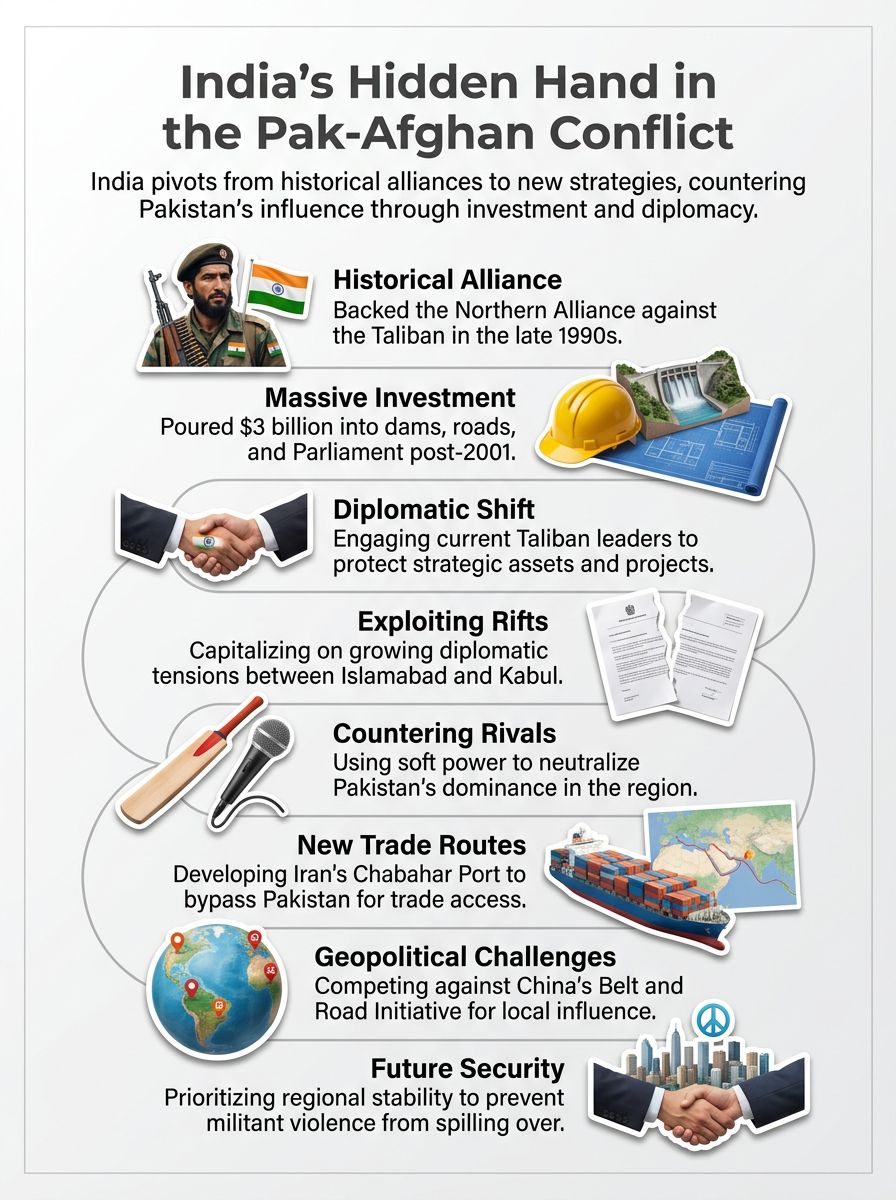
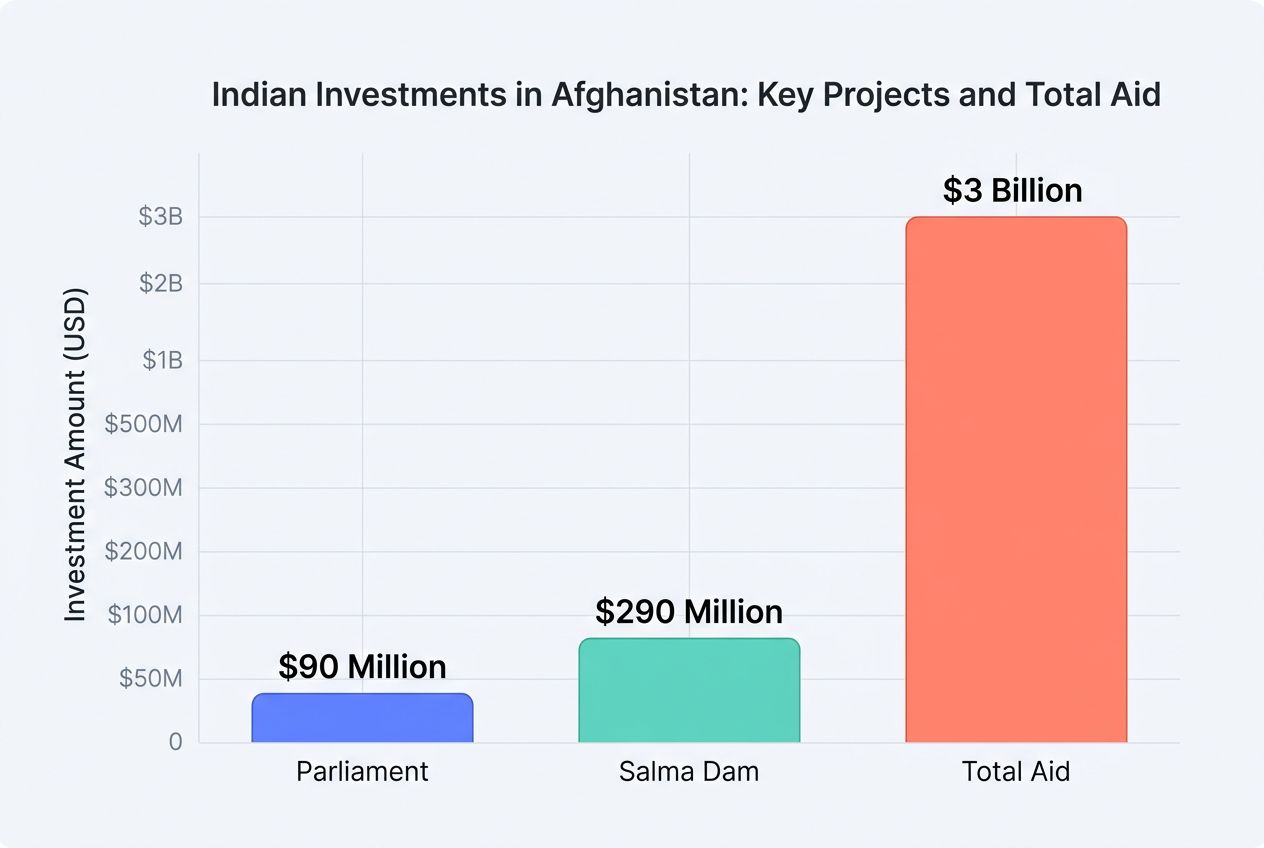
Diplomacy is rarely effective without financial backing. India understands this perfectly. They have turbocharged their economic investments in Afghanistan to solidify this new relationship. The 2026 Union Budget saw a massive twenty-seven percent increase in development assistance earmarked for Kabul. This money is building hospitals, paving roads, and restoring essential power grids. While Pakistan drops bombs, India is dropping concrete and steel.
The economic strategy is multifaceted. A critical component is the development of the Chabahar Port in Iran. This port allows India to completely bypass Pakistani land routes. Goods can be shipped from Mumbai to Chabahar and then transported over land directly into Afghanistan and Central Asia. This logistical triumph strips Pakistan of its geographic leverage. Historically, Islamabad could hold Afghan trade hostage by closing the border crossings. The Chabahar route renders that threat obsolete.
Beyond trade routes, India is eyeing Afghanistan’s vast, untapped mineral wealth. The country is sitting on trillions of dollars worth of copper, lithium, and rare earth elements. These minerals are essential for the global transition to renewable energy and advanced electronics. India is locked in a fierce competition with China for access to these resources. By building goodwill through infrastructure and humanitarian aid, New Delhi is positioning its state-owned mining companies for lucrative extraction contracts.
The Taliban are eager to monetize these resources to stabilize their fragile economy. They view India as a wealthy, reliable partner capable of delivering complex engineering projects. This economic synergy creates a powerful bond that transcends historical animosities.
Neutralizing the Anti-India Terror Threat
The driving force behind every Indian foreign policy decision is national security. Engaging with the Taliban is ultimately a calculated measure to neutralize the anti-India terror threat. Historically, groups like Lashkar e Taiba and Jaish e Mohammed operated training camps in eastern Afghanistan. These groups enjoyed the patronage of the Pakistani state and frequently launched devastating attacks in Indian administered Kashmir and major Indian cities.
New Delhi correctly assessed that a power vacuum in Afghanistan would be quickly filled by these hostile actors. By engaging directly with the Taliban leadership, India seeks to proactively deny these groups a haven. The ongoing India-Taliban Rapprochement is built on a very specific understanding. India provides the economic lifeline. In return, the Taliban must mercilessly crush any militant faction that threatens Indian territory. This arrangement essentially turns the Taliban into border guards for Indian interests.
It is a brilliant albeit risky strategy. It exploits the growing rift between Kabul and Islamabad. The Taliban are increasingly frustrated by Pakistan’s heavy-handed tactics. They are more than willing to expel Pakistani-backed militants to appease their new Indian benefactors. This dynamic flips the script entirely. Pakistan spent thirty years trying to use Afghanistan as a launching pad against India. Now India is using Afghanistan as a buffer against Pakistani-sponsored terrorism.
Pakistan’s Two-Front Nightmare
The geopolitical fallout from these developments has plunged Islamabad into a state of absolute panic. Pakistan’s military planners are currently facing their ultimate nightmare. They are fighting a desperate two-front war. For more than thirty years, the bedrock of Pakistan’s military doctrine was the concept of strategic depth. This doctrine dictated that Pakistan must maintain a friendly pliant government in Kabul at all costs. The rationale was simple. In the event of a major land war with India, the Pakistani military needed a secure rear area. They needed a place to retreat, regroup, and launch counterattacks without fear of being flanked.
The Death of a Doctrine
To achieve this strategic depth, Pakistan poured billions of dollars into funding the Mujahideen and later the Taliban. They alienated the international community, isolated their own economy, and suffered immense blowback from domestic terrorism. They paid a terrible price for this policy. Yet the military establishment always justified the cost by pointing to the ultimate prize. A secure western border. Today, that doctrine lies in ruins. The strategic depth has violently evaporated. Instead of a secure rear area, Pakistan now faces an active hostile warzone on its western flank. The Afghan Taliban are not a pliant proxy. They are a battle-hardened, heavily armed adversary with deep grievances.
The Military Dilemma
This reality creates an impossible mathematical problem for the Pakistan Army. They are heavily deployed along the Line of Control, facing a massive, technologically superior Indian military. They cannot afford to pull significant resources away from the eastern front. Yet the escalating violence along the Durand Line demands an immediate and overwhelming response. The TTP insurgency is bleeding the security forces dry. Daily suicide bombings and ambushes are demoralizing the ranks. Operation Ghazab Lil Haqq is a clear indication that the military feels compelled to act decisively. However, launching airstrikes into a neighboring country is a massive gamble. It further inflames Afghan nationalism and guarantees continuous border clashes.
The Narrative of Encirclement
The fear of encirclement is palpable in the corridors of power in Islamabad. They look to the east and see a rising global superpower. They look to the west and see a hostile regime that is openly courting their greatest enemy. The quiet but highly effective India-Taliban Rapprochement confirms their darkest suspicions. Pakistani officials frequently take to national television to denounce the Taliban as tools of Indian intelligence. They claim that Indian money is funding the TTP and fueling the border violence. This narrative serves a vital domestic purpose. It allows the military to justify the immense cost of the war to a weary public. By framing the conflict as a proxy war orchestrated by New Delhi, they attempt to rally nationalistic fervor.
The Isolation of Islamabad
However, this propaganda cannot mask the brutal strategic reality. Pakistan is isolated. Their traditional allies are hesitant to intervene. Saudi Arabia and the United Arab Emirates are focused on their own economic transformations and view the Af Pak theater as a toxic liability. Even China, its iron brother, is treading carefully. Beijing has significant security concerns regarding militant groups operating near the Xinjiang border. They are perfectly willing to let Pakistan take the lead in combating the TTP.
But China will not risk its own broader strategic interests to bail Islamabad out of a mess of its own making. Pakistan is fighting this war alone, and the walls are rapidly closing in. The spectacular failure of their proxy strategy has left them vulnerable, overextended, and devoid of good options.
Global Implications: The Third-Eye View
The tremors of this conflict are echoing far beyond the rugged mountains of the Hindu Kush. The global implications of the Pakistan-Afghanistan war and the shifting alliances require a macro-level analysis. This is the third eye view. The international community is watching this realignment with a mixture of anxiety and quiet opportunism.
The Western Perspective
The United States and its European allies find themselves in a fascinating position. Having spent two decades fighting the Taliban, they are now technically on the sidelines. However, Washington is paying very close attention to New Delhi’s maneuvers. There is a quiet recognition in Western capitals that India’s pragmatic approach might be the only viable blueprint for regional stability. The West has little appetite for renewed intervention. They are perfectly content to let India take the lead in managing the Taliban.
If India can successfully moderate the regime’s behavior and neutralize transnational terror threats, the West will silently applaud. Furthermore, India’s aggressive diplomatic push provides a useful template. Other democracies might eventually follow suit, using the India-Taliban Rapprochement as political cover to slowly normalize relations with Kabul.
The Limits of the Sino-Pakistani Axis
The most critical dynamic, however, involves the shifting balance of power in Asia. This conflict exposes the limitations of the Sino-Pakistani axis. China views the region primarily through an economic and security lens. They want to extract minerals and prevent Uyghur militants from establishing safe havens. Beijing’s approach has been highly transactional and notably cautious. They have offered investments but have hesitated to provide the massive, unconditional support Pakistan desperately needs right now. China is acutely aware that taking a definitive side in this border war could jeopardize its own delicate relationship with Kabul.
India as a Continental Force
India’s bold strategy contrasts sharply with Beijing’s hesitation. By stepping into the void left by America and exploiting Pakistan’s strategic blunders, New Delhi is projecting immense power. They are proving that they can dictate outcomes in a theater that was previously dominated by their rivals. This elevates India from a regional power to a dominant continental force. The global south is watching.
They see a confident, assertive India willing to prioritize its national interests over archaic ideological purity. They see a nation capable of managing complex security threats through a blend of hard power deterrence and smart economic diplomacy. The outcome of the current hostilities will determine the security architecture of Asia for the next century. If India succeeds in securing its western flank while Pakistan exhausts itself in a perpetual border war, the geopolitical center of gravity will shift decisively toward New Delhi.
Closing Thoughts
The bombs falling along the Durand Line are not just the echoes of a failed border policy. They are the violent death throes of an outdated geopolitical doctrine. Islamabad pushed all its chips into controlling Kabul only to find that Kabul has found a much wealthier and more strategic partner. The ongoing India-Taliban Rapprochement proves that in the modern theater of international relations, pragmatism always conquers ideology.
As Pakistan fights a two-front war of its own making, New Delhi will simply continue to build hospitals, pave roads, and quietly redraw the map of South Asia.