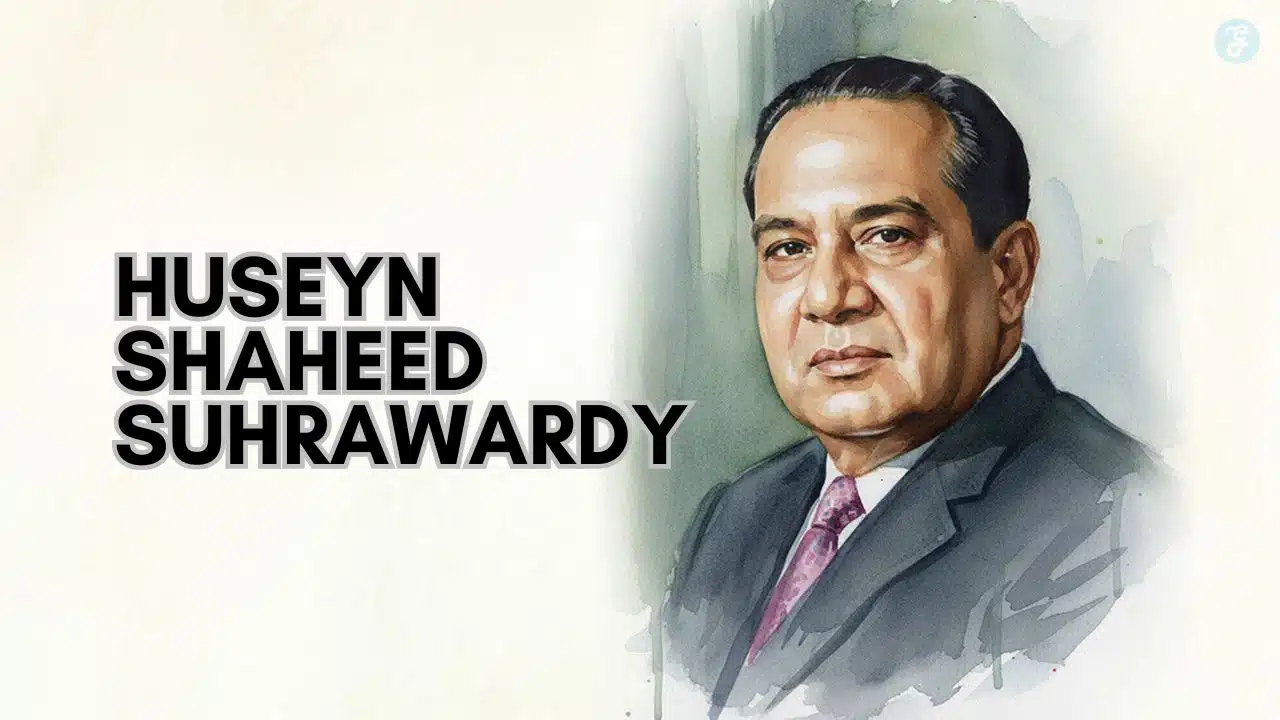
On one side of the border, Huseyn Shaheed Suhrawardy is remembered as a shrewd lawyer, mass politician, and prime minister who tried to defend parliamentary democracy in Pakistan. On the other side, in Indian memory, his name is often tied to bloodshed in Calcutta and the trauma of Partition. In Bangladesh, he appears again in yet another role: an important forerunner of Bengali autonomy and a mentor to those who would later lead the country to independence.
Few South Asian leaders carry such different reputations across three national stories.
Tracing Suhrawardy’s journey from Calcutta to Karachi, and his later presence in Dhaka’s political imagination, is not only an exercise in biography. It is also a way to understand how the same man could be cast as a villain, survivor, and democrat—depending on which side of the border is telling the story.
Elite Roots in a Changing Bengal
Huseyn Shaheed Suhrawardy was born into a well-connected Bengali Muslim family that moved comfortably in the world of law, administration, and imperial service. This background shaped him in obvious ways. He had access to the best education, both in India and abroad, and grew up with a confidence in institutions—courts, councils, legislatures—that would later define his political style.
When he returned to Calcutta as a young barrister, the city was entering a new political phase. The capital of British India had shifted to Delhi, but Calcutta remained the intellectual and commercial heart of Bengal. Nationalist ideas, communal tensions, labor unrest, and constitutional debates collided in the same crowded streets.
It was in this turbulent environment that Suhrawardy first stepped into public life—not as a separatist, but as part of C.R. Das’s Swaraj Party in the 1920s. He served as Deputy Mayor of Calcutta between 1924 and 1926, working in a municipal setup that brought Hindu and Muslim leaders together in one civic space. At this stage, his profile was closer to that of a cosmopolitan Indian nationalist than a champion of a separate Muslim homeland.
But the Bengal he knew was changing fast. Communal representation, the distribution of economic power, and fears about majoritarian rule would soon pull him toward explicitly Muslim platforms.
From the Bar to the Street: A New Kind of Muslim Leader
The evolution of Huseyn Shaheed Suhrawardy from elite lawyer to mass organizer is one of the most striking parts of his story.
Unlike many of his Muslim contemporaries who stayed in drawing rooms and legislative clubs, Suhrawardy went out into the docks, depots, jute mills, and railway lines of Bengal. He helped organize trade unions among sailors, transport workers, rickshaw pullers, and other urban laborers—many of them poor Bengali Muslims who felt excluded from both the colonial system and the Hindu-dominated urban middle class.
This work did two things at once.
First, it gave him a base that was not merely communal but class-driven. He spoke the language of wages, rations, rents, and working conditions and earned a reputation as a street-savvy leader who could bring crowds onto the road at short notice.
Second, it made him indispensable for any party that wanted to mobilize Muslim opinion in Bengal. Suhrawardy became involved with a series of organizations—Khilafat committees, Muslim election boards, and eventually the Muslim League machinery in Bengal. Over time, he shifted from the broader nationalist current into explicitly Muslim political spaces, reflecting the hardening of communal lines across North India.
By the late 1930s, the foundations of his political footprint were in place: a mix of elite access, legal training, and mass-level organizing, all anchored in Bengal’s complex social and communal reality.
Minister in a Time of Famine and War
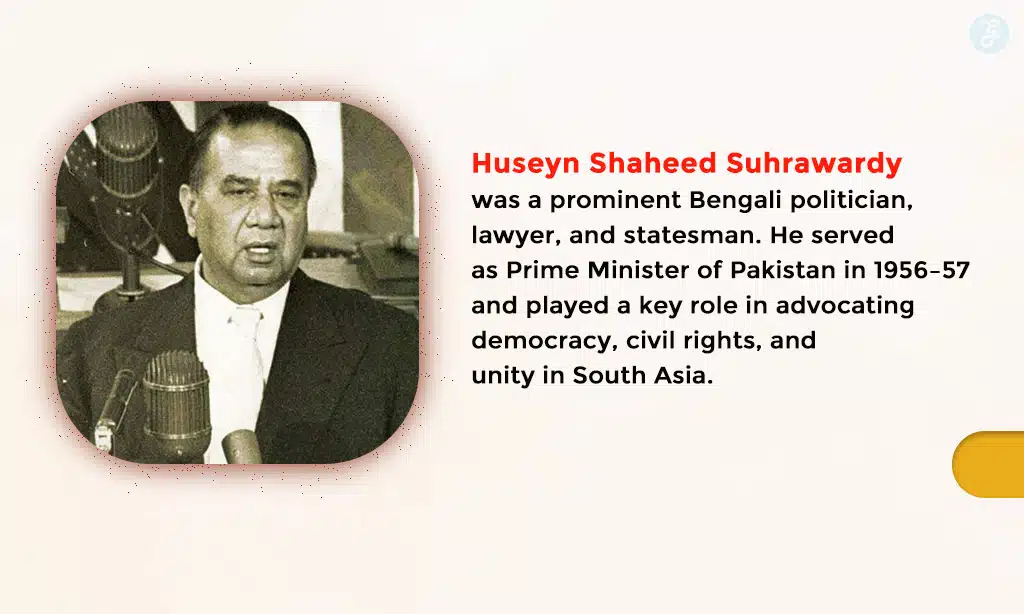
When provincial autonomy expanded under the Government of India Act, Bengal emerged as a crucial electoral battleground. Suhrawardy entered the Bengal Legislative Assembly and went on to hold ministerial portfolios, including Commerce, Labour, and later Civil Supplies.
These were not easy offices to manage. The Second World War turned Calcutta and Bengal into a militarized zone, a hub for Allied logistics, and a space of deep economic strain. Shortages, price spikes, and speculation became part of daily life.
Then came the Bengal Famine of 1943.
Here, the legacy of Huseyn Shaheed Suhrawardy becomes sharply contested. As a minister dealing with supplies, he claimed to be working tirelessly to bring food into the province and distribute relief. But for many contemporaries—and later historians—his efforts were inadequate. Some accused him of failing to crack down on hoarding and profiteering; others blamed him for misjudging the severity of the crisis.
Whether he was primarily negligent, constrained by wartime structures, or unfairly scapegoated remains hotly debated. What is clear is that the famine permanently damaged his standing among large sections of the educated Hindu middle class in Calcutta, who associated his administration with a colossal human tragedy.
The controversy left a lasting stain on his reputation, even as he continued to rise within Bengal’s Muslim political leadership.
Direct Action Day: The Shadow Over Calcutta
If the Bengal famine created doubts about Suhrawardy’s moral judgment, Direct Action Day in 1946 turned him into a symbol of communal violence in Indian memory.
As chief minister of Bengal, with the Home portfolio under his control, Suhrawardy was in a position of direct responsibility when the Muslim League called for a day of “direct action” on 16 August 1946. What followed in Calcutta is now remembered as the “Great Calcutta Killings,” a horrifying episode of communal rioting that left thousands dead.
Critics have long argued that he did not deploy the police and security forces with the necessary urgency. Some claim he used his presence in the police control room to influence operations in favor of Muslim crowds; others interpret his actions as the chaotic response of an overwhelmed administration caught off guard by the scale of violence.
Defenders point out that responsibility for Calcutta’s breakdown was shared among many actors: the League, the Congress, the colonial authorities, and local communal networks. They argue that blaming Huseyn Shaheed Suhrawardy alone is too convenient.
Yet public memory rarely has space for nuance. In much of post-Partition India, he became firmly associated with that dark August, earning labels that have stuck for decades. His subsequent career in Pakistan would not erase the images of Calcutta’s burning streets.
The United Bengal Plan: A Different Map That Never Was
In the last months before Partition, Suhrawardy pursued one of the most ambitious and least understood political experiments of his career: the proposal for a “United Bengal.”
Working with Sarat Chandra Bose, a prominent Hindu leader from the other side of the communal divide, Suhrawardy supported a plan to keep Bengal as a single, undivided entity—neither fully in India nor fully in Pakistan. This Bengal would be a sovereign unit, trying to hold together its Muslim-majority East and Hindu-majority West under a shared political framework.
The idea alarmed many. For sections of the Congress leadership, an autonomous Bengal seemed too unpredictable. For some within the Muslim League, it threatened to dilute the clear-cut logic of Pakistan as a homeland for Muslims. It also raised practical questions about borders, minorities, and control of Calcutta, the economic heart of the region.
The plan failed. Bengal was partitioned. Calcutta stayed with India; Dhaka and much of eastern Bengal went into Pakistan.
For Suhrawardy, the collapse of the United Bengal vision was deeply personal. He lost his urban base in Calcutta, the city where he had built his career. It was a turning point that pushed him to re-root himself in the new state of Pakistan while carrying memories of a Bengal that might have remained whole.
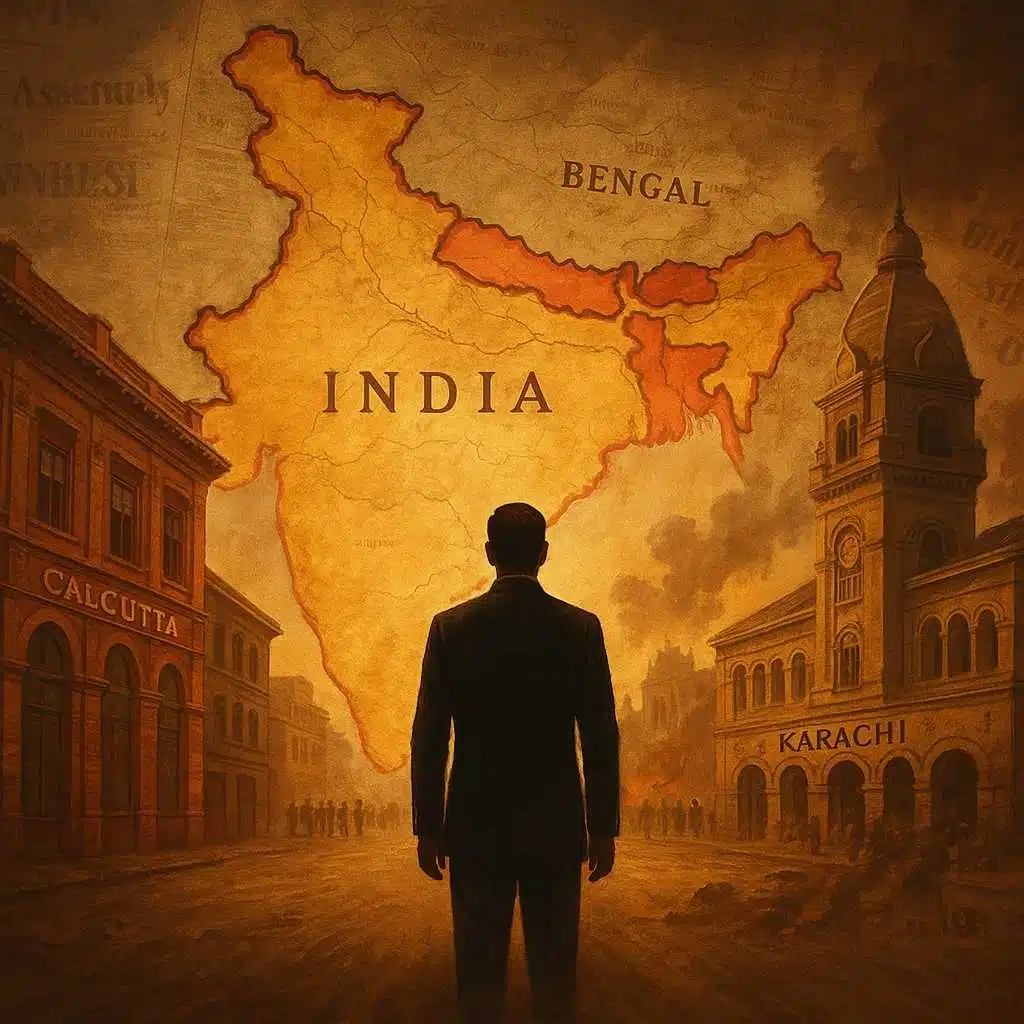
Crossing Over: From Calcutta to Karachi
The partition in 1947 not only redraws maps. It forced leaders like Huseyn Shaheed Suhrawardy to reinvent themselves.
Displaced from Calcutta’s politics and wary of his image in newly independent India, he shifted his focus to East Pakistan and the new political capitals of Karachi and later Rawalpindi/Islamabad. In Pakistan, he arrived as both an asset and a liability: a talented organizer with deep support in Bengali Muslim circles, but also a controversial figure associated with pre-Partition turbulence.
Suhrawardy joined and then broke with the ruling Muslim League. As East Pakistan’s grievances over representation, resources, and language grew, he aligned himself with forces that demanded a fairer share of power for the eastern wing.
This trajectory led him to play a foundational role in shaping the Awami League, the party that would later spearhead the struggle for Bengali autonomy and, eventually, Bangladesh’s independence. At this stage, Suhrawardy still believed in a rebalanced Pakistan rather than a separate country, but his politics gave institutional shape to East Pakistan’s emerging demands.
His political footprint now stretched from Calcutta’s corporation hall to Karachi’s cabinet rooms and Dhaka’s rally grounds.
Prime Minister of Pakistan: Hope and Frustration
In 1956, nearly a decade after Partition, Huseyn Shaheed Suhrawardy became the Prime Minister of Pakistan. It should have been the crowning achievement of his career. Instead, it turned into a brief and uneasy experiment in parliamentary governance.
Suhrawardy took charge of a fragile coalition in a country where political parties were weak, regional grievances were sharpening, and the military-bureaucratic establishment had become increasingly confident. The 1956 Constitution had just been adopted, marking Pakistan’s formal declaration as an Islamic Republic, but the underlying power structure was unstable.
As prime minister, he tried to:
- Stabilize the parliamentary system against constant intrigue.
- Navigate Cold War alignments, balancing ties with Western allies while trying to assert some autonomy.
- Address the growing sense of injustice in East Pakistan, where many felt that resources and decision-making were monopolized by West Pakistani elites.
His critics saw him as too willing to work with Western defence pacts and too eager to manage coalitions with political compromises. His supporters regarded him as one of the few leaders genuinely committed to making parliamentary democracy work in Pakistan.
The experiment did not last. After only about a year, rising tensions with President Iskander Mirza and rival politicians forced Suhrawardy out. His resignation marked the beginning of the end for Pakistan’s first parliamentary phase. Within a short time, martial law would be declared, and the military would take center stage.
In hindsight, Suhrawardy’s brief tenure looks like a warning: a reminder of how vulnerable democratic institutions can be when they stand alone against entrenched non-elected power.
A Bengali Democrat in a Centralised State
After leaving office, Huseyn Shaheed Suhrawardy did not withdraw quietly. Instead, he sharpened his criticism of authoritarian trends, constitutional manipulation, and the imbalance between East and West Pakistan.
He became more closely associated with Sheikh Mujibur Rahman, then a rising politician within the Awami League. Suhrawardy’s experience in negotiation, constitutional politics, and international diplomacy made him an important mentor figure, even as the next generation of Bengali leaders moved toward a more assertive stance.
In this phase, Suhrawardy’s political footprint became increasingly East-centric:
- He opposed the One Unit scheme that merged West Pakistan into a single administrative block while keeping East Pakistan as a separate unit, effectively institutionalizing inequality.
- He raised his voice against military rule and argued for genuine federalism.
- He warned that the persistent denial of democratic rights in East Pakistan would have long-term consequences.
These positions did not endear him to Pakistan’s ruling establishment. Yet they laid part of the intellectual foundation for the later six-point autonomy demands and the broader movement that would culminate in 1971.
To Karachi’s power brokers, he was now a troublesome Bengali democrat. To many in Dhaka, he was an early champion of their aspirations within a united Pakistan.
Three Countries, Three Memories
Today, the memory of Huseyn Shaheed Suhrawardy is split across three national narratives.
In India
In much of Indian popular imagination, especially in West Bengal, Suhrawardy is remembered through the lens of Direct Action Day and the communal violence of 1946. The traumatic images of that period overshadow his earlier work as Deputy Mayor of Calcutta, his municipal reforms, or his experiments with cross-communal politics.
For many Indians, particularly those whose families lived through the riots, the name “Suhrawardy” evokes fear and anger rather than constitutional debates or labor politics.
In Pakistan
In Pakistan, his legacy is ambiguous and often overshadowed. Official histories have tended to focus more on the founding figures and later military rulers than on short-lived prime ministers who tried—and failed—to stabilize democracy.
Those who do recall Suhrawardy often see him as an experienced parliamentarian who collided with a system drifting toward military dominance. He appears as one of the early casualties of a centralized state that was never fully comfortable with dissenting voices from either wing.
In Bangladesh
In Bangladesh, the story is different again. Here, Huseyn Shaheed Suhrawardy is often remembered as part of the democratic lineage that eventually produced independence, even if he did not live to see 1971.
His role in nurturing the Awami League, his insistence on fair representation for East Pakistan, and his criticism of military rule have earned him a more positive place. He is seen as a bridge figure between British-era Bengal politics and the later Bengali nationalist movement.
Yet even in Bangladesh, his legacy is complex. His involvement in pre-Partition controversies is not forgotten, but it is weighed against his later efforts to defend parliamentary politics and regional rights.
Reassessing Suhrawardy’s Political Footprint
What, then, should we make of Huseyn Shaheed Suhrawardy today?
One way to read his life is as a reflection of the broader tensions of 20th-century South Asia:
- Between communal identities and civic nationalism.
- Between centralized states and regional aspirations.
- Between parliamentary ideals and military-bureaucratic realities.
In Calcutta, he tried to work within a shared civic space, only to be pulled into hardened communal politics. In Bengal, he sought to balance class mobilization with religious identity, walking a thin line between inclusive mass politics and the narrower logic of communal representation. In Pakistan, he fought to hold together a deeply unequal federation using the tools of parliamentary democracy.
He made serious misjudgments. The controversies around the famine and Direct Action Day are not minor footnotes; they are central to understanding why his name still provokes strong reactions. At the same time, reducing him to a caricature—either as a communal villain or an unblemished democrat—does not do justice to his complicated journey.
To reassess his political footprint across borders is to accept these contradictions. It means acknowledging that the same man could be implicated in communal violence in one phase of his life and later stand up against authoritarian rule in another. It means recognizing that historical actors are often shaped by structures and crises they cannot fully control, even as they remain responsible for their choices.
A Life Larger Than the Borders He Crossed
From Calcutta’s town hall to Karachi’s prime ministerial office and the simmering streets of Dhaka, the journey of Huseyn Shaheed Suhrawardy mirrors the story of South Asia’s turbulent 20th century.
He started as a young lawyer in an imperial city, became a mass organizer for Muslim workers, rose to high office amid famine and war, presided over a province during one of its darkest communal episodes, advocated a united Bengal that never came to be, and finally tried to rescue parliamentary democracy in a Pakistan sliding toward military rule.
His life crossed borders that did not yet exist when he was born. Those borders later tried to pin him into separate national boxes: Indian villain, Pakistani casualty, Bangladeshi precursor. None of these labels, on their own, is enough.
In an era when India–Pakistan relations are frozen, when Bangladesh continues to negotiate its own balance between democracy and strong leadership, and when regional mistrust runs deep, revisiting the story of Huseyn Shaheed Suhrawardy offers something more than biographical interest. It invites us to look again at the messy, morally ambiguous choices that shaped the subcontinent—and to ask whether we have fully learned from them.
His political footprint stretches across three countries, but his story ultimately belongs to a wider, shared history. Understanding that shared history may be the first step toward softening the borders that still define how we remember him.