

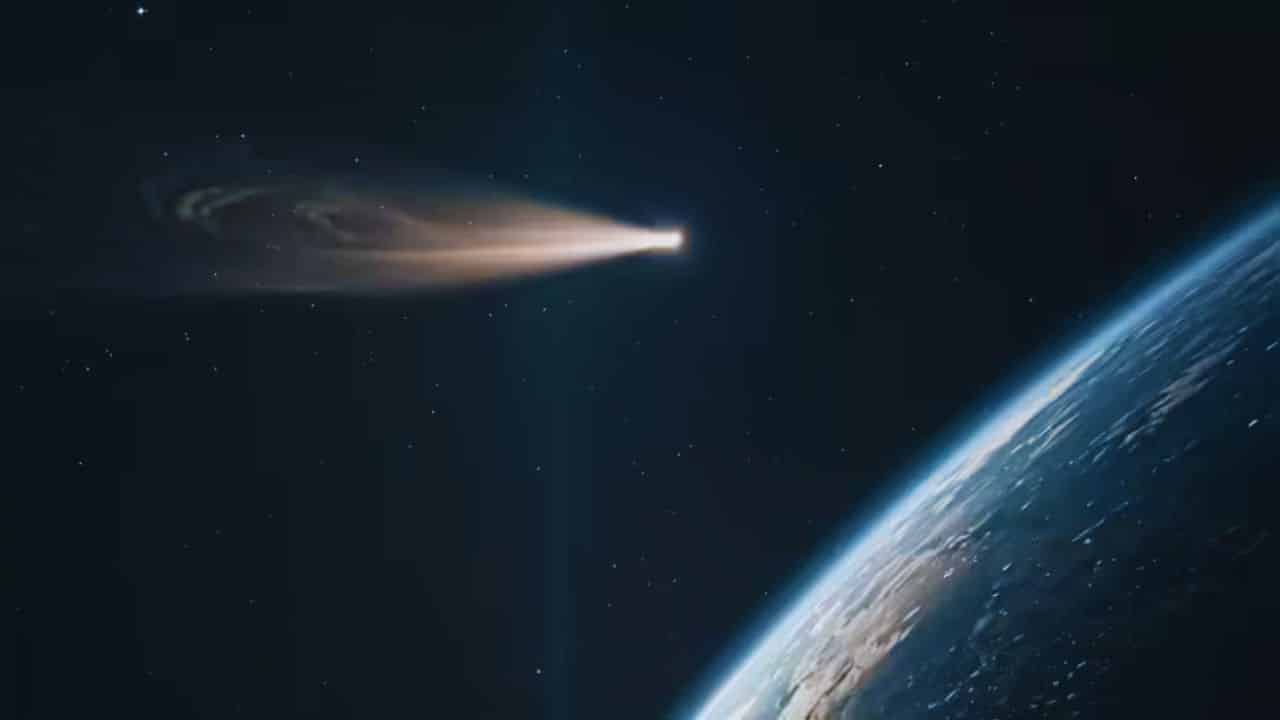
NASA’s Hubble Space Telescope is monitoring interstellar comet 3I/ATLAS—discovered July 1, 2025—and new observations plus follow-up analysis point to unusual, shifting jet activity that may be tied to the comet’s rotation as it races through the Solar System.
What Hubble saw
Hubble delivered one of the sharpest images yet of interstellar comet 3I/ATLAS, helping astronomers tighten estimates of the comet’s nucleus size and document its evolving dust activity.
In the August 2025 observing campaign, researchers reported an upper limit of about 3.5 miles (5.6 km) for the nucleus diameter, while noting it could be as small as about 1,000 feet (320 meters) because the solid nucleus cannot be directly resolved in the images.
Hubble also captured a dust plume coming off the Sun-warmed side of the comet and the early suggestion of a tail streaming away from the nucleus, indicating active outgassing and dust release as sunlight heats the surface.
A later Hubble revisit on Nov. 30, 2025 used the Wide Field Camera 3, with Hubble tracking the comet so background stars appear as streaks.
At that time, 3I/ATLAS was about 178 million miles (286 million kilometers) from Earth, substantially closer than Hubble’s earliest looks soon after discovery.
NASA said multiple other missions are also studying 3I/ATLAS, building a coordinated picture of its size, activity, and composition.
Why the jets seem to “swap”
The “swapping” description centers on a pattern seen in cometary jets: as the nucleus rotates, different active regions turn toward the Sun, and the dominant jet can change—making one feature brighten while another fades over time.
In a 2025 observing campaign spanning 37 nights (July 2 to Sept. 5, 2025), astronomers reported jet structures in 3I/ATLAS that appear to wobble or precess, a behavior consistent with a rotating nucleus whose spin changes the viewing geometry of outgassing.
That study reported jet features appearing on seven nights between Aug. 3 and Aug. 29, and interpreted the periodic motion as evidence for a rotation period of roughly 15 hours and 30 minutes.
Because 3I/ATLAS formed around another star, these changing jets are scientifically valuable: they offer a rare chance to compare how “fresh” volatile-rich material behaves when it experiences intense inner–Solar System sunlight for what may be the first time.
Researchers also point out that 3I/ATLAS showed a sun-facing dust structure (often called an “anti-tail” in popular descriptions), which can occur when larger dust grains linger along the comet’s orbital plane and are seen from Earth at a favorable angle.
The key point for scientists is not the label but the physics: repeating, structured jet behavior can reveal spin state, localized active areas, and how fast the comet’s surface is eroding.
How the observations were made
3I/ATLAS was discovered on July 1, 2025 by the NASA-funded Asteroid Terrestrial-impact Last Alert System (ATLAS), an impact-warning survey developed by the University of Hawai‘i.
Hubble’s role has been to provide high-resolution imaging that improves nucleus-size constraints and tracks dust structures that are hard to measure precisely from the ground.
NASA also highlighted a broader multi-observatory effort, naming the James Webb Space Telescope, TESS, the Neil Gehrels Swift Observatory, and the W.M. Keck Observatory partnership as part of the coordinated campaign to refine size and probe chemical makeup.
Key timeline for 3I/ATLAS (2025)
| Date (2025) | Event | Why it matters |
| July 1 | ATLAS discovery of 3I/ATLAS | Establishes this as a rare interstellar visitor and triggers worldwide follow-up. |
| July (post-discovery) | Early Hubble imaging | Enables tighter nucleus-size limits and documents early dust activity. |
| Aug. 3–29 | Jet features reported on multiple nights | Supports the idea of repeating, rotation-linked jet behavior. |
| Aug. 7 (published by NASA) | Hubble-based nucleus-size constraints and activity report | Places upper limit near 5.6 km and notes dust plume/tail behavior. |
| Nov. 30 | Hubble revisit with WFC3 | Extends the activity record as the comet continues outbound. |
What we know about 3I/ATLAS so far
NASA reported 3I/ATLAS is traveling about 130,000 miles per hour (209,000 kilometers per hour), calling it the highest velocity recorded for a Solar System visitor and noting that long interstellar travel plus gravitational encounters can boost speed over time.
At discovery, ATLAS found the comet at a distance of about 420 million miles from the Sun, and early behavior suggested dust loss consistent with comets first detected around 300 million miles from the Sun.
NASA also said the comet should remain visible to ground-based telescopes through September 2025, then become hard to observe as it passes too close to the Sun, and reappear on the other side by early December.
Snapshot of key measured/estimated values
| Metric | Best-reported value | Source note |
| Nucleus diameter (upper limit) | 3.5 miles (5.6 km) | Hubble-based constraint; nucleus not directly resolved. |
| Nucleus diameter (possible low end) | ~1,000 feet (320 m) | Lower bound described by researchers due to coma brightness. |
| Speed through Solar System | ~130,000 mph (209,000 km/h) | Reported by NASA as record-high for a visitor. |
| Distance from Earth during Nov. 30 Hubble revisit | ~178 million miles (286 million km) | NASA and ESA/Hubble image notes. |
| Rotation period estimate (from jet wobble) | ~15 h 30 m | Derived from multi-night jet tracking in 2025 study. |
What comes next
Hubble’s Nov. 30 revisit is part of a longer monitoring arc, and NASA said observations are expected to continue for several more months as 3I/ATLAS heads out of the Solar System.
As more measurements arrive from NASA’s broader telescope fleet, scientists expect improved constraints on the nucleus size and stronger clues about volatile chemistry—critical for comparing this interstellar comet with objects formed closer to the Sun.
ESA has also pointed to missions like Comet Interceptor—planned for launch in 2029—as a future way to study pristine comets and, if timing aligns, potentially an interstellar object up close.