Ever search for something on Google, only to get answers that miss the mark or bury what you need? You know that feeling. You want clear, fast info at the top. Many people feel lost when updates change how results show up, especially with AI in charge now. Did you know Google’s Search Generative Experience (SGE), now officially called AI Overviews in the U.S., uses generative AI to create quick answers right in your search results? This means old tricks for ranking high may not work anymore.
This post will break down simple steps for how to rank in Google Search Generative Experience. Get ready for tips that can help boost your spot and make sure more folks see what you share.
Ready to take a shortcut to smarter rankings? I’m going to walk you through the exact steps I use, and I think you’ll be surprised at how easy it can be. So, grab a cup of coffee, and let’s go through it together.
What is the Search Generative Experience (SGE)?
Search Generative Experience, widely known today as AI Overviews, uses artificial intelligence to create quick answers right at the top of search results. While it started as an experiment, Google officially rolled it out to all U.S. users on May 14, 2024.
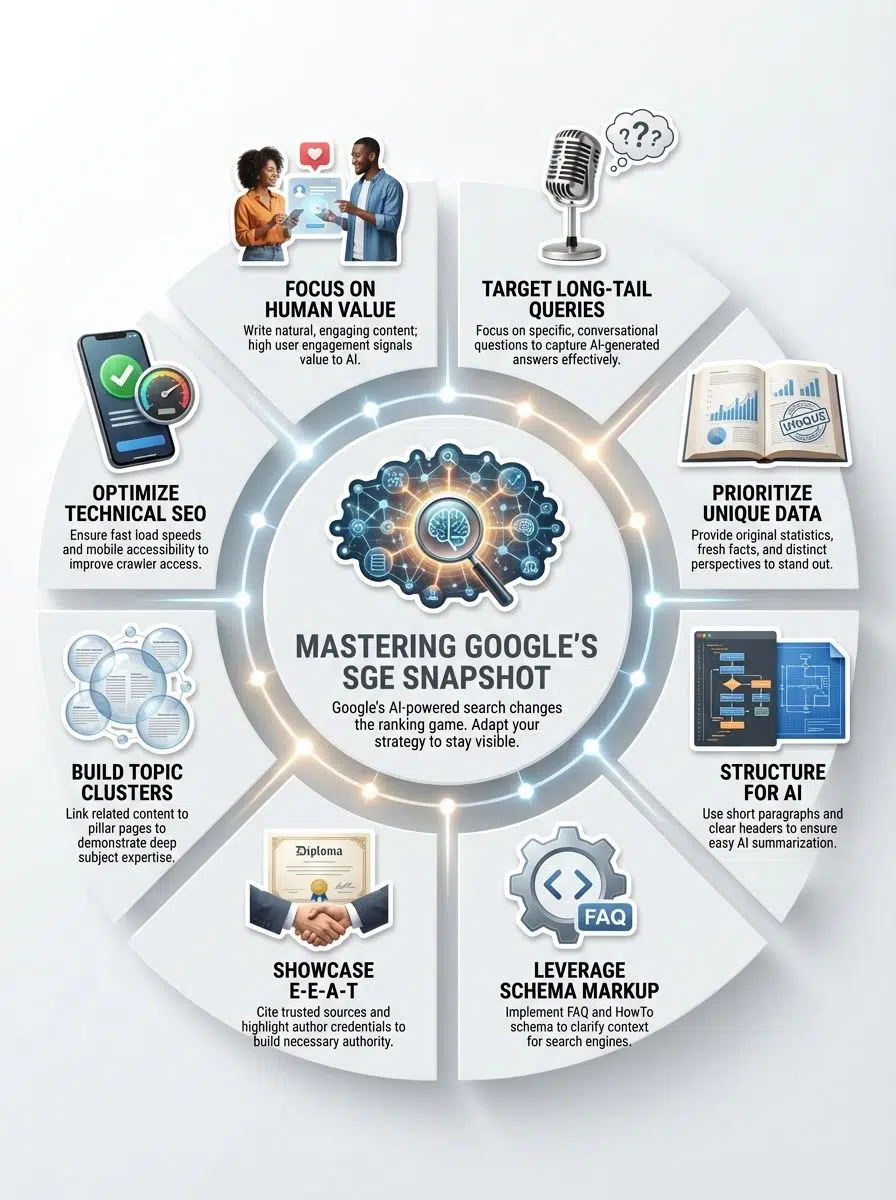
It aims to give users fast facts and clear snapshots using generative AI tools like large language models. These “snapshots” pull key info from many sources on the web and try to answer complex questions in a few lines.
SGE changes how people find what they need online. Instead of digging through links, users see short summaries for topics such as digital marketing, SEO strategies, or product reviews.
In these new organic search results, content ranking can shift fast because the system picks details that best fit user queries on long-tail informational searches. No more scrolling forever or feeling lost at sea! One early tester joked:
It feels like your smart friend whispering answers before you even finish asking.
Next up, let’s look at why grabbing a good spot in this snapshot matters more than ever for any business seeking traffic today.
Why Ranking in the SGE Snapshot Matters
Ranking high in the SGE Snapshot puts your content right under users’ noses. Google’s generative AI crafts instant summaries, and only a few sources land in that spotlight. Your snippet could be the first thing people see, way before scrolling to regular search results.
Organic traffic can soar if you show up here, but the risks of missing out are real. According to a 2025 study by Authoritas, organic click-through rates (CTR) can drop by over 60% when an AI Overview is present. This data shows that if you aren’t in the AI snapshot, you might be invisible to the majority of mobile users.
People trust information they find quickly, and those spots often spark more clicks than regular links below them. A good place here boosts brand awareness and signals authority to both humans and algorithms alike.
In digital marketing today, landing at the front means catching eyes faster. It is the best way to grow your reach without paying for ads every time someone searches for help or advice online.
Key Strategies to Rank in SGE
Crack the SGE code with simple strategies that boost your search spot and keep those digital doors swinging open for more readers. Curious yet? Keep reading.
Focus on Long-Tail Informational Queries
Long-tail informational queries help boost visibility in the Search Generative Experience snapshot. These are specific search questions like “how to improve crawlability for SEO in 2026,” instead of broad terms such as “SEO.” Targeting these queries brings more organic traffic, since people often look for quick answers from AI-powered results.
You can hit the bullseye by covering detailed topics within your digital marketing strategy or sharing step-by-step content ranking guides. Tools like AnswerThePublic are fantastic for finding these specific questions.
Content that answers narrow user needs stands out to Artificial Intelligence engines as relevant and helpful, which lifts you up in those organic search results. Think about users asking Google’s machine learning tools lots of pointed questions every day. Your site should have the right keys ready! As you create high-quality material focused on each topic cluster, focus next on making that information easy for AI summaries to grab.
Specific beats generic every time; speak your audience’s language and watch your rankings climb.
Create Unique, High-Quality Content
After choosing strong long-tail informational queries, the content must shine. Give facts that are new or present them in a fresh way. Use data from real sources, like known SEO experts such as Lily Ray and Barry Schwartz.
Include simple stats or clear examples to help search engines trust your page. For instance, mentioning specific metrics like “increasing conversion by 12%” is far better than saying “increasing conversion a lot.”
Keep each section useful, focused on the topic, and easy for people to read. Write short sentences with active verbs so readers stay interested. Pictures or charts can make ideas pop off the screen. Bonus points if you add original thoughts about trending digital marketing topics or current search results shifts driven by artificial intelligence.
This approach builds trust while improving your content ranking in any Search Generative Experience snapshot.
Structure Content for AI Summarization
AI pulls answers fast, so your content needs to be clear and direct. Make it easy for search bots to find the right facts.

- Use short paragraphs, ideally two or three sentences each. This style helps AI pick out details.
- Add bold headings every few lines. Headings tell the AI what each part is about.
- Break big topics into smaller sections. Lists, bullets, and steps work great for this.
- Write in simple words that a fifth grader can understand. Hard words confuse both readers and machines, so stick to familiar language.
- Place key ideas early in each section. This gets your message across before someone clicks away.
- Include data and dates when possible. Facts like “Google launched AI Overviews in the U.S. in May 2024” give AI clear points to summarize.
- Repeat main keywords naturally, but avoid stuffing them into every line. The right balance helps ranking in the Search Generative Experience Snapshot.
- Answer common questions clearly. Think of what people ask about your topic and respond in plain terms.
- Use examples to explain points, like showing how “long-tail informational queries” help content ranking.
- Edit with AI in mind; check if summaries make sense when you read only the first sentence from each section.
Now that content structure is covered, it’s time to look at schema markup for better search optimization.
Implement Relevant Schema Markup
Adding schema markup helps your site talk to search engines. Google and other AI tools use this code to better read your pages. For example, FAQPage schema can label questions and answers so machines know their meaning, not just the words.
Product, review, and HowTo schemas give clear signals too. This boosts your content ranking in SGE Snapshots by making information easier to find and show.
Mark up key details like ratings or publication dates with specific tags. Make sure your schema matches what users see on the page. Do not hide facts in the code that aren’t visible.
Real people create these guidelines, so follow them closely for the best results in search results powered by Generative AI. Next up, we will learn how to optimize for Search Generative Experience itself!
Optimize for Search Generative Experience
Make your site easy for both people and search engines to reach, or you’ll get lost in the shuffle. Update old pages often, as fresh info attracts those clever AI bots like bees to honey.
Prioritize Crawlability and Accessibility
Search engines need to find and read your website fast. Users want easy access, or they will leave.
- Use clear page titles so crawlers know what each page is about.
- Add meta descriptions for every page to help search results show better previews.
- Insert alt text for images, describing them in plain words for both people and AI summaries.
- Keep links simple and short, using real words instead of codes or numbers.
- Check that robots.txt allows important pages to be reached by search bots.
- Build a sitemap and send it to Google Search Console; this makes crawling faster.
- Use header tags like H1 and H2 to split up topics; AI uses these for quick summaries.
- Make sure all buttons, fonts, and forms work on phones, tablets, or computers.
- Test your load speed with tools like PageSpeed Insights. Pay special attention to Interaction to Next Paint (INP), which officially replaced FID as a Core Web Vital in March 2024.
- Avoid pop-ups that block content because they frustrate users and hurt crawlability.
Refresh and Update Outdated Content
Fresh content keeps your site alive in the Search Generative Experience. Outdated pages drop in search ranking and stop drawing traffic.
- Check old blog posts or pages every few months, scanning for broken links, wrong dates, or missing stats.
- Swap out stale facts with new studies. For example, replace a 2022 data point about AI summaries with results from 2025.
- Change images that look outdated, especially if user experience has moved forward since they were first posted.
- Add recent keywords like “AI-powered answers” or “Generative AI,” so search engines see you are up-to-date.
- Rewrite unclear sentences using simple words. This makes it easier for both users and algorithms to read and rank your work in organic search results.
- If a tool or method is no longer being used in digital marketing, remove those sections and highlight current options instead.
- Double-check schema markup. Incorrect markup hurts your chances of getting featured in SGE snapshots.
- Fix crawl errors flagged by Google Search Console; these block fresh content from reaching users who need it most.
Staying ahead means improving more than just the words on your page. Now it’s time to build topical authority with smart topic clusters.
Build Topical Authority with Topic Clusters
Search engines prefer sources that show deep knowledge on one subject. Topic clusters help boost your content ranking in SGE snapshots and Search Engine Optimization.
- Create a main page, called a pillar page, that covers one broad subject related to your business or service.
- Write shorter pages, each about a single question or part of the main topic, linking them all back to the pillar page.
- Use keywords like “SEO strategies,” “Generative AI,” and “User Experience” in both the pillar and the supporting pages for stronger search optimization.
- Connect ideas across these pages with natural links; this helps search algorithms see you as an expert in information retrieval.
- Update facts and statistics like Google Trends data from 2025 or popular questions users ask about Search Generative Experience regularly, so your cluster stays fresh.
- Highlight real cases or stories if possible, showing how you solve problems people actually face with AI-powered answers or organic search results.
- Make sure visitors can move easily between topics within your cluster; good navigation boosts user experience and time spent on your site.
- Show clear authorship on every page; it builds trust and adds authority to your digital marketing efforts in organic traffic growth.
Leverage Generative Engine Optimization (GEO)
Generative Engine Optimization (GEO) is the new frontier for getting your content to shine in AI-powered search. A landmark study by researchers from Princeton, Georgia Tech, and the Allen Institute for AI defined exactly what works.
Prepare for AI-Generated Summaries
The researchers found that specific tweaks can drastically improve your chances of being cited. Adding direct quotations from experts increased visibility by 41%, and including statistics increased it by 30%. This data proves that AI loves authority and hard numbers.

User experience matters a lot in this new search world. If you keep language straightforward, users will stay engaged longer. Mix up content types like Q&A sections or quick-reference charts.
These tricks can boost your content ranking in SGE Snapshots and get more eyes on your answers. Next up is how to adapt as algorithms change within the Search Generative Experience space.
Adapt to SGE-Related Algorithm Updates
Search Generative Experience, or SGE, updates can change fast. You need to act quickly and stay sharp to keep your content strong in AI-powered search results.
- Follow Google’s official blog and forums for news about Search Generative Experience algorithm changes, as new updates often roll out monthly.
- Study ranking shifts in your digital marketing reports using tools like Google Search Console and web analytics platforms.
- Test page speed often since crawlability matters more now. Even a one-second delay can drop rankings, based on recent studies.
- Rework old content after each update; refresh facts and stats with data from 2025 if possible to show topical authority.
- Analyze competitor websites that appear in top SGE AI summaries. Spot what they do best, such as better schema markup or clearer headings.
- Tune your SEO strategies so your site adapts quickly if the algorithm starts favoring long-tail informational queries over broad topics.
- Adjust internal linking to help Google’s AI connect related topic clusters for richer information retrieval during semantic search events.
- Ask users for feedback about the user experience (UX) via short surveys or comments after major SGE shifts to spot issues early.
- Work closely with your tech team so all technical SEO fixes deploy right after an update hits. No one likes being last to the party!
- Keep learning about machine learning’s role in SGE by joining webinars or workshops; even experts say growth comes from staying curious.
Staying flexible helps protect your content ranking and organic traffic, no matter how often algorithms change.
Showcase Expertise, Experience, Authority, and Trust (E-E-A-T)
Show your skills, share your story, and stand tall in your field. Read on to see how this builds trust and gets you noticed.
Cite Reputable Sources
Search Generative Experience snapshots favor facts, clear data, and reliable sources. Citing trustworthy sites like government pages, academic journals, or top health organizations boosts your content’s authority in the eyes of AI summaries.
Outlets like the CDC, Pew Research Center, Harvard University, or The New York Times help prove your information is accurate and current. Users want to see names they trust, and so does Artificial Intelligence.
Using reputable sources also helps fight misinformation problems online. Always link directly to these references so readers can check for themselves. This builds user experience and secures better rankings in organic search results.
Up next, highlighting author credentials for even stronger credibility.
Highlight Author Credentials
People want information from experts who know their stuff. Add short bios for each writer at the end of your posts. Share how many years they have worked in digital marketing, SEO, or content strategy.
Show any awards, books published, certifications like Google Analytics, or places where their work appeared. Linking your bio to a verified LinkedIn profile is another powerful signal.
A real photo helps readers connect and trust you more than a cartoon logo ever will. Search engines scan for these signals too when ranking in the SGE Snapshot. Small details like credentials can make users stay longer and increase organic traffic to your site.
Build High-Quality Backlinks
Strong backlinks help boost your page in SGE’s AI-driven search results. These links show search engines that other trusted sites value your content.
- Seek backlinks from websites with high authority, like recognized news outlets or educational sites; Google’s algorithm gives more weight to these links.
- Write data-backed articles, as people often reference and link to sources with statistics or original research.
- Reach out to experts for quotes, then ask them to share your article. This can earn you natural links from their platforms.
- Share helpful insights on industry forums; link back only if it adds real value and isn’t spammy.
- Make infographics with clear facts or tips; many bloggers use them, providing credit and a backlink.
- Guest post on respected sites in your field; quality beats quantity every time for SEO strategies targeting organic traffic.
- Link internally between related pages within your site, making it easy for users and AI to find more of your information.
- Fix broken links pointing to old resources by replacing them with live content from your site. Site owners appreciate the help and often update the link fast.
- Join digital marketing networks where professionals discuss trends; sometimes they highlight useful articles with a backlink in newsletters or roundups.
- Update older posts and let others know about the changes. Sometimes people will cite the refreshed content in their own lists or guides.
High-quality backlinks tell both search engines and AI summaries that your information is trusted, boosting rankings in Search Generative Experience snapshots.
Measuring SGE Performance
Watch your site’s spot in AI snapshots like a hawk, because small shifts can mean big changes in clicks. Use smart tools to keep tabs on where you shine, and see which tweaks move the needle faster.

Monitor Visibility Shifts
Spotting changes in your search presence is key. Small shifts can mean big things for SGE performance.
- Check your search rankings every week using analytics tools, so you spot trends early.
- Look at AI-generated summaries in Search Generative Experience results; see where your site appears, and how often.
- Track sudden drops or jumps in organic traffic which could hint at an SGE or algorithm update.
- Use web analytics to watch which keywords bring users from AI-powered answers and standard results.
- Notice if new competitors show up high in snapshots, since this may signal changes needed in your content strategy.
- Keep an eye on how often Google picks parts of your pages for summaries compared to the old numbers.
- Take note of user behavior metrics like click-through rates and time spent on the page after appearing in an SGE snapshot.
- Set alerts for ranking shifts, so you get notified fast if something happens overnight or on weekends.
- Test your visibility on desktop and mobile, because the SGE snapshot display can change by device and affect traffic flow.
- Log these findings over time; patterns can reveal what works best for keeping a strong spot with Generative AI search optimization.
Track Rankings in AI Snapshots
After watching your visibility, it is smart to check how you rank in AI Snapshots. These spots show quick answers at the top of search results.
- Use tracking tools that follow AI positions specifically. Tools like ZipTie.dev and Semrush have released updates for tracking these new AI features.
- Check the keywords that trigger SGE snapshots. Focus on long-tail informational queries because they get picked by generative AI more often.
- Log your main ranking queries in a spreadsheet. Spread out checks weekly, since SGE placements shift fast and without warning.
- Compare which content makes it into the AI summaries versus traditional organic search results. Note patterns in what gets pulled up.
- Study your competitors’ snapshot visibility too. This shows where you can beat them or learn from their moves.
- Watch for changes after Google rolls out SGE-related algorithm updates. Big drops or jumps may mean it is time to refresh your strategy.
- Use web analytics to track organic traffic spikes that match higher ranking inside SGE snapshots. Sudden bumps might signal a new win in these dynamic search spaces.
- Test tweaks in content formatting, schema markup, or topical depth; observe if they help bump your site up into the snapshot area.
- Share any wins with your team so everyone stays sharp on what helps land those prized positions powered by generative AI.
Future Trends in SGE
AI keeps getting smarter, changing how people find and use information. Staying one step ahead could turn your site into a hot spot for curious minds tomorrow.
Increased Demand for Human-Centric Content
Google’s Search Generative Experience now prizes content that feels real and personal. Stories, opinions, and original thoughts from actual people grab attention in search results.
In 2024 and 2025, studies showed users clicked more often on answers written with warmth or a “human touch.” Facts matter, yet readers want to hear from voices they relate to and trust.
Fast-moving generative AI means information floods in every day. Some pieces read stiff or generic. Real stories break through the noise because people connect with them easily. Google even shared that adding genuine experiences boosts user experience scores, helping your work shine in digital marketing efforts.
Readers crave both clear facts and a sense of connection as they scan each AI-powered answer. Next up comes personalization powered by artificial intelligence.
AI-Driven Personalization in Search
More people want content that feels made just for them, so search engines turn up the heat. AI gets smarter and learns what users like, dislike, and even wish they never saw again.
Platforms use data from past searches, time spent on pages, and even location to craft search results that hit closer to home. You might type a simple question about “best shoes for running,” but AI spins out answers shaped by your city’s weather or health trends in 2026. This approach changes how sites fight for front row seats in search rankings.
Marketers must now pay attention to user signals more than ever if they hope their content lands in those shiny generative AI snapshots. Search Engine Optimization SEO grows less about keywords alone and more about reading between the lines, thinking like real people do while searching online.
The Bottom Line
SGE snapshots now shape how people find answers. Search optimization is less about old tricks and more like a smart game of chess with AI. Focus on clear content, strong user experience, and up-to-date facts to win this match.
Pages that help users quickly get what they seek will rise in these new search results. Generative AI keeps learning, and so must your digital marketing moves.
SEO strategies need regular tweaks for better information retrieval in organic traffic and AI-powered answers. Stay sharp, spot trends early, and use web analytics data to track every shift in content ranking or algorithm change. Your next move just might lead the pack.