Have you ever watched a movie that felt less like entertainment and more like a mirror holding up a nation’s soul? Many people feel lost when they think about the history of Bangladesh. Stories get twisted, memories fade, and occasionally, the heart behind a nation’s struggle seems out of reach.
How do we know what freedom meant to real people during those difficult days? Which voices recorded our journey from pain to hope?
Here is one clear fact: Tareque Masud made films that showed this fight for freedom like no other. From “Muktir Gaan” to “Matir Moina,” his camera let us see struggles that textbooks cannot teach.
Stick with me and learn how Tareque Masud captured a nation’s soul through bold stories, music, and true faces on screen. You might find answers you didn’t expect—keep reading!
Key Takeaways
- Tareque Masud’s 1995 documentary Muktir Gaan was built from 20 hours of rare footage found in the New York basement of American filmmaker Lear Levin.
- He won the prestigious FIPRESCI Prize at the 2002 Cannes Film Festival for “Matir Moina” (The Clay Bird), marking a historic moment for Bangladeshi film.
- Masud and his partner Catherine Masud founded the Audiovision production house and were key figures in the Moviyana Film Society movement.
- His debut film, “Adam Surat” (1989), took seven years to make and documented the life of the legendary painter SM Sultan.
- Tragically, he died in a road accident on August 13, 2011, alongside media CEO Mishuk Munier, while scouting locations for his unfinished film Kagojer Phool.

Tareque Masud’s Vision of Freedom
Tareque Masud didn’t just film events; he captured the soul of Bangladesh with his camera, chasing stories no one dared to tell. His journey began with a deep dive into the artistic mind.
Before he became a household name, he spent seven years following the eccentric painter SM Sultan to create his first documentary, “Adam Surat” (The Inner Strength), which was released in 1989. s project wasn’t just a biography; it was a masterclass in patience, shot on 16mm film, capturing the artist’s philosophy on the history of Bangladesh and rural life.
Through films like “Adam Surat” and “Stop Genocide,” he created works that resonated with the hopes and tears of freedom fighters. How did Tareque Masud document the Liberation War?
Armed with rare 1971 footage, Masud stitched together the story of Bangladesh’s fight for freedom. He gathered almost 20 hours of archival film, including scenes by American filmmaker Lear Levin.
The focus often rested on the Bangladesh Mukti Shangrami Shilpi Shangstha, known as the Cultural Squad, showing their music and theater in refugee camps and battle zones. These artists boosted fighters’ spirits using Bengali songs and poems about hope.
He also collected stories from survivors in his documentary work, such as “Muktir Kotha.” This way, voices of ordinary people joined those of soldiers and artists. His short animation “Ganatantra Mukti Paak” covered events from Partition in 1947 to independence in 1971 without a single word spoken.
Some films faced trouble under Begum Khaleda Zia’s BNP government but still captured mass killings like those committed by Al-Badr squads against Bengali intellectuals. Each project is now part of Bangladeshi heritage—like pieces placed side-by-side in a national scrapbook.
What Are the Untold Stories of 1971 He Captured
Tareque Masud shined a light on unseen voices from the Bangladesh Liberation War. He brought out stories of cultural activists from the Free Bangladesh Cultural Squad, who sang and performed in battle zones while bombs fell around them.
These brave artists stood side by side with freedom fighters, using songs of freedom to keep hope alive through dark days. He filmed first-person accounts for “Muktir Kotha,” letting ordinary people share memories and pain that history books left out.
“We wanted to show that the war wasn’t just fought with guns, but with songs, with words, and with the spirit of the common people.” – Catherine Masud
Women spoke of gender violence; survivors recalled hunger, loss, and courage inside refugee camps. His work showed life not just for Muslim Bengalis but also for Hindus caught up in 1971’s chaos.
Folk singers like Gurusaday Dutta and those with ties to West Bengal’s IPTA got their due mention too, showing how art crossed borders even when politics divided families. Tareque Masud did not shy away from tough topics such as the broken promises after victory—poverty stayed, justice lagged behind leaders’ speeches—and he made sure these truths reached everyone who watched his films.
Muktir Gaan: The Song of Freedom
Muktir Gaan hums with the voices of the Bangladesh Mukti Shangrami Shilpi Shangstha as they marched for a free land, guitars and dhol in hand. Rare footage brings alive everyday Bengali courage, stitched together by Tareque Masud and Catherine Masud—like sunlight through rain-soaked leaves.
How Does Muktir Gaan Show Bengali Cultural Resilience
Songs and theater filled the air as the Bangladesh Mukti Shangrami Shilpi Shangstha moved across refugee camps and battle zones in 1971. Artists kept hope alive with music by Jyotirindra Moitra, Nazrul Islam, Sikander Abuzafar, and others from Swadhin Bangla Betar Kendra.
Even under fire from Pakistani military forces, these cultural activists sang about freedom and unity. Their performances lifted spirits among fighters and refugees. Old footage in “Muktir Gaan,” gathered by Lear Levin and Tareque Masud, shows ordinary Bengalis clapping to songs or crying during poetry readings.
The film proves how art fought back against war’s darkness. It highlights resistance through Baul music, Rabindranath Tagore’s verses, crowd chants for Ganatantra Mukti Paak, and the tireless energy of groups like the Free Bangladesh Cultural Squad.
Despite efforts to silence it by BNP officials after 1995, crowds flocked to outdoor screenings where Tareque became known as “Cinema Feriwalla.” This nickname, meaning “Cinema Peddler,” came from his practice of traveling to remote villages with a mobile projection unit, showing the film on white sheets strung up between trees.
What Role Do Archival Footage and Storytelling Play in Muktir Gaan
Archival footage in Muktir Gaan brings 1971 to life. It uses almost 20 hours of rare, unfinished film by Americans like Lear Levin. Viewers see the Free Bangladesh Cultural Squad singing for freedom, faces filled with hope and pain, live on camera.
Soldiers and artists share screen space; mothers feed children inside refugee camps as bombs drop nearby. Instead of just talking about war, Tareque Masud shows it. He lets old film strips carry raw truth.
Storytelling weaves these sights into a strong thread. Co-directed with Catherine Masud, each scene ties real struggles to music by Ganatantra Mukti Paak or voices like Zahir Raihan’s calls for justice over Bangladesh Radio airwaves.
| Song Title | Significance in Film |
|---|---|
| “Joy Bangla Banglar Joy” | Often used as an anthem to unite crowds and boost morale. |
| “Karar Oi Louho Kopat” | A powerful Nazrul Sangeet symbolizing the breaking of prison chains. |
| “Pak Poshu Der Maro” | A direct call to resistance against the occupying forces. |
The film balances tough moments—cultural performance under fire—with gentle lyricism from classic Bengali songs written by Rabindranath Tagore or Jyotirindra Moitra. Together, images and stories guard collective memory so later generations understand what made Free Bangladesh rise against the Pakistani military in 1971.
Muktir Kotha: Words of Freedom
Muktir Kotha brings out the raw voices from villagers, refugees, and freedom fighters alike. Through honest chats and heartfelt songs from Bangladesh Mukti Shangrami Shilpi Shangstha, you hear how courage spreads like wildfire.
How Does Muktir Kotha Highlight Personal Narratives of Resistance
In 1999, Tareque Masud and Catherine Masud released Muktir Kotha as a follow-up to Muktir Gaan. The film takes viewers into the lives of ordinary people who faced the Pakistani military in 1971.
Survivors share stories about loss, bravery, and hope. Some speak of loved ones lost in the fighting; others recall hiding from gunfire or supporting freedom fighters with songs like those by the Bangladesh Mukti Shangrami Shilpi Shangstha.
Cameras capture women telling how they sheltered refugees or led protests for free Bangladesh. Old faces light up with pride recalling resistance actions in villages and busy towns. First-person voices give every tale weight, offering glimpses official records ignore.
Through these memories from rural communities such as Ghior Upazila, forgotten heroes step forward—farmers, teachers, and musicians—each one adding color to the larger fight for freedom seen across Bangladeshi films by Tareque Al Masud and his peers like Shahriar Kabir and Zahir Raihan.
In What Ways Does it Depict Unity in the Freedom Struggle
People from many cultural and religious backgrounds stood side by side in the Liberation War. “Muktir Kotha” gives voice to refugees, artists, fighters, and villagers as they share stories of solidarity. Archival footage shows communal harmony even while chaos swept across Bangladesh.
Shared rituals such as singing songs and performing plays brought Hindu, Muslim, and Christian neighbors together under one flag. Music from the Bangladesh Mukti Shangrami Shilpi Shangstha echoed in every region.
These songs made everyone feel part of something bigger than themselves. In rural towns or refugee camps, people sat together to watch these memories unfold on screen; their laughter and tears mingled in crowded rooms. The documentary wove a patchwork quilt of unity using personal tales collected from all corners of the country.
Matir Moina: The Clay Bird
Matir Moina paints a childhood shaped by faith, family, and the search for meaning in Bangladesh. Sufi saints, old songbooks, and echoes of Rabindranath Tagore linger as young Anu faces a country torn between many worlds.
How Does Matir Moina Explore Religious Identity and Nationalism
The Clay Bird shines a light on the struggle between religious life and the push for Bengali nationalism. Set in East Pakistan just before 1971, the film follows Anu, a boy sent to study at a madrassa.
His father clings to strict Islamic rules, fearing Western ideas. His mother leans toward cultural traditions tied to Bengali roots. Across their family table, faith and national pride often crash together like two rivers meeting in a storm.
Tareque Masud uses daily scenes—prayer at dawn, folk songs sung by Sufi mystics—to show how religion and culture shape identity. As tensions rise with Yahya Khan’s army cracking down on protesters outside, boys inside the madrassa question what it means to be both Muslim and Bengali.
Some teachers back Pakistani rule; others whisper hope of freedom for Bangladesh. The film avoids easy answers but paints real fear over Islamist parties trying to erase local customs during this key moment in history.
In quiet glances or hurried lessons about Rabindranath Tagore or Sufi saints, viewers see young people wrestling with belonging while their nation struggles to be born from faith and fire alike.
What Does Sufi Mysticism Symbolize in the Film
Sufi mysticism in Matir Moina shows the soul as a “free bird” trapped in a clay body. This image stands for spiritual freedom and the wish to rise above strict rules and labels.
The film uses Sufi music, poetry, and simple teachings to show hope for unity, even when politics or rigid beliefs try to separate people. Sufi ideas here stand next to harsh dogma, giving voice to compassion and inclusion instead of hate.
The story highlights how Hindu and Muslim legacies can live together in peace through mystical Sufi traditions. Matir Moina calls out religious extremism and political power plays using these symbols. Bangladeshi figures like Tareque Masud reach back into history, drawing on themes from the 1971 war of liberation and Bengali nationalism.
This approach gives fresh life to dreams of justice, freedom, and harmony at every level—from village stories up to national struggles. The film’s brilliance was recognized globally when it won the FIPRESCI Prize at the 2002 Cannes Film Festival, becoming the first Bangladeshi film to compete for the Academy Award for Best Foreign Language Film.
Pioneering Independent Cinema in Bangladesh
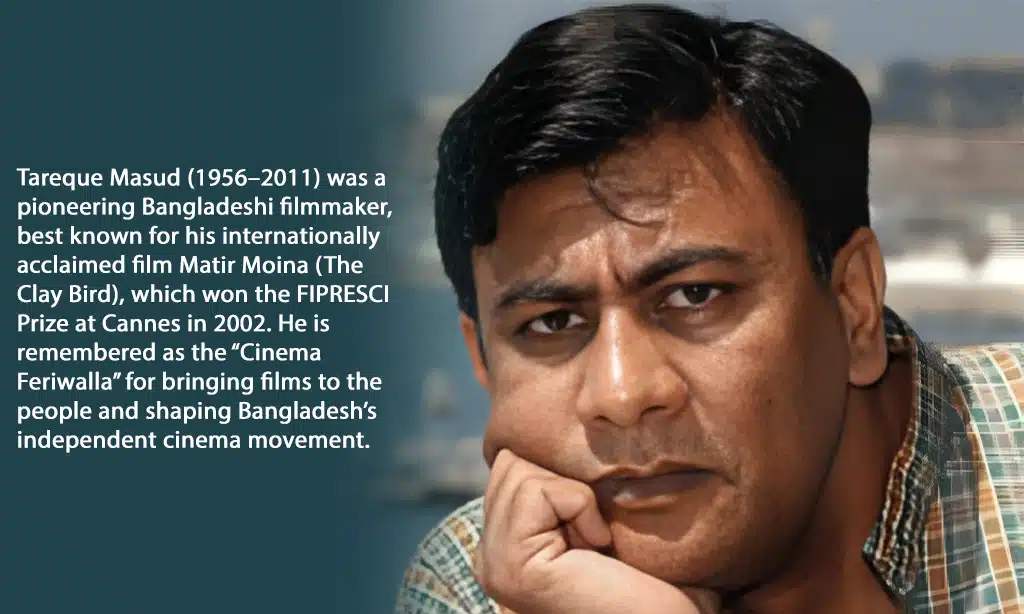
Tareque Masud picked up his camera and sparked a fresh wave for Bangladesh’s indie film scene. With Mishuk Munier and Catherine Masud by his side, he helped build support groups like Moviyana Film Society that lifted many storytellers from different walks of life.
Founding the Bangladesh Short Film Forum
Tareque Masud joined with Morshedul Islam, Tanvir Mokammel, and Yasmine Kabir to start the Bangladesh Short Film Forum in 1986. This group gave young filmmakers like them a stage to tell honest stories outside the big movie studios.
It pushed for films about real people and events, such as “Agaami” in 1984 and “Suchona” in 1988. The Forum helped spark a wave of new ideas.
Filmmakers explored animation, documentaries, and bold social topics that others ignored. Known as pioneers of independent cinema in Bangladesh, these members talked about problems like gender violence or political unrest without fear. The group became home for creative minds who loved film from all walks of life, helping build a strong community of cinephiles across the country.
Promoting Cultural Identity Through Independent Films
Independent films gave people a fresh way to see Bangladesh. Tareque Masud, Catherine Masud, and filmmakers like Shahriar Kabir highlighted Bengali cultural identity in each frame.
Films such as “Ah! America” showed the struggles of Bangladeshi immigrants, while “Sonar Beri” bravely took on gender violence. These movies spoke about the lives of everyday folk ignored by state-run stories.
Groups like Bangladesh Short Film Forum made it easier for bold voices to tell their tales. Works from Tanvir Mokammel like “Chitra Nodir Parey” explored Hindu-Muslim relations after Partition and kept wounded memories alive through film. Rural audiences started paying to watch these documentaries, eager for truth over propaganda spread by groups tied to political powers like the Awami League or the Bangladesh Nationalist Party.
Each project that slipped past censorship helped grow pride in language, heritage, and composite culture—sometimes with rebellion tucked right into song or art just as the Free Bangladesh Cultural Squad once did during Muktir Gaan’s days.
What Themes Recur in Tareque Masud’s Films
His stories often paint pictures of hope and struggle, using simple lives to show deep truths. You can spot threads of Rabindranath Tagore’s wisdom, Bengal’s fight for freedom, and the colors of Sufism running through each film like stitching in a quilt.
How Are Freedom and Justice Portrayed in His Work
Freedom stands tall in Tareque Masud’s films, walking through refugee camps, protest rallies, and village fields. He shows freedom as more than just a dream; it is food on the table, music that heals pain, and voices raised against rulers like General Ershad and Yahya Khan.
In “Muktir Gaan” and “Matir Moina,” songs of freedom ring out from the Bangladesh Mukti Shangrami Shilpi Shangstha. People fight for dignity as much as they do for their homeland.
Justice does not hide behind big speeches or political banners in his stories. Faces of victims fill the screen—teachers lost to Al-Badr death squads or families torn apart by the Pakistani military. Every story highlights broken promises made after 1971: bread denied to children, corruption looming large over dreams.
Catherine Masud once said their work demands memory and truth, so justice means remembering Noor Hossain’s sacrifice or calling out war crimes instead of sweeping them under silence.
How Do His Films Address Cultural and Spiritual Identity
Tareque Masud’s films paint a rich picture of Bengali life. He shows Hindu and Muslim neighbors living side by side, sharing food and festivals. Matir Moina explores Sufi mysticism as a sign of spiritual freedom and unity, while also showing clashes between religious ideas.
His camera finds beauty in folk songs, poetry, and the daily rituals that shape national pride. Drawing on history before the Partition of 1947, he highlights links between Bangladesh and West Bengal.
In his work with Catherine Masud on Muktir Gaan, old music fills the screen with hope from refugee camps to village streets during the Liberation War. Community storytelling becomes an act of healing after trauma—like medicine for broken spirits.
Every frame holds layers: secular voices mix with traditions, raising questions about what it means to be Bangladeshi or Muslim in South Asian countries today.
What is Tareque Masud’s Legacy and Impact
Tareque Masud set a new bar for film in Bangladesh, shaping how stories from the war live on today. His passion sparked a fresh wave of movie-makers who keep sharing untold tales, each frame keeping memories bright as city lights after sunset.
How Has He Inspired Future Filmmakers
Masud’s films, like “Muktir Gaan” and “Matir Moina” lit a fire in young artists. His win at Cannes put Bangladeshi stories on the global screen.
Yasmine Kabir followed his steps, making powerful documentaries such as “Porobashi Mon Amaar,” which grabbed awards in Mumbai and Karachi. This courage to use true tales, just as Masud did with the Bangladesh Short Film Forum and community shows, kept blooming across independent cinema.
He tackled topics many feared, showing that even tough truths belong on film. Filmmakers like Tanvir Mokammel and Morshedul Islam learned from him to fight for culture through movies.
Catherine Masud worked side by side with him, blending teamwork into each project. His voice still echoes each time a new director picks up a camera in hopes of telling their country’s story without fear or limits.
How Did He Help Preserve the Nation’s Collective Memory
He created films like Muktir Gaan and Muktir Kotha, which act as living archives of the 1971 Liberation War. These documentaries hold rare footage and interviews with survivors, activists, and everyday people—stories not found in official records.
Tareque Masud collected voices from refugee camps and villages across Bangladesh so no story slipped through the cracks. Schools now use his documentaries to teach children about the fight for a free Bangladesh.
Streets buzzed with talk after every screening because he made history personal again. His work keeps memories of martyrs alive—Noor Hossain’s courage, songs by the Free Bangladesh Cultural Squad, struggles against Pakistani military rule—all captured forever on film.
His sudden death on August 13, 2011, in a tragic road crash alongside journalist Mishuk Munier, left a void in the film world. However, the subsequent legal battle led by Catherine Masud resulted in a landmark verdict for road accident compensation in Bangladesh, adding another layer to his legacy of fighting for justice.
Takeaways
Tareque Masud’s camera caught the heartbeat of Bangladesh. Through films like Muktir Gaan and Matir Moyna, he gave new life to old songs, stories, and dreams. His lens honored those forgotten by history books and made room for every voice on screen.
Today, his work lights a path for artists chasing freedom and truth, proving that one storyteller can help a whole nation find its soul again.
FAQs on Tareque Masud
1. Who was Tareque Masud, and why is he important to Bangladeshi film?
Tareque Masud was a trailblazing director who put Bangladeshi cinema on the global map by winning the FIPRESCI Prize at the 2002 Cannes Film Festival for Matir Moina. He tragically died in a 2011 road accident, but his work remains the definitive cinematic record of the 1971 Liberation War and the region’s struggle for secular identity.
2. What is Muktir Gaan, and how did it impact people?
Released in 1995, this powerful documentary combines rare footage shot by American filmmaker Lear Levin in 1971 with new interviews to show how a traveling cultural troupe inspired freedom fighters. It famously revealed the story of artists who toured refugee camps on an open truck, using music as a weapon against the Pakistani military.
3. How did Tareque Masud connect with other artists like Rabindranath Tagore or Satyajit Ray?
Masud often cited Satyajit Ray as a primary influence, specifically noting how Pather Panchali taught him to view village life with dignity rather than pity. His storytelling also deeply reflects the humanist philosophy of Rabindranath Tagore, merging cinema with the syncretic folk traditions of rural Bengal.
Yes, his 2010 film Runway boldly tackles contemporary themes like rising religious extremism and the impact of Middle Eastern migration on local youth. He also used projects like Ah! America to explore the nuanced challenges of cultural displacement and identity for immigrants living in the West.
5. What role did music play in Tareque Masud’s documentaries?
Folk music serves as the heartbeat of his storytelling, often utilizing songs by mystics like Shah Abdul Karim to express spiritual resistance against political oppression.
6. Why do people still talk about Matir Moina today?
Viewers continue to praise the film because it offers a rare, autobiographical look at Masud’s own childhood in a madrasa during the volatile backdrop of 1969. It resonates with audiences in India and abroad for its nuanced portrayal of the conflict between moderate Islam and fundamentalism.