The image of a pilot is tied to prestige, travel, and technical skill. But behind the uniform, one question always comes up: how much do pilots earn around the world today?
Pilot pay ranges from modest regional salaries under USD 40,000 a year for low-hour first officers to well over USD 400,000 for senior wide-body captains at major airlines. The gap is huge. It depends on the country, airline, rank, aircraft type, and seniority rather than a single global average.
How Pilot Pay Actually Works
Pilot salaries are shaped by flight hours, rank, airline type, and seniority. This section explains the structure behind pilot earnings and why pay varies so widely.
Salary vs Flight-Hour Pay: Why It’s Complicated
Most airline pilot salaries are not a simple fixed monthly paycheck.
Pilots are usually paid based on:
- Block or flight hours (time from pushback to arrival)
- A minimum monthly guarantee of hours
- Extra pay for overtime
- Per diem or daily allowances, while away from base
- Various bonuses and profit-sharing at some airlines
Because of this, two pilots with the same “salary scale” can earn different amounts depending on roster, routes, and overtime. This is why reports often show ranges instead of a single figure.
Rank Matters: From Flight Instructor to Wide-Body Captain
Pilot income climbs sharply with each career step:
- Flight instructor/small charter pilot—Often the entry point after a license, with lower pay and high training debt.
- Regional airline first officer—Flies smaller jets or turboprops on shorter routes; pay is still relatively modest in many markets.
- Regional captain—Better pay, more responsibility, often still below major airline levels.
- Major airline first officer—on narrow-body or wide-body aircraft for larger carriers; income now competitive with other high-end professions.
- Wide-body or long-haul captain—the top of the ladder, especially at legacy airlines or premium carriers, with six-figure to multi-six-figure packages.
The jump from first officer to captain, and from regional to major airline, can double or even triple total pay over a career.
The Key Factors That Shape Pilot Income
Across regions, several variables decide how much airline pilots earn:
- Type of airline
- Regional and low-cost carriers often pay less.
- Legacy, flag, and cargo airlines tend to pay more.
- Aircraft type and route
- Wide-body, long-haul aircraft usually attract higher pay.
- Short-haul narrow-body fleets may pay less but offer more nights at home.
- Base location and cost of living
- Countries with strong currencies and high living costs often show higher headline salaries.
- Tax regimes can radically change take-home pay.
- Seniority system and union power
- At many airlines, pay is almost entirely based on years of service.
- Strong pilot unions and collective agreements can secure big raises during pilot shortages.
Global Snapshot: What Pilots Earn by Region
There is no single average airline pilot salary worldwide, but we can paint a realistic picture with broad ranges.
Note: Figures below are approximate, rounded, and meant as bands, not precise pay scales. Actual earnings vary by airline and contract.
North America: From Regional Paychecks to Big-League Salaries
The United States and Canada remain some of the most lucrative markets for pilots.
- Recent government data show median annual pay for airline pilots, copilots, and flight engineers in the U.S. above USD 220,000, with commercial pilots (nonscheduled, charter, etc.) typically above USD 120,000.
- Thanks to recent pay raises, some senior wide-body captains at the largest U.S. airlines can reach USD 400,000–700,000+, including bonuses and profit-sharing.
- At the lower end, entry-level regional first officers may start around USD 40,000–80,000, depending on airline and contract, but these numbers have risen sharply compared with pre-2020 levels.
Canada offers slightly lower headline pay than the U.S., but with similar patterns: regional carriers at the lower band, national and major carriers at the higher end.
Typical ranges (North America):
- Regional first officer: ~USD 40,000–90,000
- Regional captain: ~USD 80,000–160,000
- Major airline first officer: ~USD 120,000–220,000+
- Major airline wide-body captain: ~USD 220,000–400,000+ (and higher at top carriers)
Europe: Competitive Pay, High Taxes, and Strong Unions
Western Europe offers solid pilot salaries but also high taxes and living costs.
- At many large European flag carriers, long-haul captains may earn roughly the equivalent of EUR 120,000–200,000+ a year, with first officers around EUR 60,000–120,000, depending on seniority.
- Airlines in the UK, Germany, France, and the Nordics often sit in this bracket, though contract types (permanent vs. contractor) make the real picture complex.
- Low-cost carriers have raised pay in recent years to attract and keep pilots, especially on key bases. Still, they may sit slightly below their flagship legacy peers on total compensation.
Eastern and Southern Europe often pay less than Western Europe, though some captains still enjoy comfortable incomes relative to the local cost of living.
Middle East: Tax-Friendly Packages and Expat Lifestyles
The Middle East remains one of the most attractive regions for high pilot earnings.
Large Gulf carriers typically offer:
- Tax-free or low-tax base pay
- Housing or housing allowances
- Education allowances for children
- Travel benefits and comprehensive medical cover
As a result, total packages for wide-body captains at big Gulf airlines can land comfortably in the USD 200,000–350,000+ range. First officers often sit around USD 90,000–170,000, again depending on aircraft and seniority.
The trade-off: demanding rosters, long-haul night flying, and time away from home, especially for expat pilots with families.
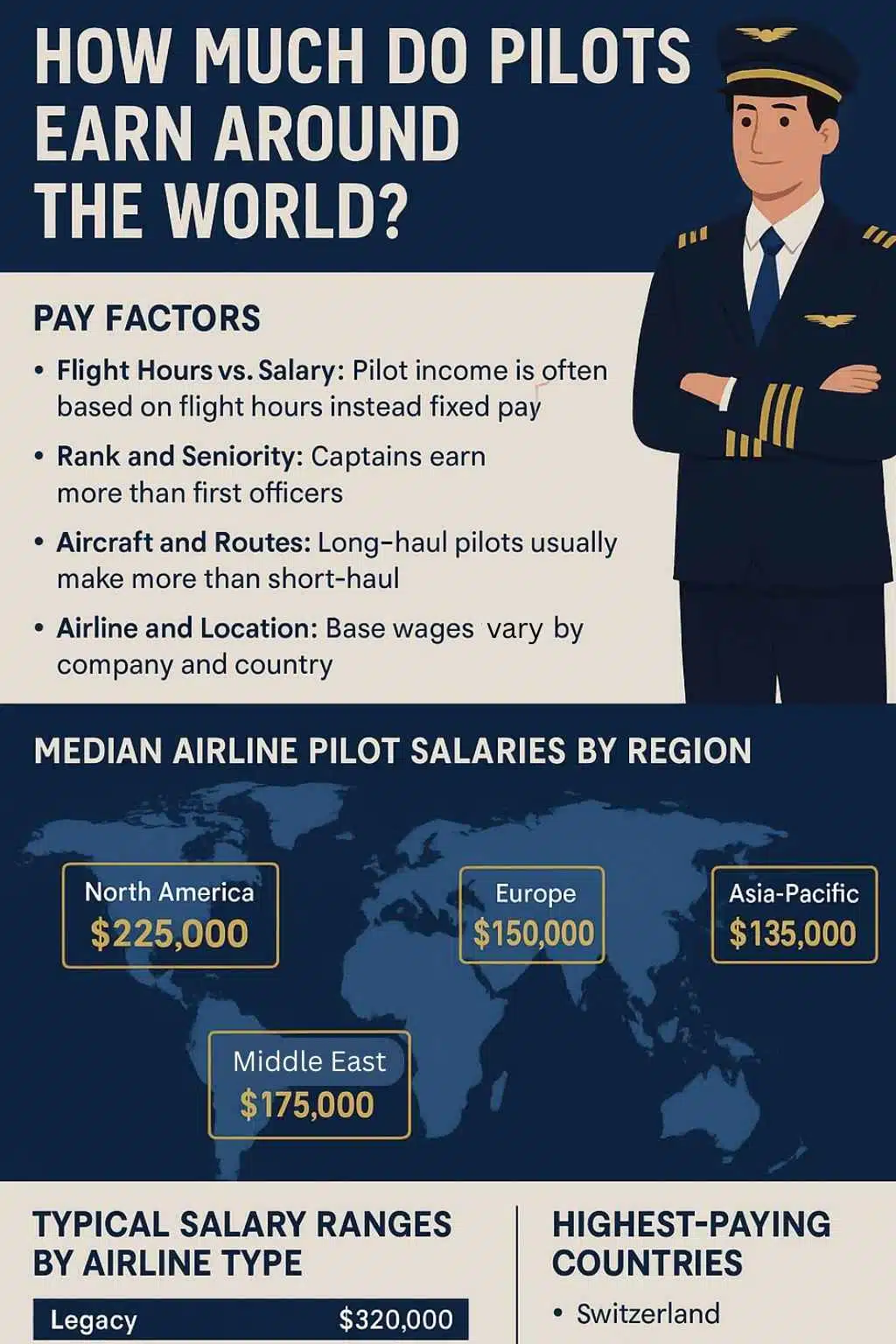
Asia-Pacific: Rapid Growth and Wide Salary Range
The Asia-Pacific region is diverse, with fast-growing markets and big pay differences.
- Major hubs like Singapore, Hong Kong, Japan, and South Korea tend to offer strong six-figure packages for captains, often in line with or slightly below Western European levels in dollar terms.
- Emerging markets such as India, Indonesia, Vietnam, and the Philippines have seen rising commercial pilot salaries, but many pilots still earn less than their counterparts in North America or Western Europe, especially in domestic/regional operations.
- Some premium carriers and cargo operators based in Asia offer highly competitive deals, particularly on long-haul fleets, sometimes approaching Middle East levels.
In short: Asia-Pacific pilot pay ranges from modest local salaries to world-class packages at top-tier airlines.
Latin America and Africa: Lower Averages, Big Variations
Across Latin America and Africa, pilot salary by country varies even more.
- Many airlines in these regions pay less than North American or Western European carriers in absolute terms.
- However, when adjusted for local cost of living, senior captains can still be in the upper middle or top income brackets in their home countries.
- In some African and Latin American countries, national carriers or premium regional airlines may offer salaries that rival European levels for captains, especially on international routes, while smaller domestic carriers sit much lower.
Broadly, captain salaries might range from USD 40,000–60,000 at smaller carriers to USD 120,000+ at leading airlines in stronger economies.
Highest-Paying Countries for Pilots Right Now
Recent comparative studies of pilot salaries by country consistently highlight:
- Switzerland
- Luxembourg
- United States
- Denmark, Belgium, Canada, Germany, Australia, Norway
The above are the highest-paying countries for pilots, based on average annual earnings. In these markets, average salaries for experienced captains can sit comfortably in the high five-figure to low or mid six-figure range in USD terms.
Again, the cost of living and taxes in these countries are also high, which shapes how far that money goes.
Airline-Level Comparison: Legacy, Low-Cost, Cargo, and Business Aviation
Not all airlines pay pilots the same. This section breaks down how different airline models influence earnings and career growth.
Legacy and Flag Carriers: Top of the Pay Pyramid
Legacy and flag carriers—national champions or long-established majors—often lead the pay tables.
Typical characteristics:
- Wide pay scales based on seniority
- Strong union representation
- Long-haul fleets with attractive premium pay
- Pension schemes and profit-sharing at some airlines
For many pilots, securing a job as a wide-body captain at a large legacy airline is the end goal: high airline pilot salary, route choice, and relative job security.
Low-Cost Carriers: Better Than Before, Still Catching Up
Low-cost carriers used to be associated with noticeably lower pay and tougher conditions. That picture is changing.
- Sharp pilot shortages in recent years have forced many low-cost airlines to improve pay and conditions to remain competitive.
- In some markets, senior captains at big low-cost carriers now earn amounts similar to or approaching those of legacy airline captains, especially with bonuses and seasonal incentives.
However, rosters can remain intense, and benefits (pensions, housing, etc.) may lag behind the most established flag carriers.
Cargo and Corporate Jets: Niche but Lucrative Paths
Cargo and business aviation offer alternative career paths:
- Cargo pilots often enjoy strong pay, especially on wide-body fleets flying global freight. Night operations and irregular schedules are common but compensated.
- Corporate and private jet pilots for high-net-worth individuals or large companies can command high salaries, sometimes matching or exceeding airline pay, particularly at the senior captain and chief pilot level.
These roles can involve more flexible routes but also require high discretion, variable schedules, and a strong service mindset.
Beyond the Payslip: Benefits, Perks and Hidden Costs
Pilot income isn’t just about salary—benefits, allowances, and training expenses also shape real financial outcomes. This section highlights the often-overlooked factors.
Benefits That Boost a Pilot’s Real Income
When comparing pilot salaries around the world, headline pay is only part of the story.
Benefits can significantly boost effective income:
- Per diem / daily allowances for meals and expenses on trips
- Accommodation during layovers, often in reputable hotels
- Pension or retirement schemes, especially at legacy carriers
- Profit-sharing and bonuses tied to company performance
- Staff travel perks for pilots and their families on the airline’s network or partners
These extras are hard to compare country by country, but they matter greatly to total compensation.
Training Debt, Licence Costs and Ongoing Checks
Becoming a commercial pilot is expensive.
- In many markets, a full training route from zero hours to a commercial license with instrument rating and multi-engine qualification can cost the equivalent of tens of thousands of dollars, often over USD 80,000–150,000.
- Type ratings for specific aircraft may be sponsored by airlines or paid by pilots, depending on the contract.
- Pilots also undergo regular simulator checks, recurrent training, and medicals, largely funded by their employer, but still adding pressure and time commitments.
For new pilots, early career salaries must be weighed against the need to repay training loans. This affects the real attractiveness of entry-level positions.
Work–Life Balance, Rosters and Fatigue
A high airline pilot income comes with trade-offs:
- Long-haul flying means time zone changes, night flying, and extended time away from home.
- Short-haul operations can involve multiple early starts per week and several sectors a day.
- Fatigue risk, strict rest rules, and lifestyle disruptions are part of the job.
These factors do not appear on a payslip, but many pilots view them as central to the question of whether the role is “worth it.”
Why Pilot Salaries Have Surged—and Where They’re Going
Pilot pay has risen sharply due to global demand and industry changes. Here, we explore the reasons behind salary increases and what the future may hold.
The Pilot Shortage Story: From Panic to Normalising Demand
The last few years saw headlines about a global pilot shortage:
- Air travel demand rebounded strongly after pandemic-era cuts.
- Many experienced pilots retired or switched careers.
- Training pipelines slowed down, creating a gap between airline growth and pilot supply.
This imbalance pushed airline pilot salaries higher, especially in North America, the Middle East, and parts of Asia. Some carriers offered big sign-on bonuses, quicker promotions, and premium pay deals to retain crew.
More recently, airlines and training providers have started to catch up. Delivery delays from aircraft manufacturers have also moderated growth. That has shifted the narrative from “acute crisis” to structural but more managed shortage.
Pay Raises, Union Deals and New Contracts
Between 2021 and 2025, many pilot unions negotiated:
- Double-digit pay raises spread over several years
- Larger overtime premiums
- Improved rosters and rest rules
- Enhanced pension or bonus structures
In some cases, new contracts led to cumulative pay increases of 25–50% or more over a contract cycle, especially where shortages were severe.
While airlines emphasize cost control, fierce competition for cockpit talent has kept pressure on pilot pay upward in many developed markets.
Long-Term Outlook: Demand Still Strong
Industry forecasts, including major manufacturers’ Pilot and Technician Outlooks, continue to project strong long-term demand:
- Hundreds of thousands of new pilots are needed through the 2030s and 2040s as fleets expand and older pilots retire.
- Fastest growth in Asia, the Middle East, South Asia, and Africa, with North America and Europe still requiring a large number of replacements.
This suggests that, while the extreme spikes may cool, pilot salaries are likely to remain attractive in many regions over the long term, particularly for those willing to move where demand is highest.
Is Becoming a Pilot Worth It Financially?
Aviation careers offer high earning potential but require a major investment. This section weighs training costs, lifestyle factors, and long-term financial benefits.
Return on Investment: Training Cost vs Lifetime Earnings
From a pure financial perspective, the question is, does the lifetime airline pilot income justify the upfront cost and risk?
Broadly:
- Training often requires significant loans or family support.
- Early-career pay, while rising, may not be enough to live comfortably and repay debt in expensive cities.
- Once established at a major airline—as a narrow-body captain or wide-body first officer—many pilots move into strong six-figure territory in high-paying countries.
Over a 30+ year career, the total earnings of a pilot who reaches a senior captain position at a good airline can be very competitive compared with other high-end professions such as medicine, law, or senior engineering. The challenge is surviving the early years financially and successfully reaching that level.
Who Benefits Most from High Pilot Salaries?
Becoming a pilot is often most financially attractive for:
- Young entrants who start early reach a major carrier and benefit from decades of seniority.
- Individuals are able to relocate to high-paying markets (for example, North America, parts of Europe, the Gulf, or selected Asia-Pacific hubs).
- Pilots who progress to wide-body fleets, cargo, or corporate roles at well-paying employers.
For mid-career switchers or those unable to move, the equation is more complex. The cost of training versus expected local earnings must be analysed carefully.
Bottom Line: How Much Do Pilots Earn Around the World?
So, how much do pilots earn around the world?
- Entry-level pilots at regional or smaller airlines may start in the USD 30,000–80,000 range, depending on the country and type of flying.
- Established first officers and narrow-body captains at major carriers often sit in the mid-five-figure to low-six-figure band.
- Senior wide-body captains at the best-paying airlines in high-income countries can reach USD 200,000–400,000+, and in some cases significantly more when bonuses and allowances are counted.
The profession remains one of the best-paid skilled careers globally, especially at the top end. Yet salary is only one part of the story. Training costs, lifestyle trade-offs, and market volatility all shape the real value of a pilot’s career.
For those who love flying, can manage the upfront investment, and are willing to chase opportunities internationally, the cockpit still offers not just a view above the clouds, but a powerful long-term earning potential as well.