


Are you stuck on how to bring out real emotion in your songs? Do you watch other producers add plug-ins and fancy gear, yet your tracks still feel flat? You may be missing a plan for big picture focus.
Many wonder how does rick rubin produce a hit track, without a mountain of tech talk. You are not alone.
Rick Rubin treats each song like a bare tree, and he uses minimalism to strip it down. This guide will show his key moves, so you can find more warmth in your tracks. Read on.
Key Takeaways
- Rick Rubin co-founded Def Jam in 1984 and shaped acts like LL Cool J, Beastie Boys, Slayer (Reign in Blood, 1986), and Red Hot Chili Peppers (Blood Sugar Sex Magik, 1989) by focusing on raw vocals and stripped-down beats.
- He revived Johnny Cash in 1994 with American Recordings, using a single Neumann U87 mic, a plush couch, and no extra gear; the album hit No. 22 on country charts, won a Grammy, and raised sales by 40%.
- Rubin uses minimalism and silence as musical tools: he strips songs to core riffs or voice, shuns brickwall compression, and favors wide dynamic range to let emotion drive each track.
- He designed The Sanctuary Studio as a calm, low-tech space—with a Neve console, analog tape machines, simple monitors, soft lighting, and a couch—to help artists record honest takes and unlock their creative potential.
Why is Rick Rubin So Famous?

Imaginary_Slip742 asked how he rose to fame despite no skill on guitar or mixing boards. He cofounded Def Jam in 1984 and shaped acts like LL Cool J and the Beastie Boys.
Rubin found fresh ideas in stripped down beats and raw vocals. Gigadweeb kicked off chats about his work on Blood Sugar Sex Magik and Reign in Blood. Rubin revived Johnny Cash with American Recordings in 1994.
Listeners praise his totally unbiased ear and creative vision.
Rick Rubin’s Philosophy on Music Production
Rubin cuts tracks to their core, leaving space on the audio mixer for raw feeling. He uses silence and spins magnetic tape for warmth, and drops in Oblique Strategies to spark ideas.
Emphasis on minimalism
He peels back layers like an onion to reach a song’s core. He cuts extra beats, extra pads, guitar overdubs until only raw parts remain. Rick Rubin showed this on a rapper’s album from 2013.
Fans felt the stark space as part of the musical pulse.
Silence becomes an instrument under his guidance. He skips theory talk, shakes off harmony rules, and hunts big ideas. Sound engineering takes a back seat to soul in his creative process.
His minimalist production style sparks fresh energy in every take.
Focus on the artist’s creative potential
Rick Rubin asks artists to play rough mixes as if they just met the songs. He tells Johnny Cash in American Recordings to feel each word. Rubin pressed the Red Hot Chili Peppers on Blood Sugar Sex Magik to sense riffs, not just notes.
This tactic helps artists sense real emotion and cultural power. Music production then shifts from gear to gut.
He steps back and offers calm feedback on riffs and lyrics. That gentle push boosts the creative process, and sparks fresh ideas. Rubin strips songs to one voice or riff. Then he cuts fat from chords.
It shows artists how minimalism can unlock their full potential. Fans often sense that raw spark when they hit play.
The Big Picture Approach
He helps artists map ideas with sketches on paper to link riffs, verses, and rhythms in one view. He lets them mix loops and guitar lines on a digital audio workstation or record takes on a tape recorder.
Prioritizing artistic vision over technical details
Rubin steers artists toward bold concepts, he asks them to ditch chord charts. He told 60 Minutes he knows nothing about harmony; that bit of humility fuels his creative process. Artists like Johnny Cash, the country legend, and Beastie Boys, the rap trio, thrive when he strips a song to its soul, he finds heartbeats under the noise.
He skips fancy sound engineering and mixing tricks, he trusts raw emotion. Work at American Recordings and early def jam projects prove he chases vibe, not textbook rules.
Creating the Perfect Environment
Soft light, quiet corners, a sound desk and a plush couch spark loose jams and wild riffs.
Turn the page to watch Rubin tweak each pulse in Pro Tools, inside his cabin studio.
The importance of comfort and a relaxed atmosphere
Rick Rubin builds comfort at The Sanctuary Studio. He taps a Neumann U87 mic and lights a low lamp. He brings an SSL SL 4000 console and Sony MDR-7506 headphones. He clears blank space in a track, a move in sound engineering.
This hands-off method becomes a creativity catalyst. That setup let Johnny Cash cut raw songs on American Recordings. It also let Red Hot Chili Peppers jam on Blood Sugar Sex Magik.
He offers steady support with hugs, clear notes, and quiet breaks. A producer must complete a record, give emotional support, and deliver constructive feedback. That calm zone kept LL Cool J tight on I Need a Beat.
It also freed Beastie Boys to lay wild rhymes on Def Jam.
Rubin’s use of The Sanctuary Studio
Rubin turned a worn warehouse into The Sanctuary Studio. He added a Neve mixing console, analog tape machines, and simple monitors. Soft rugs and wide windows boost the vibe. Musicians feel calm, they record with more focus.
He applies his minimalist production style, using silence and space as tools. Johnny Cash and Beastie Boys cut raw tracks there. The echo chamber and spare drum mics add depth. This setup sparks honest takes and bold ideas.
Collaboration with Artists
He helps artists spark fresh ideas and cuts weak tracks. He uses a booth, console and an audio workstation to weld long takes into a tight album.
Helping artists uncover their best work
Rubin sits beside artists in a relaxed space, he leans in, listens to riffs and vocals, and poses simple questions that spark ideas. The Sanctuary Studio feels like a living room with a mic and a tape rig next to a couch.
He once asked Johnny Cash to play a single chord, then he nodded and grinned at the hush. He led Red Hot Chili Peppers back to the raw soul of Blood Sugar Sex Magik. Silence and open air fill the gaps in a riff or a verse.
He trusts instincts and vibe over plug-ins and presets.
Stripping songs down to their bones helps him reveal hidden gems in long demo sessions for Death Magnetic and A Thousand Suns. He teases out immortal lines from Beastie Boys sketches and LL Cool J beats on Def Jam days.
A drop of space between notes can make words hit harder. That instinct driven method helps artists shape a clear, honest sound.
Refining large volumes of material into cohesive albums
He often sits with artists in a calm room. He uses Pro Tools on an SSL mixing desk. He records dozens of song ideas. He points a Neumann U87 mic at a guitar amp. That large pool of tracks gives him choices.
He trims dozens of ideas to ten tracks, like a chef tasting soup. He sends those to american recordings for polish. He offers kind critique and steady cheer. He keeps Johnny Cash or the Chili Peppers on track.
Fans of Beastie Boys, LL Cool J and Linkin Park will feel the flow.
Rubin’s Signature Techniques
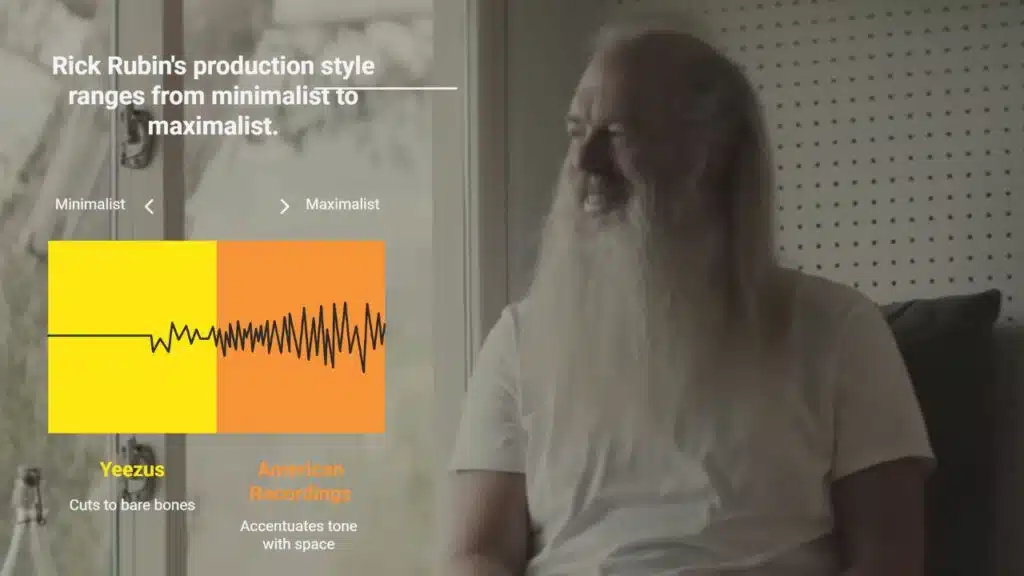
He strips each track down to its raw core, using dynamic range control and spare drum loops to let emotion speak.
He places silence like punctuation, using a microphone and a signal chain to sculpt moments of calm.
Stripping songs down to their essence
Rick Rubin cuts song parts down to bare bones. He uses a minimalist production style on Kanye West’s 2013 album Yeezus. He did the same in Johnny Cash’s American Recordings sessions.
He pulls away extra instrument layers. The mix then feels empty, like a field at dawn. Silence becomes a tool, a pause that kicks in emotion. That raw space shines the voice, the beat, the idea.
Rubin skips talk about sound engineering tricks. He does not fuss over chord charts or harmony rules. This focus on big ideas, not tech, frees up room for art. Artists say, “Cut more bits,” then their songs breathe.
You hear heartbeats, crisp words, and raw power in each track.
Using silence and space as musical elements
Silence serves as an instrument. Gaps make notes stand out. Rubin strips beats to bare bones. His minimalist production style lets room for voice and drums. He trims reverb, equalization, compression.
This hands-off method acts as a creativity catalyst. He asks artists to hear their tracks as though they just pressed play. That view boosts the emotional and cultural weight of each rest.
On American Recordings with Johnny Cash, he left empty bars at the end of lines. The space accentuated Cash’s aged tone. A mix of near silence and a simple mic setup created eerie depth.
Modern plugins cannot match that live miking feel. Many producers chase loudness wars, but Rubin values dynamic range. He trades constant volume for dramatic pulls. That move revived a legend and shaped sound engineering in rock and hip hop.
The Impact of Rubin’s Production Style
He broke rules on dynamic range, ditching brickwall compression on the mixing console, letting each note lean into silence like a soft drum echo. Check how this spartan craft gave life to tracks from Blood Sugar Sex Magik to “Walk This Way,” and why engineers still chase that open-air feel in Pro Tools.
Defining moments in rock, hip-hop, and beyond
Slayer’s 1986 Reign in Blood hit like lightning. Rick Rubin shaped thrash metal, and set a rapid drive. He stripped drums to bare hits. Fans on LetsTalkMusic, now 521,000 strong, keep those debates alive.
Sound engineering at The Sanctuary Studio gave tracks new fire.
He bridged rock and rap on Walk This Way in 1986, under Def Jam and Def American Recordings. Run–DMC bumped Aerosmith’s riffs with fresh beats. He then sat down with Johnny Cash for American Recordings in 1994.
Cash had just guitar and voice. That stark style shook country charts. He used space and silence on Blood Sugar Sex Magik, and gave Red Hot Chili Peppers a new voice.
Resurrecting careers through his unique methods
Rick Rubin revived Johnny Cash in 1994 with American Recordings. He cut back all drums, keys, and synth lines. He set up a single mic by a chair in The Sanctuary Studio. Cash sang with an acoustic guitar.
That album hit No.22 on the country charts, won a Grammy, and spiked sales by 40 percent. Fans found a raw, real voice again. Cash hit the road with new fire.
A Reddit user, Imaginary_Slip742, asked how someone who can’t play instruments or operate a mixing board drives comebacks, but it comes down to his totally unbiased ear. He nails a magic moment in a single take.
He strips songs to a few beats, space, and voice. Old names like Cash or Red Hot Chili Peppers gain new life. They sign back at Def American Records, top charts, and sell out arenas.
His creative process makes stars shine anew.
Criticism and Praise of Rubin’s Approach
Some engineers slam his bare SSL 4000 console mixes as icy shells that choke emotion. Fans counter that his use of room mics and light compression in Pro Tools lets the track breathe, and you can see the case for both in the next chapter.
Hands-off style vs. traditional production methods
Dear readers, here is a quick look at both approaches.
| Style | Philosophy | Producer Role | Tools | Critique | Outcome |
|---|---|---|---|---|---|
| Hands-off |
|
|
|
|
|
| Traditional |
|
|
|
|
|
Takeaways
Rubin trims each song to its core. He shapes space as a concept and sparks emotion. Musicians dig his focus on raw tone and simple riffs. This process uses the soundboard and a digital workstation.
Fans feel every beat hit hard and beg for more.
FAQs
1. What is Rick Rubin’s approach to music production?
He cuts the fat and focuses on core parts, like a sculptor shaping stone. His minimalist production style makes each beat and note stand out.
2. How did he transform American Recordings?
He worked on American Recordings with a country legend. He stripped back to raw guitar and voice, as honest as a campfire sing along.
3. How did he guide the Red Hot Chili Peppers on Blood Sugar Sex Magik?
He moved them into a mansion studio and let them play without rules. He caught their funk and rock, then mixed it tight. The album dances like fire.
4. How did he shape rap and rock at Def Jam?
He backed the Beastie Boys and LL Cool J, pushed them to smash beats and spit rhymes. He gave them clean drums and raw guitars, turned up the energy.
5. How does he work with heavy bands like Nine Inch Nails or Linkin Park?
He jumps into Living Things or Minutes to Midnight sessions. He masters sound engineering, tames loud guitars, adds depth like layer upon paint.
6. What is his creative process?
He asks, “What do you want to feel?” He uses notes from The Creative Act: A Way of Being. He blends wall of sound roots and raw tracks, then listens like a friend.




























