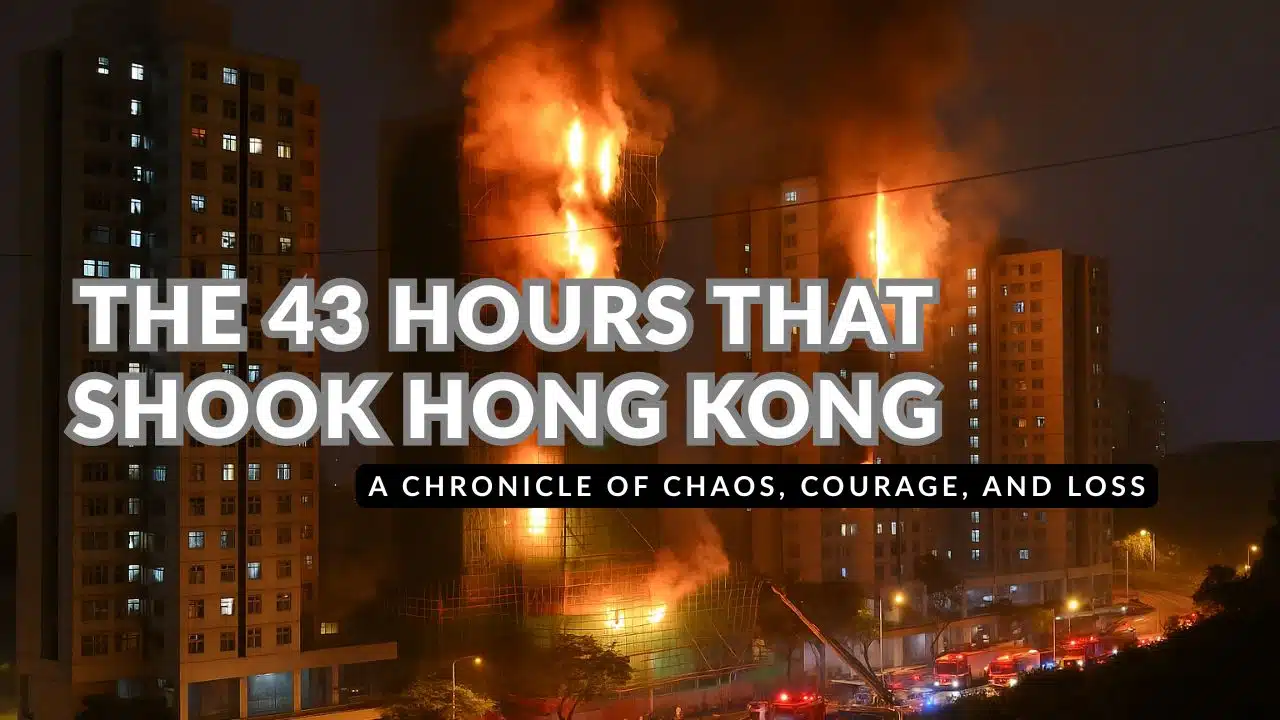
At 2:51 PM on November 26, 2025, Hong Kong was carrying on with its usual rhythm—the thrum of buses, the metallic clatter of elevators in housing estates, and the chorus of students returning from school. The city’s skyline, a forest of concrete and glass, stretched confidently across the afternoon haze. Nothing about this moment suggested that Hong Kong was seconds away from one of its darkest modern disasters.
In the northeastern district of Tai Po stood Wang Fuk Court—an eight-tower apartment complex under renovation. The buildings loomed like silent monoliths wrapped in layered bamboo scaffolding. Green nylon mesh covered their facades like shrouds, and polystyrene foam boards sealed many windows as part of an energy-saving retrofit. To residents, the site was a daily inconvenience: blocked sunlight, drilling noise, and the faint chemical scent of construction materials. No one imagined these everyday features were quietly transforming the towers into a massive vertical tinderbox.
But in a city built on density and perpetual renovation, danger often hides in plain sight.
Within the next hour, flames would crawl, sprint, and leap across seven high-rise buildings with terrifying speed. Families would flee down smoke-filled stairwells. Others would cling to balconies awaiting rescuers who might never reach them. Firefighters would wage an exhausting, nearly two-day-long battle against a blaze that seemed alive.
This is the story of the 43 hours that shook Hong Kong—hours filled with chaos, courage, and profound loss. And it is the story of the questions that linger in the smoky aftermath: How did this happen? Who failed? And what must change to prevent it from happening again?
Hour Zero 2:51 PM: The First Flame
Residents later described the first signs as “nothing unusual.” A faint burning smell drifted through the lower floors of Block 3. A mother preparing snacks for her children noticed wisps of gray smoke outside the kitchen window, assuming a construction worker nearby was burning packaging waste. On the 19th floor, an elderly man saw a small orange flicker on the outer scaffolding and wondered whether welding work had resumed unexpectedly.
Within minutes, those flecks of suspicion hardened into fear.
The fire did not behave like a typical building fire. It spread upward along the bamboo poles, racing vertically as if pulled by invisible strings. The green nylon mesh shriveled instantly, igniting like dry leaves. The wind—funneled by the estate’s clustered design—intensified the flames.
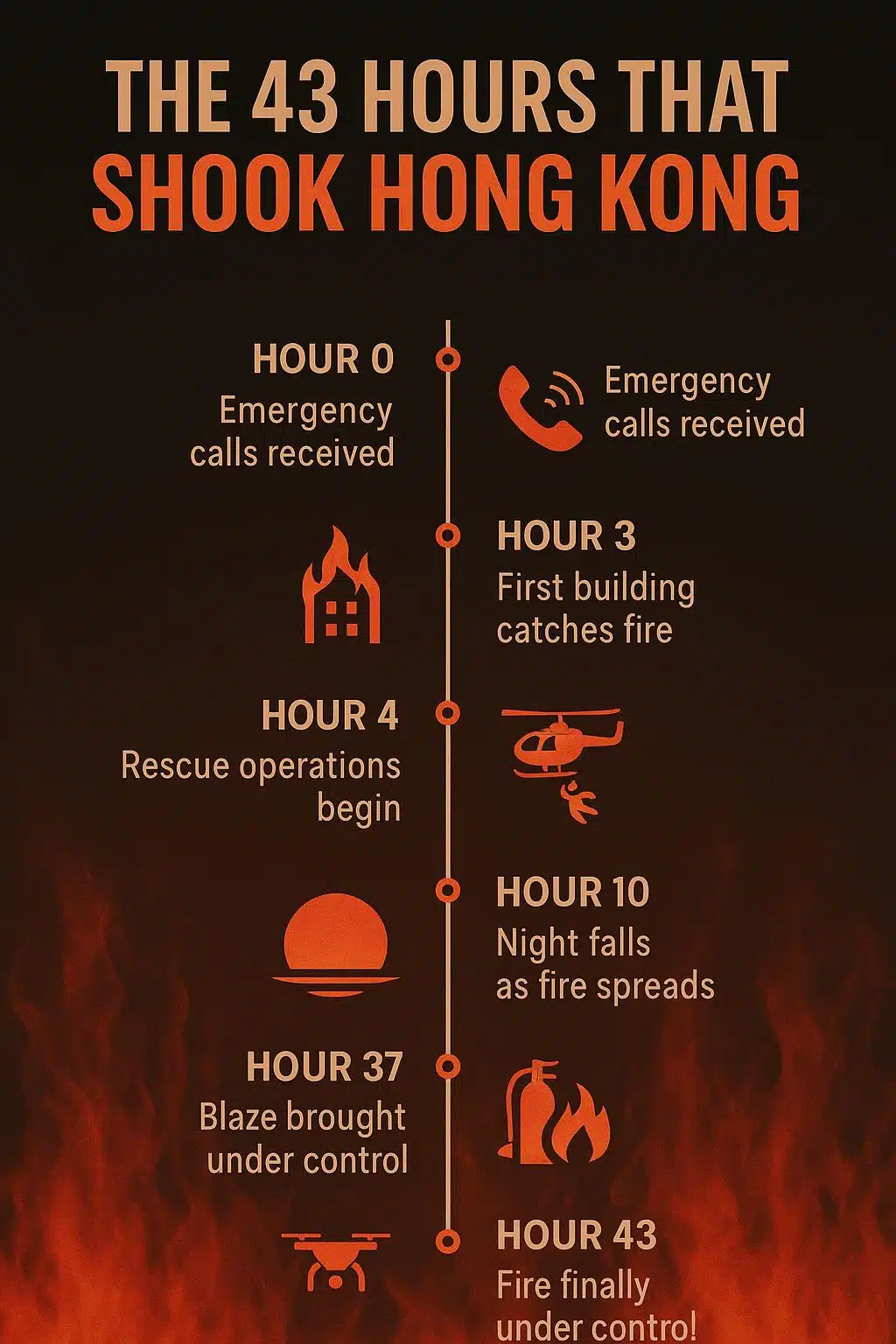
Emergency calls flooded the hotline of the Fire Services Department. Dispatchers heard the same terrified message repeated:
“The scaffolding is on fire! It’s climbing the building!”
Inside the towers, chaos stirred. Residents smelled melting plastic. Fire alarms began shrieking. Some hallways darkened as smoke seeped in. Parents grabbed schoolbags, wallets, and children’s hands. Workers on the scaffolding scrambled to descend, with some climbing down bamboo poles as flames licked at their feet. m Workers on the scaffolding scrambled down bamboo poles as flames licked at their feet. And become a vertical inferno accelerating toward the top floors, feeding on the very materials meant to shield the buildings during renovation.
Outside, a crowd was forming. Phones lifted toward the sky, capturing videos that would soon dominate social media feeds. Hong Kong was witnessing a catastrophe unfold in real time.
Hours 1–2: The Fire Jumps From Tower to Tower
Fire rarely moves with intention. But to those who watched, the blaze seemed to possess a terrible logic.
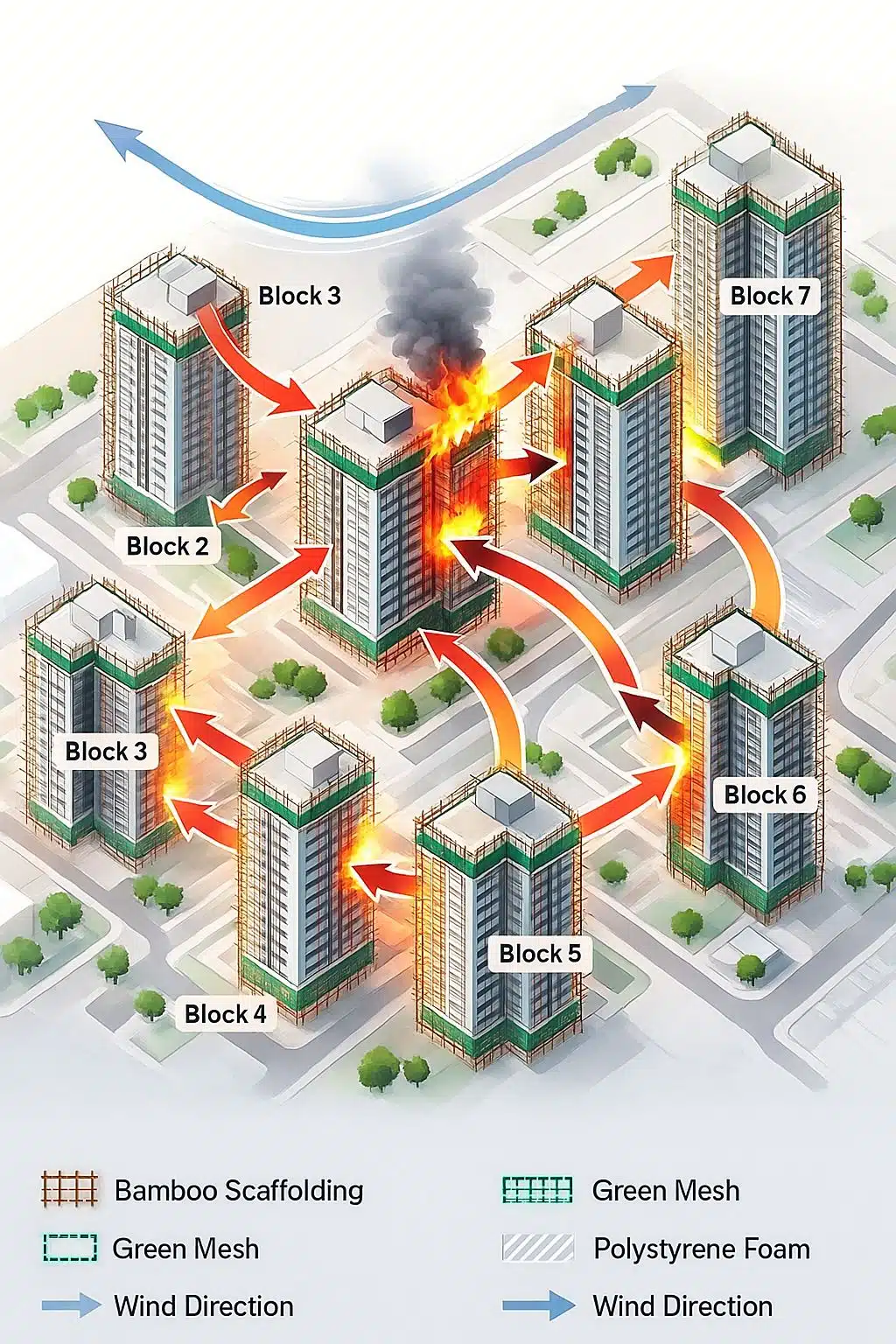
As firefighting teams arrived, they realized they were not facing a conventional structural fire but a nightmare scenario—an external fire engulfing the wrapping around multiple towers. The combination of bamboo scaffolding, nylon mesh, and polystyrene foam created a kind of “chimney effect.” The flames surged upward and sideways, using the scaffolding as a network of pathways.
By 3:20 PM, the fire had reached the top floors of Block 3. Sparks, radiant heat, and flaming debris jumped across the narrow gaps between towers, igniting Block 2 and Block 4. Videos captured the surreal spectacle of burning mesh sheets billowing like flaming sails as they detached and drifted onto nearby buildings.
Inside the towers, stairwells filled with heat and smoke. Some families descended safely before conditions deteriorated. Others, particularly those on upper floors, were trapped. Elderly residents found escape impossible. A renovation worker, separated from his team, used his shirt as a mask and crawled down a hallway blinded by smoke.
At 3:35 PM, the Fire Services Department elevated the incident to a Level 4 fire. Within minutes, as flames streaked across a fourth tower, it was raised again—Level 5, Hong Kong’s highest emergency classification.
The city had not seen a Level 5 fire since 2008. Now, seven towers stood in danger.
Hours 3–8: The Nightfall of Chaos
By sunset, Hong Kong witnessed a horrifying transformation. What had begun as isolated flames had turned into a roaring multi-tower inferno visible across the district. As daylight faded, the estate glowed in ominous orange. Smoke plumes spiraled into the night sky, illuminated from below like volcanic eruptions.
Inside the estate, conditions deteriorated rapidly. Electricity was cut in several blocks. Hallways plunged into darkness except for flickering emergency lights. Residents trapped on upper floors signaled for help using phone flashlights and reflective kitchen utensils.
Firefighters faced nearly impossible odds:
-
Visibility was near zero. Thick chemical smoke from burning mesh and foam filled entire corridors.
-
Heat was extreme. Some external surfaces exceeded 800°C.
-
The scaffolding was collapsing. Burning bamboo poles rained down like spears.
-
Ladders could not reach upper floors. The estate’s design blocked access from key angles.
Helicopter rescue—a dramatic but risky option—was deemed too dangerous due to violent updrafts. As the fire consumed more scaffolding, it occasionally created vortex-like whirlwinds of ember and debris.
Below, the estate grounds swelled with evacuees and terrified relatives. Emergency shelters opened in nearby schools. Volunteers distributed water, blankets, and masks. One woman screamed her mother’s name into the smoky sky. A father clutched his daughter, both coughing violently from smoke inhalation.
As firefighters fought the flames, Hong Kong watched helplessly. Social media feeds were flooded with live footage of burning towers, people waving from balconies, and debris raining down like meteor showers. The world was witnessing an urban disaster unfold with painful clarity.
Hours 9–15: The Battle Through Dawn
Shortly after midnight, the fire’s behavior shifted. It remained ferocious but less explosive, giving firefighters a chance to mount a more coordinated assault. The primary objective was no longer just containment—it was to carve out escape corridors and prevent structural collapse.
Firefighting strategy evolved hour by hour:
-
Teams hacked through sections of the scaffolding to create firebreaks.
-
Internal units crawled through stairwells to reach trapped residents.
-
Engineers assessed load-bearing points in real time to avoid sending crews into deadly zones.
-
Medics treated dozens of residents for smoke inhalation, burns, and shock.
Heroic moments emerged amid the chaos.
A firefighter carried an 88-year-old woman down 16 flights of stairs in pitch darkness. A young medic improvised a breathing aid using wet towels and a portable fan for a child suffering respiratory distress. A team braved falling debris to evacuate residents trapped behind a jammed fire door.
By dawn, the city awoke to grim news: the first confirmed fatalities. Families gathered at hospitals and shelter centers, clutching identification documents and hope.
The government issued a statement urging calm. But anger simmered on social media, with many asking the same question:
“How could a renovation turn into this?”
Hours 16–24: The Investigation Begins Before the Flames Die
Even as the fire raged, investigators began piecing together the disaster’s origins.
At 11 AM, a team of fire engineering experts arrived on-site. They examined surviving fragments of mesh, foam, and scaffolding. The evidence pointed to a shocking truth: many materials used in the renovation were highly flammable. Even worse, some may have been installed improperly or without adequate safety oversight.
Government officials quietly summoned contractors and subcontractors for questioning. Rumors circulated of early arrests tied to renovation safety violations. While authorities urged the public not to speculate, anger was building.
Residents shared stories of previous concerns:
-
complaints about the quality of renovation work
-
fears about excessive foam paneling
-
observations of uncovered wiring
-
worries that fire exits were partially blocked during construction
The answers were unclear, but the pattern was troubling.
By 6 PM, while the upper parts of some blocks still burned, Hong Kong’s political landscape was shifting. Opposition groups called for an independent inquiry. Lawmakers demanded immediate suspension of all similar renovation projects across the city.
Even before the flames were extinguished, the reckoning had begun.
Hours 25–34: The Slow Grind of Control
Fires are deceptive. The dramatic flames that capture headlines often signal only the beginning. What comes next—the slow, suffocating grind of suppression—is equally dangerous.
Through the second night, firefighters continued to battle smaller but stubborn pockets of fire. The external blaze had weakened, but interior hotspots smoldered inside wall cavities, behind foam panels, and within structural voids.
Firefighters were nearing exhaustion. Many had been on rotation for over 20 hours. Some suffered heatstroke. Equipment needed constant replacement; hoses melted, helmets warped, and breathing apparatus cylinders were depleted rapidly.
New tools shifted the battle:
-
Drones equipped with thermal imaging identified hidden hotspots.
-
High-pressure water jets targeted upper floors unreachable by ladders.
-
Robotic units probed structurally unstable corridors.
Meanwhile, community groups arrived with supplies—water, instant noodles, cooling towels, and handwritten notes of encouragement. A sense of collective grief and solidarity enveloped the area.
Still, danger persisted. Engineers warned of possible façade collapses if internal supports weakened. Cracks appeared in portions of scaffolding. Every step firefighters took inside the towers carried risk.
The fire was weakening but far from over.
Hours 35–43: The Final Push and the Last Survivor
By dawn on November 28, the air around Wang Fuk Court felt eerie—still smoky, but quieter. Helicopters hovered overhead, capturing the extent of the damage: blackened towers, gutted floors, and melted scaffolding hanging like charred spiderwebs.
At 8 AM, the final push began. Firefighters launched a coordinated assault on the last burning sections. Internal teams advanced floor by floor, guided by thermal readings. External teams blasted water streams upward, creating cooling zones for entry.
At 9:47 AM, rescuers located one more survivor—an elderly man trapped in a bathroom on a high floor. The man was dehydrated and disoriented, yet he managed to survive. His rescue sparked a moment of relief amid overwhelming despair.
Finally, at 10:18 AM, the Fire Services Department declared the blaze “under control.”
The fire was not extinguished, but it was no longer spreading.
After 43 hours of relentless firefighting, Hong Kong exhaled—not in triumph, but in grief.
Firefighters embraced one another, some collapsing from exhaustion. Families wept openly as the final survivors were escorted out. The smell of smoke lingered, but the roar of flames had quieted.
Key Events During the 43-Hour Blaze
| Time (HKT) | Hour Mark | Key Events |
|---|---|---|
| 2:51 PM, Nov 26 | Hour 0 | Fire ignites on the bamboo scaffolding of Block 3. Residents report a burning smell; emergency calls begin. |
| 3:20–3:35 PM | Hours 0–1 | Fire races up the exterior, fueled by nylon mesh & polystyrene. The fire spreads to Blocks 2 and 4. The incident was raised to Level 5. |
| 4:00–7:00 PM | Hours 1–4 | The fire consumed multiple towers. Stairwells fill with smoke. First rescue teams were overwhelmed. Evacuation shelters are open. |
| 7:00 PM–12:00 AM | Hours 4–9 | Nightfall intensifies chaos. Helicopter rescue ruled out. Collapse of scaffolding begins. The search and rescue operations are currently in progress. |
| 12:00–6:00 AM, Nov 27 | Hours 9–15 | Firefighters gain limited control in some sectors. First fatalities confirmed. Tactical shift to internal corridor clearing. |
| 6:00 AM–2:00 PM | Hours 15–23 | Investigative teams arrive. Early signs of flammable materials have been noted. Public anger grows. Arrests of contractors begin. |
| 2:00 PM–12:00 AM | Hours 23–33 | Fire slows but persists inside cavities. Drones/thermal cameras deployed. Firefighters rotate due to exhaustion. |
| 12:00–8:00 AM, Nov 28 | Hours 33–41 | The final major fire fronts weaken. Engineers assess structural stability. The last attempt at rescue was made. |
| 10:18 AM, Nov 28 | Hour 43 | The fire was officially declared “under control.” Last survivor was rescued. Aftermath and investigation accelerate. |
Aftermath: Counting the Dead, Questioning the Living
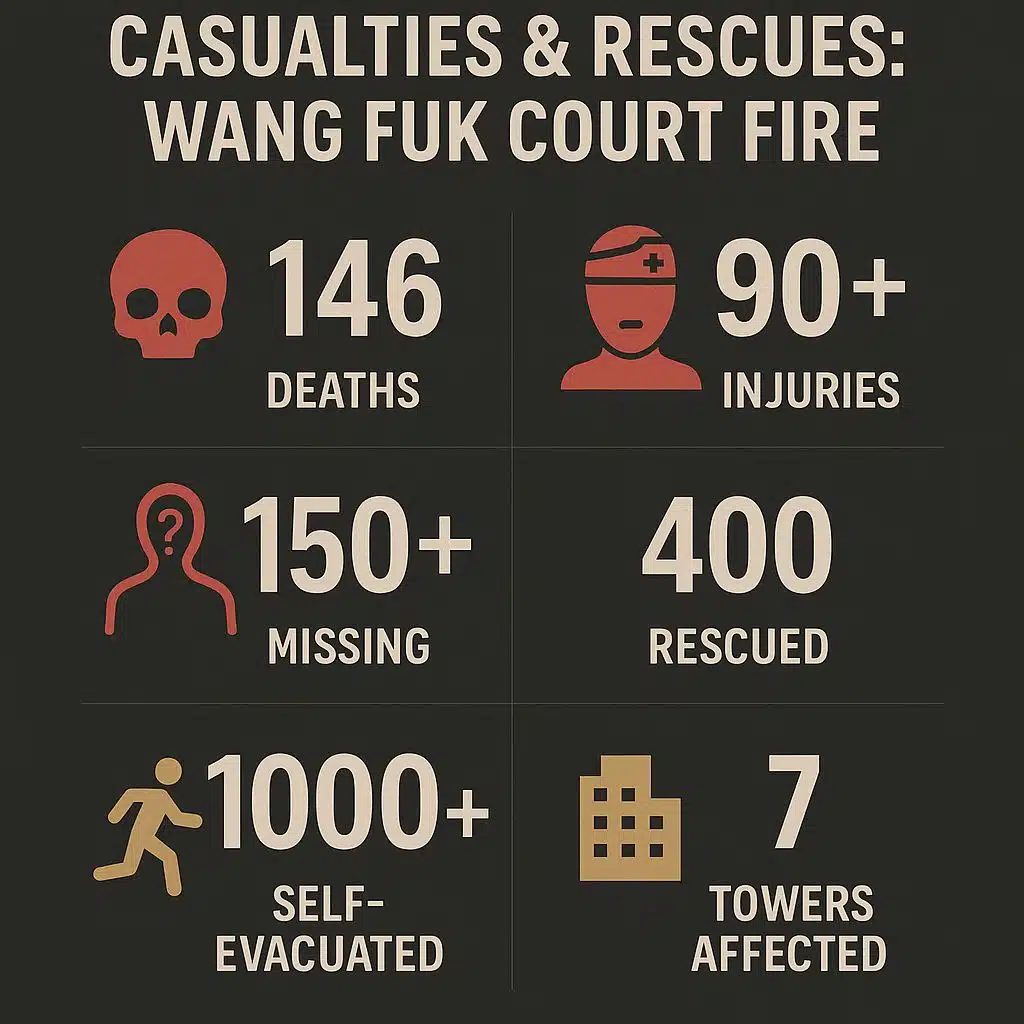
As emergency crews combed through the remains, the scale of the disaster emerged with brutal clarity.
The death toll climbed rapidly—dozens at first, then over a hundred. Some victims were found in stairwells, overcome by smoke while attempting escape. Others were discovered inside apartments whose windows had been sealed by renovation foam panels. The green mesh meant to protect pedestrians had instead acted like fuel.
More than a hundred people were missing or displaced. Families slept in shelters, clutching the only possessions they managed to save. Volunteers organized donation drives for clothes, toiletries, and children’s supplies.
The psychological toll was immense:
-
Children suffered nightmares about burning buildings.
-
Elderly survivors, already vulnerable, faced deep trauma.
-
Firefighters carried the emotional weight of those they could not save.
At the site, eerie remnants of the disaster remained: melted foam dripping like black icicles, bamboo poles twisted into skeletal shapes, and entire apartment rows gutted down to bare concrete.
But perhaps the most haunting image was the contrast—parts of the buildings remained untouched, their everyday objects intact, while adjacent floors were reduced to ash. The fire had been both merciless and indiscriminate.
The Accountability Question: Who Failed Hong Kong?
In the weeks following the fire, the narrative shifted dramatically from sympathy to scrutiny. Experts pointed to a series of compounding failures:
1. Flammable Renovation Materials
Polystyrene insulation, nylon mesh, and bamboo scaffolding are known fire hazards. Many jurisdictions strictly regulate their use. Why were they allowed — and widely used—in Hong Kong high-rises?
2. Inadequate Safety Oversight
Renovation sites often operate on tight budgets and even tighter timelines. Investigators questioned whether inspections were rushed or superficial.
3. Subcontracting Chain Issues
Large projects frequently involve multiple layers of subcontractors, some lacking proper licenses. The arrests hinted at deep systemic gaps.
4. Emergency Preparedness Gaps
Some residents claimed fire exits were partially obstructed during renovation, while others said alarm volumes were too low on upper floors.
Comparisons with global disasters intensified criticism:
-
London’s Grenfell Tower fire (flammable cladding)
-
Dubai’s Torch Tower blaze (exterior cladding spread)
-
Seoul’s renovation-related fires involving external insulation
The pattern was unmistakable: When flammable materials wrap residential buildings, disaster follows.
Politicians argued over who bore ultimate responsibility. Who was ultimately responsible? Who was ultimately responsible—the renovation company? Government regulators? The Fire Services Department? Housing authorities?
Factors That Accelerated the Spread of the Fire
| Factor | Description | Impact on Fire Spread |
|---|---|---|
| Bamboo Scaffolding | Traditional scaffolding tightly wrapped around all seven affected towers. | Created continuous vertical pathways for flames to travel upward rapidly. |
| Green Nylon Mesh | Used to prevent falling debris during renovation. Highly flammable. | Ignited instantly; acted as fuel and allowed fire to move horizontally. |
| Polystyrene Foam Panels | Installed over windows for insulation and energy efficiency. | Melted, dripped, and exploded under heat, accelerating internal ignition. |
| High-Density Tower Layout | Towers were closely spaced, with narrow air gaps. | Enabled flames and burning debris to jump from one block to another. |
| Wind Tunnel Effect | Natural airflow between towers intensified fire behavior. | This created a chimney effect, causing flames to climb at extreme speeds. |
| Blocked or Narrowed Access Routes | Some renovation tools/materials partially obstructed fire exits. | Slowed evacuation and complicated internal rescue operations. |
| Delayed Detection on Upper Floors | Alarms and smoke detection systems didn’t activate uniformly. | Residents on high floors had less time to escape. |
| Subcontracting & Oversight Issues | Multiple layers of contractors with unclear supervision. | Potential lapses in safety compliance and material standards. |
Lessons Hong Kong Cannot Ignore
Urban disasters often become turning points. For Hong Kong, the Wang Fuk Court fire must be more than a tragedy—it must be a catalyst. Experts proposed sweeping reforms:
1. Ban or Strictly Regulate Flammable External Materials
There should be an end to the use of nylon mesh and inexpensive foam. Alternatives exist, though they cost more.
2. Mandatory Fireproof Renovation Wrapping
Some countries require fire-resistant fabrics for building facades during construction. Hong Kong may need similar rules.
3. Real-Time Digital Oversight
Drones, sensors, and AI monitoring can flag dangerous heat or structural risks during renovations.
4. Stronger Inspection Regimes
Inspections should be frequent, unannounced, and thorough.
5. Transparency in Subcontracting
Every worker and material must be traceable. Accountability cannot disappear in subcontracting chains.
6. Community Preparedness
Evacuation drills, elderly-focused safety plans, and clearer communication channels could save lives.
The fire exposed not just technical weaknesses but cultural ones—a tolerance for corner-cutting, a reliance on tradition without adaptation, and a belief that “it won’t happen here.”
But it did happen. And without change, it could again.
Final Words: 43 Hours That Will Haunt a City
In the weeks after the fire, the skyline of Tai Po looked scarred. The once-green-wrapped towers stood blackened and hollow. The smell of smoke lingered long after the last embers cooled.
At night, residents in nearby estates reported phantom flickers of orange light reflected in their windows—not real flames, but memories etched into the city’s consciousness.
The disaster reshaped Hong Kong in ways statistics cannot capture. It altered trust in public institutions. It challenged assumptions about safety. It revealed the fragility of daily life in a city built vertically and relentlessly.
But amid the ashes, stories of courage endure—firefighters who risked everything, neighbors who carried the elderly on their backs, medics who inhaled smoke to save others, and strangers who embraced grieving families.
The 43 hours from November 26 to 28 will forever mark Hong Kong’s history.
They remind us that progress without safety is fragile and that the cost of negligence is measured not in dollars, but in lives.
As the city rebuilds and reforms take shape, one truth remains: Some disasters end in hours—but their echoes last for generations.