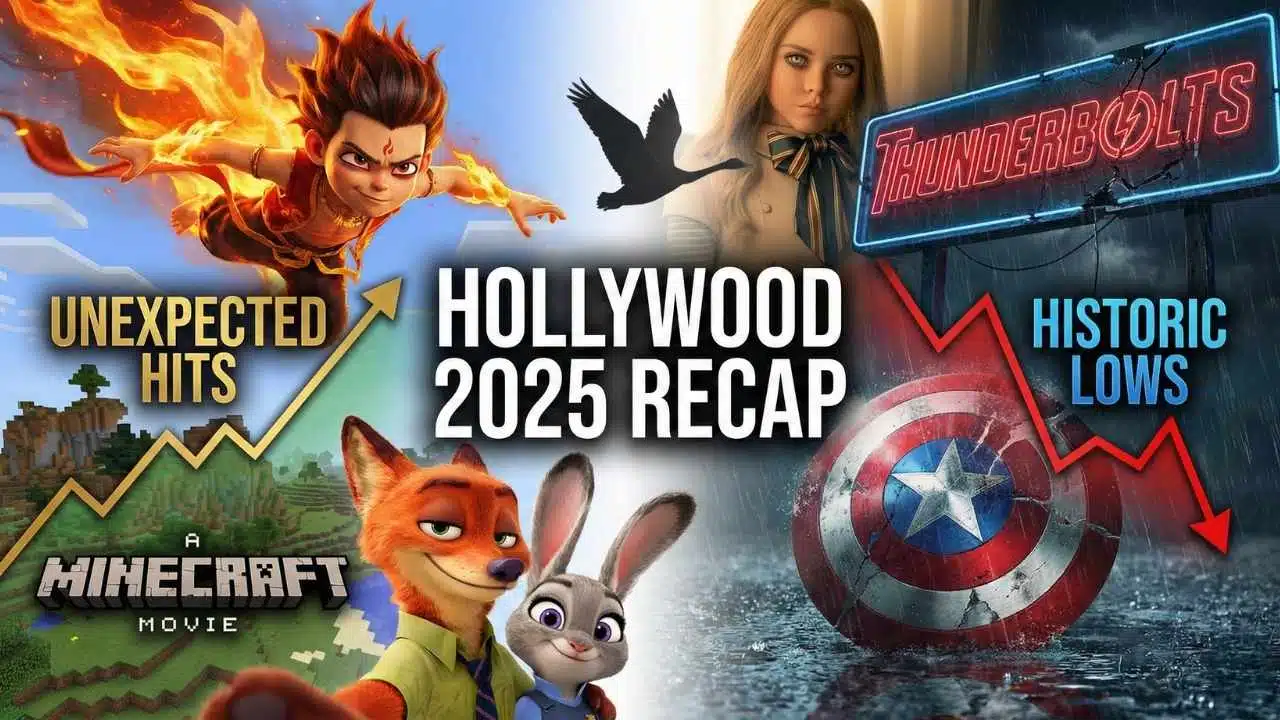
If 2023 was the year of “Barbenheimer” and 2024 was the year the industry held its breath during the strikes, 2025 will be remembered as the year the rulebook wasn’t just rewritten—it was thrown into a shredder.
Standing at the dawn of 2026, the landscape of Hollywood looks vastly different than pundits predicted twelve months ago. We entered the year expecting the return of the superhero hegemony and the stabilization of the streaming wars. Instead, we witnessed a Chinese animated sequel dethrone Western juggernauts, a video game movie overcome viral mockery to become a billion-dollar sensation, and the “too big to fail” franchises proving that, actually, they can fail quite spectacularly.
This was a year of extreme polarity. The highs were dizzying, driven by Gen Alpha trends and international box office muscle, while the lows were devastating, claiming the careers of executives and the profitability of once-surefire intellectual properties. This is the comprehensive recap of Hollywood in 2025—the year of the Black Swan.
The Billion-Dollar Surprises
The defining story of 2025 was the disruption of the global box office hierarchy. The assumption that the international market would always support American exports has been shattered.
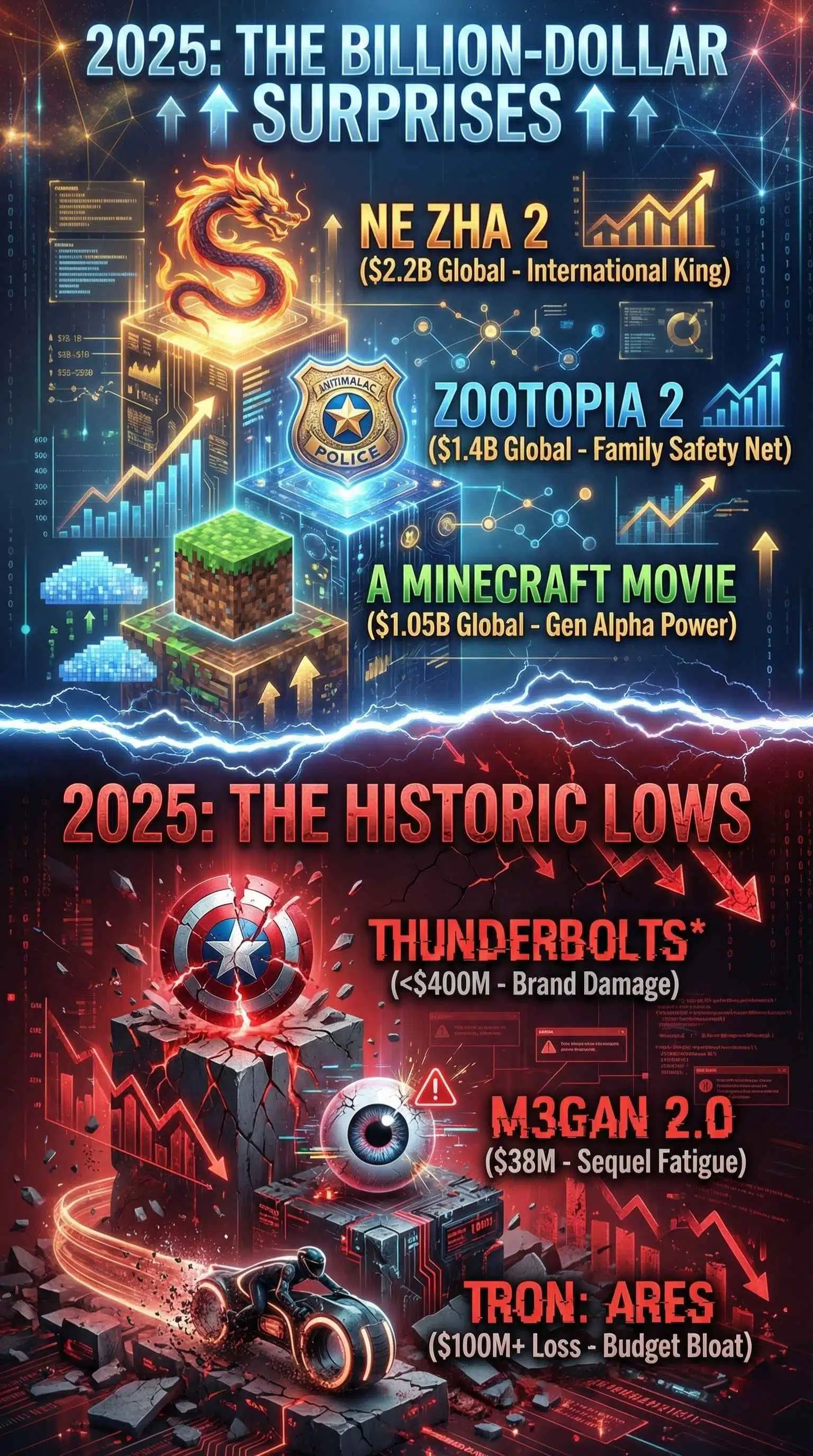
The “Big Three” of 2025
| Rank | Movie Title | Global Gross | The Lesson |
| #1 | Ne Zha 2 | $2.2 Billion | Local stories can now beat global franchises. |
| #2 | Zootopia 2 | $1.4 Billion | Families are the only “sure thing” left. |
| #3 | A Minecraft Movie | $1.05 Billion | Gen Alpha drives the economy; critics don’t matter. |
The Dragon That Ate the World: Ne Zha 2
The biggest shock was “Ne Zha 2.” While expected to perform well in Asia, its $2.2 billion total obliterated records, pushing past Inside Out 2 to become the highest-grossing animated film in history.
Key Stat: Ne Zha 2 earned more in the Asia-Pacific region alone than the entire global gross of Captain America: Brave New World.
The “Ugly Sonic” Effect: A Minecraft Movie
When the trailer dropped in late 2024, the internet mocked the live-action/CGI hybrid. But finishing with nearly $1 billion, Minecraft proved that Twitter (X) is not real life. It tapped into the sheer power of Gen Alpha, proving that if a brand is strong enough with the under-12 demographic, critical reception is irrelevant.
The Superhero Slump & The “Franchise Fatigue” Myth
For a decade, the question was, “When will the superhero bubble burst?” In 2025, it didn’t burst—it just slowly deflated. The year made it painfully clear that the “Multiverse Saga” era of storytelling has alienated general audiences who are tired of doing homework before buying a ticket.
The Tragedy of Thunderbolts
The most fascinating case study of 2025 is Marvel’s “Thunderbolts.” By all critical metrics, it was a success. With an 88% Rotten Tomatoes score, it was praised as a grounded, character-driven film that finally gave Florence Pugh’s Yelena Belova her due. It was the “Andor” of the MCU—gritty, mature, and well-made. And it flopped.
Earning less than $400 million worldwide on a budget close to $200 million (plus marketing), Thunderbolts* lost money. This failure is more alarming than a bad movie flopping. It suggests that the brand itself is damaged. Audiences didn’t stay away because they heard it was bad; they stayed away because they no longer trust the Marvel logo to deliver a standalone entertainment experience. They assumed they needed to watch three Disney+ shows to understand it, so they simply didn’t bother.
Captain America: Brave New World and the Reshoot Curse
If Thunderbolts* was a noble failure, “Captain America: Brave New World” was a disaster of production. Plagued by extensive reshoots that ballooned the budget, the film felt like a Frankenstein’s monster of committee decisions. Earning just $415 million, it was a commercial low point for the franchise. The absence of Chris Evans was felt deeply, and Anthony Mackie’s Sam Wilson was unfortunately saddled with a political thriller plot that felt dated upon arrival.
The Man of Steel’s “Okay” Return
Meanwhile, James Gunn’s rebooted DC Universe kicked off with “Superman.” The film was … fine. It wasn’t the disaster of the Snyderverse end days, nor was it the cultural reset of 2008’s Iron Man. With a $616 million global haul, it was profitable, but it didn’t ignite the world. It exists in a “wait and see” limbo, proving that even the most recognizable hero on Earth isn’t a guarantee of a billion dollars anymore.
Historic Lows & The Flop Sweats
2025 will also be studied in business schools for its high-profile failures. These weren’t just misses; they were career-altering bombs that exposed the dangers of bloated budgets and misread cultural rooms.
The Horror Crash: M3GAN 2.0
Horror has long been Hollywood’s safety net—cheap to make, high yield. 2025: Cut that net. “M3GAN 2.0″ attempted to turn a campy, viral hit into a serious sci-fi action franchise, and audiences rejected it. Earning under $40 million globally, it killed the franchise instantly. It was a lesson in “sequel escalation”—sometimes audiences just want the doll to dance in a hallway, not a geopolitical thriller.
The Rock Hits Rock Bottom: The Smashing Machine
Dwayne “The Rock” Johnson made a bold pivot in 2025, stepping away from the jungle khaki to star in A24’s “The Smashing Machine”, a gritty biopic directed by Benny Safdie. It was his “Oscar play.” While critics appreciated the effort, the box office was nonexistent ($21 million). It highlighted the limitation of his stardom: audiences love him as an avatar of invincibility, not as a vulnerable, broken human.
The Budget Bloat: Tron: Ares & Elio
Disney had a rough year outside of Zootopia. Tron: Ares” (budget: $200M+) and Pixar’s “Elio” (budget: $175M+) both lost over $100 million each. Elio is particularly concerning; it marks the first time a non-IP Pixar film has outright bombed since the pandemic recovery. It suggests that the “Pixar Magic” branding is no longer enough to sell an original concept.
The Sydney Sweeney Stumble: Christy
Sydney Sweeney, arguably the biggest “IT girl” of 2024, faced a harsh reality check with the boxing biopic “Christy.” The film opened to historical lows. While partially due to the niche subject matter, analysts pointed to the “overexposure” factor and a concurrent social media controversy regarding her ad campaigns. It was a stark reminder that internet fame does not automatically convert to ticket sales.
The Cultural Pulse
Beyond the box office receipts, 2025 was a year of massive cultural moments that shaped the industry’s water cooler conversations.
The Engagement Heard ‘Round the World
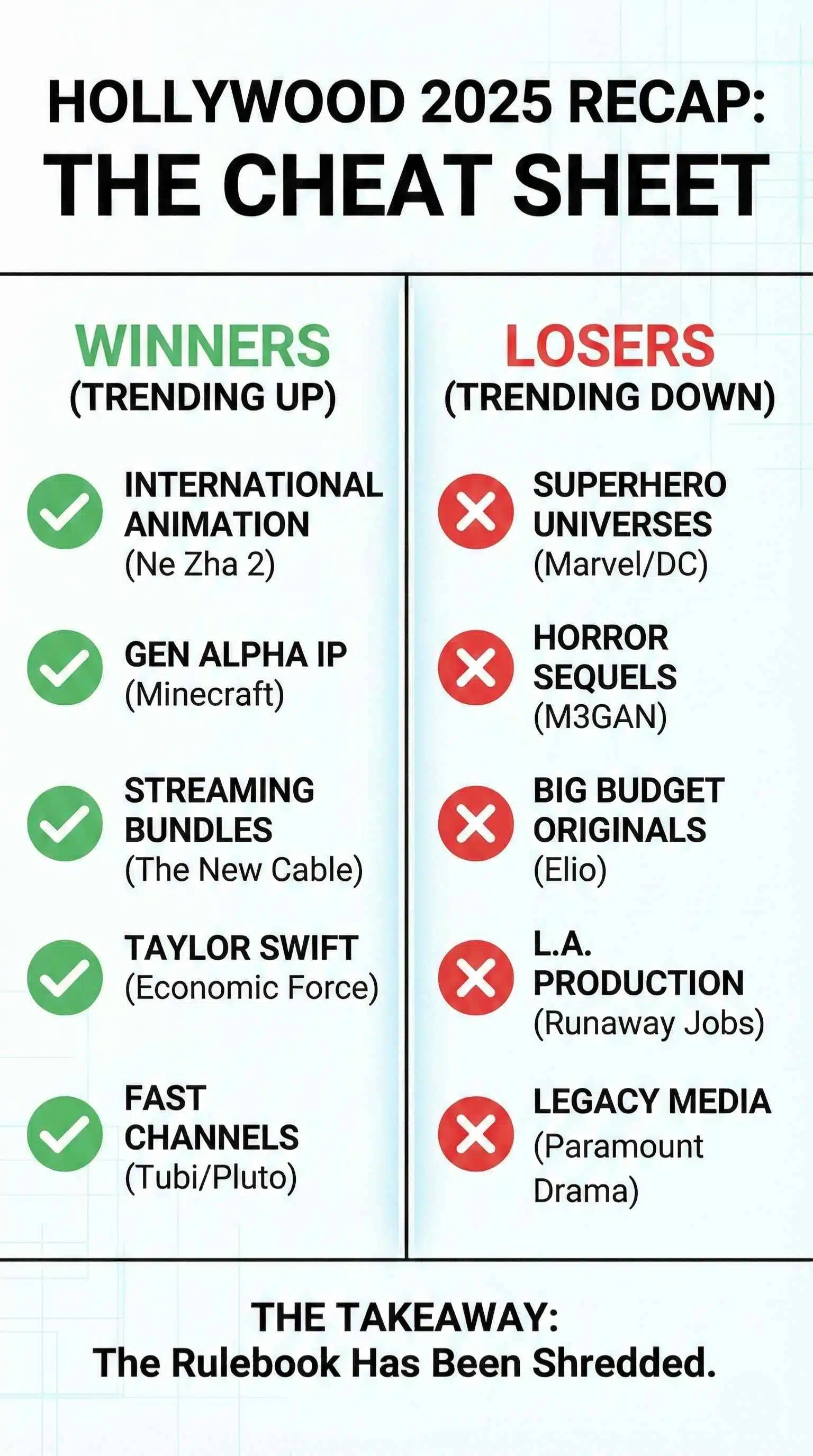
You cannot discuss 2025 entertainment without mentioning Taylor Swift and Travis Kelce. Their engagement in the summer wasn’t just celebrity gossip; it was a media event that eclipsed most movie releases. The “Swift Effect” continued to influence studios, who now actively avoid releasing major films during her tour dates or album drops.
The “Labubu” Invasion
In a bizarre twist of consumerism, the “Labubu” vinyl toys became the year’s Baby Yoda. Originating from Asian markets, the craze swept Hollywood, with celebrities from Blackpink’s Lisa to Western pop stars posting them. It highlighted the increasing speed at which Asian pop culture trends are penetrating the Western mainstream, mirroring the box office success of Ne Zha 2.
The Fallout: “Runaway Production”
On a more somber note, the physical location of “Hollywood” suffered. Following the 2023 strikes and the 2024 contractions, 2025 saw a massive exodus of production from Los Angeles. Soundstages in London, Budapest, and Toronto were booked solid, while LA production dropped by over 20%. The “industry” is becoming increasingly decentralized, leaving the city of Los Angeles in an economic identity crisis.
Industry Shifts & The Streaming Wars
The business side of Hollywood saw consolidation and panic.
The Paramount/Skydance Era
The soap opera of the Paramount Global sale finally ended with David Ellison’s Skydance taking the reins. The merger has led to immediate restructuring, with a focus on “tech-forward” entertainment. It marks the end of the Redstone dynasty and the beginning of a Silicon Valley mindset entering a legacy studio.
Streaming: The Great Bundling
2025 was the year streaming services essentially reinvented cable. The “bundling” of Disney+, Hulu, and Max became the standard. Furthermore, we saw the explosive growth of FAST (Free Ad-supported Streaming TV). Platforms like Tubi became major players, with audiences showing a willingness to watch ads if it meant not paying a subscription fee. This shift is forcing studios to reconsider their “direct-to-consumer” models, which are still bleeding cash.
Awards Season Outlook (Oscars 2026)
The gap between “Movies people watch” and “Movies that win awards” has never been wider.
-
The Frontrunner: Anora (Sean Baker)—A kinetic, chaotic comedy.
-
The Epic: The Brutalist (Brady Corbet)—A 3.5-hour 70 mm masterpiece.
-
The Wildcard: Emilia Pérez (Jacques Audiard)—A musical crime comedy.
Notable Absence: Unlike the Oppenheimer year, no major blockbuster is in serious contention for Best Picture.
Final Words: The “Bridge Year”
Historians will likely look back at 2025 as a “Bridge Year.” It was the bridge between the superhero dominance of the 2010s and whatever comes next. It was the bridge between Hollywood-centric cinema and a truly global box office.
The lessons for 2026 are clear: Budgets must come down. IP is not a safety net. And if you want to make a billion dollars, you don’t need a cape—you might just need a pixelated pickaxe or a Chinese demon child.
As we prepare for 2026—a year that promises “Avengers: Doomsday” and the next Star Wars film—the industry is leaner, more scared, and perhaps, finally, ready to innovate again.