
A federal judge has temporarily blocked former President Donald Trump’s latest attempt to stop international students from studying at Harvard University. This executive action had aimed to suspend entry visas for foreign students, escalating what Harvard calls a “political vendetta” against one of the world’s most prominent academic institutions.
Emergency Order Issued by Judge Allison Burroughs
Late Thursday, U.S. District Judge Allison Burroughs issued a temporary restraining order (TRO) that halts the enforcement of Trump’s proclamation signed just a day earlier. The proclamation attempted to suspend visa entry for new international students—primarily under F, M, and J visa categories—seeking to study at Harvard.
Judge Burroughs, appointed by President Obama, found that immediate judicial intervention was necessary. In her brief but decisive order, she warned that without the TRO, Harvard would face “immediate and irreparable injury before there is an opportunity to hear from all parties.” She scheduled a more detailed hearing for mid-June to decide whether the block should be made permanent.
Background: Trump’s Controversial Proclamation
The Trump administration’s latest move comes in the form of a presidential proclamation that directs the Secretary of State to consider revoking or denying entry visas for foreign nationals admitted to Harvard, citing national security risks. The order also alleges that Harvard has “failed to address antisemitism on campus” and has been prioritizing Diversity, Equity, and Inclusion (DEI) initiatives that Trump calls “illegal and immoral discrimination.”
According to the White House’s public summary of the proclamation, the policy would bar nearly all new international students from entering the U.S. to attend Harvard. Existing visa holders could also be subject to revocation if they fit certain undisclosed “criteria.”
Harvard’s Legal Response: Amended Lawsuit Against the Trump Administration
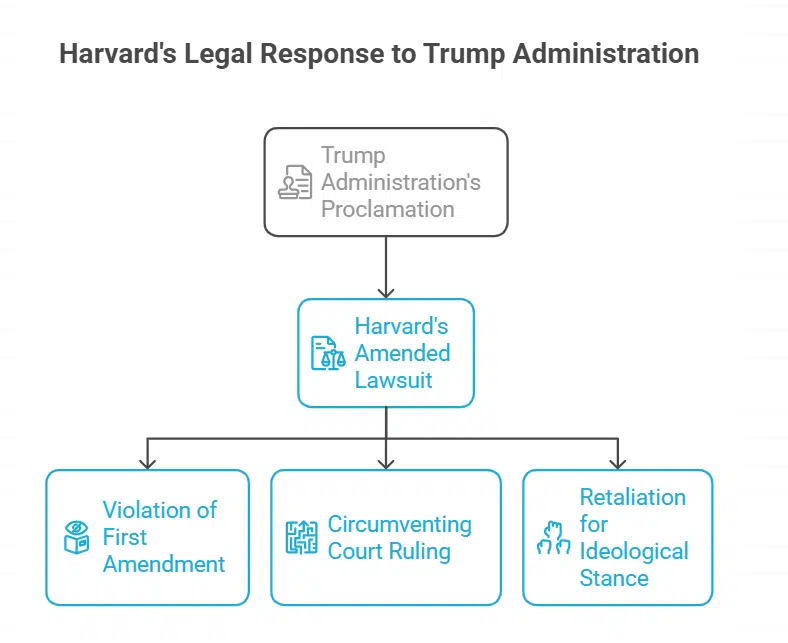
Harvard responded within hours by filing an amended lawsuit to an ongoing case it had already brought against the Department of Homeland Security (DHS). In its updated complaint, Harvard argued that the Trump administration’s proclamation was a clear violation of the First Amendment, as it appeared to punish the university for its political stance and commitment to academic freedom.
Harvard also claims the administration is trying to circumvent an earlier court ruling that temporarily blocked DHS from revoking Harvard’s certification under the Student and Exchange Visitor Program (SEVP). That certification is required to enroll international students legally in the U.S.
The amended complaint further asserts that the policy is not about protecting national security, as the Trump administration claims, but about retaliating against Harvard for refusing to implement federal policies that the university believes are ideologically driven.
“Without International Students, Harvard Is Not Harvard”
Harvard emphasized that its international students are integral to its identity and mission. Roughly one in four students at the university comes from abroad, contributing significantly to the academic, scientific, and cultural fabric of the institution.
The university argues that the visa programs—F for academic students, M for vocational students, and J for exchange visitors—have long supported not just Harvard, but American innovation and global influence.
President Alan Garber released a strongly worded statement to the Harvard community, calling the proclamation “yet another illegal step” taken by the administration to retaliate against the school.
Two Simultaneous Legal Battles with the Trump Administration
This is just one front in an expanding legal war between Harvard and the Trump administration. In addition to the student visa dispute, Harvard is also suing the federal government for:
-
Cutting over $2.2 billion in federal research funding
-
Threatening its tax-exempt status
-
Pressuring the university to change its DEI policies
Both lawsuits are currently being handled by Judge Burroughs. Arguments in the funding and tax-exempt status case are scheduled for next month.
U.S. Government Cables: Screening Harvard Applicants’ Social Media
The lawsuit also reveals that following the proclamation, the U.S. Department of State sent an internal cable to all consulates and embassies globally, instructing them to scrutinize all visa applicants related to Harvard.
This includes not just students but:
-
Faculty
-
Researchers
-
Guest speakers
-
Contractors
-
Even tourists visiting Harvard facilities
The cable reportedly requires a full review of the applicant’s online presence, including public and private social media accounts. If applicants do not have social media or set their accounts to private, this is to be interpreted as “evasive behavior,” potentially resulting in visa denial.
The Harvard lawsuit claims this protocol is discriminatory and aimed solely at Harvard under the guise of a “pilot program.”
A Broader Campaign Against U.S. Higher Education?
Legal experts and education advocates suggest that this latest proclamation fits into a broader pattern of the Trump administration’s hostility toward elite academic institutions.
This includes attempts to:
-
Tie federal funding to DEI compliance
-
Impose political restrictions on university governance
-
Restrict research collaboration with foreign scholars
The administration has consistently claimed its actions are about national security and combating antisemitism, but Harvard and others argue that these policies are politically motivated and infringe on academic freedom, free speech, and institutional independence.
What Comes Next?
For now, Judge Burroughs’ temporary restraining order ensures that Harvard can continue enrolling international students, at least until the court reconvenes in mid-June for a full hearing.
If a preliminary injunction is granted at that time, the ban could be halted indefinitely while the larger lawsuit proceeds through the courts.
In the meantime, Harvard has pledged to support its international community and oppose what it sees as unconstitutional overreach.