
If you are managing Type 2 diabetes or early stage kidney strain, you probably feel like you are stuck in a revolving door. One moment you are grabbing a quick burger between meetings, and the next you are punishing yourself on a treadmill to “cancel out” the damage. This modern cycle of overconsumption followed by aggressive compensation is exhausting and, quite frankly, often ineffective. There is a better way to find balance. By adopting the Hara Hachi Bu Diet for Diabetes and Kidney Health, you can stop the damage before it even starts. This Okinawan practice of eating until you are only 80% full offers a gentle, sustainable path to metabolic alignment.
Consider Samudragupta (name changed) in Texas, a middle-aged professional who spent years in this exact trap. He would fuel his long shifts with fast food and then spend his weekends trying to “undo” the damage with high intensity gym sessions. Despite his effort, his blood sugar remained a rollercoaster and his kidney markers began to flag. Samudragupta was treating his body like a machine that needed aggressive fixing rather than a delicate system that needed steady care. His story changed when he stopped trying to burn off his mistakes and started preventing them at the dinner table.
The Modern Lifestyle Reality
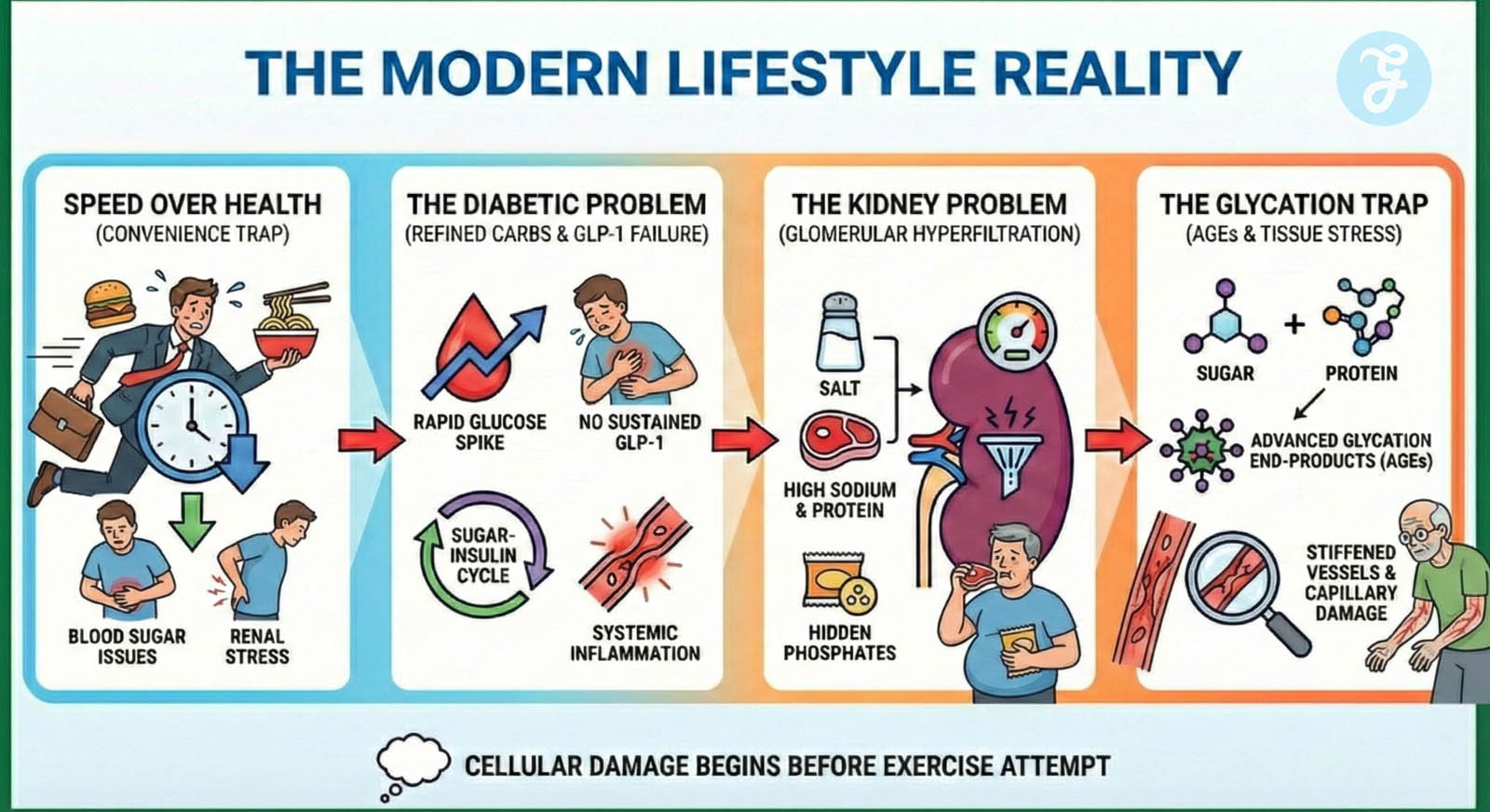
Most of us live in a world designed for speed, not health. Like Samudragupta, many professionals grab burgers between meetings, creamy pasta at night, or instant noodles on rushed evenings. These convenient choices are anything but helpful for those dealing with blood sugar issues or renal stress.
The Problem for Diabetics
Refined carbohydrates in these meals spike blood glucose rapidly. Because they lack fibre, they fail to trigger the sustained release of GLP-1, the gut hormone responsible for insulin regulation and satiety. This absence of a natural “slow down” signal leads to consistent overeating and metabolic stress. The resulting sugar insulin cycle does more than just cause weight gain; it creates systemic inflammation that damages the endothelial lining of your arteries.
The Problem for Kidney Patients: Glomerular Hyperfiltration
Fast food is often a hidden source of high sodium, which increases fluid retention and raises blood pressure. When you consume excessive animal protein and salt, your kidneys enter a state of hyperfiltration. This means the tiny filters, known as nephrons, are forced to work at a frantic pace to clear waste. Over time, this high pressure “burns out” the filters, leading to the early stage strain Samudragupta experienced. Furthermore, processed foods contain hidden phosphates that the body struggles to excrete, further calcifying the renal pathways.
The Glycation Trap and Tissue Stress
When blood sugar stays high from refined carbs, sugar molecules attach to proteins in the blood. This creates Advanced Glycation End products or AGEs. These molecules act like grit in a fine watch. For someone like Samudragupta, these AGEs accelerate the stiffening of blood vessels. This is particularly dangerous for the delicate capillaries in the kidneys. The fast food cycle does not just provide too much fuel. It changes the very chemistry of the body’s ecosystem.
By the time someone hits the treadmill to burn it off, the cellular damage has already begun. The common response is a frantic attempt to “burn it off.”
Burning Calories with Gym Machinery
The modern instinct is to respond to a heavy meal with aggressive cardio: treadmill sprints, stationary cycling, or high intensity aerobics. However, this machine-based approach often backfires for those with specific medical needs. It views the body as a furnace where “calories out” simply erases “calories in.”
The Risk for Diabetics: The Rebound Effect
High intensity exercise can cause unpredictable blood sugar fluctuations. While it may lead to a rapid drop for some, it often triggers a stress response that spikes glucose initially, followed by a sharp crash and a powerful “rebound hunger.” This is the body’s survival mechanism screaming for more glucose. You often leave the gym so famished that you eat even more to compensate, keeping the sugar-insulin rollercoaster in motion.
The Risk for Kidney Patients: Blood Pressure Spikes
Overexertion triggers a temporary but significant spike in blood pressure and releases stress hormones like cortisol. For a healthy person, this is manageable. For someone with early-stage kidney strain, this extra pressure can be harmful to the tiny blood vessels in the renal system. The pattern becomes a punishing loop: eat dense, burn aggressively, feel depleted, and eat again. This is the Compensation Model.
Enter the Alternative: Hara Hachi Bu
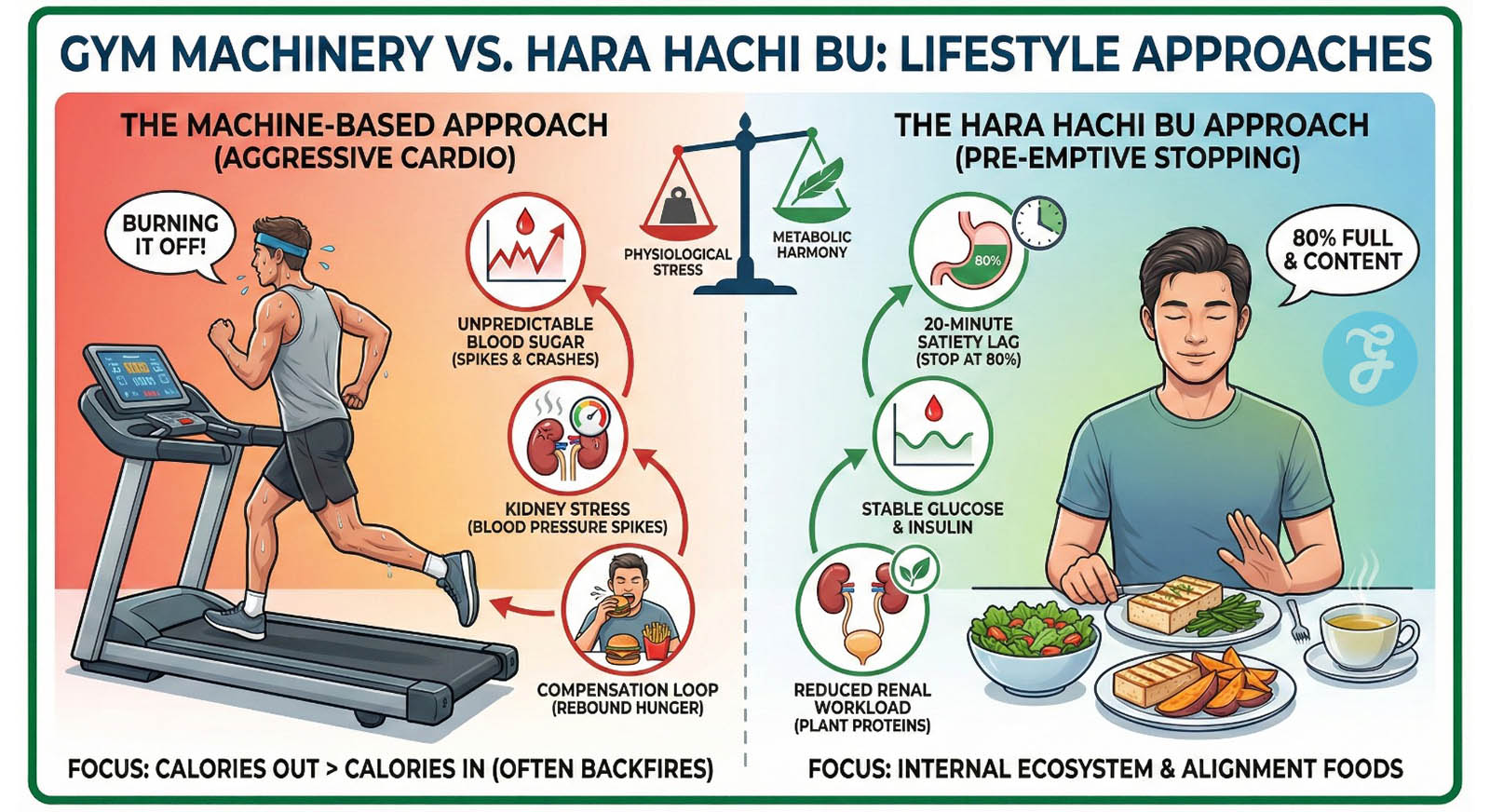 The Okinawan secret to longevity is a pre-emptive strike against metabolic stress. The Hara Hachi Bu Diet for Diabetes and Kidney Health is not a restrictive diet, but a practice of stopping when you are 80% full.
Why Pre-Emptive Stopping Wins
It takes about 20 minutes for your brain to receive the signal that your stomach is full. By stopping at 80% satisfaction, you allow the biological “lag time” to catch up. This prevents the physiological overload that leads to a “food coma” and massive glucose surges.
What Alignment Food Looks Like
This model focuses on high volume, low calorie options that protect the internal ecosystem:
- High volume vegetables: These provide bulk and essential fibre without the calorie load.
- Sweet potatoes and complex carbohydrates: These release energy slowly, preventing the sharp insulin spikes that damage blood vessels.
- Tofu and plant proteins: These provide “clean” protein that produces less nitrogenous waste (urea). This reduces the filtration workload on the kidneys compared to heavy animal proteins.
- Light, clear broths: These aid hydration without the hidden sodium found in processed, tinned soups.
The Power of Fibre and Satiety
For diabetics, the high fibre content in these foods slows down the absorption of glucose. This means the pancreas does not have to pump out massive amounts of insulin. For kidney patients, this shift naturally lowers the acidic load on the blood, making the kidneys’ job significantly easier. Instead of trying to burn off excess, the excess never enters the system.
Burning Calories Without Machinery
You do not need an expensive gym membership to stay healthy. Natural movement is often far more effective for managing chronic conditions because it aligns with our evolutionary biology.
The Science of Micro-Movements
One of the most profound evergreen discoveries in metabolic health is the role of the soleus muscle in the calf. Even while Samudragupta is sitting at his desk, he can engage in the Alignment Model through soleus pushups. Research shows that repetitive calf raises while seated can significantly improve blood glucose regulation. Unlike a treadmill run, these micro-movements do not trigger a stress response.
For Diabetics: Insulin Sensitivity
Activities like yoga flows, stretching, or slow bodyweight squats improve insulin sensitivity gradually. They help the muscles “sponge up” glucose without the sudden crashes seen in high intensity cardio.
For Kidney Patients: Circulation Without Pressure
Low impact movements like wall sits during chores or calf raises while cooking support circulation without spiking blood pressure. For a kidney patient, a sudden burst of high intensity activity can divert oxygen away from the kidneys. In contrast, natural movement maintains a steady, gentle flow of oxygenated blood to the renal filters.
A Comparison of Two Worlds
Food Philosophy
| Feature | Modern Fast Food | Hara Hachi Bu Diet |
| Volume & Calorie | Low volume, high calorie | High volume, low calorie |
| Carbohydrates | Refined carbohydrates | Complex, fibre-rich |
| Protein Source | Heavy animal protein | Moderate plant protein |
| Sodium Content | Very high | Naturally low |
| Fullness Signal | Delayed satiety | Slow, natural signals |
Calorie Strategy
| Feature | With Gym Apparatus | Without Gym Apparatus |
| Intensity | High / Stressful | Low to moderate |
| Sugar Impact | Can destabilise glucose | Stabilises glucose gradually |
| Accessibility | Requires equipment | Can be done anywhere |
| Integration | Often compensatory | Integrated with lifestyle |
The Industrial Trap: Why We Treat Our Bodies Like Engines, Not Ecosystems
The modern fitness and diet industry has sold us a dangerous lie: that the human body is a simple combustion engine. We are told that if we put too much fuel in, we must simply run the engine hotter at the gym to burn it off. This “Input-Output” obsession is a toxic myth. It ignores the delicate biological reality of a diabetic or kidney patient.
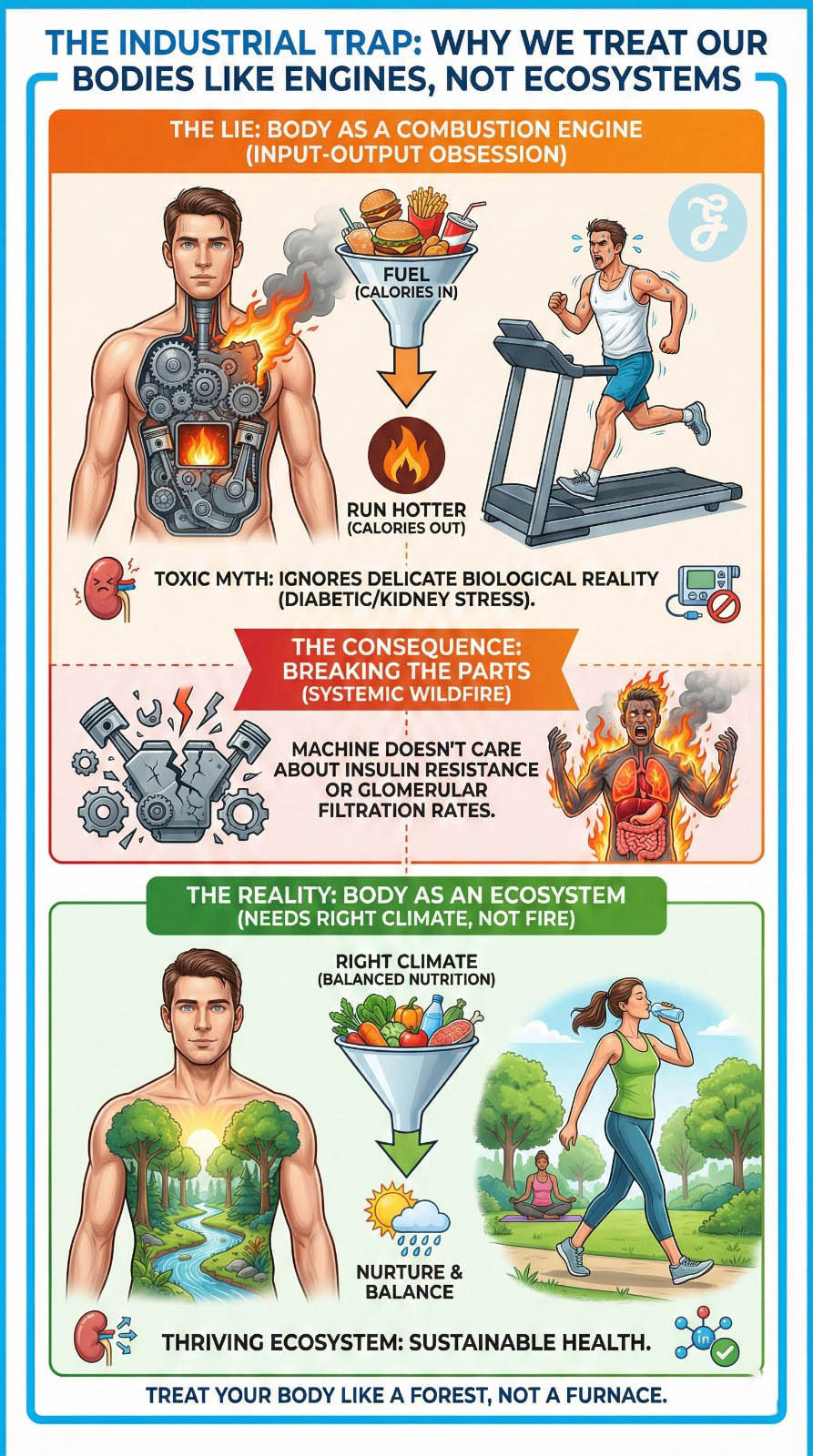 When you treat your body like a machine, you eventually break the parts. A machine does not care about insulin resistance or glomerular filtration rates, but an ecosystem does. Your body is a forest that needs the right climate, not a furnace that needs more fire. If the forest is dry and the trees are stressed, throwing more “heat” at it will only lead to a wildfire.
The Radical Act of Doing Less
We must stop viewing health as a series of aggressive corrections. For many managing chronic strain, the most radical and effective act is not doing more, but doing significantly less. By choosing the Hara Hachi Bu Diet for Diabetes and Kidney Health, you are rejecting the loud, expensive “burn” of the gym in favour of the quiet, sustainable “balance” of the 80% rule.
We have been conditioned to believe that health must be earned through sweat and deprivation. In reality, longevity is found in the space we leave empty.
The Turning Point: Redesigning Your Life
The turning point for Samudragupta came when he realised he did not need to erase his meals; he needed to redesign them. He shifted to using smaller plates to naturally limit portions. He stopped viewing a 15-minute walk after dinner as “too little” and started seeing it as “just right.”
By stopping at 80% and integrating household isometrics, his weight loss followed naturally. This was not a “transformation” in the Hollywood sense. It was a restoration. His blood sugar stabilised and his kidney markers improved modestly because his body was finally out of “crisis mode.”
Longevity is found in the space we leave empty, the 20% of the plate we do not eat and the 20% of the workout we do not force. Peace for your kidneys and stability for your blood sugar starts the moment you decide you have had enough.
Disclaimer: Consult a medical professional before making dietary or exercise changes, as this general health information does not replace professional advice, diagnosis, or treatment.