

The engine has been off for twenty minutes. Outside the car window, the rain smears the streetlights into blurry amber bruises. Inside, the silence is thick and heavy. It feels like a physical weight. You are caught in a state of emotional paralysis, staring at the front door of your own home. It is a simple wooden door. Yet, at this moment, it looks like the entrance to a vault you no longer have the combination for. Your hands are still gripped around the steering wheel at ten and two. This is not mere indecision. It is a total systemic failure of the will.
This is the quiet life, built brick by painful brick. But as you sit in the dark, you realise you are no longer actually living it; you are simply inhabiting the space where life used to be. Your limbs feel leaden. A strange, grey fog has settled behind your eyes, making every thought slow and sluggish. The infrastructure of your existence remains intact, but the power grid has gone dark.
Emotional Paralysis: Living in the Double Bind
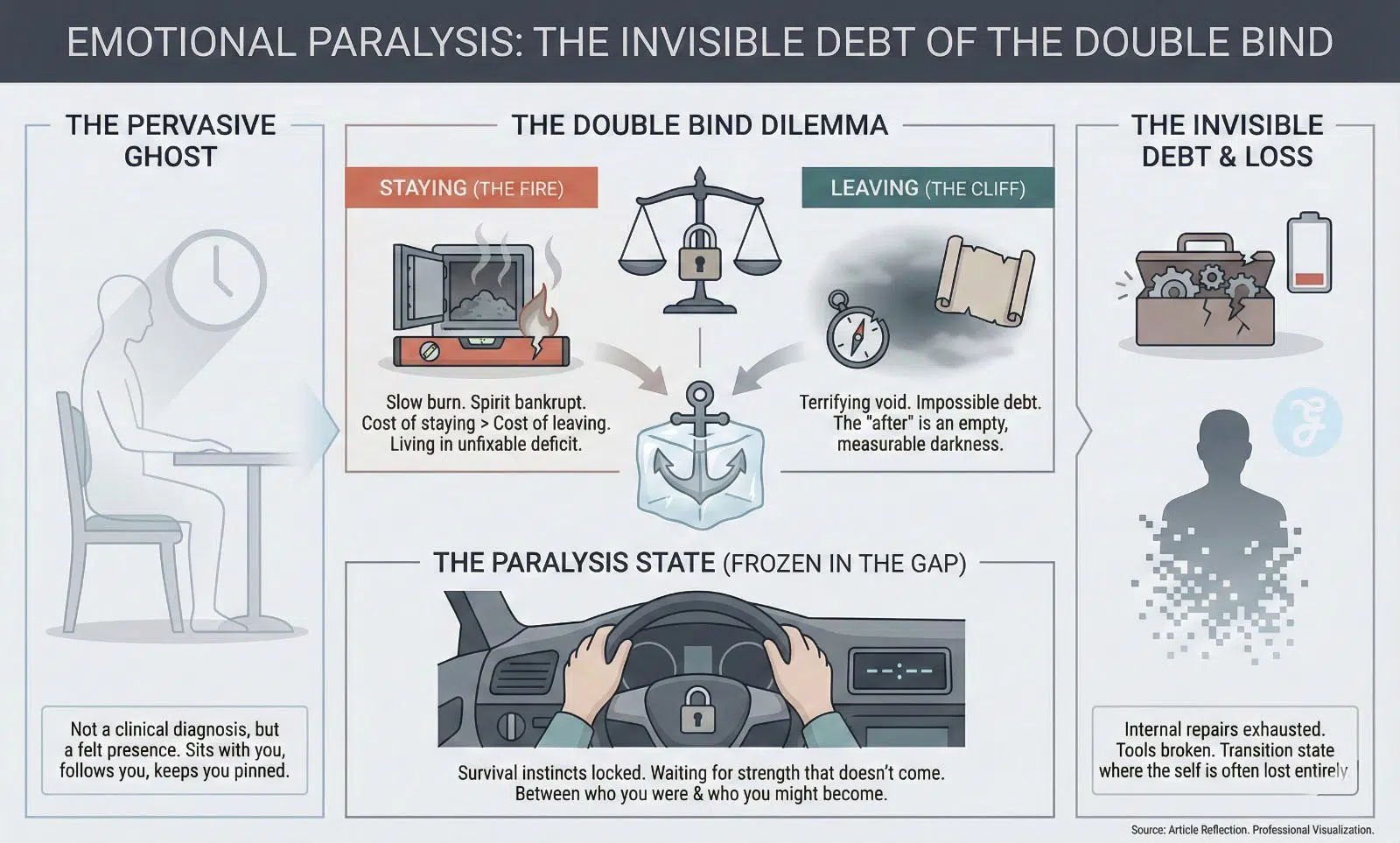
This condition is not a clinical diagnosis found in a textbook. It is a ghost that has moved into your spare room. It sits at the dinner table with you. It follows you into meetings. It is the invisible force that keeps you pinned to a seat when every instinct is screaming at you to run. It happens when the cost of staying has bankrupted your spirit, but the cost of leaving feels like an impossible debt. You are living in a deficit that no amount of sleep can fix.
This is the double bind. You are far too exhausted to keep fighting for this version of your existence. You are empty, yet the space beyond that front door feels like a void. The “after” is a terrifying, empty map. You have performed the internal repairs until your tools are broken, and now you are essentially a prisoner of your own survival instincts.
You are caught between a fire and a cliff. To stay is to burn slowly until there is nothing left but ash. To leave is to jump into a darkness you cannot measure. So, you do the only thing your nervous system will allow. You sit. You stare at the steering wheel. You wait for a strength that does not come. You are not weak. You are simply frozen in the gap between who you were and who you might become. This transition state is where most people lose themselves entirely.
The Anatomy of the Freeze: When the Body Says No
The body always knows before the mind is willing to admit it. Long before you say the words aloud, your physical self begins to protest. You wake up with a jaw so tight it feels as though you have been biting down on a stone all night. There is a dull, persistent pressure behind your temples. It is not quite a headache. It is more like the ghost of a scream that has no way out.
Your physiology is reacting to a persistent threat that your conscious mind is trying to ignore.
Even the simple pleasures of the world begin to retreat. You sit at the kitchen table and chew through a meal that should be delicious. Instead, it tastes like damp cardboard. Your senses are narrowing. Your world is losing its colour and its flavour. This is not a lack of gratitude. It is a biological shutdown. Your body is rerouting its power to the core just to keep you upright. It is a triage situation.
The science of this state is both brutal and precise. Inside your skull, a primitive part of the brain called the amygdala has become hypersensitised. It has sensed a threat it cannot fight and cannot outrun. In response, it bypasses your logic and signals the Periaqueductal Grey to initiate a physical freeze. This process hijacks the prefrontal cortex, the part of you that makes plans and weighs options. By overriding this system, your brain effectively disables your ability to envision a future.
Running in Safe Mode: The Mechanics of the Social Mask
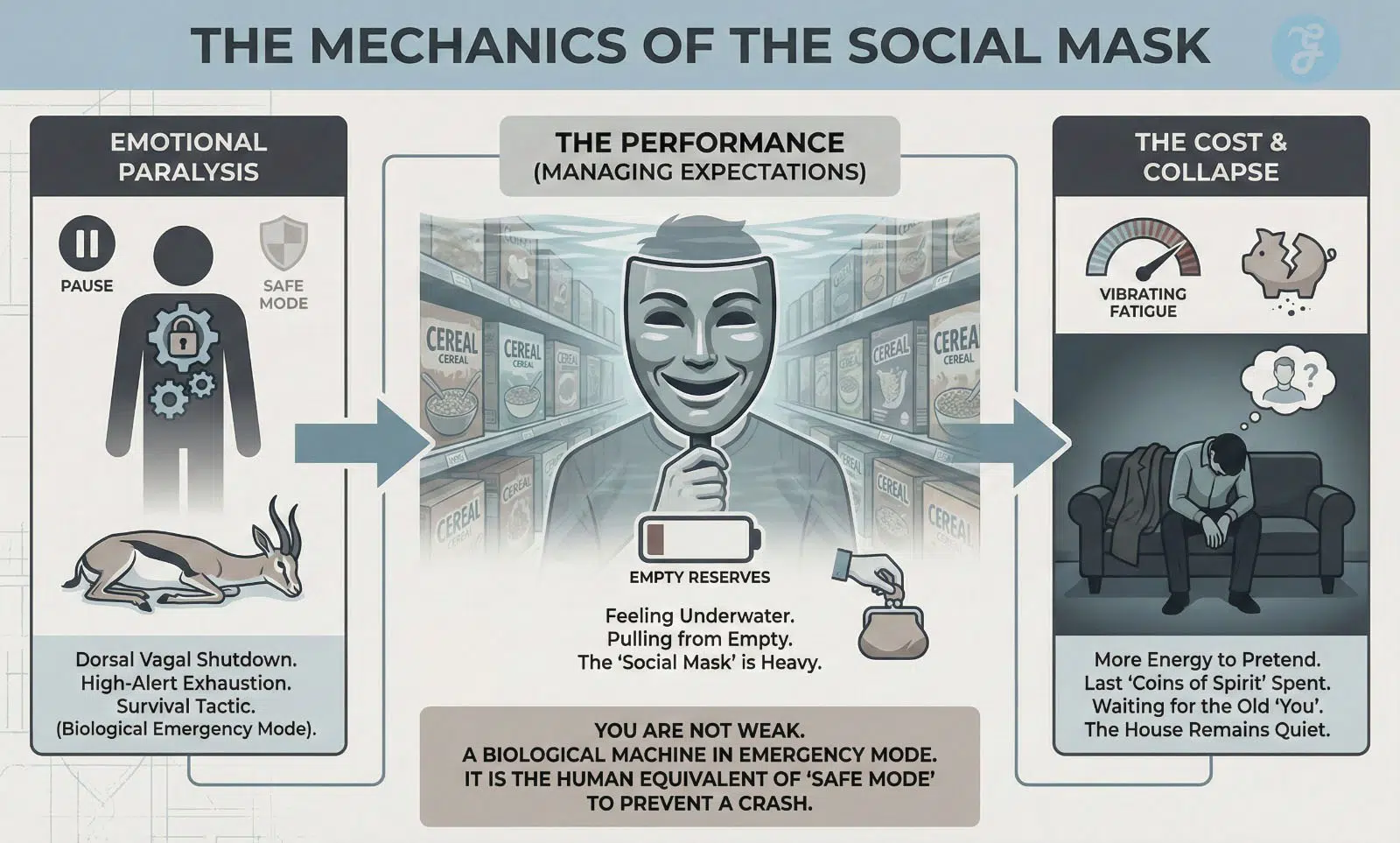
When you are in the grip of emotional paralysis, your nervous system is not just blocking exit pathways; it is actively inhibiting your motor functions to keep you still. This is dorsal vagal shutdown, a state of high-alert exhaustion. It is a survival tactic as old as time. If the gazelle cannot run, it plays dead. You are playing dead in your own life to conserve the tiny amount of energy you have left.
You are not weak or lazy. You are simply a biological machine running in emergency power mode. It is the human equivalent of a computer entering safe mode to prevent a total crash.
Then there is the performance. You go to the supermarket and stand in the aisle staring at boxes of cereal. You feel as though you are underwater. A neighbour asks how you are doing. You reach deep into your empty reserves to pull out a smile. You say you are fine. You say you are just a bit tired. You are managing expectations while your internal world collapses.
This social mask is the heaviest thing you carry. It takes more energy to pretend to be okay than it does to actually be okay. By the time you get home, you are vibrating with fatigue. You have spent your last coins of spirit on a three-minute conversation about the weather. You collapse onto the sofa. You are still wearing your coat. The house is dark. You are waiting for the “you” that used to exist to come home and take over. But the house remains quiet.
Signs of Emotional Paralysis: Lessons from Mumbai to Austin
Mia sits in a high-rise in Austin, staring at a spreadsheet that has blurred into a grey haze. Five years in corporate tech have left her hollow. She is too exhausted to update her CV, yet the fear of losing her health insurance keeps her tethered to a desk that feels like a tomb. Across the world in Mumbai, Rahul navigates the same internal landscape. He stands on his balcony overlooking the humid sprawl, trapped in a family business that stifles his creative soul. He is too drained to argue for his own path, but the terror of disappointing his lineage acts as a physical weight.
Both are victims of emotional paralysis. Despite the thousands of miles between them, their symptoms are identical. They inhabit lives that are objectively successful but subjectively vacant. Mia chooses the familiar stress of Austin over the uncertainty of a career change. Rahul chooses the quiet resentment of Mumbai over the chaos of independence. They are both waiting for a permission slip that will never arrive. Their stories prove that this frozen state knows no borders.
What this means is that emotional paralysis is the new global epidemic of the modern professional class. It is the result of a world that demands constant growth while offering no clear path for retreat. Mia and Rahul are not outliers; they are the standard. They represent a workforce that is technically productive but spiritually stagnant. This stagnation has a compounding interest. The longer they stay, the harder the eventual break will be. It is a universal human struggle to find the strength to choose the unknown over a comfortable decline.
The Sunk Cost Trap: Looking Backward
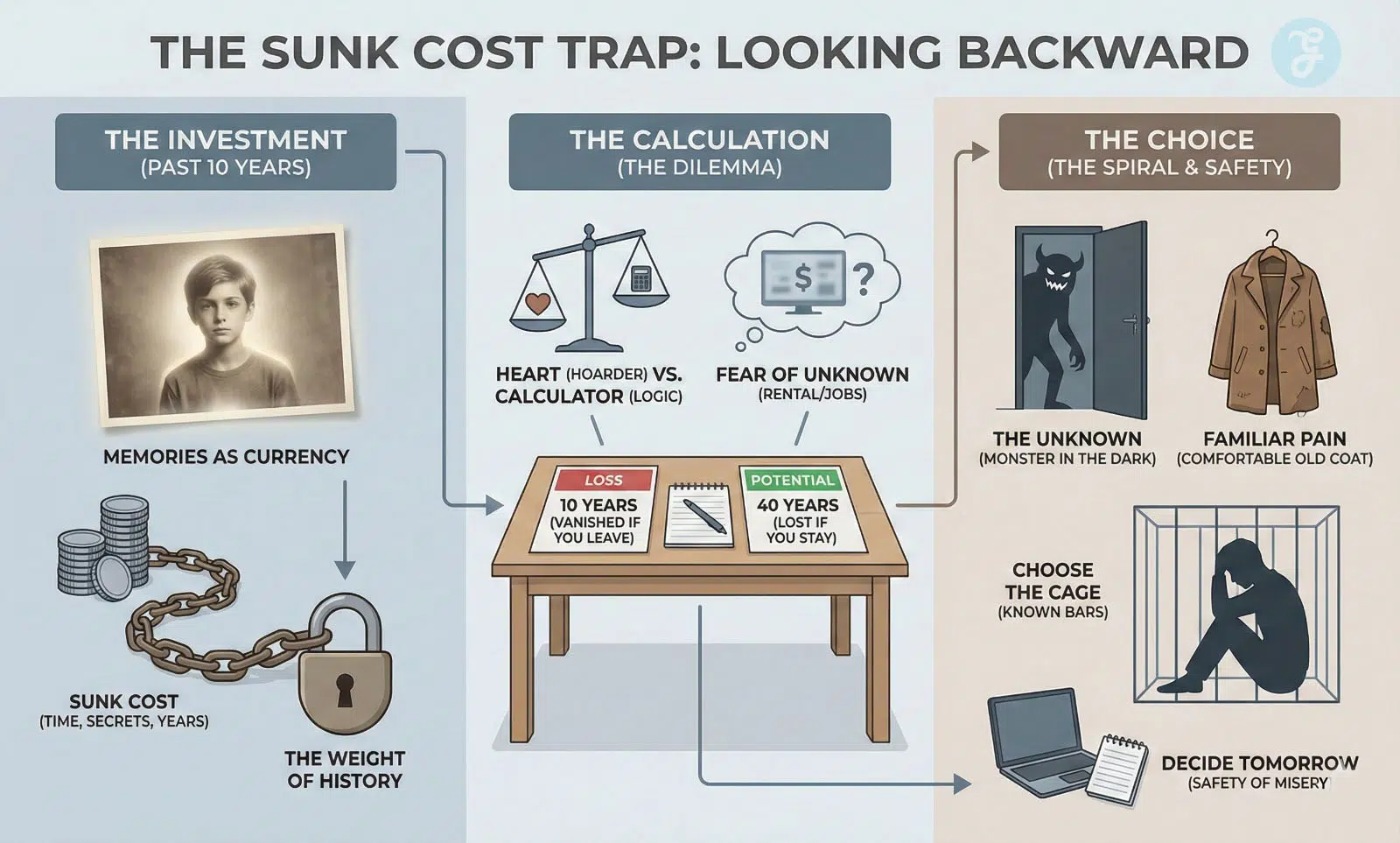
You wipe the dust from a framed photograph. In the image, taken five years ago, you look young and certain. That day felt like a promise, but today, these memories are more than pictures; they are currency. You have invested your best years and deepest secrets into this life. Leaving now feels like setting fire to a pile of money, an admission that a decade was for nothing. This is the weight of history pulling you backward.
This is the sunk cost trap: a cruel economic principle applied to the heart. You sit at the kitchen table with a notepad, trying to do the sums. You have spent ten years building this. If you walk away, that decade vanishes. But then you look at the other side of the ledger. You have perhaps forty years left. If you stay, you lose those too. The maths should be simple: it is better to lose ten years than fifty. But the heart is a hoarder, not a calculator.
The spiral begins. You open a browser tab to look at rental prices or job listings. The numbers are terrifying. The “what ifs” spin into a blur: What if you end up alone? What if you regret it every day? Your chest tightens; the world feels too sharp. The pain you are in right now is terrible, but it is familiar. You know the shape of it. It is a comfortable old coat.
The unknown, however, is a monster in the dark. You close the laptop and push the notepad away. You decide to think about it tomorrow. In the silence of the kitchen, you choose the safety of your misery. You choose the cage because, at least, you know where the bars are.
The Catalyst: The Moment of Peak Exhaustion
The breaking point does not always arrive with a crash. It does not always look like a slammed door or a shouted argument. Sometimes it is far quieter than that. It is the sound of a plastic lid hitting the floor. It is the realisation that you have run out of milk. It is a single email notification at nine o’clock on a Tuesday evening. For you, it is a glass of water. You are standing at the kitchen sink. The tap is running. You watch the water rise to the brim. Your hand begins to shake. It is a very slight tremor.
The glass slips through your fingers. It does not shatter. It simply tips over. The water spills across the counter and onto your shoes. You do not move. You do not reach for a towel. You simply stand there and watch the puddle grow. This is the moment. It is the small fracture that reveals your total lack of reserves. You have no more energy to clean it up. You have no more spirit to be annoyed. You are a hollow shell. This is peak exhaustion.
You walk into the hallway. You catch your reflection in the mirror by the door. You stop. You look at the person staring back at you. They look familiar. They have your eyes. They have your hair. But you do not recognise them. The light has gone out of your face. The skin looks grey under the harsh hallway bulb. The shoulders are slumped. You realise that you are looking at a stranger. This person is a ghost of the version of yourself you used to know. You wonder when exactly you vanished. You wonder if anyone else has noticed.
The Erasure of Self and the Active Choice
You lean in closer to the glass. You search for a spark of the old fire. There is nothing there. There is only a profound, echoing emptiness. You are witnessing the slow death of your own identity. It is a terrifying sight. This recognition is what finally strips away the delusion. You cannot keep pretending that you are just “tired.” You are undergoing a fundamental erasure of the self.
The silence in the house feels different now. It is no longer peaceful. It is isolating. You realised a long time ago that you were waiting for something. You were waiting for a sign. You were waiting for a friend to tell you it was time to leave. You were waiting for a miracle. Perhaps you were waiting for the situation to become so bad that the choice would be made for you. But the miracle is not coming. No one is going to knock on that door and hand you a new life. Your friends have their own burdens. Your family has their own maps. You are entirely alone in this room.
This is the hardest truth to swallow. You realise that staying is not a passive act. It is a choice you make every single morning. You choose to put on the mask. You choose to walk back into the fire. You choose to let the emotional paralysis keep you frozen. By doing nothing, you are actively participating in your own destruction. You are choosing a slow decay over a sudden change.
You see the water still dripping from the counter. You see the stranger in the glass. You realise that you are dying while you are still alive. The weight of this knowledge is almost too much to bear. But for the first time in a long time, the pain is sharp. It is not a dull ache. It is a wake-up call. It is the first sign of life you have felt in months.
The Thaw: Small Wins and Micro-Movements
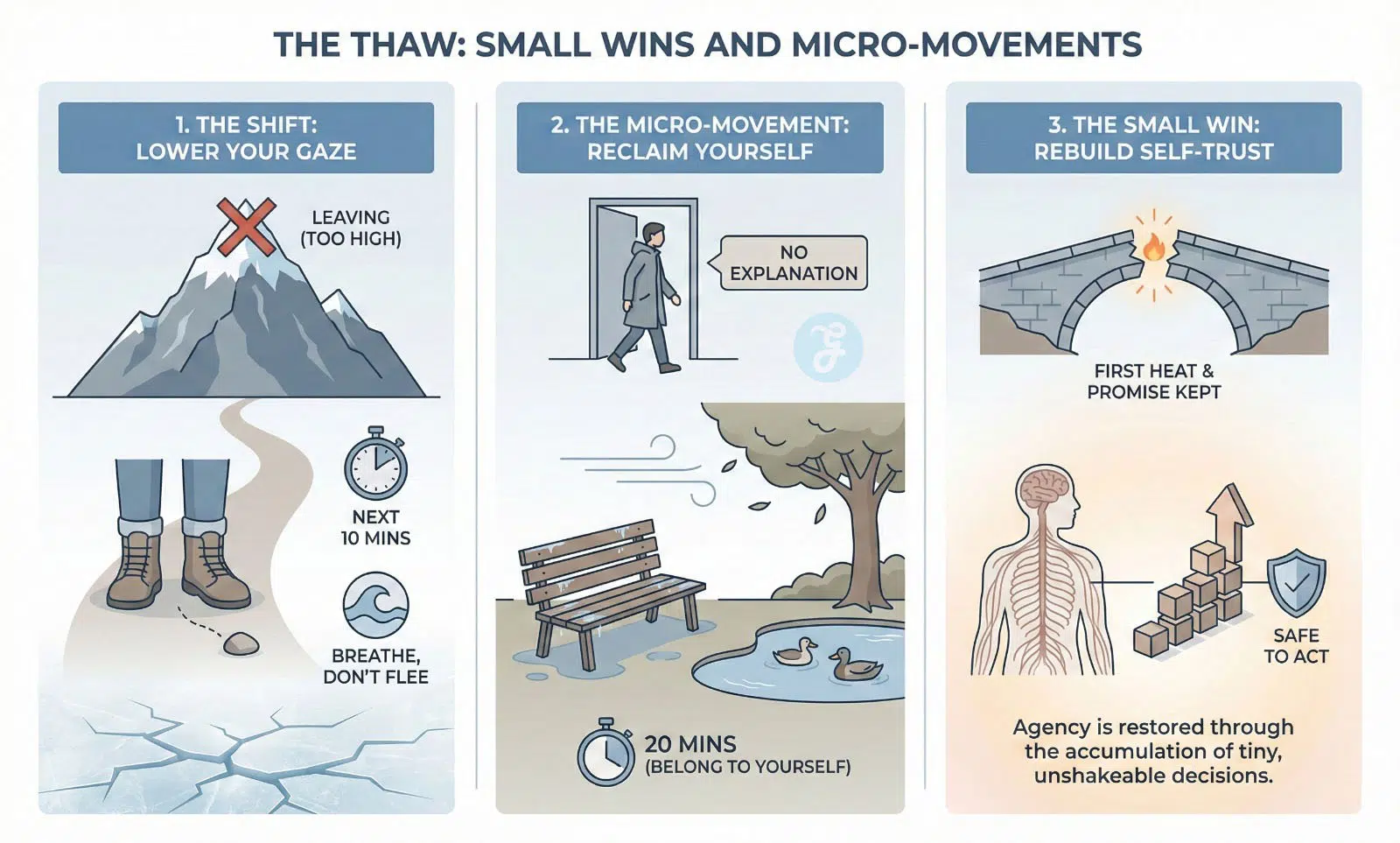
You stop looking at the mountain. For months you have stared at the summit of “Leaving” and found it too high to climb. The sheer scale of the change was what kept you pinned to the floor. Now you lower your gaze. You look only at your feet. You stop trying to solve the next ten years of your life. You decide instead to solve the next ten minutes. You realise that you do not need to move the mountain today. You only need to move a single pebble. You stop trying to flee and you simply start trying to breathe. This shift is subtle but it is everything. It is the first crack in the ice.
You decide to reclaim a tiny piece of yourself. It is a small act of rebellion. It is almost invisible to the outside world. You go for a walk in the park on a Tuesday evening. You do not ask for permission. You do not explain where you are going. You just put on your coat and walk out of the door. You sit on a damp wooden bench and watch the ducks on the pond. You listen to the wind in the trees. For twenty minutes you belong only to yourself. This is a micro-movement.
It is a small win that begins to rebuild the bridge of self-trust. You kept a promise to yourself. You chose a direction and you followed it. The spark is small but it is real. It is the first heat you have felt in years. Agency is restored through the accumulation of tiny and unshakeable decisions rather than a single grand gesture. You are proving to your nervous system that it is safe to act.
The Private Domain: Reclaiming Power Through Boundaries
You begin to practise saying no. It starts with something small. A colleague asks you to take on an extra task. Usually you would agree just to avoid the friction. This time you pause. You feel the familiar surge of anxiety. You ignore it. You say that you cannot do it. The world does not end. The sky does not fall. You feel a strange sense of power in that two-letter word. It is a boundary. It is a fence you are building around your remaining energy. You are no longer a public road that everyone is allowed to walk on. You are becoming a private garden again.
You create a space of conditional safety. This is a mental room where the “Big Decision” is not allowed to enter. You give yourself permission to stay for now without the guilt of staying. You tell yourself that you are not trapped. You are just resting. You are gathering your strength. By removing the immediate pressure to quit your job or end your marriage you actually find the room to think.
The emotional paralysis begins to lose its grip because you are no longer fighting it with panic. You are outsmarting it with patience. You are not running yet. You are just standing up. You are stretching your cramped muscles. You are remembering how it feels to be the one in control of the breath in your lungs.
The Choice to Exist
The fog is finally beginning to lift. You are still in the same house. You are still working the same job. On the surface nothing has changed. Yet everything is different. The heavy lead in your limbs has been replaced by a quiet tingle of life. You have stopped waiting for the ghost to leave the room. You have simply stopped giving it a seat at the table. The emotional paralysis that once felt like a stone wall now feels like a thin veil. You realise that you can simply reach out and pull it aside whenever you are ready. The power has shifted from the situation back to the observer.
You look at your fear with new eyes. You used to see it as a barrier. You saw it as a sign that you were headed towards a cliff. Now you see it as a compass. It is pointing exactly toward the things that matter. You are afraid to leave because you value your freedom. You are afraid to stay because you value your soul. This fear is not an enemy. It is a guide. It is telling you that you are still alive. It is telling you that you still have something worth protecting. You do not need to be fearless to move. You only need to be brave enough to walk while you are trembling.
This state was never a life sentence. It was only a season. It was a long and bitter winter of the spirit. But even the hardest ground eventually softens. You have survived the freeze. You have protected your core through the darkest nights. You are not the same person who sat in that car staring at the door. You are stronger now. You have learned how to exist in the silence. You have learned how to find your own pulse in the dark. This knowledge is your exit visa.
You stand by the window and watch the sun come up. You take a breath. It is a deep and clean sensation. It is the first breath of a person who is no longer drowning. You do not know exactly what the next year holds. You do not have a map for the void. But you are no longer afraid of the empty spaces. You are ready to fill them with your own choices. You are no longer just inhabiting a space. You are beginning to live in it. The weight is gone. The door is just a door. You reach for the handle and you turn it. You are no longer waiting for life to happen to you; you are finally happening to life.
Note: Names and identifying details in these case studies have been changed for privacy. This content is for educational purposes only.




























