Ever feel like keeping up with artificial intelligence is a full-time job? Every week brings a new model, a fresh headline, and another debate about which AI tool is actually worth your time. If you’ve been wondering whether Google’s Gemini is really giving OpenAI’s ChatGPT a run for its money, the answer in 2026 is a clear yes.
According to Google’s fourth-quarter 2025 earnings, the Gemini app surpassed 750 million monthly active users, up from 650 million just one quarter earlier. That’s stunning growth by any measure, and it tells a bigger story about how this AI race is shifting.
This guide breaks down how Google Gemini vs OpenAI in 2025, covering performance, features, real-world use, and what’s coming next. Let’s walk through it together.
Ever feel like keeping up with artificial intelligence is a full-time job?
Every week brings a new model, a fresh headline, and another debate about which AI tool is actually worth your time. If you’ve been wondering whether Google’s Gemini is really giving OpenAI’s ChatGPT a run for its money, the answer in 2025 is a clear yes.
According to Google’s fourth-quarter 2025 earnings, the Gemini app surpassed 750 million monthly active users, up from 650 million just one quarter earlier. That’s stunning growth by any measure, and it tells a bigger story about how this AI race is shifting.
This guide breaks down how Google Gemini is competing with OpenAI in 2025, covering performance, features, real-world use, and what’s coming next. Let’s walk through it together.
The Rise of Google Gemini
Google Gemini has made serious waves in artificial intelligence over the past year. Its rapid growth in features and users has the whole tech world paying attention, and for good reason.
Launch of Gemini 3
Google announced Gemini 3 in November 2025, about eight months after the release of Gemini 2.5. The new model set its sights squarely on OpenAI’s lead, with Alphabet CEO Sundar Pichai describing it as “built to grasp depth and nuance” and designed so users get what they need with less prompting.
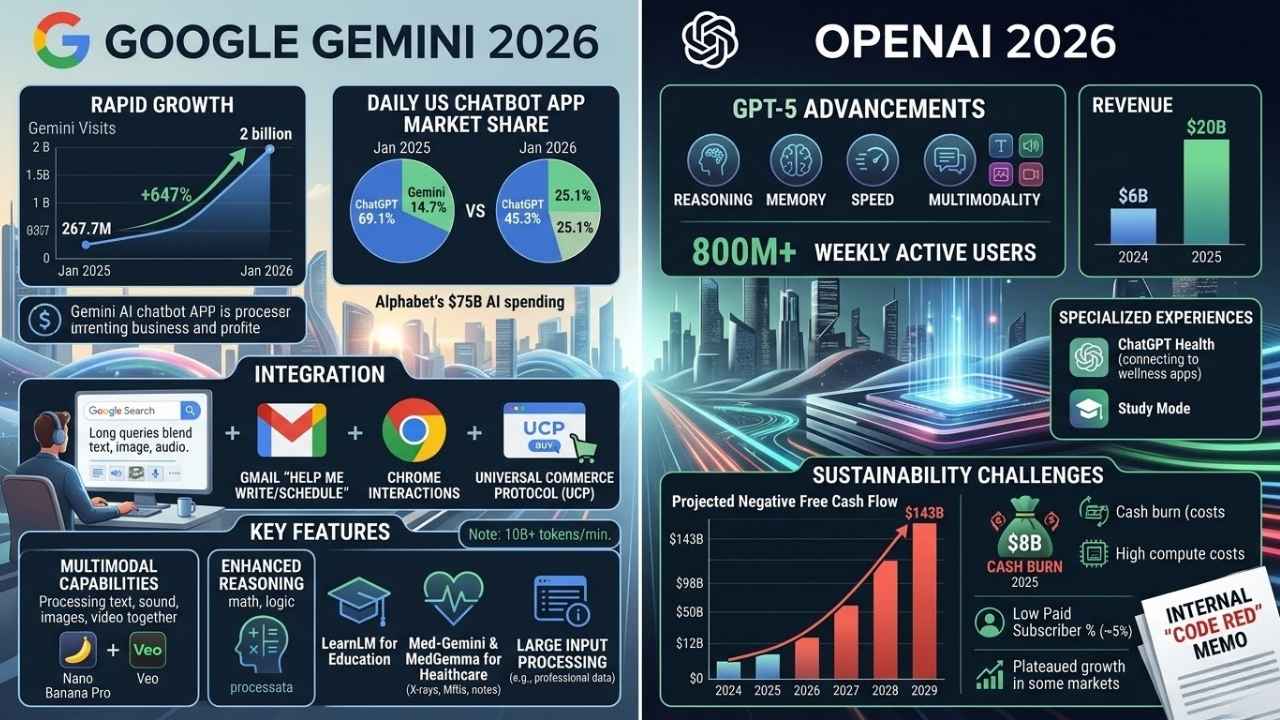
The launch sent real shockwaves through the tech industry. Google expects to spend $75 billion on AI infrastructure in 2025 alone, according to MIT Technology Review, which shows just how aggressively it’s pushing forward.
One of the most telling stats? According to data from mobile analytics firm Apptopia, Gemini’s share of the daily U.S. chatbot app market rose from 14.7% to 25.1% between January 2025 and January 2026. Over that same period, ChatGPT’s share fell from 69.1% to 45.3%. The gap is closing fast.
According to Similarweb data, visits to Gemini jumped from 267.7 million to 2 billion between January 2025 and January 2026, a 647% increase. That’s not just growth; that’s a platform shift.
With those kinds of numbers, competition between Google Gemini and OpenAI grew fiercer every quarter, pushing both companies to accelerate their machine learning development timelines.
Integration with Google Search
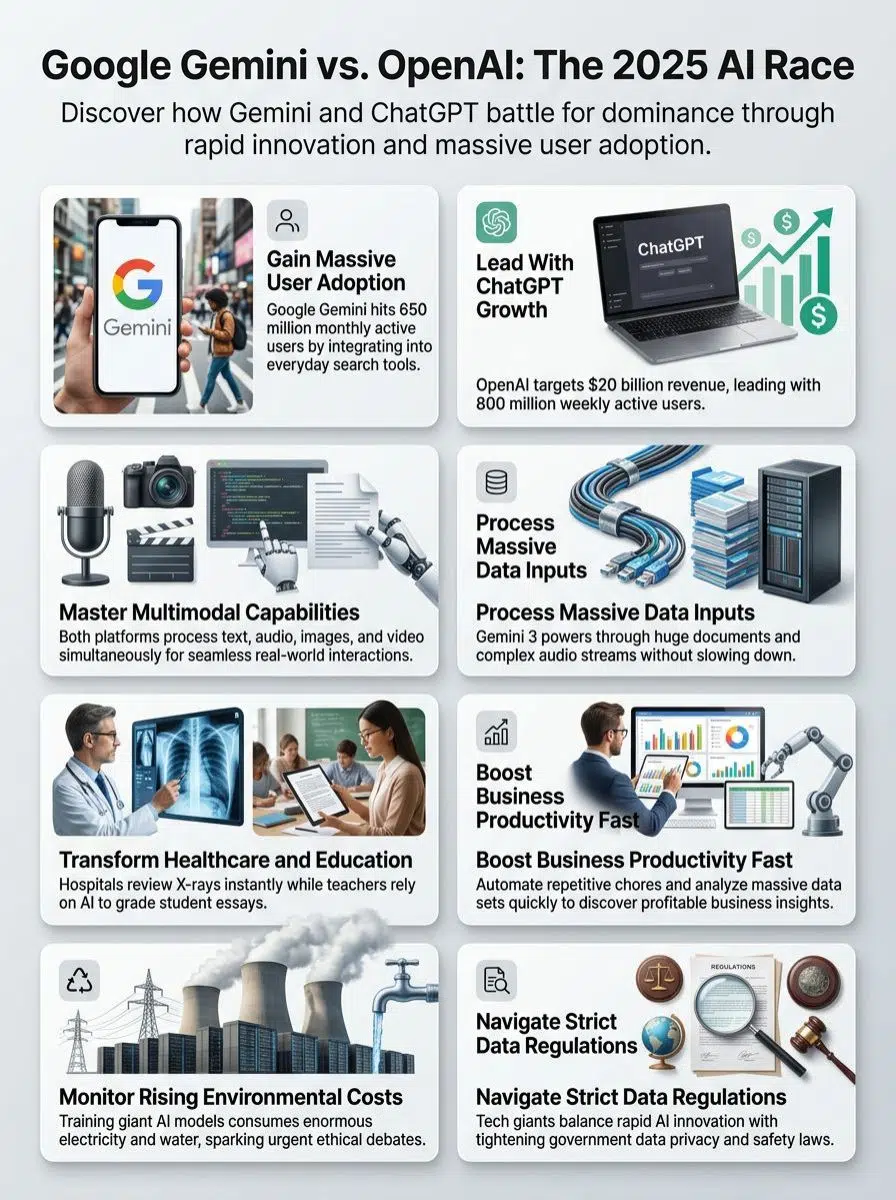
Gemini 3 has moved deep into Google Search, making everyday searches smarter. Users now get answers that blend text, images, and even audio in one smooth experience, making it feel less like a search engine and more like a conversation.
One especially useful detail here: since the Gemini 3 upgrade, AI Mode queries in Google Search are three times longer than traditional searches, according to data reported by Demand Sage. People aren’t just looking things up anymore. They’re asking richer, more complex questions and getting genuinely useful answers back.
Gemini is also now available directly in the Chrome browser to interact with web pages, and Google has added “Help me write” and “Help me schedule” features inside Gmail. For anyone already living inside Google’s ecosystem, this kind of integration means less switching between tools.
Google also launched its Universal Commerce Protocol (UCP) in early 2026, letting U.S. users browse products and complete purchases directly inside Gemini’s chat interface. It’s a direct response to ChatGPT’s “Instant Checkout” feature, which launched in late 2025 with a major retail partnership with Walmart.
OpenAI’s Current Standing in 2026
OpenAI keeps pushing the boundaries of AI and machine learning, drawing attention from every corner of the tech industry. But turning all that attention into sustainable profit is still a tough challenge.
Advancements in GPT-5
OpenAI launched GPT-5 in August 2025, with upgrades in reasoning, memory, and response speed. ChatGPT’s weekly active users surpassed 800 million as people flocked to try the new features.
The model’s multimodal abilities let it work with text, audio, images, and video, making conversations feel smooth and capable. OpenAI’s CFO Sarah Friar confirmed in a blog post that the company’s annualized recurring revenue exceeded $20 billion in 2025, up from $6 billion in 2024. That’s an incredible revenue run rate. The problem is what it costs to get there.
OpenAI also launched ChatGPT Health in early 2026, a dedicated experience inside ChatGPT that lets users connect medical records and wellness apps like Apple Health and MyFitnessPal. In education, the company rolled out Study Mode in July 2025 to compete directly with Google’s Gemini for Education tools. These vertical moves show that OpenAI isn’t just chasing raw user numbers. It’s building specific experiences to keep users deeply engaged.
Struggles with Profitability
Here’s where things get complicated for OpenAI. Despite that $20 billion revenue milestone, the company is projected to burn approximately $8 billion in cash in 2025 on compute and other costs, according to financial analysis from Sacra.
A Deutsche Bank report highlighted that OpenAI could face up to $143 billion in negative cumulative free cash flow between 2024 and 2029 before turning a profit. As Deutsche Bank analysts put it, “No startup in history has operated with losses on anything approaching this scale.”
- Training and running AI models at scale costs a fortune in computing power and electricity.
- Only about 5% of ChatGPT’s 800 million weekly users pay for a subscription, according to data cited by TechCrunch.
- Paid subscription growth has plateaued in several major markets, including parts of Europe, since mid-2025, per a Deutsche Bank consumer spending report.
- OpenAI has committed to spending over $1 trillion on infrastructure over the next decade.
In December 2025, CEO Sam Altman issued an internal “code red” memo, urging employees to refocus on core products amid the competitive pressure from Gemini. Google is pouring billions into Gemini to fight for user loyalty, and both sides are finding it hard to turn excitement about machine learning into steady, profitable revenue.
Key Features of Google Gemini
Gemini brings some genuinely fresh technology to the AI table. Its capabilities are drawing attention from developers, businesses, and everyday users who want more than a basic chatbot.
Multimodal Capabilities
Multimodal power is one of Gemini 3’s biggest differentiators. The model handles text, sound, images, and video all at once, which is a big step up from earlier AI models that could only work with one data type at a time.
Think about what that actually looks like in practice. Your phone could read a recipe aloud, display photos of each step, and answer your follow-up questions about ingredient substitutions, all through a single AI system. That kind of seamless experience is what Google is building toward.
Google also released Nano Banana Pro, an AI image generator that became one of the viral success stories of the Gemini 3 launch, alongside Veo for video generation. These tools aren’t just cool demos. They show how multimodal development is becoming the real battleground in AI innovation.
OpenAI’s GPT-5 has strong multimodal features too, but Google’s advantage is distribution. According to Similarweb data, twice as many U.S. Android users engage with Gemini through the operating system compared to the standalone app, because it’s already built in.
Enhanced Reasoning and Problem-Solving
Gemini 3 handles complex tasks like math, logic, and multi-step planning much better than past versions. The model breaks down hard problems into smaller steps, much like a detective connecting clues one by one.
Google also integrated LearnLM, a family of fine-tuned models built specifically for education, directly into Gemini 2.5 and beyond. A Google Research tech report found that Gemini with LearnLM outperforms other models on learning science benchmarks and is the preferred choice for educators. For students, that means better tutoring, smarter quiz generation, and more adaptive feedback.
Since the Gemini 3 upgrade, Gemini models now process over 10 billion tokens per minute via direct API use, according to CEO Sundar Pichai’s Q4 2025 earnings statement.
That processing scale matters for real-world performance. It’s the reason Gemini can handle rich, complex queries at a global scale without grinding to a halt.
Handling Large Inputs Efficiently
Google’s Gemini 3 model handles big data chunks with ease. Processing huge files, images, audio streams, and long documents comes naturally to this system, and that’s a genuine advantage for professional use cases.
Business users feed entire project plans and financial reports directly into Google’s productivity apps. Teachers can upload full textbooks for analysis. Healthcare researchers can process ICU patient records of extraordinary length, which Google’s Med-Gemini system was specifically designed to handle.
Speaking of healthcare, Google launched MedGemma, its most capable open model for multimodal medical image and text comprehension, in 2025. MedGemma can analyze X-rays, MRIs, and clinical notes together in a single pass. It’s a research tool built to help developers create better health applications, and it shows how Google is applying large-input processing to real-world medical challenges.
This large-input capability gives Google a strong edge in AI performance for enterprise users, and it’s one of the reasons businesses are increasingly choosing Gemini for data-heavy workflows.
Comparing Google Gemini and OpenAI
Google Gemini and OpenAI are racing head-to-head, each pushing artificial intelligence to new heights. Their rivalry shapes the choices you make every day when picking an AI tool.
Performance in Real-World Applications
Let’s look at the numbers side by side, because they tell a clear story.
| Metric | Google Gemini | OpenAI ChatGPT |
|---|---|---|
| Monthly Active Users | 750M+ (Q4 2025) | ~810M (late 2025) |
| US App Market Share (Jan 2026) | 25.1% | 45.3% |
| Web Traffic (Jan 2026) | 2 billion visits | 5.7 billion visits |
| Annual Revenue Run Rate (2025) | Part of $400B+ Alphabet revenue | $20B ARR |
| Enterprise Market Share | ~20-21% | ~25% |
ChatGPT still leads in total traffic and raw user numbers. But Gemini’s growth rate is the real story here. A 647% increase in web visits in one year is the kind of momentum that changes competitive dynamics.
For everyday use, Gemini’s advantage is convenience. It’s built into Gmail, Google Docs, Android, and Google Search’s AI Overviews, which reach 1.5 billion monthly users. You don’t have to go looking for it. It finds you where you already work.
User Experience and Adoption Rates
People like how easy Gemini feels to use across tools they’re already in every day. According to data from Apptopia and Similarweb, Gemini’s U.S. mobile app market share more than doubled in just one year, going from 14.7% to 25.1%. That kind of jump doesn’t happen by accident.
One interesting detail from a 2025 Andreessen Horowitz consumer AI report: while ChatGPT’s free user retention is stronger overall, paid users on both platforms are performing similarly, with ChatGPT showing 68% retention by month 12 and Gemini at 57%. That gap is narrowing as Google improves its product experience.
ChatGPT still pulls bigger numbers with over 800 million weekly active users. GPT-5 keeps the product sharp for writing, coding, and complex problem-solving. Still, Google’s rapid growth is starting to close that gap, and businesses are genuinely debating which platform helps them innovate faster using machine learning and natural language processing every day.
The Competitive Landscape
Big money is flowing into AI research, and it’s not just Google and OpenAI in this race. New players are entering with real funding, real products, and real users.
Investments by Google and OpenAI
Both companies are making enormous financial bets on the future of AI. Here’s a quick look at what they’re spending and what they’re getting for it.
- Google expects to spend $75 billion on AI infrastructure in 2025, according to MIT Technology Review, funding everything from chips to data centers to new model development.
- OpenAI hit $20 billion in annualized recurring revenue in 2025, but is still projected to burn around $8 billion in cash that same year on compute costs.
- Google parent Alphabet surpassed $400 billion in annual revenue for the first time in Q4 2025, which it attributes largely to AI-driven demand growth.
- OpenAI raised $40 billion in a March 2025 funding round led by SoftBank at a $300 billion post-money valuation, then secured $110 billion in new investment announced in February 2026 at a $730 billion pre-money valuation.
- Google introduced its Ironwood TPU AI accelerator chip in 2025 to compete with Nvidia, giving it more control over the infrastructure powering Gemini.
- Both companies are betting heavily on multimodal AI, throwing money at neural networks that can handle text, sound, and images together for better real-world performance.
Emerging Competitors in the AI Space
The AI market isn’t just a two-horse race anymore. Several companies are carving out serious positions.
Anthropic, the maker of Claude, is the biggest enterprise story of 2025. According to a Menlo Ventures survey of 150 technical decision-makers, Anthropic’s Claude models captured 32% of enterprise AI production workloads, ahead of OpenAI at 25% and Google at 20%. Anthropic’s edge is particularly strong in code generation, where Claude commands 42% developer market share, more than double OpenAI’s 21%.
Beyond Anthropic, the field is getting crowded fast. Meta keeps investing heavily in open-source AI through its Llama models. ByteDance is charging hard with its own language models. Microsoft, through its deep partnership with OpenAI and its Azure cloud platform, remains a key player in enterprise AI delivery. Elon Musk’s xAI, with its Grok chatbot, grew its U.S. daily app market share from 1.6% to 15.2% in just one year, according to Apptopia data from early 2026.
All of this competition is genuinely good for users. It forces every company, including Google and OpenAI, to keep pushing on performance, development speed, and user experience.
The Role of AI in Various Industries
Artificial intelligence is weaving into daily life at a pace that would have seemed impossible just three years ago. The practical applications in healthcare and business are already changing how real work gets done.
Applications in Healthcare and Education
Google’s MedGemma, launched in 2025, is one of the more meaningful healthcare AI developments of the year. Built on Google’s Gemma 3 architecture and fine-tuned for clinical medicine, MedGemma processes X-rays, MRIs, CT scans, clinical notes, and patient records together in a single pass. That’s the kind of integrated data analysis that was difficult even for experienced specialists.
OpenAI countered with ChatGPT Health in January 2026, letting users connect medical records and wellness apps like Apple Health and MyFitnessPal directly to ChatGPT. OpenAI confirmed it would not train its models on personal medical data, and health conversations are excluded from model training by default. Both companies are clearly positioning AI as a personal health companion, not just a research tool.
In education, Google’s LearnLM is now integrated directly into Gemini 2.5 and beyond. A Google Research tech report found it is the preferred tool for educators on learning science benchmarks. OpenAI launched Study Mode in July 2025 to compete in this space. With over 650 million monthly Gemini app users, schools and training programs are actively making the switch from manual systems to AI-based support tools.
One helpful data point from a 2025 study published in Frontiers in Medicine: when tested on cardiovascular pharmacology questions, ChatGPT-4 showed the highest accuracy overall, while both tools performed well on standard and intermediate questions. That kind of head-to-head research helps educators understand where each tool excels and where human oversight is still needed.
Impact on Business and Technology
Businesses are moving fast on AI adoption. According to the 2025 Menlo Ventures enterprise AI report, more than half of enterprise AI spending in 2025 went to AI applications, meaning companies are prioritizing immediate productivity gains over long-term infrastructure bets.
For teams using Google Workspace, Gemini’s integration into Docs, Gmail, Sheets, and Android makes it a natural productivity layer. For developers, Gemini 3 was described by Google VP Josh Woodward as the company’s “best vibe coding model ever,” a reference to the fast-growing market of tools that generate code from plain-text prompts.
OpenAI’s enterprise adoption is strong too. As of late 2025, over one million organizations use OpenAI’s technology, and the company has more than 9 million paying business users according to data from Sacra. Subscription tiers range from ChatGPT Plus at $20 per month to ChatGPT Pro at $200 per month for power users, with enterprise pricing customized for large organizations.
AI technology means fewer repetitive tasks for workers. Machines handle massive data quickly and spot trends before humans do. Companies that get this right now will have a real edge over those still deciding whether to adopt.
Challenges in the AI Race
The AI boom is exciting, but it brings some real-world challenges that both companies, and society as a whole, need to take seriously.
Ethical Concerns and Environmental Impact
Training and running large AI models requires enormous amounts of electricity and water. This isn’t a minor footnote. It’s becoming a genuine policy debate in the U.S.
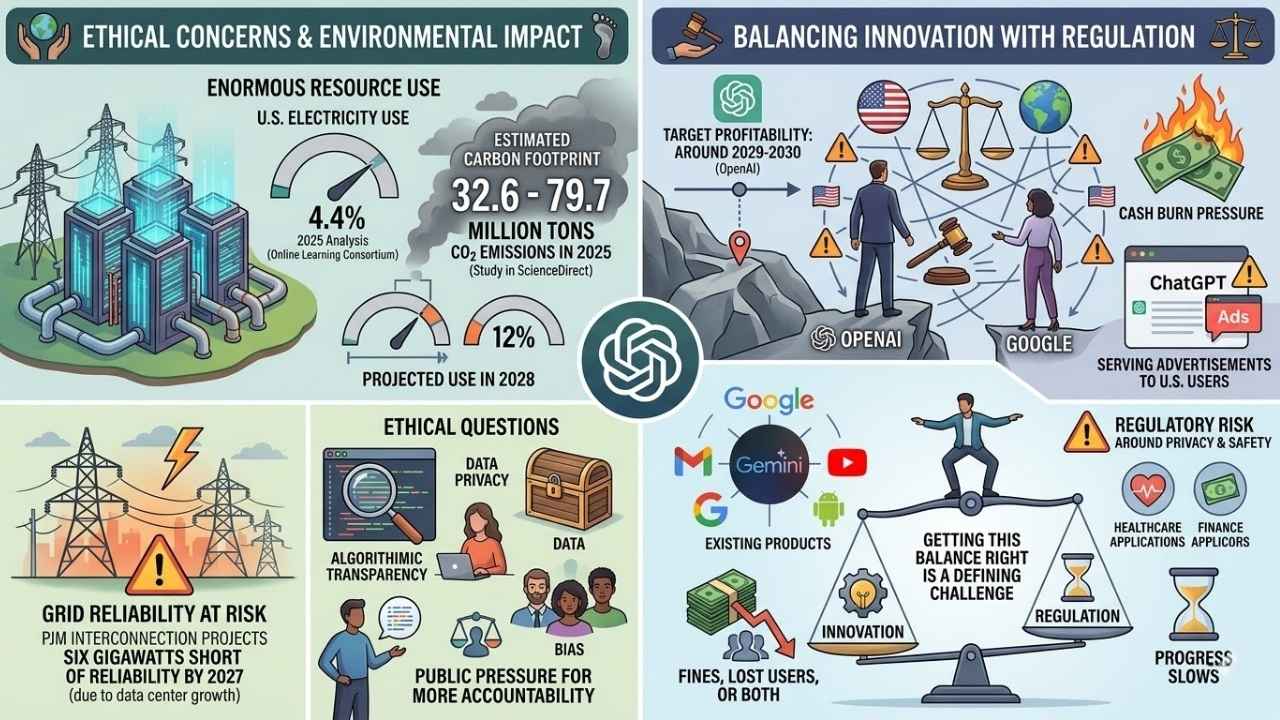
According to a 2025 analysis reported by the Online Learning Consortium, data centers already account for 4.4% of U.S. electricity use, with projections suggesting that could rise to 12% by 2028. A study published in ScienceDirect estimated the carbon footprint of AI systems alone could be between 32.6 and 79.7 million tons of CO2 emissions in 2025.
The energy pressure is real at the grid level too. PJM Interconnection, the largest U.S. grid operator serving over 65 million people across 13 states, projects it could be six gigawatts short of reliability requirements by 2027, partly due to data center growth, according to a CNBC report cited by Common Dreams.
Beyond energy, there are questions about bias, data privacy, and algorithmic transparency. People want AI that’s genuinely safe, not just powerful. Both Google and OpenAI have public commitments to responsible AI development, but the details of how they manage energy use and data practices are often not fully disclosed, which adds to the public pressure for more accountability.
Balancing Innovation with Regulation
OpenAI and Google both face tough choices as U.S. regulators and global governments tighten scrutiny around AI. Racing to push artificial intelligence forward while staying within ethical and legal boundaries is genuinely hard.
OpenAI’s financial situation adds pressure here. The company aims to reach profitability by around 2029 or 2030, but its cash burn means it needs new revenue streams quickly. One move that raised eyebrows: OpenAI announced it would begin serving advertisements to some U.S. users within ChatGPT, a significant shift for a product that built trust partly on being ad-free.
For Google, integrating Gemini into billions of existing products means any misstep reaches a massive audience fast. Every update carries regulatory risk around data privacy and user safety, especially as AI models become more capable of handling sensitive personal information in healthcare and finance applications.
Keeping up with regulations can slow progress. Not following them can lead to fines, lost users, or both. Getting this balance right is one of the defining challenges of the next few years for every company in the AI space.
Final Thoughts
The Google Gemini versus OpenAI story in 2025 is genuinely one of the most interesting tech battles to follow. Both companies are pushing artificial intelligence to new heights, and their competition is making both products better for you.
Gemini’s deep ecosystem integration, multimodal capabilities, and explosive growth in monthly active users make it a serious force. ChatGPT’s massive user base, strong enterprise relationships, and continued model innovation keep it in the lead for now.
Your best move is to try both tools and see which fits your workflow. These are already changing healthcare, business, education, and daily life in meaningful ways. The best way to stay ahead of tomorrow’s tech trends is to get hands-on with these tools today.