Google has announced that its AI Plus subscription plan—a mid-tier option designed to bring more users into its AI ecosystem—has been rolled out to 40 additional countries worldwide. The expansion follows its pilot launch in Indonesia just two weeks ago, signaling Google’s intent to rapidly broaden access to affordable AI services in emerging and developing markets.
This move comes as part of Google’s wider strategy to position AI not just as a premium product, but as an everyday utility that can support productivity, creativity, and collaboration for a global audience.
What is Google AI Plus?
Google AI Plus sits between the free version of Gemini (Google’s flagship AI assistant) and the higher-end AI Pro and AI Ultra tiers. The aim is to provide enhanced AI capabilities at a price point accessible to wider user bases, particularly in countries where affordability is a key factor.
Here’s a closer look at what AI Plus offers:
Cloud Storage & Family Sharing
- Users receive 200 GB of cloud storage across Gmail, Google Drive, and Google Photos.
- The storage can be shared with up to five family members, making it ideal for households managing large amounts of digital content.
Gemini & AI Models Access
- Expanded access to Gemini 2.5 Pro with higher prompt limits.
- Inclusion of Deep Research, Google’s advanced AI search and analysis tool.
- Access to Nano Banana, Google’s image generation and editing tool.
- Limited access to Veo 3 Fast, the video generation model, with a 128K token context window, allowing for more contextually rich AI interactions.
AI Credits and Creative Tools
- Subscribers receive 200 monthly AI credits.
- Credits can be used across platforms like Google Flow (video generation powered by Veo 3 Fast) and Whisk (image-to-video creation using Veo 2).
- Enhanced allowances in NotebookLM, Google’s AI-powered research assistant.
- Access to Gemini’s side panel in Gmail, Docs, Sheets, and other Workspace apps, which allows seamless integration of AI into daily productivity workflows.
Countries Where AI Plus is Now Available
Following its debut in Indonesia, AI Plus is expanding to the following countries:
Africa: Angola, Benin, Burkina Faso, Cameroon, Côte d’Ivoire, Egypt, Ghana, Kenya, Mali, Morocco, Mozambique, Nigeria, Rwanda, Senegal, Tanzania, Togo, Tunisia, Uganda, Zambia, Zimbabwe.
Asia: Bangladesh, Cambodia, Kyrgyzstan, Laos, Nepal, Pakistan, Philippines, Tajikistan, Uzbekistan, Vietnam, Yemen.
Europe: Moldova, Ukraine.
Latin America & Caribbean: Bolivia, El Salvador, Haiti, Honduras, Mexico, Nicaragua.
Pacific: Papua New Guinea.
This wide rollout clearly shows Google’s focus on emerging markets—regions with rapidly growing internet penetration, mobile-first digital habits, and a strong demand for affordable digital services.
Pricing and Regional Differences
Google describes AI Plus pricing as “accessible” and adjusted according to local market conditions.
- In Indonesia, the subscription launched at around Rp 75,000 per month (≈ $4.50 USD).
- In most of the new countries, the plan costs around $5 USD per month.
- Some markets, such as Nepal and Mexico, are receiving introductory discounts of 50% for the first six months to encourage adoption.
Google advises users to check their country-specific pricing via the Google One website or subscription portal, as rates may vary due to exchange rates, taxation, and regional pricing policies.
Comparison With AI Pro and Ultra Plans
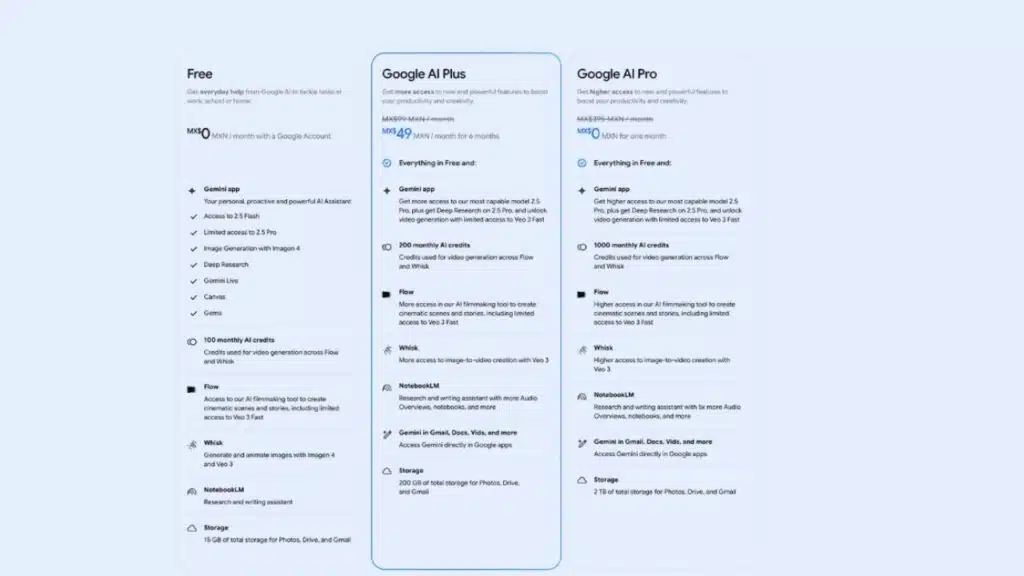
To understand the positioning of AI Plus, here’s a comparison with Google’s higher tiers:
| Feature / Benefit | AI Plus | AI Pro | AI Ultra |
| Storage | 200 GB (shared with 5 family members) | 2 TB | Higher multi-TB storage |
| Gemini Access | Gemini 2.5 Pro, Nano Banana, limited Veo 3 Fast, Deep Research | Full access to Gemini Pro features, larger context | Highest tier models (Veo 3, Deep Think, etc.), unlimited context |
| AI Credits | 200 monthly | 1,000 monthly | 25,000 monthly |
| Workspace AI | Side panel in Gmail, Docs, Sheets | Extended limits | Maximum limits, advanced features |
| Pricing | ~$5 / month | ~$20 / month | ~$40+ / month |
This table highlights AI Plus as a budget-friendly, middle-ground plan, giving users meaningful access to AI without the higher costs of Pro or Ultra.
Why This Expansion Matters
Google’s expansion of AI Plus reflects broader industry trends and its own ambitions:
- Democratizing AI Access: AI is often seen as a luxury due to high subscription costs. AI Plus breaks this barrier, particularly in markets where average income levels are lower.
- Emerging Market Strategy: By targeting countries in Africa, South Asia, and Latin America, Google positions itself as a leader in AI adoption in the Global South, a region expected to host the next billion internet users.
- Competitive Edge: Google is directly competing with OpenAI’s ChatGPT Go and Microsoft’s Copilot offerings. The lower-cost tier ensures Google doesn’t lose ground in markets where affordability dictates adoption.
- Digital Ecosystem Growth: By tying AI Plus into Google One storage, Workspace, Gemini, and NotebookLM, Google strengthens its ecosystem lock-in, encouraging long-term user loyalty.
What Experts Are Saying
Analysts note that Google’s choice of countries is deliberate: these are mobile-first, rapidly digitizing economies with young populations who are more likely to adopt new digital tools. The plan could also provide Google with valuable data on how AI is used in diverse cultural and economic settings.
Additionally, by offering family-sharing and affordable pricing, Google is testing a model that could eventually reshape AI subscription economics worldwide.
Looking Ahead
The expansion of AI Plus is not just about making AI accessible—it’s about preparing for a future where AI becomes as common as email or search. With competitors like OpenAI, Anthropic, and Microsoft intensifying their global strategies, Google’s push into 40+ new countries ensures it stays at the forefront of the AI subscription economy.
For users, this expansion means easier access to powerful AI tools at an affordable price, while for Google, it represents another step toward its goal of making AI an everyday global utility.