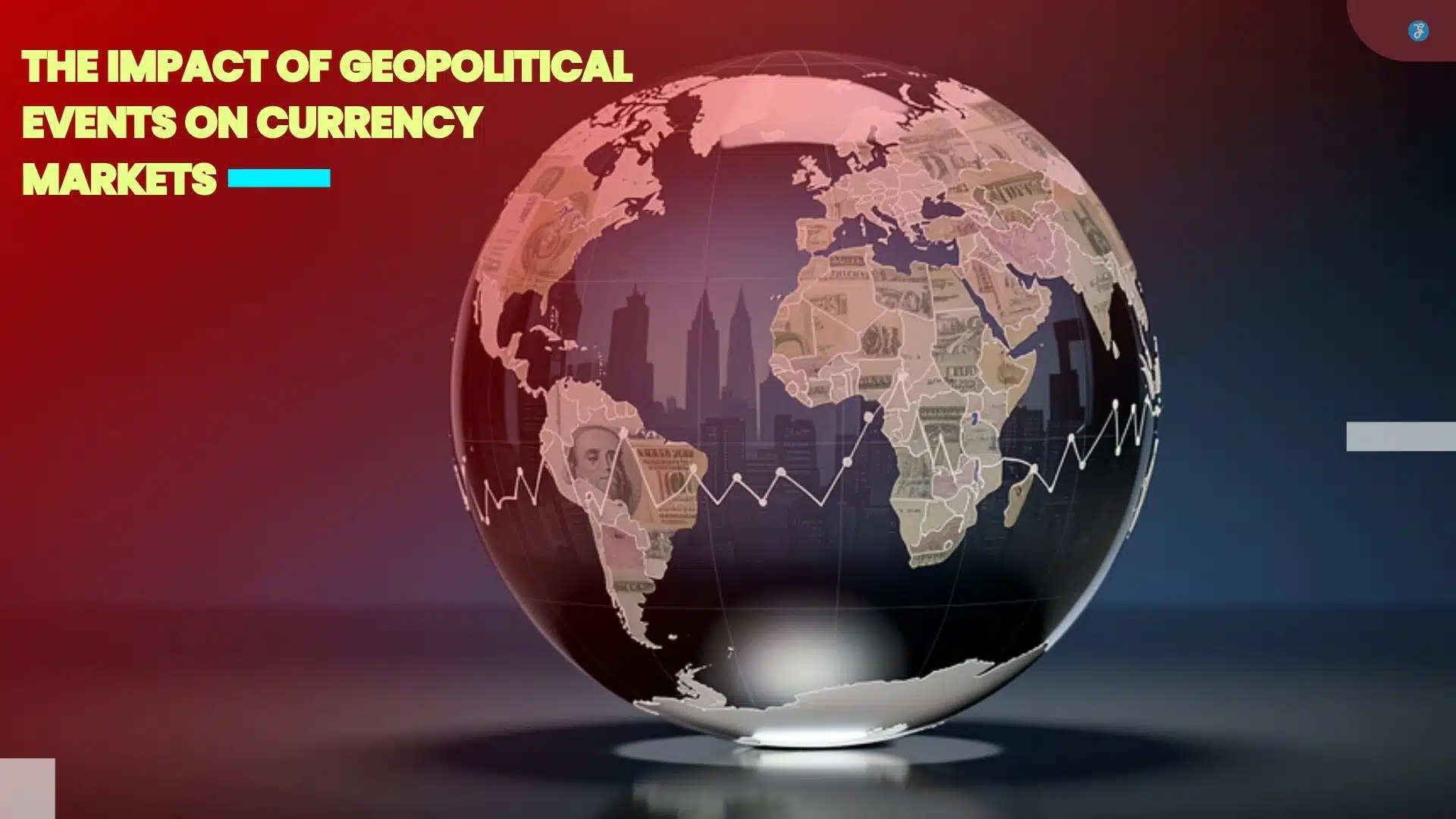
Geopolitical Events On Currency Markets can trigger sudden and powerful shifts in forex trading, directly impacting investment value. Elections, conflicts, and trade disputes often lead to sharp currency fluctuations, increasing market volatility and uncertainty for traders and investors.
Global tensions and geopolitical risks frequently disrupt currency stability, making exchange rates unpredictable. Events like the Russia-Ukraine conflict, which began on February 24, 2022, caused the Russian ruble to drop nearly 50% against the U.S. dollar, while safe-haven currencies such as the Japanese yen strengthened as investors sought stability.
Understanding how Geopolitical Events On Currency Markets influence investor sentiment, central bank decisions, and global trade is essential. By recognizing signs of geopolitical instability, managing risk effectively, and applying hedging strategies, traders can better navigate foreign exchange markets and protect their portfolios.
What Are Geopolitical Events?
Geopolitical events mix politics with land and power, sparking big changes across borders. Wars like the Russia-Ukraine clash, elections, and trade fights show how they rattle global ties, and you might wonder what that means for your wallet.
Definition and Examples
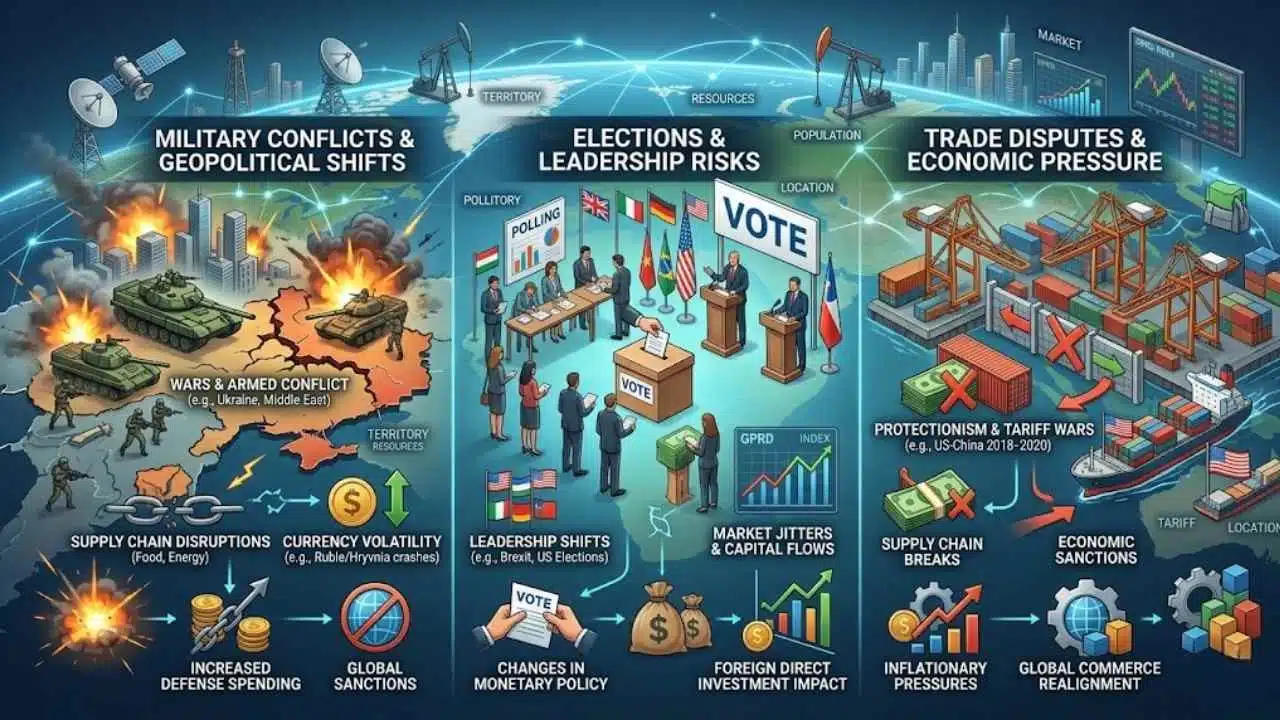
Geopolitics looks at how factors like territory, resources, population, and location shape political power in international relations. These events hit forex markets hard, sparking changes in trade policy, economic sanctions, military conflicts, territorial disputes, political instability, leadership shifts, diplomatic tensions, and supply chain breaks.
Think of them as storms that rock the boat of global finance, leading to big swings in exchange rates. Wars, trade disputes, and diplomatic talks count as prime examples, stirring up uncertainties from armed conflicts and civil unrest.
Geopolitical risks encompass uncertainties arising from armed conflicts, trade disputes, and political instability. – GPRD index insight
Picture the Russia-Ukraine war, which kicked off on February 24, 2022, jacking up tensions and slamming currencies like the Ukrainian hryvnia. Or consider Middle East clashes, where oil prices spike over $100 a barrel and chokepoints like the Strait of Hormuz disrupt energy markets.
Protectionism in US-China trade spats fuels inflationary pressures, while elections in places like the European Union or India shake capital flows and equity markets. Category 1 studies from sources like S&P Global show how these risks jolt commodities, stocks, and foreign exchanges, highlighting global interconnectedness in the international monetary system.
Types of Geopolitical Events (e.g., Military Conflicts, Elections, Trade Disputes)
Geopolitical events shake up the world like a sudden storm, catching traders off guard and sparking wild swings in currency values. You know, these happenings range from wars to votes, each one packing a punch that ripples through financial markets and stirs up currency volatility.
- Military conflicts ignite chaos in global markets, think of the Russia-Ukraine war that kicked off on February 24, 2022, slamming the Russian ruble with a 50% drop against the USD from harsh sanctions. These clashes disrupt resource access, like wheat and corn supplies, leading to economic disruption and spikes in natural gas prices. Picture defense spending soaring as nations scramble, fueling geopolitical fracturing and shifts in trade alliances. Eastern Europe felt the heat hard, with capital flight and long-term hits to economic resilience.
- Elections spark uncertainty that rattles monetary policy and investor relations, just like the Brexit referendum in 2016 that tanked GBP/USD by 10% to 31-year lows amid fears of economic policy uncertainty. Leadership changes trigger quick market jitters, as folks worry about fresh directions in international markets and foreign direct investment. Imagine voters flipping the script, causing ripples similar to those in the global financial crisis, where credit and risk factors loomed large.
- Trade disputes brew tensions that reshape economic integration, take the US-China trade war from 2018 to 2020, which hammered the Chinese yuan with a 12% depreciation during peak clashes over tariffs and sanctions. These spats alter commerce patterns, hitting critical minerals and energy transition efforts, much like ongoing Middle East tensions from 2024 to 2025 that pressured regional currencies. Envision diplomatic rows versus cooperation, driving capital flight and volatility in spots like Canada or South Korea, all while groups like the IMF and World Economic Forum watch the fallout on sustainability and technology & AI fronts.
How Geopolitical Events Influence Currency Markets
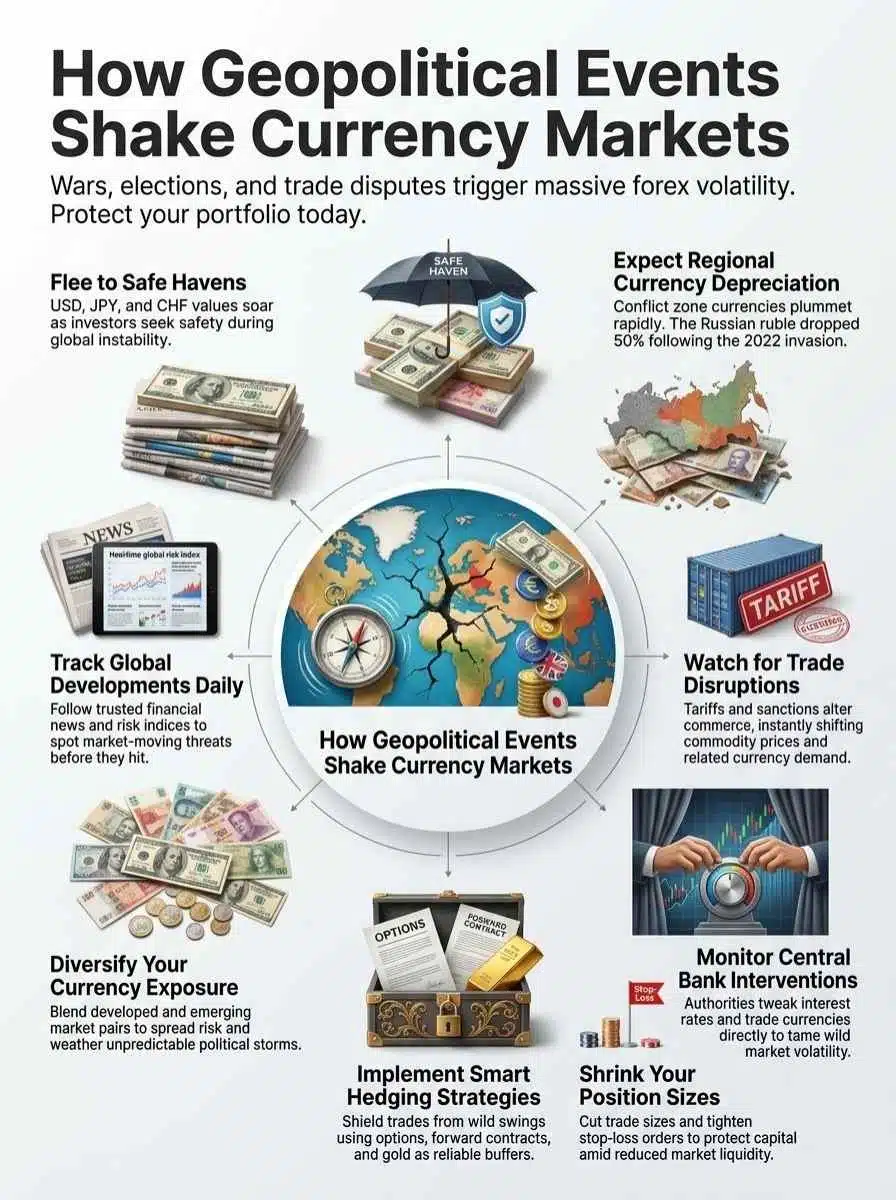
Wars and elections can send shockwaves through forex markets, spiking prices in a flash. Traders watch safe-haven currencies like the dollar soar, while others in troubled spots plunge, as seen in the Russia-Ukraine war data from S&P Global Market Intelligence.
Immediate Currency Volatility
Geopolitical tensions spike forex volatility right away, folks. Shifts in risk sentiment drive this wild ride. Market speculation pushes currency movements before events even hit, like investor apprehension building up to 10 days prior to April 13, 2024.
Imagine the Russia-Ukraine war shaking things up, with energy stocks posting big negative returns that very day. You see, cumulative average abnormal returns turned positive beforehand and flipped negative after.
S&P Global Market Intelligence tracks these patterns, showing how GPR predicts rapid market shifts within one day, fading in a quarter.
Wider spreads and low liquidity jack up transaction costs during these times, making trades tough. Take the Brexit referendum in 2016; EUR/GBP volatility soared over 500 pips. Observable changes in risk roles and market pathways happen fast due to geopolitical risk.
Gita Gopinath might note this in World Economic Outlook reports. Energy markets respond especially, as S&P Global Energy data reveals. Credit & risk factors intensify, leading to capital flight and hasty decisions.
Long-Term Valuation Shifts
Wars and trade policy changes shape long-term currency trends. They spark sustained demand shifts for specific currencies. Take the Russia-Ukraine war, for example. Sanctions hit the Russian ruble hard, causing its value to drop.
The Ukrainian hryvnia felt intense pressure too. Companies with top S&P Global ESG Scores pulled out of Russia faster. Basnet and team found in 2022, via Finance Research Letters, these firms faced fewer bad market reactions after leaving.
Currencies in nations deep in global value chains depreciate more at first from geopolitical risks. Yet, over time, things flip. South Africa, Brazil, Australia, and Iceland saw their currencies rise after a year of shocks.
Studies with structural vector autoregression models show this pattern. They reveal depreciations in places like China, Israel, the Philippines, and the United States from risk shocks.
Researchers checked 35 countries and spotted big differences in responses. This variability matters a lot. It pushes for policies that back countries tied to global chains. Fixed income investors watch these shifts closely.
Private markets feel the ripple effects too. Imagine your portfolio as a boat in stormy seas; these long-term changes decide if it sails smooth or hits rocks. S&P Dow Jones Indices track such trends, offering insights for smart moves.
Risk Sentiment and Safe-Haven Flows
Geopolitical events shake up risk sentiment in currency markets, folks. Traders flee to safe-haven currencies like the US dollar, Swiss franc, and Japanese yen during global uncertainty.
Imagine, it’s like investors hunkering down in a storm cellar when trouble brews. Safe-haven inflows spiked demand for the USD and JPY amid the US-China trade disputes, boosting their value.
The USD hit unprecedented strength in 2020 during the COVID-19 pandemic as the global reserve currency. Switzerland’s neutral stance draws capital in crises, so the Swiss franc appreciates, even against central bank moves.
Japan’s current account surplus and low interest rates prop up the yen in risk-off times, much like a reliable old friend. Gold serves as a traditional store of value in political instability, affecting currencies like the Australian dollar and South African rand.
The USD gains from this flight to quality, thanks to its deep, liquid Treasury markets.
Investors watch these flows closely, especially in events like the Russia-Ukraine war. S&P Global Ratings often highlights how such tensions drive volatility. Safe-haven demand strengthened the USD/JPY pair from 2024 to 2025 during Middle East tensions.
You know, it’s like money rushing to the safest harbors when waves get rough. Currency depreciation hits affected regions hard, prompting capital flight. Trade disruptions add fuel to the fire, shifting long-term valuations.
Central banks step in with interventions, but safe-havens still shine. Diversify your exposure, readers, to ride these waves.
Key Impacts on Currency Markets
Geopolitical shocks hit currency values hard, like a sudden storm shaking a boat on open water. Traders watch these changes closely, using tools from S&P Capital IQ Pro to spot safe-haven shifts in dollars, yen, and francs amid the chaos.
Safe-Haven Currency Appreciation (USD, JPY, CHF)
Safe-haven currencies shine bright during tough times, like the U.S. Dollar, Japanese Yen, and Swiss Franc. Investors flock to them for safety amid geopolitical storms. Think of the USD as the world’s top reserve currency.
It gains from that “flight to quality” rush when uncertainty hits. Deep, liquid Treasury markets back it up strong. Imagine this, folks, in the Brexit referendum back in 2016, the CHF and JPY climbed in value fast.
Switzerland’s solid banking system and stable setup keep the Swiss Franc rising, even if central banks step in. Japan’s current account surplus makes the Yen a go-to during risk-off moods, thanks to those low interest rates.
Yen strength shows up clear in pairs like USD/JPY, which often drops in crises. Take the US-China trade war, for instance. Safe-haven flows pumped up demand for USD and JPY. Or look at the Russia-Ukraine war; it pushed folks toward these currencies too.
Investors chase them in tensions, dodging risks elsewhere. Hey, it’s like grabbing an umbrella before the rain pours. Entities like S&P Capital IQ Pro help track these shifts, offering insights on market moods.
Tools from Charles Schwab let traders adjust quickly. Diversify with care, and you stay ahead in forex games.
Currency Depreciation in Affected Regions
Geopolitical tensions hit currencies hard in troubled spots. Take the Russia-Ukraine war, for instance. The Russian ruble dropped 50% against the USD right at the start. Investors fled, seeking safety elsewhere.
The Ukrainian hryvnia took a beating too, under massive pressure. Countries hooked on Russian energy suffered even more, their economies shook up. Picture it like a leaky boat in a storm, folks jump ship fast.
Emerging market currencies weaken as cash flows to stable places during crises. During the US-China trade disputes from 2018 to 2020, the Chinese yuan fell 12%. That hurt traders betting big.
Brexit in 2016 slammed the British pound. GBP/USD plunged 10% to 31-year lows. Ouch, that stung investors. In the COVID-19 mess of 2020, emerging market currencies slid 15% to 30%.
Politically shaky areas see their money depreciate when folks chase safer assets. Think of it as a game of musical chairs, no one wants the risky seat. Reports from The Economist highlight these shifts.
Even in trade blocs like Mercosur, disputes ripple out. Corporate responsibility plays a role, firms eye stable spots. S&P Global Mobility tracks how these events shake auto sectors, tying into broader currency woes.
Trade Disruptions and Capital Flight
Sanctions and tariffs spark trade flow disruptions. They alter international commerce patterns. This affects currency demand right away. Look at the Russia-Ukraine war, folks. It disrupted agricultural production and supply chains.
Prices for commodities like wheat and corn shot up. Rising energy prices from that conflict hiked inflation for consumers, you know. Commodity price volatility messes with energy and agricultural supplies.
This impacts commodity-linked currencies big time. During the US-China trade disputes, AUD/USD fell. Reduced commodity demand from China caused that drop. Events like the world petrochemical conference highlight these shifts in energy markets.
Middle East tensions from 2024 to 2025 brought oil price volatility. That influenced currencies tied to resources.
Political instability drives capital flight patterns. Capital flows from emerging markets to developed economies fast. Investors seek safety, like during the Russia-Ukraine conflict.
Commodity currencies such as NOK and CAD strengthened then. Increased resource prices fueled that rise. Think of it as money running to a cozy bunker in tough times. Tools like spice: the index source for esg data help track these flows.
Conferences such as ceraweek discuss energy impacts on capital moves. Breakbulk26 events focus on logistics disruptions too. Ratings360 provides insights into credit risks amid this chaos.
Autocreditinsight aids in assessing auto sector hits from trade breaks. Even artificial intelligence analyzes these patterns for traders.
Role of Central Banks During Geopolitical Crises
5. Role of Central Banks During Geopolitical Crises: Central banks act fast in tense times, like the Federal Reserve cutting rates to boost confidence or the Bank of Japan buying yen to curb wild swings, steadying the ship when wars or disputes rock global markets—curious about their exact moves? Stick around for the details.
Interest Rate Adjustments
Central banks step in during geopolitical crises, like the Russia-Ukraine war, by tweaking interest rates. They cut or raise these rates to steady their currency, folks. Monetary authorities make these moves to counter wild swings in forex markets.
Imagine a central bank slashes rates to boost spending and calm nerves amid chaos. Or they hike them to draw in cash and fight inflation spikes from trade disruptions. These policy responses can amp up or dial down the fallout from events that shake global trust.
Take the COVID-19 mess in 2020, central banks teamed up and their coordination finally tamed the markets. They sometimes jump right into forex trading too, buying or selling currencies to curb extremes.
Yet, safe-haven stars like the Swiss Franc still climb, even with these efforts, showing how policy hits a wall against big money rushes. Investors feel the shift in mood, as these actions tweak risk vibes and push smart folks to watch closely.
Keep an eye on these plays, they guide your next trade in tense times.
Foreign Exchange Market Interventions
Geopolitical crises push central banks to act fast in forex markets. They buy or sell currencies to steady their own money. Imagine a ship captain steering through a storm, that’s how these banks work to calm wild waves of volatility.
Traders watch policy statements closely for hints of moves. Such actions can ease or boost swings in currency values during shocks like the Russia-Ukraine war. In that conflict, Russian and Ukrainian banks dealt with huge pressures to handle their currencies.
Swiss National Bank steps in often to curb Swiss franc gains in tough times.
These interventions sometimes widen spreads and cut liquidity, which hikes costs for trades amid tensions. Coordination among banks, as seen in the COVID-19 crisis, helped steady markets worldwide.
Emerging market banks struggle if reserves run low in long crises, limiting their defense. Picture traders on edge, scanning news for bank signals. Forex players adjust strategies, knowing these moves shape the game.
Managing Geopolitical Risks in Forex Trading
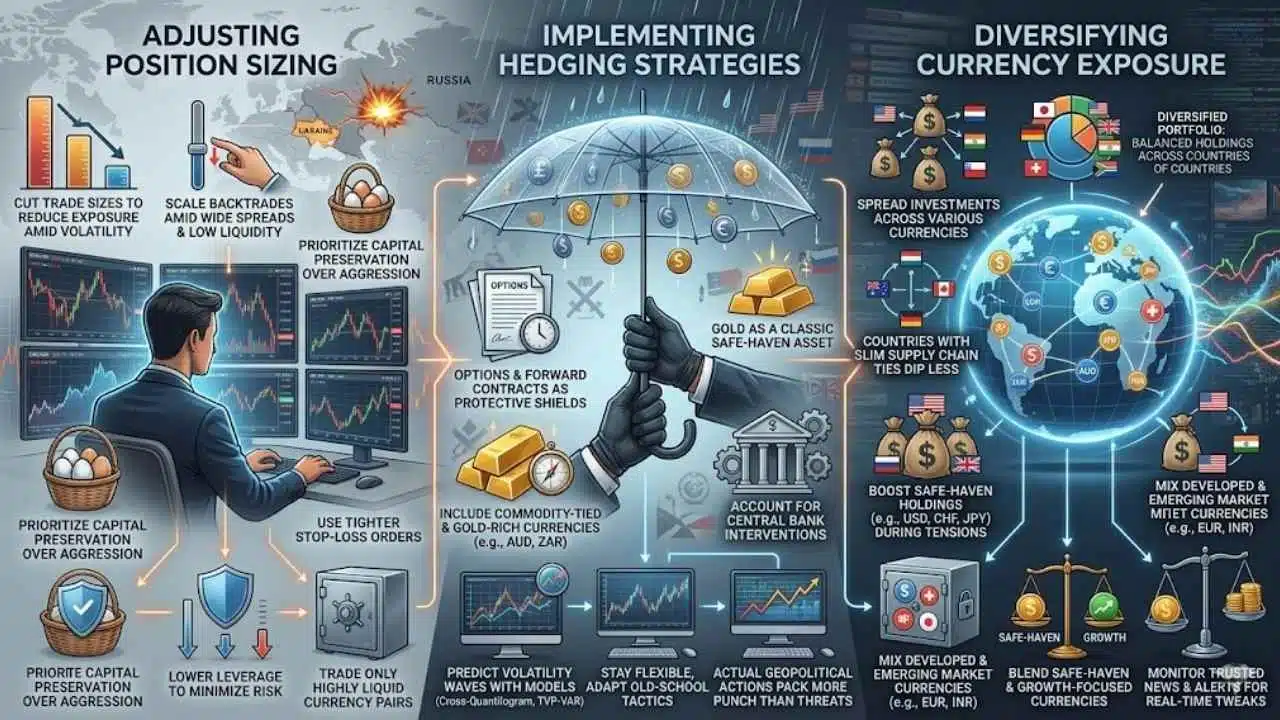
Imagine, you’re trading forex and a sudden election or border clash sends prices on a rollercoaster ride, but you can fight back with smart moves like cutting your trade sizes to dodge big hits, setting up currency options as shields against wild swings, and mixing up your pairs, say blending euros with yen, to spread out the danger—eager for real examples that could save your account? Keep scrolling!
Adjusting Position Sizing
Geopolitical events shake up currency markets in wild ways. Traders like you need smart moves to stay ahead, especially with things like the Russia-Ukraine war stirring the pot.
- You cut down on position sizes to dodge big losses when volatility spikes from geopolitical tensions, think of it as not putting all your eggs in one basket during a storm.
- Flexible position sizing acts as your shield, it lets you protect capital by scaling back trades amid wider spreads and reduced liquidity that jack up transaction costs.
- Lower leverage pairs well with adjusted positions, this combo minimizes risk and keeps your investments safe from sudden market swings.
- Tighten those stop-loss orders alongside smaller positions, you safeguard your funds against the chaos of events like the Russia-Ukraine war.
- Prioritize capital preservation with this approach, ditch aggressive strategies for ones that focus on survival in tense times.
- Trade only highly liquid currency pairs while resizing positions, this ensures smoother deals and avoids getting stuck in low-liquidity traps.
- Effective risk management demands these tweaks, they help you weather heightened political tensions without major wipeouts.
Implementing Hedging Strategies
Hedging strategies shield your trades from wild swings in currency markets during tense times. Traders often turn to these tools to stay ahead of the curve, like a financial umbrella in a storm.
- Options and forward contracts serve as key hedging tools that guard against bad currency shifts sparked by geopolitical events, much like a safety net for your portfolio when tensions rise, say, in the Russia-Ukraine war.
- Gold stands out as a classic safe spot for value during political chaos, so add it to your mix as a hedging asset to weather the ups and downs.
- Include currencies tied to commodities, plus those from gold-rich spots like AUD for Australia and ZAR for South Africa, in your hedging setup during big events to spread out risks and catch some upside.
- Central banks jump in with moves that shake up hedging plans, since their quick tweaks to currency values can flip the script on your protections overnight.
- Models like cross-quantilogram and time-varying parameter vector autoregressive point to how geopolitical risks predict volatility waves, guiding you to smarter hedging steps based on solid data.
- Shifts in market risk from these risks often upend old-school hedging tactics, so stay flexible, like adjusting sails in shifting winds, to keep your strategy strong.
- Factor in the fast start and long haul of volatility after shocks hit, because your hedging needs to match that pace to avoid getting caught off guard.
- Actions in geopolitics pack more punch in predictions than mere threats, so weigh that difference when picking your hedging moves to boost their edge.
Diversifying Currency Exposure
Diversifying your currency exposure acts like a safety net in stormy forex seas. It shields your portfolio from wild swings caused by events like the Russia-Ukraine war.
- Spreading investments across various currencies cuts down geopolitical risk’s bite on your portfolio, much like not putting all eggs in one basket during a shaky market ride.
- Countries with slim ties to global supply lines see their currencies dip less sharply in the short run amid crises, so think about adding those to your mix for a smoother sail.
- Boost holdings in safe-haven picks like the USD, CHF, and JPY when tensions rise, as this move cushions blows from events that spike uncertainty.
- Unstable times from geopolitics bring volatility and threats, yet they open doors for smart traders who adapt quickly and seize chances in the flux.
- History shows no sure bets for what’s next, but diversification steps in to tame the unknown and keep your trades steady.
- Keep your ear to the ground with trusted news and live alerts, so you tweak your spread-out strategies on the fly and stay ahead of shifts.
- Mix developed and emerging market currencies in your lineup to blunt the sting from area-specific troubles, like those in ongoing conflicts.
- Shifts in how folks feel about risk during political storms underline why you need a blend of safe-haven and growth-focused currencies to weather the ups and downs.
Case Studies of Geopolitical Events Impacting Currencies
Imagine a global chess game where nations move, and currencies react in wild swings, like during major conflicts that send shockwaves through forex markets. Explore real-world examples, such as wars and trade spats, to see how the ruble plunged or the yuan wobbled, and grab those insights to sharpen your trading edge.
Russia-Ukraine Conflict
Russia invaded Ukraine on February 24, 2022, sparking the russia-ukraine war and ramping up global tensions. The Russian ruble dropped 50 percent against the U.S. dollar right away, like a house of cards tumbling in a storm.
Traders watched in shock as EUR/USD pairs weakened from energy security fears, hitting European markets hard. Commodity currencies, such as the Norwegian krone and Canadian dollar, gained strength amid soaring resource prices, a silver lining for some investors.
Nations hooked on Russian energy faced bigger hits, especially those with high economic policy uncertainty.
Countries near Russia and Ukraine felt the pain most, with disrupted farms and supply lines jacking up wheat and corn costs. Think of it as a chain reaction, where one domino falls and knocks down the rest.
Studies from experts like Boungou and Yati in 2022, plus Yousaf and team that same year, dug into these market shakes. Zhou and Lu in 2023, Basnet’s group in 2022, Ahmed’s crew in 2023, and Kamal’s folks in 2023 all spotlighted the fallout.
Safe-haven flows rushed to the USD, JPY, and CHF, while capital fled affected spots, amplifying volatility in forex trading.
US-China Trade Disputes
The US-China trade war kicked off in 2018 and lasted until 2020. Tensions rose with big changes in trade policy and tariffs. These shifts shook up international commerce patterns and currency demand.
Imagine this, folks, like two giants wrestling over a pile of cash, currencies got caught in the crossfire. The Chinese yuan dropped by 12% during the peak of it all. AUD/USD pair tumbled too, hit hard by lower commodity demand from China.
Safe-haven inflows pumped up demand for USD and JPY, you know, those go-to spots when things get dicey.
This mess sparked wild volatility in global forex markets, especially for emerging market currencies. Market speculation drove moves even before real policy changes hit. Central banks jumped in, tweaking interest rates to counter the heat.
It shone a light on how commodity-linked currencies and those from emerging markets suffer from geopolitical risk. Think about it, similar vibes to the russia-ukraine war, where safe havens shine and others sink.
Traders felt the burn, adjusting strategies on the fly to dodge the chaos.
Lessons for Investors and Traders
Traders, picture yourself dodging market storms like a pro sailor spotting dark clouds early. Spot global news fast, and build your toolkit with stop-loss orders to shield against wild swings, sparking curiosity for deeper strategies ahead.
Monitoring Geopolitical Developments
Stay on top of global news to spot risks early in forex trading. You need credible sources for this, like trusted financial news outlets, official government statements, and analyses from financial experts.
Picture yourself as a detective, piecing together clues from daily updates. The GPRD index helps a lot here; it provides daily data on geopolitical risks, including government policies, trade tensions, civil unrest, and conflicts.
Experts stress the value of watching central bank statements too, along with how markets react to them. This approach keeps you ready for shifts caused by events like the Russia-Ukraine war.
Studies back this up with solid evidence. One paper, “Exchange Rate Instabilities During the Russia-Ukraine War: Evidence from V4 Countries,” looked at daily data from February 1, 2022, to February 1, 2023.
It appeared in the Journal of Stock & Forex Trading, which sits in indexes like Open J Gate, Genamics JournalSeek, and Academic Keys. That journal boasts 813 citations on Google Scholar.
Check out related reads for more insights, such as “Is Geopolitical Risk Interconnected? Evidence from the Russian-Ukraine Crisis” by S. Ahmed and team from 2023. Another good one is “The Role of ESG in the Decision to Stay or Leave the Market of an Invading Country: The Case of Russia” by A.
Basnet and others from 2022. These resources sharpen your edge in tracking developments.
Preparing for Volatile Market Conditions
Geopolitical tensions, like the Russia-Ukraine war, often spark wild swings in currency markets. You face wider spreads and lower liquidity then, which hikes transaction costs and makes trades tougher to pull off.
Focus on highly liquid pairs, such as USD/EUR, to keep things smooth. Picture your portfolio as a ship in a storm; you batten down the hatches by reducing leverage right away. That cuts your risk big time.
Traders, prioritize safe-haven currencies like the USD during these uncertain times, they tend to climb in value. Tighten those stop-loss orders to shield your investments from sudden drops.
Capital preservation beats bold moves every time in volatility. Use flexible position sizing and diversification as your safety net; they guard your funds amid the chaos. Past results offer no promises, so adapt constantly to stay ahead.
Final Thoughts
Geopolitical events shake up currency markets, from quick volatility in safe-haven assets like the US dollar to long-term shifts in trade flows and capital flight. Traders can easily manage these risks by adjusting position sizes, hedging with options, and diversifying across currencies, keeping things simple and effective even in wild times.
Have you checked your portfolio for exposure to elections or conflicts lately? Spotting these impacts early boosts your trading edge, turning potential losses into smart gains amid global uncertainty. Explore forex news sites for more insights, or chat with a broker about customized strategies, and staying alert is your best bet against market surprises.