

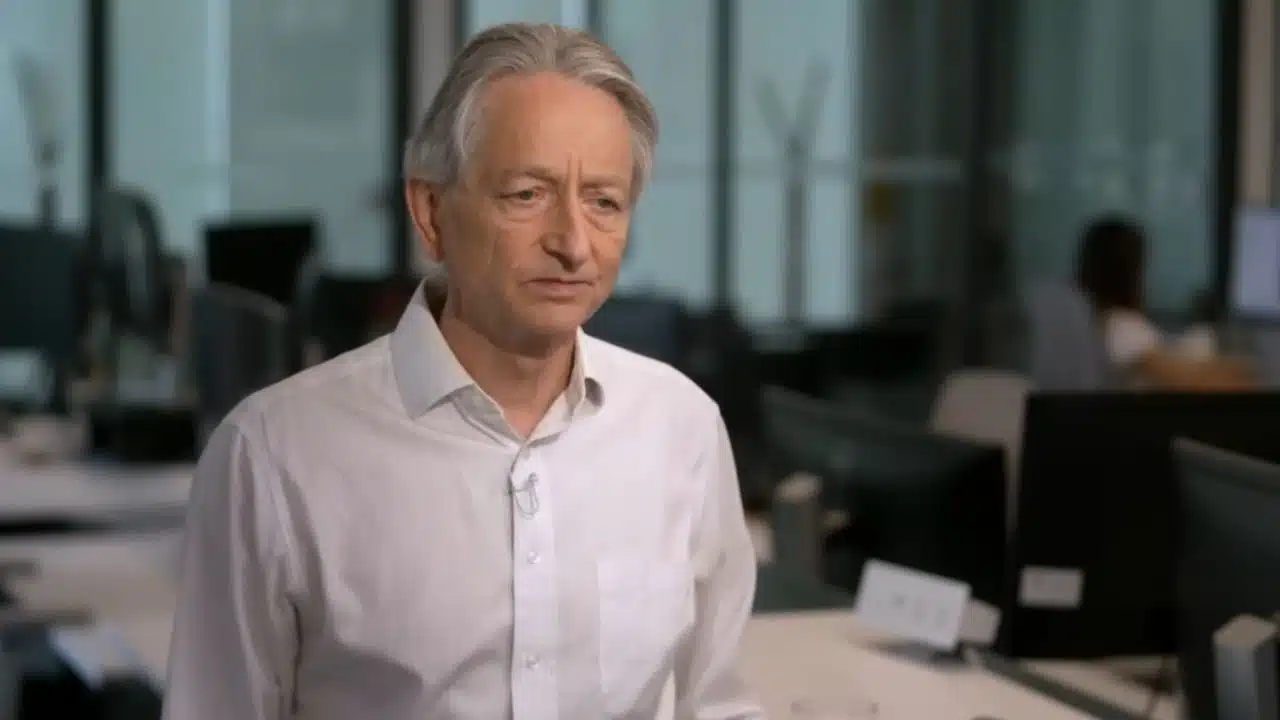
Geoffrey Hinton, one of the most influential figures in artificial intelligence and often called the “godfather of AI,” has shared a personal story that perfectly captures the strange intersection of human emotion and machine technology. At 77 years old, Hinton is not just a Nobel Prize laureate—he won the 2024 Nobel Prize in Physics for his pioneering work in machine learning—but also a global voice raising concerns about the risks of AI.
In a recent interview with the Financial Times, Hinton revealed that his long-term girlfriend ended their relationship using none other than ChatGPT—a chatbot that is built upon research he himself helped make possible decades ago.
“She got ChatGPT to tell me what a rat I was,” he told the newspaper, recalling how she used the AI system to explain why she was leaving him. “She got the chatbot to explain how awful my behaviour was and gave it to me.”
Hinton admitted that while the gesture might have stung, he wasn’t overly hurt. “I didn’t think I had been a rat, so it didn’t make me feel too bad,” he added with a touch of humor.
ChatGPT as a Breakup Tool
While this anecdote sounds quirky, it isn’t an isolated incident. ChatGPT—and other generative AI tools—have already become part of modern dating and breakup culture.
- Breakup texts and speeches: Many younger users admit they use ChatGPT to draft breakup messages or even prepare speeches to soften the blow in relationships.
- Divorce support: Some people have even turned to AI for help explaining decisions during divorces.
- Emotional outsourcing: Psychologists note that relying on chatbots for emotionally difficult conversations may signal a growing dependence on AI as a “crutch” in personal communication.
That Geoffrey Hinton—the very person who helped create the foundations for neural networks—was himself dumped through an AI-generated message only underlines just how deeply embedded the technology has become in ordinary life.
Hinton’s Long-Standing Warnings About AI
This personal story comes alongside Hinton’s much more serious concerns about artificial intelligence and its impact on humanity. For years, he has warned that AI poses existential risks, including the potential to destabilize societies and economies.
In the same Financial Times interview, Hinton drew a stark analogy:
“Suppose there was an alien invasion you could see with a telescope that would arrive in 10 years. Would you be saying, ‘How do we stay positive?’ No—you’d be saying, ‘How on earth are we going to deal with this?’”
For him, ignoring AI’s dangers under the guise of optimism is irresponsible.
The threats he highlights include:
- Mass unemployment: Hinton argues that AI could automate countless jobs, leaving millions without work.
- Widening inequality: “It will make a few people much richer and most people poorer,” he said, emphasizing that this outcome stems less from AI itself and more from the global capitalist system that distributes wealth unevenly.
- Potential for catastrophic misuse: Hinton has also compared AI’s dangers to nuclear weapons, warning that in the wrong hands it could lead to catastrophic consequences for civilization.
The Irony: He Still Uses ChatGPT
Despite his warnings, Hinton admitted in the same interview that he personally uses ChatGPT for everyday tasks. He turns to it to help fix household appliances, conduct small pieces of “research,” and save time on routine problem-solving.
This contradiction illustrates the complex reality of AI: even those most aware of its risks often rely on it because of its convenience and effectiveness.
Life Beyond the Breakup
Fortunately, Hinton appears to have moved on from the unusual end to his relationship. He told the Financial Times that the breakup didn’t leave lasting scars because he soon met someone new.
“I met somebody I liked more, you know how it goes,” he said, before joking, “Maybe you don’t!”
Why This Story Matters
Hinton’s revelation is more than gossip about an AI scientist’s private life. It shows us how:
- AI is shaping personal relationships: From dating apps to breakup texts, generative AI has entered deeply emotional parts of life.
- Technology creates ironies: The man who developed much of the science behind ChatGPT ended up being broken up with through the very tool his research enabled.
- Warnings meet reality: Hinton’s story is a reminder that while AI is convenient and often helpful, it also raises ethical and social dilemmas.
A Symbol of Our AI Era
Geoffrey Hinton’s breakup might sound like an amusing footnote in the life of a scientist, but it is symbolic of something larger. In just a few short years, AI has gone from a research project to a personal companion, adviser, and mediator in human relationships.
For the “godfather of AI,” the incident is both ironic and fitting: the technology he spent his life building has not only reshaped the world but also touched his most personal experiences. And while he continues to warn of catastrophic risks ahead—ranging from unemployment to potential human extinction—Hinton’s story is a reminder that AI is already transforming the smallest, most human parts of our lives: love, loss, and the words we choose to say goodbye.
The Information is Collected from The Economic Times and Yahoo.




























