Remember when everyone said 2025 would be the year VR finally replaced your TV? Well, that didn’t quite happen. But as we settle into 2026, the gaming industry isn’t just promising a revolution anymore—it’s actually delivering one. We’ve moved past the “hype cycle” of generative AI and clunky headsets into an era of utility.
The shift this year is palpable. It’s no longer about what technology might do; it’s about what it’s doing right now in your hands. From handheld PCs that rival desktops to AI that acts more like a Dungeon Master than a chatbot, the rules of play are being rewritten.
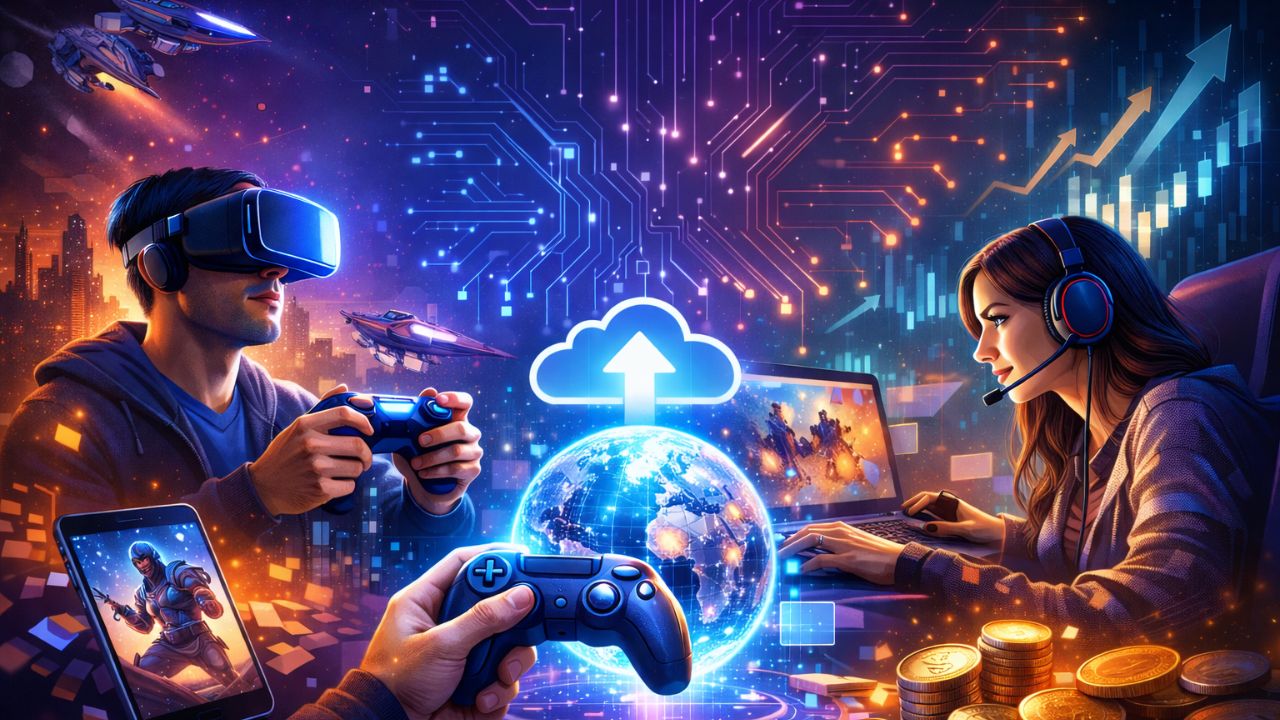
If you’re trying to understand where the $200+ billion industry is headed, you need to look beyond the console wars. The Gaming Trends 2026 landscape is defined by accessibility, immersion, and a complete rethink of how we buy and play games. Let’s dive into the seven massive shifts defining this year.
1. AI Beyond the Hype: The Rise of “Smart” NPCs
Let’s be real—we were all a bit skeptical when studios first started talking about AI. But in 2026, Artificial Intelligence isn’t just a buzzword; it’s the engine under the hood. We aren’t talking about AI generating bad art anymore. We’re talking about “Smart NPCs” (Non-Player Characters) that don’t rely on a script. Large Language Models (LLMs) have been optimized to run locally on consoles and high-end PCs. This means the shopkeeper in your RPG doesn’t just have three lines of dialogue; they remember you stole an apple three towns back and raise their prices accordingly. This dynamic storytelling is creating worlds that feel genuinely alive, reacting to your playstyle in real-time.
Beyond gameplay, AI is doing the heavy lifting in development. It’s handling the boring stuff—QA testing, bug hunting, and texture upscaling—freeing up human developers to focus on the creative sparks that machines can’t replicate. We are seeing “AI Native” workflows that are cutting production timelines by nearly 40%, allowing smaller teams to build massive, sprawling worlds that previously required hundreds of developers. The most exciting application is the “AI Director.” Imagine a horror game that tracks your heart rate via your controller or wearable. If you aren’t scared enough, the AI dims the lights or spawns a monster. If you’re stressed, it backs off. This level of personalization is becoming the new standard for AAA titles.
| Metric | 2026 Data Points |
| Market Size | Generative AI in gaming is forecast to hit approx. $55.5 billion this year. |
| Adoption | Over 60% of studios are now using AI for asset creation or QA. |
| Player Impact | 25% increase in player retention for games using dynamic, AI-driven narratives. |
| Key Tech | On-device LLMs (reducing latency/cloud costs) & Biofeedback integration. |
2. The Portable Revolution: Handhelds Are the New Standard

Gone are the days when “portable gaming” meant sacrificing performance. With the maturity of the handheld PC market—led by the Steam Deck’s successors and competitors like ASUS and Lenovo—high-fidelity gaming is now mobile by default. This is the “Switch 2 effect.” As Nintendo pushes the boundaries of what a hybrid console can do, the entire PC hardware industry has followed suit. We are seeing Windows on Arm chips and optimized Linux OS builds that allow you to play Cyberpunk-level titles on a device that fits in your backpack, with battery life that actually lasts a cross-country flight.
The market has shifted toward “multifunction” devices. These aren’t just game consoles; they are full PCs with detachable controllers, bridging the gap between a tablet and a gaming rig. This portability is driving a surge in “cross-save” functionality, where players expect to move seamlessly from their desktop rig to their handheld without losing a second of progress. Battery anxiety is finally being addressed with solid-state battery tech trickling into consumer hardware, offering higher energy density and faster charging. It’s changing where we play. The “gaming den” is dying. In 2026, the couch, the train, and the coffee shop are all equally viable battle stations.
| Feature | 2026 Trend Details |
| Market Growth | Handheld gaming PC market projected to reach $4.4 billion in 2026. |
| Form Factor | 61% of new devices are “multifunction” (hybrid tablet/controller designs). |
| Battery Tech | Solid-state battery tech is finally trickling into consumer hardware, boosting play time. |
| OS Wars | SteamOS vs. Windows on Arm is the main battleground for optimization. |
3. XR Maturity: Spatial Computing Enters the Living Room
For years, VR felt like a lonely experience. You strapped a brick to your face and disappeared. 2026 is the year of “Mixed Reality” (MR) and lighter, passthrough-native headsets. The battle between Apple’s ecosystem and the Android XR alliance (Google/Samsung) has driven hardware prices down and utility up. We are seeing games that invade your physical space. Imagine a board game where the dragon flies around your actual living room lamp, or a detective game where clues are hidden on your real-world walls. It’s less about escaping reality and more about enhancing it.
Hardware is finally becoming “socially acceptable.” The shift from heavy helmets to “glasses-like” visors has reduced the friction of putting them on. Hyper-realistic avatars are solving the “isolation” problem, allowing you to see your friends’ facial expressions in real-time as you play together in a virtual space. This is creating a new genre of “Spatial Strategy” games, where the table in front of you becomes the battlefield. The market is seeing a split: high-end enthusiasts are buying deep immersion rigs, while the mass market is adopting lighter, AR-focused glasses that pair with their phones for casual, heads-up gaming.
| Category | 2026 Status |
| Global Revenue | XR (VR/AR) gaming market projected to reach $26–$31 billion this year. |
| Hardware | Shift from heavy “helmets” to lighter “glasses-like” visors with high-res passthrough. |
| Social | Hyper-realistic avatars are solving the “isolation” problem of early VR. |
| Top Genre | Tabletop/Strategy games adapted for Spatial Computing. |
4. Cloud Gaming 2.0: The 5G Standalone Era
Cloud gaming has had a rocky road (RIP Stadia), but it finally works. Why? Infrastructure. The widespread rollout of 5G Standalone (SA) networks and edge computing has slashed latency to near-imperceptible levels. In 2026, you don’t need a console to play the latest FIFA or Call of Duty. You just need a Smart TV. Manufacturers like Samsung and LG have effectively turned their TVs into consoles, with apps that stream games directly. We are also seeing “Negative Latency” prediction models—AI that predicts your button press milliseconds before the server receives it—smoothing out the experience for competitive play.
This isn’t just about replacing consoles; it’s about hybrid performance. Your local hardware might render the character model to keep it crisp, while the cloud handles the physics of a massive explosion in the background. This hybrid approach allows for scale that local hardware alone can’t touch. Telcos are driving this adoption by bundling “Gaming Passes” with 5G data plans, making high-end gaming accessible in regions where buying a $500 console isn’t feasible. In Asia and Latin America, this model is exploding, bypassing the need for expensive hardware entirely and turning the smartphone into the primary gaming device.
| Metric | 2026 Figures |
| Market Value | Cloud gaming market estimated at $6.23 billion globally. |
| Growth Rate | Expanding at a CAGR of over 28% through 2031. |
| Primary Device | Smart TVs and Smartphones are now the primary “consoles” for cloud users. |
| Key Region | Asia-Pacific leads the charge, driven by mobile-first cloud adoption. |
5. The Evolution of Subscriptions: Bundles and Ad-Tiers
Subscription fatigue is real. People are tired of paying $15 a month for ten different services. In response, 2026 has brought the “cable-ification” of gaming. We are seeing a massive shift toward “Ad-Supported Tiers.” Just like Netflix or Hulu, Game Pass and PlayStation Plus counterparts now offer cheaper (or free) tiers for gamers willing to watch a few ads or tolerate in-game billboards. Additionally, your phone provider is likely bundling these subscriptions. Verizon or T-Mobile giving you a “Gaming Pass” with your 5G plan is becoming the norm to reduce churn.
Family plans are the fastest-growing segment in the subscription economy. Households are opting to share one massive library across 4-5 accounts, similar to how families share Spotify. This reduces the per-user cost significantly and locks entire households into a single ecosystem. We are also seeing “Cross-Platform Portability” become a major selling point—buy the subscription on your PC, and it works seamlessly on your mobile and console without extra fees. Publishers are using these subscriptions to maintain “Live Service” roadmaps, ensuring that even older games get fresh content to keep subscribers engaged and paying month after month.
| Model | How It Works in 2026 |
| Total Market | Subscription gaming market hitting $13.1 billion. |
| Ad-Tiers | “Lite” versions of subscriptions offer access for $5-8/month with ad breaks. |
| Family Plans | Fast-growing segment (10% CAGR); households sharing one library. |
| Bundling | Telcos integrating gaming subs into internet/mobile data packages. |
6. UGC as the New AAA: The “Roblox-ification” of Everything
User Generated Content (UGC) is eating the industry. The biggest games of 2026 aren’t just games; they are platforms. Franchises like Fortnite, Minecraft, and even GTA have evolved into engines where the players build the content. This has birthed a legitimate “Creator Economy” within gaming. Teenagers and indie developers are earning livable wages by designing skins, levels, or entire mini-games within these massive ecosystems. It’s a democratization of game design, where the barrier to entry is just a creative idea and some time.
However, this comes with a downside: “Gameslop.” Markets are flooded with low-effort, AI-generated content, forcing platforms to build better curation algorithms to surface the diamonds in the rough. Major studios are pivoting to become platform holders rather than just game developers. They provide the tools and the audience, while the community provides the infinite stream of content. This shift is changing the financial model of the industry, with revenue sharing becoming a standard practice. Top creators on these platforms are now out-earning mid-sized independent studios, proving that UGC is no longer a side mode—it’s the main event.
| Aspect | Trend Analysis |
| Revenue Share | Top creators on UGC platforms are out-earning mid-sized indie studios. |
| Tools | No-code tools allow players to build complex games without knowing C++. |
| Risk | Discoverability is the #1 challenge; algorithms decide winners and losers. |
| Shift | Major IPs are pivoting to become “platforms” rather than standalone releases. |
7. Demographic Shifts: The “Cozy” & Aging Gamer
The stereotype of the “angry teenage gamer” is dead. The average gamer in 2026 is older, likely employed, and often a parent. This demographic shift has exploded the popularity of “Cozy Games”—low-stress titles about farming, organizing, or socializing. People are playing to decompress, not just to compete. This has led to accessibility becoming a major selling point. Controllers are being designed for aging hands (better ergonomics), and UI text is getting larger and clearer for aging eyes.
Furthermore, the female gaming demographic in Asia and MENA has hit 40%+, influencing narrative choices and character designs across the board. We are seeing a rise in “Hybrid Casual” games—titles that are easy to pick up but have deep meta-progression systems—catering to adults who have money but very little time. These games respect your schedule, allowing for short bursts of meaningful play rather than demanding 4-hour raid sessions. This “aging up” of the audience is also driving a nostalgia boom, with remasters and remakes of classic titles performing exceptionally well as older gamers seek to relive their youth.
| Demographic | Key Traits |
| The “Cozy” Gamer | Prioritizes relaxation over difficulty; drives sales of simulation/puzzle games. |
| The Aging Gamer | 35-45 age bracket; high disposable income but low free time. |
| Global Shift | Massive growth in female gamers in emerging markets (MENA/Asia). |
| Accessibility | Hardware/Software features for disabilities are now standard, not optional. |
Honorable Mentions: Trends Watching from the Sidelines
- Crypto/Web3: While the “Play-to-Earn” bubble burst years ago, the technology has pivoted to “Play-and-Own.” It’s now a backend utility for preserving digital assets across games, rather than a get-rich-quick scheme.
- Esports Regionalization: We are seeing a shift from massive global leagues to country-based tournaments. National pride is becoming a key driver, with “Olympic Esports” style events gaining more traction than traditional franchise leagues.
Final Thoughts
So, what’s the takeaway here? The Gaming Trends 2026 data paints a clear picture: the industry is growing up. We are moving away from the “move fast and break things” mentality of the early 2020s into an era of refinement and accessibility. Whether it’s an AI that crafts a unique story just for you, a handheld PC that lets you take that story anywhere, or a pair of glasses that puts a board game on your coffee table, the barrier between “gamer” and “non-gamer” is dissolving.
Technology is finally getting out of the way, letting the most important part—the fun—take center stage. Which of these trends are you most excited—or worried—about? The future isn’t coming; it’s already installed on your drive.