Have you ever opened a new forex trading account and immediately dreamed of big profits? Many traders enter the currency exchange market after seeing others succeed and naturally want similar results. Then reality hits. The first few trades often result in quick losses.
Trading accounts begin to shrink, leading to panic and rushed decisions that cause even greater losses. This situation is extremely common among beginners.
The main reason is simple. Most traders skip the most critical step: Forex trading risk management. A key principle widely recommended by top trading experts is to risk only 1% to 5% of total trading capital on a single trade.
However, many beginners ignore this rule and try to beat the odds. The result is often a wiped-out account. Understanding Forex Risk Management can completely change trading outcomes. It focuses on protecting capital first before aiming for profits. Effective strategies include using stop-loss orders to limit losses early and setting a proper risk-reward ratio that aligns with individual trading goals.
By applying the right Forex Risk Management techniques, traders can reduce losses, stay disciplined, and build a more sustainable path toward long-term success.
What Is Forex Risk Management?
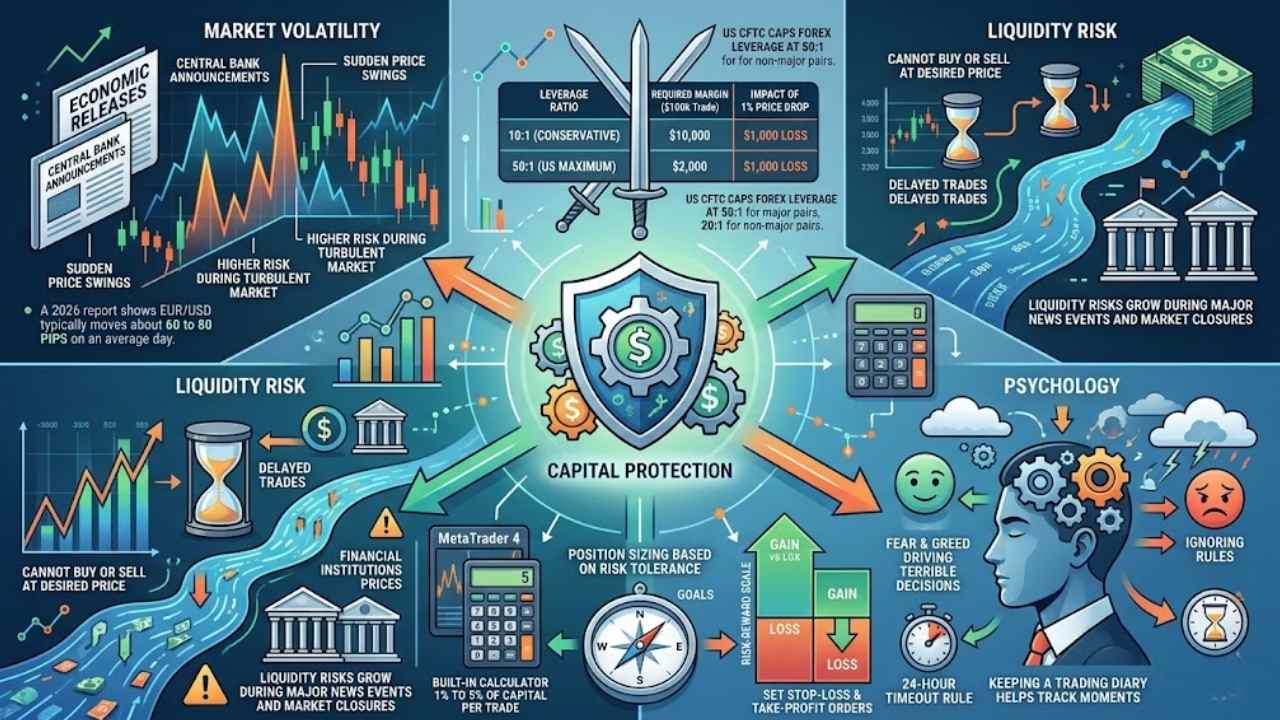
Forex risk management is your shield against losing money in the currency markets. It is the specific set of rules and tools you use to protect your trading capital from massive losses. Think of it like wearing a seatbelt while driving.
You do not expect a crash, but you are ready if one happens. This process includes setting stop-loss orders to exit trades automatically. You also must calculate position sizes based on your risk tolerance.
Deciding exactly how much money you will risk on each trade is the core of forex risk management. Most experts recommend risking anywhere from 1% to 5% of your total capital per trade.
Starting with just 2% of your available trading capital is a brilliant way to keep your account safe long-term. Traders use popular trading platforms like MetaTrader 4 and MetaTrader 5 to set these protective orders easily.
These platforms have built-in calculators to help you plan your moves. You can use technical analysis and fundamental analysis to spot the best entry and exit points. The goal is incredibly simple.
Make smart decisions before you place a trade, instead of panicking after you lose money.
In trading, the goal is not to be right, it is to manage risk properly so you can trade another day.
Your risk tolerance is personal. Some people handle big swings in their account balance perfectly well. Other traders sleep much better with smaller risks.
Before you start trading forex or CFDs (contracts for difference), you must figure out what level of risk feels comfortable. You have to look at your financial situation, your goals, and your personality.
A solid trading plan includes your risk-reward ratio. This tells you how much you might gain compared to what you might lose on each trade. Stop-loss orders and take-profit orders work together to manage your trades automatically.
Keeping a trading diary helps you track what worked and what failed. Interest rates, economic releases, and market gaps can move prices instantly. Knowing your risk limits prevents you from getting wiped out.
Capital protection matters so much more than chasing massive wins.
Understanding the Risks of Forex Trading
Forex trading throws multiple challenges right at you. You will face sudden market swings and the heavy pressure of borrowed money working against you.
You face real dangers that can drain your account fast if you fail to respect them.
Market volatility
Currency prices swing up and down constantly in the forex markets. These price swings happen fast. Sometimes they happen within seconds or minutes.
Market volatility simply refers to how much prices move around in the financial markets. High volatility means prices jump around a lot. Low volatility means prices stay fairly steady.
You face real money risks when volatility spikes suddenly. A major currency pair like EUR/USD can drop or climb sharply without warning. This sudden movement can wipe out your trading capital if you are not careful.
A 2026 report on US trading patterns shows the EUR/USD pair typically moves about 60 to 80 pips on an average day. Understanding this market volatility is a fundamental step in managing risk effectively.
You need to know what causes these wild price swings before you start trading. News events trigger massive price movements in the forex market. Central bank announcements, economic reports, and geopolitical tensions shake up currency values instantly.
Trading fees, margin requirements, and overnight policy changes add extra layers of risk to your account. You can use candlestick charts to spot volatility patterns on platforms like TradingView. Stop loss orders protect you right when volatility works against your position.
Position sizing based on your risk appetite keeps you safe during turbulent market conditions. Smart traders use exit orders and stop orders to manage their trades through volatile periods.
Your individual tolerance to risk should be determined before engaging in forex trading. This is especially true during times of high market swings.
Leverage risks
Leverage acts exactly like a double-edged sword in forex trading. You borrow money from your broker to control larger positions than your actual capital allows. This magnifies your profits, but it multiplies your losses just as fast.
A small move against your position can wipe out your entire account in seconds. Most traders do not realize that leverage can turn a tiny mistake into a financial disaster. Your risk per trade should always stay small.
Keep it between 1% to 5% of your total capital to protect yourself from this danger. Understanding leverage is essential for proper risk management in forex trading. This is crucial when you trade popular currency pairs like GBP/USD.
In the United States, the Commodity Futures Trading Commission caps forex leverage at 50:1 for major currency pairs. They limit it to 20:1 for non-major pairs. Many forex scams attract customers with misleading offers of high-return, low-risk investment opportunities.
They use excessive leverage as their hook. You must grasp exactly how leverage works before you place your first trade.
| Leverage Ratio | Required Margin ($100k Trade) | Impact of a 1% Price Drop |
|---|---|---|
| 10:1 (Conservative) | $10,000 | $1,000 Loss |
| 50:1 (US Maximum) | $2,000 | $1,000 Loss |
Your individual tolerance to risk should guide how much leverage you use. Start with lower leverage, maybe 10:1 or 20:1, until you build solid experience and confidence. Calculating appropriate position sizes based on your risk tolerance helps protect your trades effectively.
Demo accounts on platforms like Dukascopy or JForex let you practice with leverage safely. You learn how it works without real money at stake. This hands-on experience teaches you deep respect for leverage before it teaches you an expensive lesson.
Liquidity risks
Liquidity risk strikes when you cannot sell or buy a currency pair at the price you want. It happens exactly when you need to exit the market. This occurs in forex markets that lack enough active traders buying and selling at a given moment.
Your position gets stuck, and you cannot exit your trade fast. Market orders might execute at terrible prices far from what you originally expected. Both standard lot and mini lot traders face this problem.
Illiquid currency pairs move in wild swings. Your stop-loss orders might fail to trigger at the exact right levels. Automated trading systems can amplify liquidity problems because they execute trades without human judgment during very slow market hours.
Liquidity risk teaches us a painful lesson. Sometimes, speed actually matters more than the specific price.
Liquidity risks grow much worse during major news events and market closures. For example, Friday afternoons in the US session often see massive drops in trading volume. Banks and wealth management firms handle large trades.
They move markets easily and leave smaller traders scrambling. Your risk-reward ratio falls apart completely when you cannot exit at planned prices. Trading discipline requires you to trade only the most liquid currency pairs.
This is critical if you use leverage. CFDs and other derivatives can easily mask liquidity problems until the markets crash. Start with a demo account to practice trading during different hours.
You will quickly learn which pairs flow smoothly and which ones jump erratically. You protect your trades effectively by choosing pairs with incredibly tight spreads and high volume.
Psychological risks
Your own mind plays tricks on you in forex trading. Fear and greed drive most traders right into terrible decisions. You watch your account drop, and panic takes over entirely.
Suddenly, you close a winning trade too early or hold a losing one way too long. Your emotions completely hijack your trading plan. Many traders ignore their strict 1% to 5% risk rule when pure fear strikes.
A simple trading diary helps you track these vulnerable moments. Experienced traders on platforms like Reddit’s r/Forex often recommend a strict “24-hour timeout” rule. If you lose three trades in a row, you walk away from the computer for a full day.
Your trading algorithm cannot feel fear, but you definitely can. That massive gap between logic and emotion costs traders real money every single day. Impulsive decisions destroy trading accounts much faster than bad market moves.
- You check your phone constantly when a trade is open.
- News hits the market, your heart races, and you panic.
- You jump into a random trade without checking your risk-reward ratio.
- You skip setting your stop-loss order entirely.
- You falsely tell yourself this specific trade is different.
Selwyn M. Gishen and other trading experts stress that controlling emotions separates winners from losers. Your individual tolerance to risk matters greatly here. Know exactly who you are before you trade.
Set your position sizes based on what you can handle mentally, not just mathematically. A solid trading plan keeps you grounded safely. It tells you exactly when to enter, when to exit, and how much to risk.
You follow the plan, you ignore the noise, and you protect your capital. That boring consistency is what actually builds real wealth.
Key Strategies to Manage Risk in Forex Trading
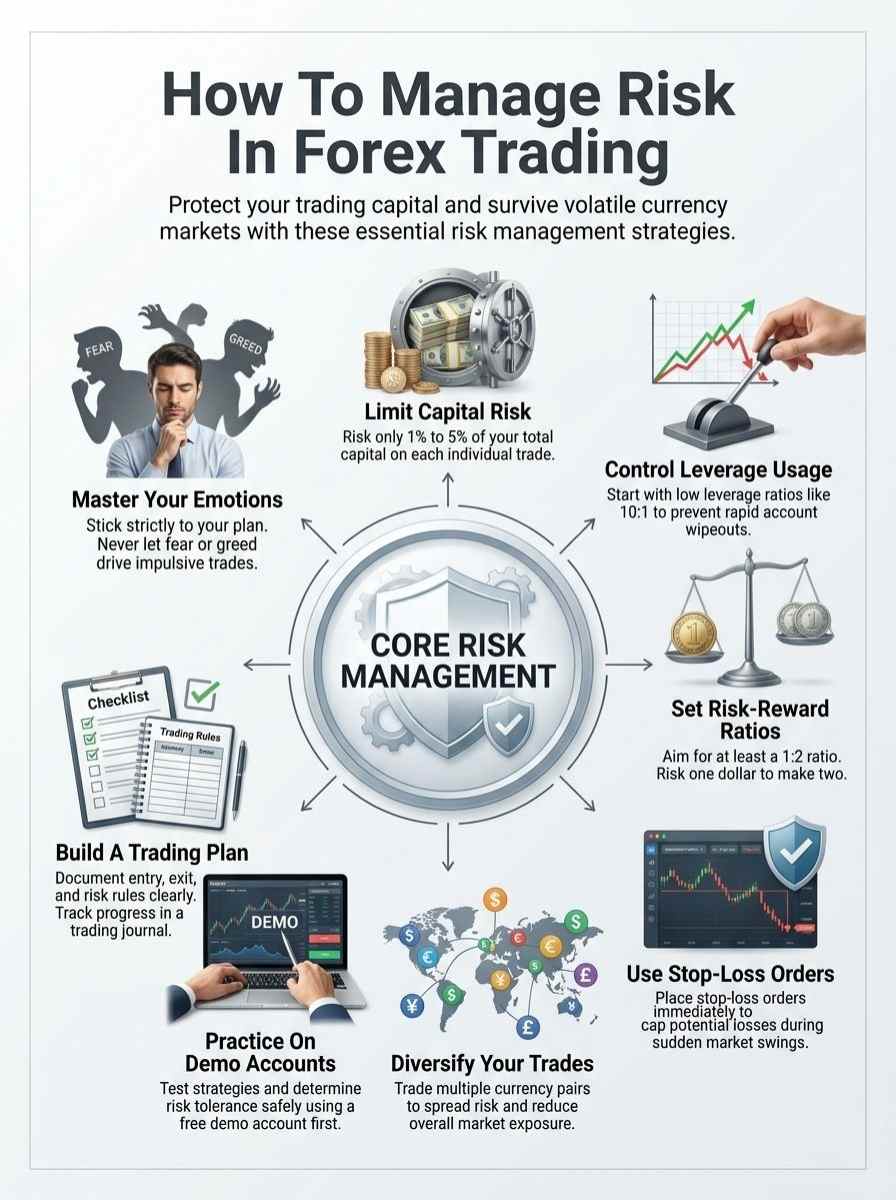
You absolutely need solid tactics to protect your money in forex trading. This section shows you the practical moves that separate clear winners from heavy losers in the currency markets.
Understand the forex market
Learning exactly how the forex market works is your first step toward smart trading. Forex involves buying and selling different currencies from around the world. Traders exchange one currency for another.
They hope to profit from natural price changes. The market operates 24 hours a day across major hubs like London, New York, and Tokyo. The most liquid time to trade in the US is between 8 AM and 12 PM Eastern Time.
This is when the London and New York sessions overlap. Understanding these basics helps you spot opportunities and avoid costly beginner mistakes. Grasping how leverage works is truly essential for proper risk management.
Leverage lets you control massive amounts of money with a very small deposit. A tiny price move can multiply your gains. It can also multiply your losses just as fast. Starting with a strict 2% risk per trade gives you a solid, safe foundation as you build your experience.
Tools like limit orders and stop-loss orders help you control your positions tightly. Studying resources from an established trading academy helps immensely. Keeping detailed trading diaries tracks your progress accurately.
CFDs offer another way to trade forex without owning actual currencies. Scammers often lure traders with false promises of high returns. Always stay sharp and verify any platform before depositing your hard-earned funds.
Use leverage responsibly
Leverage acts like a powerful multiplier in forex trading. You must handle it with extreme care at all times. Most traders fail because they ignore leverage risks completely.
They blow up their accounts far faster than they ever expected.
- Understand leverage before you trade a single pip. It multiplies your losses just as quickly as your gains.
- Start with lower leverage ratios. Regulated US brokers limit major pairs to 50:1, which is plenty for a beginner.
- Know your personal risk tolerance. Every trader has their own individual tolerance to risk. Determine yours before engaging in forex trading.
- Calculate your position size carefully. If you risk just 2% of your available trading capital, you will survive a bad trade easily.
Use stop-loss orders to automatically cap your losses when leverage works against you. Avoid the terrible temptation to use maximum leverage just because your broker offers it.
High leverage attracts eager traders with dreams of quick riches, but it destroys accounts in mere seconds. Monitor your full leverage exposure across multiple trades. If you have several positions open simultaneously, your total leverage might be shockingly high.
Practice with a demo account first. Platforms like IG Academy show you leverage in action safely.
Set a realistic risk-reward ratio
Your risk-reward ratio acts exactly like a map for your trades. It tells you how much money you might lose compared to how much you might actually gain.
Most seasoned traders aim for a ratio of at least 1:2. This means you risk one dollar to make two dollars. This brilliant approach protects your account from stringing together big losses.
You calculate it by dividing your potential loss by your potential gain on each specific trade. If you risk 2% of your total capital per trade, you should logically target gains of at least 4%. This very simple math keeps you from chasing bad trades.
| Risk-Reward Ratio | Win Rate Needed to Break Even |
|---|---|
| 1:1 | 50% |
| 1:2 | 33.3% |
| 1:3 | 25% |
Setting your risk-reward ratio before you enter any trade prevents emotional decisions entirely. You decide your numbers when your mind is beautifully clear, not when fear takes over.
Many trading platforms, like SWFX and other banking partners, let you set orders that lock in your ratio automatically. A solid ratio gives you a massive edge in the market.
Use stop-loss and take-profit orders
Stop-loss and take-profit orders act as your absolute safety net in forex trading. These digital tools help you protect your money effortlessly.
- Stop-loss orders close your trade when the price drops to a specific level. This brilliant tool prevents raw emotions from taking over when the market moves against you.
- Take-profit orders automatically close your trade when the price reaches your target profit level. You lock in great gains without sitting at your computer all day long.
- A trailing stop is an advanced order that moves with the price. If your trade is winning, the trailing stop moves up to protect your new profits.
- Place your stop-loss order immediately after entering a trade. Waiting to set this order leaves you heavily exposed to sudden, violent price swings.
Calculate your precise position size based on where you place your stop-loss order. A wider stop-loss requires you to trade a smaller position. This keeps your risk perfectly at 2% of your capital.
A tighter stop-loss lets you trade a larger position safely. Do not use mental stops where you promise yourself you will exit if the price drops. That rarely works in reality.
Use hard stops programmed right into your broker’s platform. Dukascoin and other modern platforms make setting these hard orders a simple, one-click process. Different currency pairs absolutely require different stop-loss distances.
You must base these distances clearly on their unique daily volatility.
Diversify your trades
Spreading your trades across different currency pairs protects your trading account wonderfully. You easily avoid putting all your money into one massive bet that could go wrong.
- Trade multiple currency pairs instead of focusing purely on just one. Different pairs move in entirely different directions.
- Understand currency correlation deeply. For example, EUR/USD and USD/CHF often move in completely opposite directions. Buying both might actually cancel out your profits.
- Include both major currency pairs and minor pairs in your personal trading mix. Major pairs have high liquidity, while minor pairs offer unique price movements.
- Vary your specific entry and exit points across different trades throughout the day. Catching different market movements reduces the harsh impact of any single bad trade.
Combine high-risk trades seamlessly with low-risk trades in your overall portfolio. A high-risk trade might target massive profits while a low-risk trade protects your capital quietly.
Balancing these two types helps you manage your risk-to-reward ratio incredibly well. Separate your trades by geographic regions. Traders in Switzerland and other regions know economic news hits different currency pairs differently.
Spreading trades across regions means one country’s bad news does not ruin your whole account. Track every single diversified trade carefully in your journal. Your journal quickly becomes hard proof of what works best for your specific situation.
Start with a demo account
A free demo account gives you a perfectly safe space to practice forex trading. You practice without risking any real money at all. You can easily test your strategies and learn exactly how the platform works.
Most excellent brokers offer free demo accounts that perfectly mirror real market conditions. Top platforms like TradingView even offer built-in paper trading specifically for beginners. This practice ground helps you quickly spot your mistakes early.
The cost is exactly zero dollars instead of your hard-earned capital. You will quickly discover your personal risk tolerance. You will clearly see how you react to wild market swings without the intense stress of losing real funds.
Treat your demo money exactly like real money. Educational sites like Investopedia also highly recommend treating your demo money exactly like real money. If you have $5,000 to invest eventually, do not open a $100,000 demo account.
Practice with a $5,000 demo account so the numbers and emotions feel authentic. Trading on a demo account lets you calculate appropriate position sizes perfectly. You can experiment safely with different risk to reward ratios.
Once you fully understand how leverage works, you can finally move to a real account with deep confidence.
Enhancing Risk Management Through Planning

Your trading plan acts as your daily roadmap. It tells you exactly when to enter trades, how much to risk, and when to exit.
A detailed trading journal tracks your moves flawlessly. It reveals your patterns and helps you easily spot what actually works.
Build a solid trading plan
A truly solid trading plan serves as your steadfast guide in the forex market. It keeps you hyper-focused and prevents rash decisions entirely.
- Write down your exact risk tolerance before you start trading anything real. Every single trader has their own individual tolerance to risk.
- Set your strict risk-reward ratio clearly right in your plan. A solid 1:2 ratio means you comfortably risk one dollar to make two dollars.
- Decide exactly how much capital you will risk per trade. Starting with just 2% of available trading capital is a phenomenal starting percentage.
- Include your firm stop-loss order rules in your written plan. Using stop-loss orders is an incredibly important tool for reducing trading risk.
- List the specific currency pairs you will actually trade. Sticking to pairs you understand deeply helps you spot reliable patterns.
Establish crystal clear exit rules for your losing trades. These vital rules tell you exactly when to cut your losses quickly. Discipline right here saves you massive amounts of money over the long run.
Many top professionals use simple tools like Notion or Microsoft Excel to map out these exact rules clearly. Schedule regular, honest plan reviews. Check your plan fully every month to see if it still fits your financial goals perfectly.
Monitor market news and events
Market news violently moves prices fast. Economic reports, sudden interest rate changes, and tense political events shake the forex market instantly. You absolutely need to track these happenings to protect your money safely.
Major announcements from massive central banks can easily shift currency values in mere seconds. In the US, the Non-Farm Payrolls report is released closely on the first Friday of every month. This specific report causes massive volatility across nearly all major currency pairs.
Traders who ignore this news often lose big. Set up fast news alerts directly on your phone or computer. Read reliable financial websites every single morning before you trade. This excellent habit keeps you one step ahead of sudden, violent price swings.
A great trader does not predict the news. A great trader prepares perfectly for the volatility the news creates.
Your personal trading plan should absolutely include an economic calendar. Mark highly important dates when major financial events happen. The entire forex market reacts strongly to these exact moments.
Some cautious traders avoid trading right before big announcements entirely. Prices simply jump around too much for their comfort. Your personal risk tolerance naturally determines which approach fits you perfectly.
Check standard economic calendars from trusted sources carefully to decide when to sit tight.
Keep a trading journal
A detailed trading journal tracks absolutely every trade you make. This remarkably simple tool helps you clearly spot patterns and easily improve your forex trading over time.
- Write down the exact date, time, and currency pair for every single trade you enter quickly.
- Record your specific entry price and exit price clearly in your daily journal.
- Note the exact reason you opened the trade boldly. Include which specific signals led you to make that exact decision.
- Document your firm stop-loss level and take-profit level perfectly before you place the actual trade.
- Use a modern journaling software like Edgewonk or Forex Tester. These digital tools can automatically track your statistics accurately.
Describe the actual market conditions when you traded carefully. Note whether the market volatility was unusually high or fairly low. Include your honest emotional state clearly during the trade.
Note perfectly if pure fear or deep greed influenced your rapid choices. Review your entire journal thoroughly every single week. Find your unique strengths and your glaring weaknesses easily.
Identify exactly which currency pairs treat you well consistently. Turn your past trades beautifully into highly profitable lessons for future success.
The Role of Psychology in Risk Management
Your own mind plays a much bigger role in your success than you might think. Read on carefully to learn how to master your emotions perfectly.
Control emotions while trading
Raw fear and blind greed are the two absolute biggest enemies of forex traders. These intense feelings push traders straight into terrible choices fast. A frightened trader might easily panic and sell the exact moment prices drop.
Another trader might foolishly hold a position way too long. They are completely blinded by greed and hoping for massive profits. Both common mistakes cost you real money.
The absolute best traders know exactly how to keep their feelings fully in check. They stick tightly to their trading plan no matter what actually happens. They absolutely do not let one single loss make them angry.
They do not let one single win make them overly confident. Controlling your emotions means you strictly follow your rules. You do this even when it feels incredibly hard.
This exact moment is where most eager traders fail. They fully know the right moves but cannot execute them calmly. Impulsive emotional decisions destroy trading accounts incredibly fast.
A frustrated trader who risks a massive 5% of their capital is making a purely emotional choice. That trader feels highly excited and throws all caution away quickly. Stop-loss orders easily help you avoid this deadly trap.
A detailed trading diary absolutely keeps you perfectly honest with yourself. Traders who control their feelings simply win much more often.
Avoid impulsive decisions
Impulsive, wildly unplanned trades destroy accounts faster than a storm destroys a fragile house. Your own brain tricks you deeply into making rapid snap decisions. You see a massive price jump and your fingers hit the button instantly.
You must stop this terrible habit right now. Most failed traders who blow up their accounts made extremely impulsive moves. They rarely made carefully planned ones.
One amazing trick professionals use is the 15-minute rule. When you eagerly spot a highly tempting trade setup, force yourself to wait exactly 15 full minutes before clicking buy. This short pause lets your logical brain catch up.
Emotions naturally run incredibly high in forex trading. That exact moment is when eager traders make their absolute worst calls. You strictly risk 1% to 5% of your total capital per trade for a reason.
Protect that money by trading logically with your head. Set your firm stop-loss orders perfectly before you ever enter a trade. Set your clear take-profit levels precisely too.
Your position size naturally matters greatly here as well. Calculate it fully based on your actual risk tolerance perfectly. Traders who follow this one simple rule keep their massive accounts alive and growing.
Final Thoughts
You have absolutely learned the core tools that separate highly successful traders from those who fail. Risk management is definitely not boring or overly complicated at all. It is your best shield against the market’s wild, unpredictable swings.
Start very small with your brilliant 2% risk rule easily. Use firm stop-loss orders exactly like a safety net daily. Build a comprehensive trading plan carefully before you risk a single real dollar.
Your raw emotions will definitely test you greatly. Keeping a trading journal perfectly will keep you fully grounded when prices wildly move against you. Take massive action today simply by opening a free demo account. You can practice these amazing methods safely right now. The traders who win long-term are absolutely the ones who fiercely protect what they already have.