
You know that feeling when your life is on hold, just waiting for a piece of paper? Whether you are dreaming of a new life abroad or trying to settle in the United States, the wait for a residency permit can feel agonizingly slow. Maybe you have a job offer, a family member waiting for you, or you simply want the freedom to put down roots.
Many people get stuck because they assume every visa takes five or ten years to process. But that is not always the case. Did you know some countries actually want you to settle down quickly?
In fact, a few specific visa pathways can get you permanent residency in under five years—and some start you on that path almost immediately. I am going to walk you through 5 fastest visas to Permanent Residency available right now, cutting through the confusion to show you exactly where to look.
So, grab a coffee and let’s look at the visas that can fast-track your future.
Why Permanent Residency is Important
Permanent residency is the game-changer that turns you from a “visitor” into a true local. It gives you the legal right to work, access national healthcare, and often buy property with the same ease as a citizen. For many, the biggest perk is stability: you no longer have to worry about renewing a short-term visa every year.
Take the EB-5 Immigrant Investor Program in the United States. It creates a direct route for investors to get a U.S. Green Card without ever needing a boss to sponsor them. Since the Reform and Integrity Act of 2022, this pathway has become significantly faster for those investing in specific rural areas.
Other countries offer similar stability. In places like Mexico and Portugal, permanent residency means you can eventually apply for citizenship, which gets you a powerful passport. Uruguay is unique because it offers a path to citizenship that can be as short as three years for married couples—one of the fastest timelines in the world.
Families also gain the right to stay together long-term, which is why these “fast-track” options are so popular for people planning a safe future for their children.
Factors That Make a Visa Path Faster
Not all visas are created equal. Some are designed to be slow and steady, while others are built for speed. Knowing what to look for can save you years of waiting.
Shorter Residency Requirements
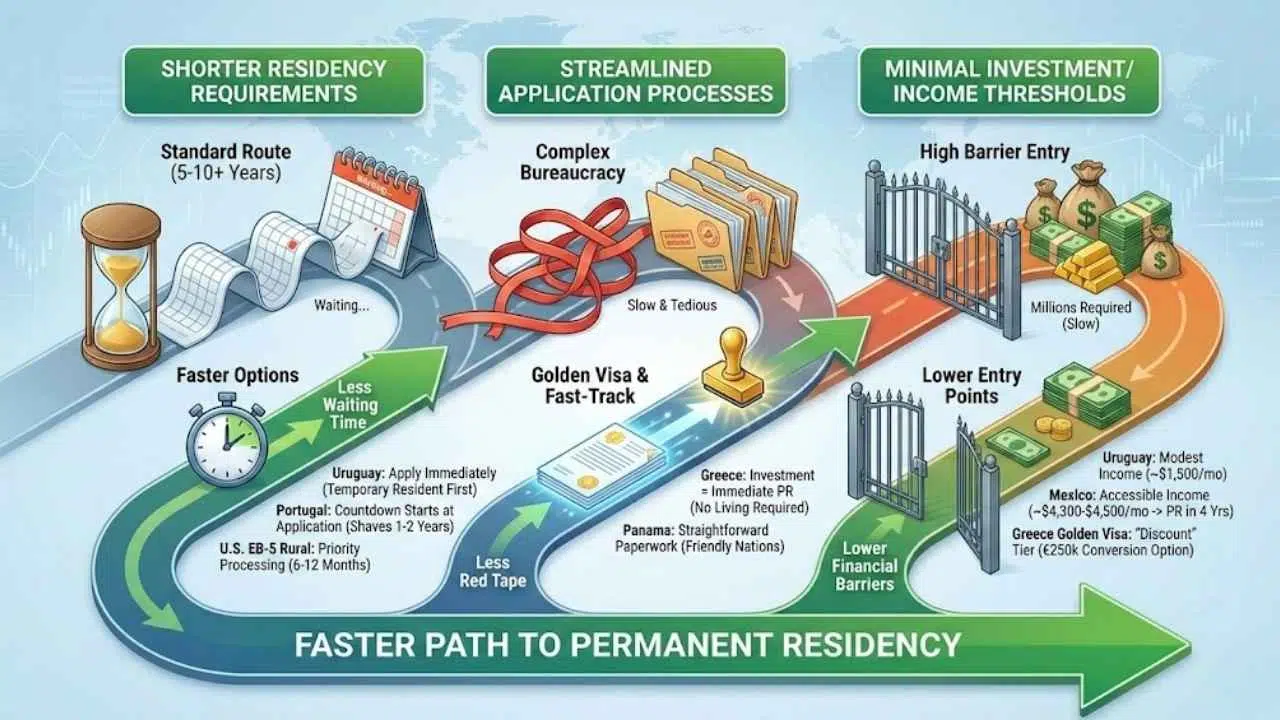
The biggest bottleneck is often the “physical presence” rule—how long you must live in a country before you can stay forever. Most countries demand five to ten years of continuous living. But the fastest options cut this down dramatically.
Uruguay is a standout here. Instead of making you wait years to start the process, you can apply for permanent residency almost immediately upon arrival. You spend your waiting time as a temporary resident with full rights.
In Portugal, a recent change has made the timeline much friendlier. As of 2024, your five-year countdown to permanent residency or citizenship starts from the moment you submit your application and pay the fee, not when it is finally approved. This simple administrative change effectively shaves 1-2 years off the total wait time compared to the old rules.
In the U.S., the EB-5 Rural projects are the speed kings. Because the government wants to stimulate jobs in rural areas, these applications get “priority processing.” While a standard investor visa might take years, rural project investors are seeing approvals in as little as 6 to 12 months in some cases.
Streamlined Application Processes
Some countries have cut the red tape to attract talent and capital. The “Golden Visa” concept is the prime example: you make an investment, and the government fast-tracks your paperwork.
Greece offers one of the most streamlined processes in Europe. You can essentially buy your way to immediate permanent residency (valid for five years and renewable) without living there first. You just need to visit once to submit your biometric data.
Panama is another winner with its Friendly Nations Visa. While they updated the rules in 2021 to require a two-year provisional period, it remains one of the most straightforward paperwork processes for citizens of 50 specific countries, including the U.S. and Canada.
Minimal Investment or Income Thresholds
You do not always need millions of dollars to move fast. Some of the quickest residency visas are based on modest income proof.
Uruguay relies on a “means of life” test rather than a strict number, but showing around $1,500 per month is often sufficient for a single applicant. This is far lower than the income requirements for many European nations.
Mexico is also accessible. For 2026, the income requirement is tied to the “UMA” (a fluctuating economic unit). You typically need to show a monthly income of around $4,300 to $4,500 USD (varies by consulate) to qualify for temporary residency, which converts to permanent residency in just four years.
For investors, the Greece Golden Visa has a secret “discount” tier. While the main investment threshold jumped to €800,000 in popular areas like Athens, you can still qualify with just €250,000 if you invest in a “commercial-to-residential” conversion project. This is a massive savings for the exact same permanent residency status.
Family Reunification Visas
Bringing your family together is often the biggest motivator for moving. Fortunately, family visas are usually prioritized over other categories.
Eligibility and Key Benefits
If you have a spouse, parent, or child who is already a citizen or permanent resident, you can often skip the lines. The key benefit here is the waiver of many financial or skill-based requirements. You don’t need to be a doctor or an investor; you just need to be family.
The timelines vary wildly by country. In Canada, spousal sponsorship applications are processed relatively quickly, with a service standard of about 12 months for both inland and outland applications. This is a reliable path compared to the unpredictable lottery systems found elsewhere.
In Europe, countries like Portugal and Greece allow you to include your family in your initial investment application. This means your spouse and dependent children get their residency cards at the same time you do, without filing separate “reunification” cases later. This “bundled” approach is the fastest way to move a whole household at once.
Work Visas Leading to Permanent Residency
If you have skills that are in demand, many countries will roll out the red carpet. The trick is finding a visa that doesn’t just let you work, but leads directly to a green card.
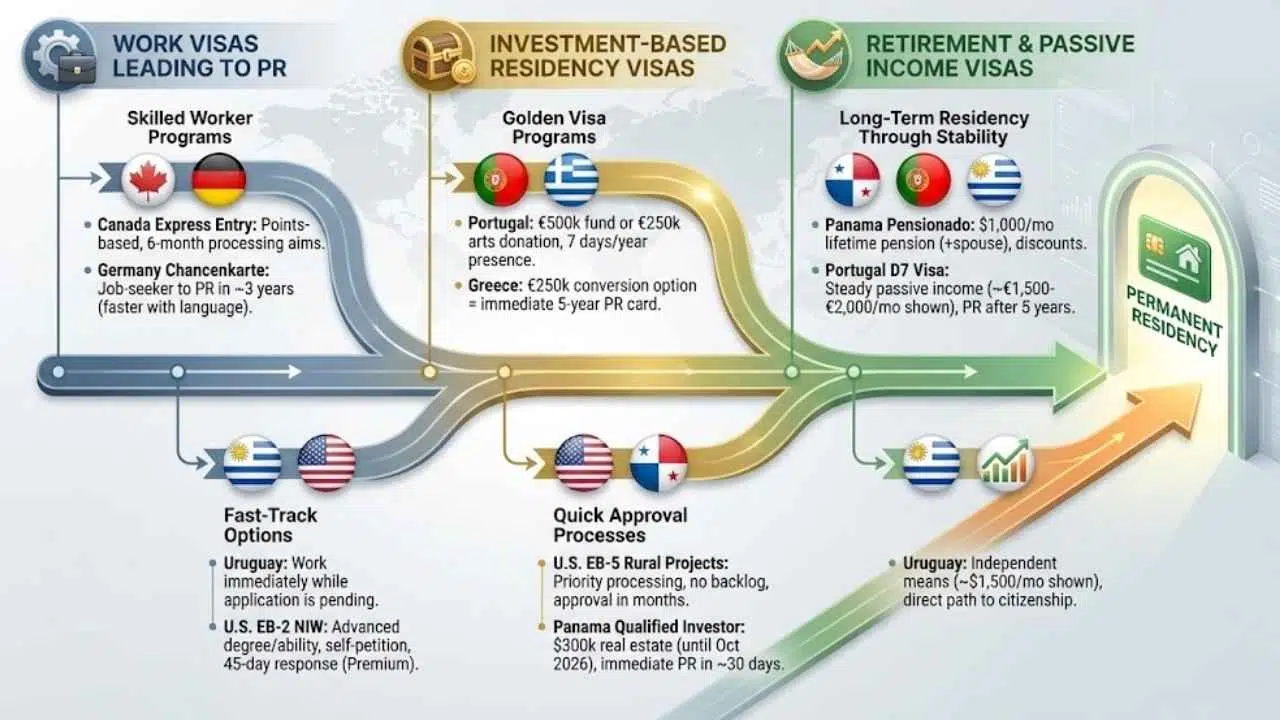
Skilled Worker Programs Canada’s Express Entry system is the gold standard for speed. It uses a points-based system to rank candidates. If your score is high enough, you receive an “Invitation to Apply” (ITA). Once you submit your full application, the government aims to process it in just six months. That is incredibly fast for a G7 nation.
Germany recently introduced the “Chancenkarte” (Opportunity Card). While it starts as a job-seeker visa, it allows skilled workers from outside the EU to enter Germany to look for work. Once employed, it offers a fast track to permanent residency (Niederlassungserlaubnis) in as little as three years, or even less if you master the German language quickly.
Fast-Track Options in Certain Countries Uruguay is unique because it doesn’t really distinguish between a “work visa” and a “residency visa” in the same way. You enter, apply for residency, and can legally work while your application is pending. This eliminates the “chicken and egg” problem of needing a visa to get a job, but needing a job to get a visa.
In the U.S., the EB-2 NIW (National Interest Waiver) is a powerful option for professionals with advanced degrees or exceptional ability. It allows you to self-petition for a Green Card without an employer sponsor. If you pay for “Premium Processing” (Form I-907), USCIS guarantees a response on your petition in 45 business days.
Investment-Based Residency Visas
If you have capital to deploy, investment visas are almost always the fastest route because they bypass the need for job offers or family connections.
Golden Visa Programs
These programs are famous for a reason: cash for residency. However, the rules are tightening.
Portugal’s Golden Visa has evolved. You can no longer buy residential real estate to qualify. Instead, you can invest €500,000 in qualifying investment funds or donate €250,000 to arts and culture. The big advantage remains the low physical presence requirement—you only need to spend an average of 7 days per year in the country to keep your residency active.
Greece remains the king of immediate results. As soon as your investment is processed, you get a 5-year permanent residency card. As mentioned earlier, the smart money is on the €250,000 conversion option (buying a commercial space and converting it to a home) or restoring a listed building. Be aware, though: under the 2024 rules, you are strictly forbidden from using these converted properties for short-term Airbnb-style rentals.
Countries with Quick Approval Processes
For pure speed of approval, the US EB-5 Rural Projects are hard to beat right now. Thanks to the “set-aside” visas, there is currently no backlog for new investors from any country (even typically backlogged ones like China and India). Combined with priority processing, you could have your conditional Green Card approval in months, not years.
Panama also deserves a mention here. Their Qualified Investor Visa grants permanent residency immediately (in about 30 days) if you invest $300,000 in real estate. Note that this $300,000 price tag is a special promotion that is set to expire in October 2026, after which it may jump to $500,000.
Retirement and Passive Income Visas
You don’t need to be “retired” in the traditional sense; you just need steady income from a source outside the country.
Long-Term Residency Through Financial Stability Panama’s Pensionado Visa is legendary. If you have a lifetime monthly pension of at least $1,000 (+ $250 for a spouse), you can get permanent residency. The best part? It grants you discounts on everything from utility bills to airline tickets and movie theaters.
Portugal’s D7 Visa is the European equivalent. You need to show reliable, recurring passive income (like rent or dividends). While the official minimum is low (based on the Portuguese minimum wage), successful applicants usually show at least €1,500 to €2,000 per month to be safe. It leads to permanent residency or citizenship after five years.
Uruguay is incredibly friendly to those with independent means. There is no hard “minimum income” law, but showing you can support yourself (approx. $1,500/month) is key. Once accepted, you are on a direct path to citizenship.
Digital Nomad Visas with Residency Options
Working remotely is the new normal, and some countries are turning temporary remote work permits into permanent homes.
Transitioning to Permanent Residency Spain’s Digital Nomad Visa is a fantastic pathway. It allows you to live in Spain while working for a foreign company. The time you spend on this visa counts directly toward the 5 years needed for permanent residency. Plus, it offers a special tax regime (the “Beckham Law”) where you pay a flat 24% tax rate on income up to €600,000.
Portugal also allows Digital Nomad visa holders to count their years toward the 5-year citizenship clock. Since the clock starts ticking from your initial application submission, you might find yourself eligible for a permanent card sooner than you think.
Top Countries Offering Fast Permanent Residency
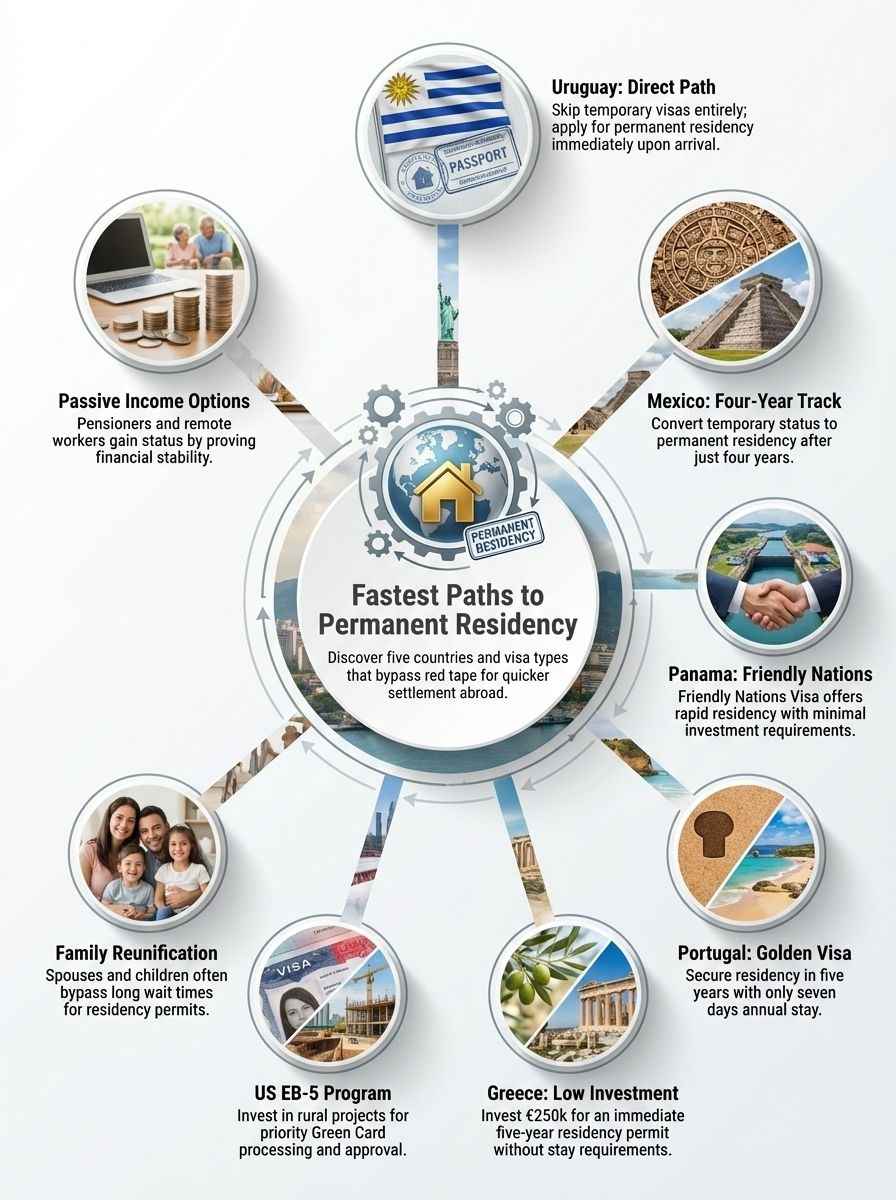
If speed is your top priority, these five countries should be at the top of your list. Here is the breakdown of why they are the fastest.
Mexico
Mexico is the practical choice for North Americans. The process is a clear, four-year track. You start with a Temporary Resident visa (Residente Temporal), which you renew for three years. At the start of your fourth year, you simply swap it for a Permanent Resident card (Residente Permanente).
The financial requirements are reasonable, and you don’t need to live there full-time to keep the temporary visa active. However, to get the permanent card, using a specialized facilitator is often recommended to navigate the local appointment systems, which can be tricky. Once you have “Permanente” status, you never have to renew it again.
Panama
Panama offers two distinct “fast” tracks. The first is the Qualified Investor Visa ($300,000 real estate investment), which grants immediate permanent residency in as little as 30 days. It is arguably the fastest permanent residency program in the world right now.
The second option is the Friendly Nations Visa. It is cheaper but slower. You invest $200,000 (in property or a fixed bank deposit) or get a local job contract. You get a temporary residence permit for two years, and then you upgrade to permanent residency. Even with the two-year wait, it is faster than almost any European option.
Uruguay
Uruguay is the hidden gem of South America. Its “fast track” is actually its citizenship timeline. Married couples can apply for citizenship after just three years of residency. Single applicants wait five years.
The unique part? You are a temporary resident from day one, with all the rights to live and work. The “clock” for citizenship starts counting the moment you arrive in the country with the intent to stay, not months later when the paperwork is stamped. Just be aware that the actual passport issuance can take some time after you apply.
Portugal
Portugal remains the top choice in Europe because of how “years” are counted. As mentioned, the 5-year clock to permanent residency or citizenship starts when you submit your application.
Even though bureaucratic delays might mean you don’t get your first card for 12-18 months, that time is not wasted—it counts toward your 5-year goal. You will need to pass a basic A2-level Portuguese language test to get the final permanent status, but A2 is beginner-level conversational ability.
Greece
Greece wins the prize for the “Lowest Cost for Immediate Status” in Europe—if you know the rules. By using the €250,000 “Conversion” route, you bypass the new €800,000 requirement imposed in popular areas.
You buy a commercial property (like an old office or shop), convert it to residential usage, and you qualify for the Golden Visa. You get your permanent residency card immediately (renewable every 5 years). There is no need to wait years to earn the status. You can live there if you want, or just visit for a summer holiday; the card remains valid either way.
Final Thoughts
You now know that you do not have to wait a decade to settle down. Whether it is the rural investment path in the U.S., the immediate residency option in Greece, or the citizenship fast-track in Uruguay, you have choices that fit different budgets and timelines.
These visa routes save you time and keep your stress levels low. The key is to pick the one that matches your lifestyle—do you want to move tomorrow (Panama/Greece), or do you want to secure a future option while you continue working (Portugal/Mexico)?
My advice? Don’t just read about it. Pick the one country that excited you the most and check their specific requirements for this year. Your future abroad starts with one good decision—make it count.