

The global race for connectivity has shifted dramatically. It is no longer just about which nations have launched the next generation of mobile technology; it is about who has mastered it. When analyzing the Fastest 5G Countries today, we see a distinct shift in power away from the traditional tech giants of the West toward the agile, infrastructure-heavy economies of the Middle East and East Asia. For users streaming 4K video, gamers demanding zero latency, and businesses relying on cloud computing, the “fastest” network isn’t just a marketing term; it’s a daily necessity.
Understanding which nations offer the best performance requires looking beyond simple coverage maps. It demands a deep dive into download speeds, spectrum allocation, and government investment. Currently, the United Arab Emirates (UAE) is widely recognized as the leader in median download speeds, delivering a blisteringly fast experience that often exceeds half a gigabit per second. However, nations like South Korea and Malaysia are challenging this dominance with networks that prioritize consistency and nationwide availability.
This article provides a comprehensive analysis of the top 10 nations setting the speed limit for the rest of the world. We will explore the technologies driving these speeds, the difference between median and average metrics, and what the future holds for global connectivity.
Key Takeaways
-
The Gulf Dominance: The United Arab Emirates (UAE) and Qatar currently hold the top spots for median 5G download speeds, frequently surpassing 500 Mbps.
-
The Consistency King: While the Middle East leads in peak speeds, South Korea remains the global leader in consistent high-speed coverage and 5G availability.
-
Emerging Surprises: Malaysia has skyrocketed in rankings due to its unique “Single Wholesale Network” model, and Brazil has entered the top tier following successful spectrum auctions.
-
Metric Matters: Rankings change depending on whether you measure “Median” speed (typical user experience) or “Average” speed (technical capacity).
-
The Future: 5G Advanced (5.5G) is already being trialed in leading markets, promising speeds of up to 10 Gbps by 2026.
The Global Benchmark: Defining High-Speed Connectivity
Before diving into the rankings, it is crucial to understand that the definition of a “fast network” has evolved. In the early days of 5G, the focus was purely on which nations could launch the technology first. Today, the metric for success has shifted from simple availability to tangible performance quality.
The global 5G landscape is no longer dominated solely by the early pioneers in North America and Western Europe. Instead, we are witnessing a “digital shift” where nations with focused regulatory environments and modern infrastructure—specifically in the Middle East and Asia- are setting new benchmarks.
For the purpose of this analysis, we prioritize Median Download Speed over “peak” speed. While peak speed measures the absolute theoretical maximum a network can hit under perfect lab conditions, the median speed represents the “real-world” experience of the 50th percentile user. This metric filters out the anomalies and provides a transparent look at what you, the consumer, can actually expect when you tap “download” on your smartphone.
As we examine the top 10, notice the correlation between speed and spectrum investment. The countries leading this list haven’t just built towers; they have opened up wide lanes of “C-band” and mid-band spectrum, creating the digital superhighways necessary to support the speeds listed below.
The Top 10 Countries with the Fastest 5G Speeds
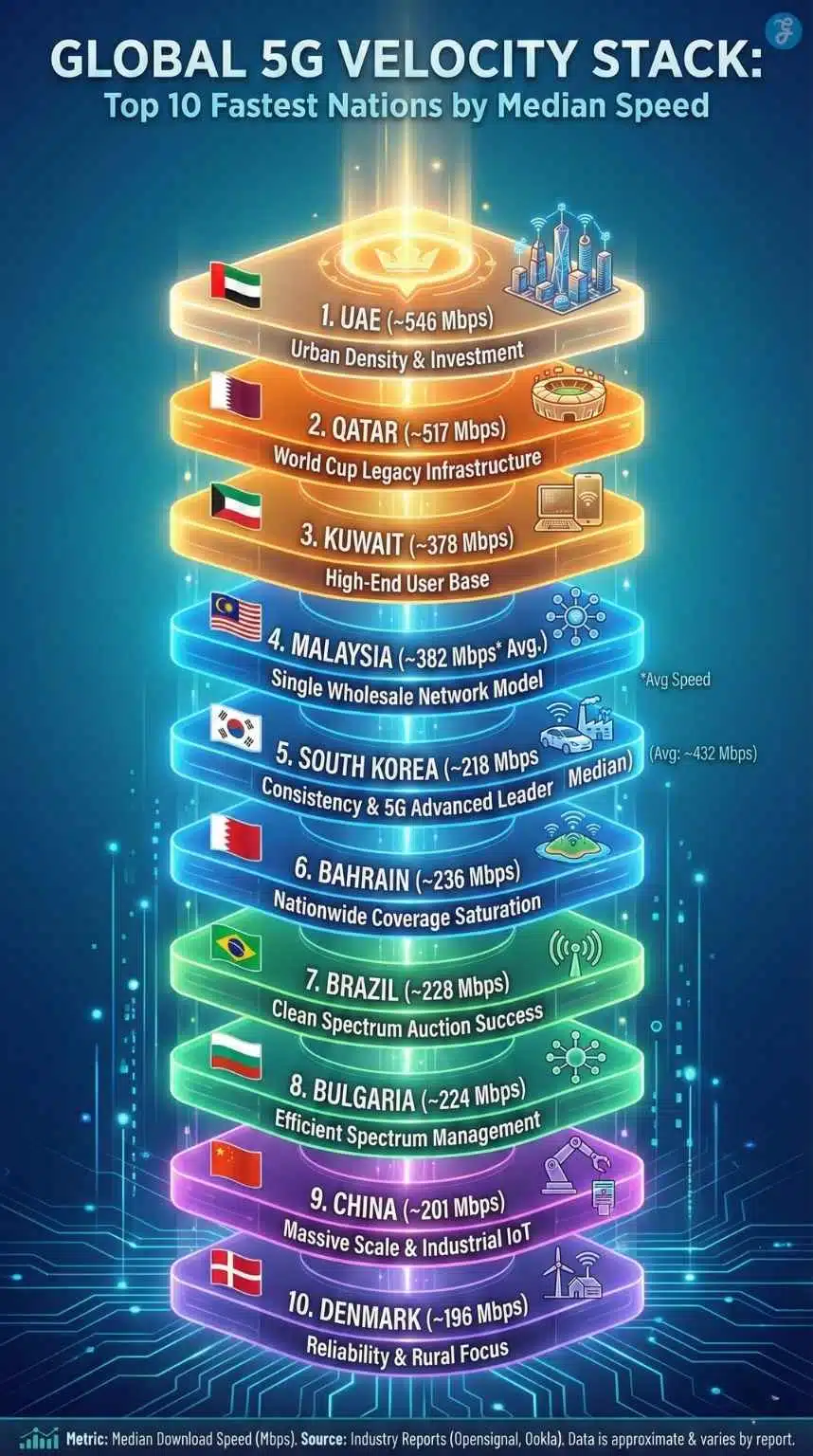
When ranking global network performance, the most user-centric metric is Median Download Speed. This represents the speed a typical user is most likely to experience in daily life, filtering out extreme outliers. Based on the latest data from major network intelligence providers like Ookla and Opensignal, here are the top 10 performers.
1. United Arab Emirates (UAE)
-
Median Speed: ~546 Mbps
-
Top Operators: e& (Etisalat), du
The UAE sits comfortably at the top of the global charts. The country’s success is driven by a combination of high urban density and aggressive government strategy. The “Vision 2031” initiative has prioritized digital infrastructure, allowing operators like e& and du to roll out massive amounts of mid-band spectrum (C-band) without the bureaucratic hurdles faced in other regions.
Because the majority of the population lives in concentrated urban centers like Dubai and Abu Dhabi, operators can deploy fewer towers to cover more people with high-intensity signals. The result is a network that feels almost like fiber-optic broadband in your pocket.
2. Qatar
-
Median Speed: ~517 Mbps
-
Top Operators: Ooredoo, Vodafone Qatar
Hot on the heels of the UAE is Qatar. The massive infrastructure upgrades prepared for the 2022 FIFA World Cup left a lasting legacy of world-class connectivity. Qatar was one of the first nations to achieve near-universal 5G coverage.
The competition between Ooredoo and Vodafone Qatar is fierce, driving both companies to push the limits of speed. They have extensively utilized the 3.5 GHz spectrum, which offers the “sweet spot” between range and speed, ensuring that users in Doha can stream high-definition content without buffering, even in crowded areas.
3. Kuwait
-
Median Speed: ~378 Mbps
-
Top Operators: Zain, STC, Ooredoo
Kuwait’s presence in the top three solidifies the Middle East’s dominance in the 5G era. Like its neighbors, Kuwait benefits from a wealthy population with a high demand for premium digital services. The relatively flat geography and urban concentration allow for efficient signal propagation. Kuwaiti operators have been quick to adopt 5G Standalone (SA) architectures, which move away from relying on older 4G cores, unlocking lower latency and faster throughput.
4. Malaysia
-
Average Speed: ~382 Mbps (Note: High ranking in Average metrics)
-
Top Operators: CelcomDigi, Maxis, U Mobile
Malaysia is the “surprise” of the 2024-2025 cycle. Unlike most countries where multiple telecom companies build their own towers, Malaysia adopted a Single Wholesale Network (SWN) model. A government-owned entity, Digital Nasional Berhad (DNB), built the entire 5G infrastructure and leases it to private telcos.
While controversial initially, this centralized approach has allowed Malaysia to optimize the network purely for performance without duplication of efforts. The result is one of the highest average download speeds in the world, proving that non-traditional rollout strategies can yield massive rewards.
5. South Korea
-
Average Speed: ~432 Mbps | Median: ~218 Mbps
-
Top Operators: SK Telecom, KT, LG U+
South Korea is the “Godfather” of 5G, having launched the world’s first commercial network. While Gulf nations may currently edge it out on median peak bursts, South Korea remains the undisputed king of consistency and availability.
In Seoul, 5G is not a luxury; it is the default. The country has the highest penetration of 5G devices in the world. South Korean operators are also leaders in “5G Advanced” trials, experimenting with technologies that will eventually lead to 6G. If you want a connection that never drops, South Korea is the place to be.
6. Bahrain
-
Median Speed: ~236 Mbps
-
Top Operators: Batelco, Zain
Another Gulf Cooperation Council (GCC) member, Bahrain, punches well above its weight. The kingdom has achieved nationwide 5G coverage, meaning you can get high speeds whether you are in the capital of Manama or the southern desert areas. Bahrain’s regulators have been very proactive in releasing spectrum, ensuring that pipes remain uncongested even as data consumption skyrockets.
7. Brazil
-
Median Speed: ~228 Mbps
-
Top Operators: Vivo, Claro, TIM
Brazil is the rising star of the 5G world and the leader in Latin America. After a delayed but highly organized “clean” spectrum auction (which cleared interference from satellite dishes), Brazilian operators launched 5G in major cities with strict quality obligations.
Unlike the “Non-Standalone” networks used initially in the US and Europe (which piggybacked on 4G), Brazil pushed for “Standalone” 5G in its capitals. This decision has paid off, propelling Brazil into the global top 10 and surpassing many wealthy European nations.
8. Bulgaria
-
Median Speed: ~224 Mbps
-
Top Operators: Vivacom, A1, Yettel
Europe generally lags behind the Middle East and Asia in raw speed due to older regulatory frameworks and stricter tower planning laws. However, Bulgaria is a notable exception. The country has a long history of excellent internet infrastructure. Bulgarian operators have aggressively modernized their networks, delivering some of the fastest speeds on the continent by focusing on efficient spectrum management in key urban hubs.
9. China
-
Median Speed: ~201 Mbps
-
Top Operators: China Mobile, China Telecom, China Unicom
China operates on a scale different from any other nation. With over 3 million 5G base stations, it has the world’s largest network by far. While its median speeds are slightly lower than the smaller Gulf states due to the sheer volume of users (creating network load), the engineering achievement is unparalleled. China is also the leader in industrial 5G, using the network to automate ports, mines, and factories.
10. Denmark
-
Median Speed: ~196 Mbps
-
Top Operators: TDC, Telenor, Telia
Rounding out the top 10 is Denmark, representing the Scandinavian standard for quality. Denmark may not chase the “flashy” peak speeds of the UAE, but its network is incredibly reliable. Danish operators have focused on balancing speed with energy efficiency and rural coverage, ensuring that the 5G experience is equitable across the population.
Visualizing the Speed Gap
The following table illustrates the performance of the top 5 countries using the “Median” metric, which best reflects what a new user would experience today.
| Rank | Country | Median Download Speed (Mbps) | Primary Strength |
| 1 | UAE | 546.14 | Unmatched urban density & investment |
| 2 | Qatar | 517.44 | Modern infrastructure from the World Cup era |
| 3 | Kuwait | 378.45 | High-end user base & small geography |
| 4 | Bahrain | 236.77 | Nationwide coverage saturation |
| 5 | Brazil | 228.89 | “Clean” spectrum auction success |
Regional Analysis: Who Dominates the 5G Map?
The global distribution of 5G speed is not uniform. We can observe three distinct “power blocs” in the telecommunications world.
The Gulf Advantage (The Speed Leaders)
The Middle East is currently the undeniable champion of 5G speed. Countries like the UAE, Qatar, and Kuwait share specific characteristics that make them ideal for high-speed networks:
-
Geography: They are relatively small with highly concentrated urban populations. This makes it easier and cheaper to blanket the population with high-frequency mid-band towers.
-
Investment: State-backed telecom providers are less constrained by immediate return-on-investment pressures than their Western counterparts, allowing for massive capital expenditure.
-
Modernity: Many of these cities have modern infrastructure, making it easier to lay fiber-optic backhaul (the wires connecting the towers), which is crucial for 5G speed.
East Asia (The Innovation Hubs)
South Korea, China, and Taiwan view 5G as a strategic economic asset. While their median speeds are high, their primary focus is ubiquity. They want 5G to be everywhere—in subways, elevators, and mountains. Their strategy is to support the “Industrial Internet of Things” (IIoT), where factories and autonomous vehicles rely on the network.
Europe & The Americas (The Catch-Up Game)
With the exception of Brazil and the Nordics, much of the West is playing catch-up. The United States has improved significantly with the deployment of C-band spectrum, now averaging around 180-200 Mbps, but it faces challenges with vast rural distances. Europe is hampered by fragmented markets; unlike China (3 major operators) or the US (3 major operators), Europe has dozens of operators across different borders, making unified high-speed investment more difficult.
What Drives Blazing Fast 5G? (The Tech Behind the Speed)

Why is the UAE getting 550 Mbps while your phone might struggle to get 50? The answer lies in three technical pillars.
1. Spectrum Availability (The “Highway Width”)
Think of data as cars and spectrum as the highway. 4G was a two-lane road. 5G is a ten-lane superhighway. The fastest countries have allocated massive chunks of C-Band (3.5 GHz) spectrum to their operators. This frequency is the “Goldilocks” band; it carries a lot of data and travels a decent distance. Countries that delayed auctioning this spectrum (like parts of Europe) are slower.
2. Fiber Backhaul (The Invisible Wire)
A wireless tower is only as fast as the wire connecting it to the internet. The top-ranked countries have nearly 100% of their 5G towers connected by fiber optics. In slower nations, towers often connect via microwave links, which can become bottlenecks.
3. 5G Standalone (SA) vs. Non-Standalone (NSA)
Most early 5G networks were NSA—they used a 5G radio but a 4G “brain” (core). This limited their potential. Countries like Brazil, China, and Kuwait are aggressively moving to Standalone (SA) 5G. SA uses a cloud-native 5G core, enabling lower latency and the ability to “slice” the network for different uses (e.g., giving a gamer a dedicated fast lane).
Median vs. Average Speed: What Matters More?
You will often see conflicting reports where South Korea is #1 in one list, and the UAE is #1 in another. This is due to the difference between the Median and the Average metrics.
-
Median Speed (The User’s Reality): This is the middle number. If 100 people test their speed, the median is the result of the 50th person. This is the best measure of what a normal person will see. The UAE wins here because almost everyone there gets a great signal.
-
Average Speed (The Technical Potential): This adds up all speeds and divides by the user count. This can be skewed by a small group of users getting insanely fast speeds (1 Gbps+) near a tower. South Korea often wins here because its infrastructure allows for incredibly high peak bursts, even if the typical user experience is slightly lower than the UAE’s.
For most consumers, the Median is the more honest metric.
The Future: 5G Advanced and the Road to 6G
The race doesn’t end here. The industry is already pivoting to 5G-Advanced (often called 5.5G).
-
10 Gbps Downlink: The goal of 5.5G is to increase download speeds by a factor of 10, moving from gigabit speeds to 10-gigabit speeds.
-
Passive IoT: This will allow the network to track cheap, battery-free tags (like shipping labels) directly.
-
AI Integration: Future networks will use AI to heal themselves, redirecting bandwidth automatically to where it is needed (e.g., to a stadium during a concert).
The UAE, China, and South Korea have already begun commercial trials of 5.5G, ensuring they will likely remain at the top of these rankings for the foreseeable future.
Frequently Asked Questions (FAQ)
1. Which country has the best overall 5G coverage?
While the UAE and Qatar are the fastest, South Korea and the United States often rival them for coverage. The US has excellent low-band 5G coverage (T-Mobile), which reaches rural areas, though at slower speeds. South Korea has the densest high-speed coverage.
2. Why is my 5G slower than 4G sometimes?
This usually happens due to network congestion or a weak signal. If you are on the edge of a 5G cell, your phone might struggle to maintain the connection, resulting in slower speeds than a strong 4G signal. Additionally, “Fake 5G” (DSS) used in some countries shares spectrum with 4G, offering no real speed boost.
3. Is 5G faster than Wi-Fi 6?
In the top-ranked countries (UAE, Qatar), 5G can actually be faster than many home Wi-Fi connections, especially if the home broadband is copper-based. However, a proper Wi-Fi 6 connection connected to a fiber line will generally offer lower latency and more stability for indoor use.
4. How does 5G impact battery life?
Early 5G modems drained batteries quickly. However, modern smartphones (Snapdragon 8 Gen 2/3 chips, Apple A17/18) are much more efficient. Furthermore, 5G Standalone networks are more energy-efficient than the older Non-Standalone versions because the phone doesn’t have to connect to 4G and 5G simultaneously.
5. What is the difference between mmWave and Sub-6 5G?
Sub-6 GHz (used by most of the world) offers a balance of speed and range. mmWave (used in stadiums and parts of the US) offers insane speeds (3 Gbps+) but has very poor range—a tree or a window can block it. The top countries in this list rely primarily on Sub-6 GHz (C-Band) for their nationwide speed.
Final Thought: The Need for Speed
The landscape of the Fastest 5G Countries serves as a barometer for global digital readiness. The dominance of the Middle East highlights the power of focused government investment and modern infrastructure. Meanwhile, the rise of Malaysia and Brazil proves that with the right regulatory decisions, like wholesale networks or clean spectrum auctions, emerging economies can leapfrog established powers.
As we move toward 2026, the gap between the “haves” and “have-nots” of 5G will likely widen, not just in speed, but in what those networks can do. For the citizens of the UAE, South Korea, and Qatar, the mobile internet is no longer a bottleneck, it is an infinite canvas for innovation.
Are you getting the speeds you pay for? Run a speed test today and see how your country stacks up against the global elite.





























