In a world where AI can handle the majority of administrative tasks, the role of the executive has transitioned from “manager of processes” to “orchestrator of outcomes.” Implementing the right Executive productivity methods 2026 allows you to leverage these new technologies without becoming overwhelmed by the data they produce.
The landscape of leadership has shifted fundamentally in 2026. With the integration of autonomous agents and a move toward human-centric management, traditional time-blocking is no longer sufficient to keep pace. Adopting modern Executive productivity methods 2026 is essential for leaders who need to navigate high-stakes decision-making while maintaining personal sustainability.
By moving away from “busy-work” and toward strategic orchestration, today’s executives can reclaim their time for vision and culture. Here are the five most effective frameworks for high-performance leadership this year.
The following strategies are designed to help you cut through the noise of a 24/7 digital economy and focus on what truly moves the needle for your organization.
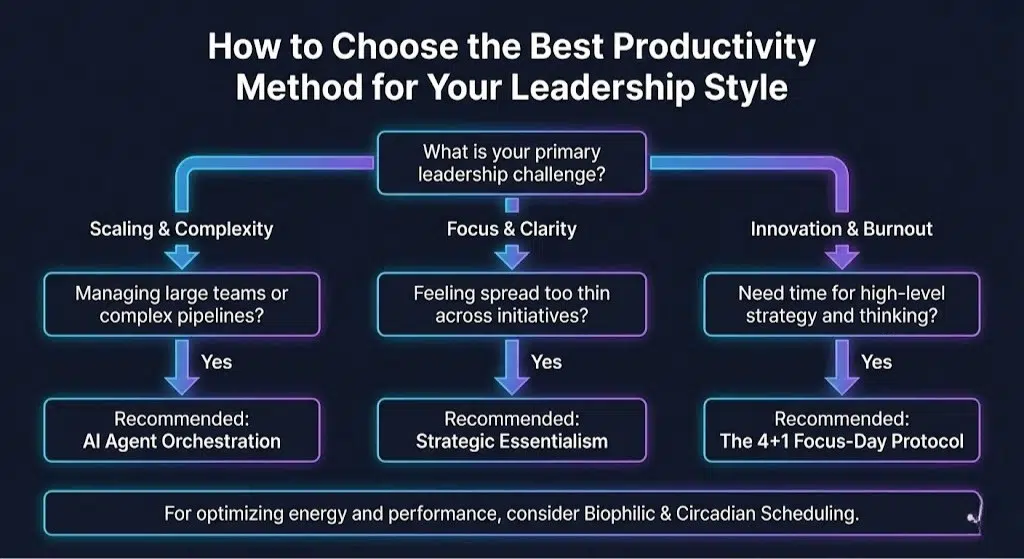
Traditional vs. 2026 Executive Frameworks Overview
The difference between 20th-century time management and 2026-era productivity lies in the shift from manual effort to intelligent systems. This table outlines the evolution of these management styles.
| Feature | Traditional Management | 2026 Executive Frameworks | Primary Shift |
| Priority Setting | Long To-Do Lists | Strategic Essentialism (Rule of 3) | Focus on Impact |
| Execution | Manual Delegation | AI Agent Orchestration | Autonomous Workflows |
| Time Management | Back-to-Back Meetings | Focus-Day Protocols (4+1) | Protected Deep Work |
| Measurement | Input/Hour Tracking | Outcome-Based Analytics | Result-Oriented |
| Wellness | “Grind” Culture | Biophilic Optimization | Sustainable Performance |
By adopting these modern paradigms, leaders can ensure their energy is directed toward high-value strategic thinking. Let’s look at some immediate ways to apply these concepts.
Before we dive into the details, it is important to understand the criteria used to vet these specific methods.
What Things Did We Consider When Choosing Our List?
To identify the most effective Executive productivity methods 2026, we analyzed performance data from top-tier firms and looked at the intersection of AI technology and human psychology.
When selecting these five methods, we weighed the following factors:
-
Inference Efficiency: We prioritized methods that reduce the cognitive load on the executive, allowing for clearer decision-making.
-
Autonomous Scalability: We looked for frameworks that leverage 2026 AI agents to handle execution without constant human oversight.
-
Human Sustainability: We excluded “hustle-based” models in favor of strategies that prevent burnout and support long-term leadership health.
-
Measurable Output: Each method on this list is tied to observable business outcomes rather than just “feeling” busy.
With these rigorous standards in mind, here are the top five productivity frameworks for today’s leaders.
The 5 Best Executive Productivity Methods 2026
Effective leadership in 2026 requires a blend of high-tech tools and low-tech discipline. These five methods represent the pinnacle of modern efficiency, designed specifically for the unique pressures of the executive suite.
The following list provides a roadmap for transforming your daily routine into a high-impact leadership system.
1. AI Agent Orchestration (The Digital Chief of Staff)
The biggest shift in Executive productivity methods 2026 is the move from “AI tools” to “AI agents.” Instead of just using a chatbot to write an email, executives now use autonomous agents to manage entire workflows, such as cross-departmental reporting or complex scheduling.
-
Best For: Executives managing large, multi-functional teams or complex project pipelines.
-
What We Liked: It removes the executive from the “approval bottleneck” by allowing agents to handle routine decisions based on predefined logic.
-
Things to Consider: It requires a significant initial investment in “prompt governance” to ensure agents are operating within company values.
2. Strategic Essentialism (The Rule of Three)
In an age of infinite data, the most productive executives are those who do less. Strategic Essentialism dictates that a leader should have no more than three active strategic priorities at any given time. Anything beyond this leads to fragmented attention and mediocre results.
-
Best For: C-suite leaders who feel “spread too thin” across multiple initiatives.
-
What We Liked: It provides extreme clarity for the entire organization; when the CEO only has three priorities, the rest of the company knows where to focus.
-
Things to Consider: Saying “no” to good opportunities is difficult and requires strong boundary-setting with stakeholders.
3. Outcome-Based (Skills-First) Management
Traditional job descriptions are becoming obsolete. This method focuses on defining specific outcomes and the skills needed to achieve them, rather than tracking hours or tasks. It utilizes predictive analytics to match the right talent—human or AI—to the desired result.
-
Best For: Dynamic industries where project requirements shift rapidly (e.g., Tech, Biotech).
-
What We Liked: It fosters a culture of high accountability and transparency, as performance is measured strictly by the quality of the final output.
-
Things to Consider: Transitioning to this model requires a complete overhaul of traditional HR and performance review systems.
4. The 4+1 Focus-Day Protocol
This time-management framework involves four days of standard execution and “sync” meetings, followed by one full day (typically Friday) of totally disconnected “Deep Work.” This day is reserved for high-level strategy, reading, and creative problem-solving.
-
Best For: Leaders who find themselves trapped in “back-to-back” meetings with no time to think.
-
What We Liked: It treats “thinking” as a core work requirement rather than an after-hours luxury, leading to more innovative long-term strategies.
-
Things to Consider: This only works if the executive leads by example and enforces a “no-meeting” policy for their entire direct-report layer on that day.
5. Biophilic and Circadian Scheduling
Modern productivity isn’t just about software; it’s about biology. This method involves scheduling high-stakes cognitive work (negotiations, strategy) during your biological “peak” and using biophilic environmental adjustments (natural light, air quality) to maintain mental stamina.
-
Best For: Executives looking to optimize their physical energy levels and mental sharpenss throughout the day.
-
What We Liked: It recognizes that human performance is cyclical; by working with your body rather than against it, you can achieve higher focus with less strain.
-
Things to Consider: It may require adjusting traditional 9-to-5 expectations to accommodate individual “chronotypes” (e.g., early birds vs. night owls)
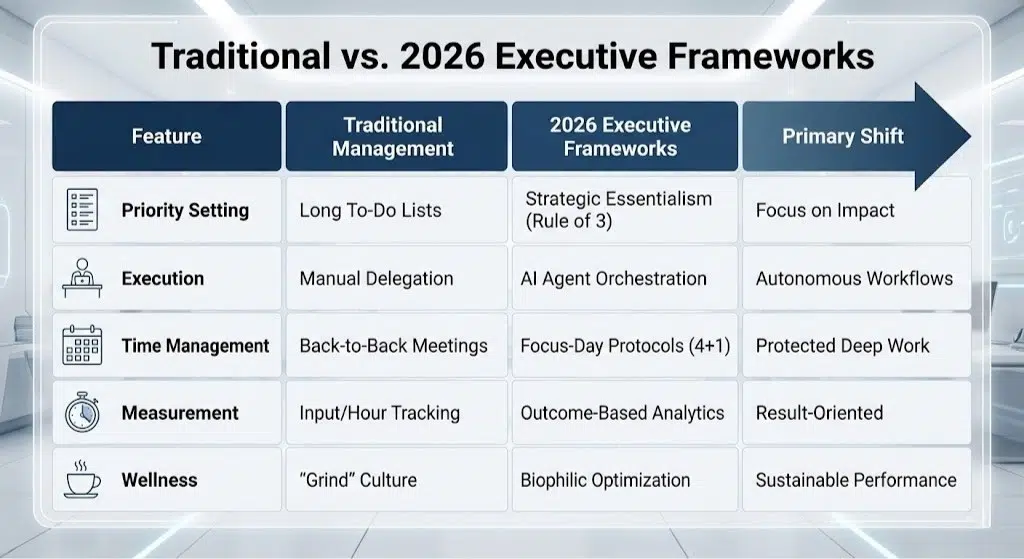
How to Choose the Best Productivity Method for Your Leadership Style
Deciding which of these Executive productivity methods 2026 to implement depends on your organizational culture. If your company is tech-forward, focus on AI Agent Orchestration. If you are in a high-stress, traditional industry, the 4+1 Focus-Day Protocol may provide the most immediate relief.
Ultimately, the most effective leaders are those who combine the efficiency of AI with the irreplaceable depth of human judgment.
If you are looking for immediate improvements to your workflow, these three “quick wins” are highly recommended for the modern C-suite.
-
Best for Scaling: AI Agent Orchestration – Delegate your routine reporting and scheduling to autonomous agents rather than human assistants.
-
Best for Mental Clarity: The Rule of Three – Limit your daily strategic priorities to exactly three items to prevent decision fatigue.
-
Best for Innovation: Protected Fridays – Clear your Friday calendar entirely for “Long-Horizon” thinking and strategic planning.
Wrap-Up
The goal of implementing Executive2026 is not just to do more work, but to do work that matters. By automating the routine, narrowing your focus, and respecting your biological limits, you can lead with a level of clarity and steadiness that was previously impossible. In the modern era, productivity is no longer about speed—it’s about the quality of the direction you set.