
Dreaming of a fresh start in Europe? Navigating job listings abroad can feel overwhelming when visa rules seem like a complex puzzle. Many professionals struggle to make their move due to paperwork and strict requirements.
Portugal stands out as one of Western Europe’s most accessible countries for work visas, especially for freelancers and remote workers with its D8 digital nomad visa. This guide covers top destinations like Germany, Estonia, Spain, Ireland, and the Czech Republic, detailing options such as the EU Blue Card, employer-sponsored visas, and working holiday permits.
Explore job markets, processing times, and expert tips to secure a Europe work visa successfully. Discover the pathways to start a new career overseas.
What is a Work Visa?
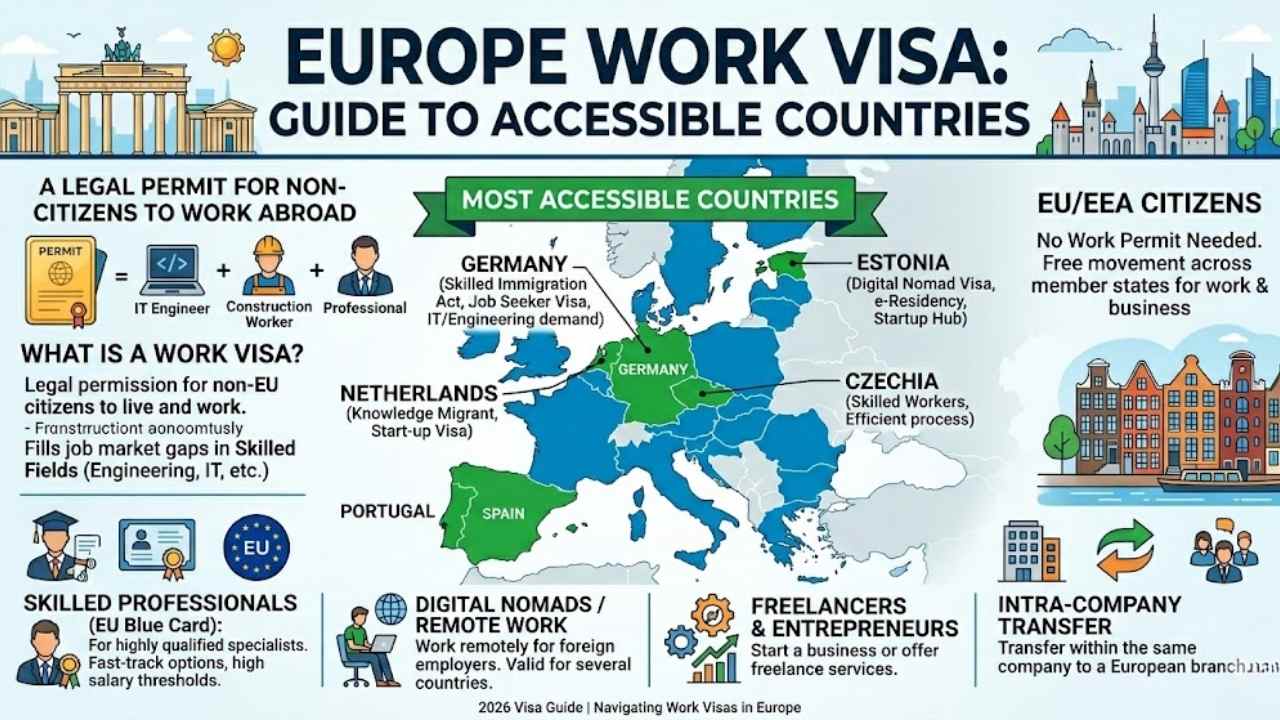
A work visa acts like your golden ticket to live and earn money in another country. It gives non-citizens the legal right to take jobs abroad. Countries issue these permits to fill gaps in their job markets, especially for skilled workers in fields like engineering, construction, and information technology.
Think of it as a bridge connecting your talents to opportunities overseas. EU nationals skip this step altogether; they work freely across member states without a work permit. Self-employed folks in the EU also dodge the need for one, letting them run businesses smoothly from place to place.
Many nations tailor employment visas for groups like digital nomads, freelancers, and entrepreneurs, with options such as the EU Blue Card for highly qualified professionals.
Accessibility differs a lot among European countries. Some spots, like Germany and Estonia, streamline the process for quick entry. Others keep stricter rules on residence permits and health insurance.
Picture applying for a job seeker visa in one nation, then landing a role that leads to permanent residency. Remote workers often grab digital nomad visas to blend travel with income.
Skilled migration programs attract international professionals through paths like intra-company transfer visas. Each choice hinges on your skills, job offers, and goals for working abroad.
Types of Work Visas in Europe
You know, landing a job in Europe often starts with picking the right permit, like an EU Blue Card for skilled pros or a freelance visa for remote workers chasing that laptop lifestyle.
Imagine swapping your desk for a cafe in Berlin, yeah, these options open doors to tech gigs in Germany or startup scenes in Estonia, so keep reading to find your fit.
Employer-Sponsored Visas
Companies in Europe often sponsor work visas for skilled workers from outside the EU. These visas tie you to a specific job offer. Luxembourg stands out with its Blue Card program for highly qualified professionals.
This option fits non-EU nationals who meet salary and skill thresholds. Germany also shines here, offering the EU Blue Card as a top path for employment in fields like technology and finance.
Think of it like a golden ticket, opening doors to stable jobs in wealthy economies. Ireland provides the Critical Skills Employment Permit for roles in high demand, such as tech and skilled trades.
The Netherlands has the Highly Skilled Migrant Programme, which attracts experts with fast processing.
Sweden’s Migration Agency handles similar permits, while the Czech Republic, or Czechia, simplifies the Employee Card for sponsored workers. Countries like Latvia and Slovakia offer accessible routes too.
You get support from employers who handle much of the paperwork. Portugal and Spain join in with options for intra-company transfer visas. These programs target sectors like IT and engineering.
Estonia leads with its modern tech visa for digital pros.
The EU Blue Card makes moving to Europe for work feel like a smart adventure, says a recent migrant from the US.
EU Blue Card
EU Blue Card opens doors for skilled workers from outside the EU. This highly qualified professional visa targets folks with strong job offers in fields like technology sector. Germany stands out with its Blue Card option, a top pathway for employment abroad in 2026.
Picture landing a role in Berlin’s buzzing economy; you apply, show your skills, and boom, you’re set. Luxembourg, that wealthy EU gem, uses this program to attract non-EU talents to its stable job market.
Multiple countries tailor these for pros, making entry smoother than a well-oiled machine.
Non-EU pros love how EU Blue Card streamlines access to jobs across member states. EU nationals skip work permits altogether, moving freely like birds in the sky. Accessibility differs by nation, with some offering quick processes for golden opportunities.
Think of it as your express entry to Europe’s workforce, no fuss for the right fit. Germany and Luxembourg lead the pack for skilled folks eyeing stable gigs.
Digital Nomad and Self-Employment Visas
Portugal stands out as one of Western Europe’s easiest spots for easy work visas, especially for independent workers and freelancers. They designed their system to welcome folks like you, with the Digital Nomad Visa, or D8, requiring a minimum income of about $3,300 per month.
Remote workers earning $3,000 or more each month find this remote worker visa super accessible. Picture yourself sipping coffee in Lisbon while handling clients from afar; that’s the dream Estonia pushes too, as Europe’s easiest digital door for work visas with a modern twist.
Multiple European countries tailor programs for digital nomads, remote workers, and skilled pros, including self-employment visas that let you chase entrepreneur visa dreams without heavy barriers.
Self-employed people in the EU skip the need for work permits to run businesses across member states, opening doors wide. You get to focus on your hustle, like launching a startup visa venture in the Czech Republic, where easy work visas emphasize simplicity.
Accessibility shifts from country to country, with some spots streamlining the process for golden visas or remote worker visa options. Imagine ditching the office grind for a self-employment visa in Spain; it feels like hitting the jackpot for location-independent life.
Countries like these craft paths for you, blending job freedom with quality vibes.
Working Holiday Visas
Young travelers, listen up. These visas let you work and explore Europe for a set time, often up to a year. Countries like Ireland and Germany offer them to folks from places such as Canada, Australia, and New Zealand.
You mix jobs with adventures, earning cash while seeing sights. Picture flipping burgers in Berlin one day, then hiking in the Irish countryside the next. EU nationals skip the work permit hassle to hop around member states, but non-EU folks grab these for easy entry.
Think of it as a ticket to live like a local, not just a tourist.
Multiple spots tailor programs for specific workers, including those from Singapore or Iceland. Germany stands out with its Blue Card for skilled pros, yet working holiday options draw in the youth crowd.
You apply through agencies like the Swedish Migration Agency or national employment spots. Estonia shines as a digital hub, blending tech jobs with travel vibes. Czech Republic keeps things simple for quick approvals.
Grab one if you qualify, and turn your gap year into paid fun across the continent.
Seasonal or Temporary Worker Visas
Europe offers seasonal or temporary worker visas for folks like you who want short gigs in farming, tourism, or construction. These permits let non-EU nationals fill jobs during peak times, say summer harvests or winter ski seasons.
Countries adjust programs to match labor needs, much like the temporary foreign worker program elsewhere. For example, you apply through the national employment agency in places like Spain or Portugal, and snag a visa for up to nine months.
EU rules make it straightforward for skilled hands, but watch out, requirements differ by spot. Take Cyprus, for instance, it draws workers with its warm vibes and quick processes, kind of like an open door during busy months.
I get it, chasing these can feel like a puzzle, but hey, many find the path smoother than expected.
Think about Germany or the Czech Republic, they push for easy access in seasonal roles, aligning with their focus on simplicity. You might compare it to the global talent stream for fast tracks, though Europe’s versions suit temporary stints.
Estonia stands out too, with its modern twist on visas for short-term pros, almost like a digital invite to join the fun. Luxembourg joins in, offering Blue Card paths that sometimes cover temp work in stable sectors.
Self-employed types, listen up, you often skip permits across the EU, freeing you to hustle without red tape. Job markets buzz with opportunities, and places like Ireland mix in working holiday vibes for a temporary boost.
Just gather your docs, prove your skills, and jump into the action, no fuss.
Top European Countries for Accessible Work Visas
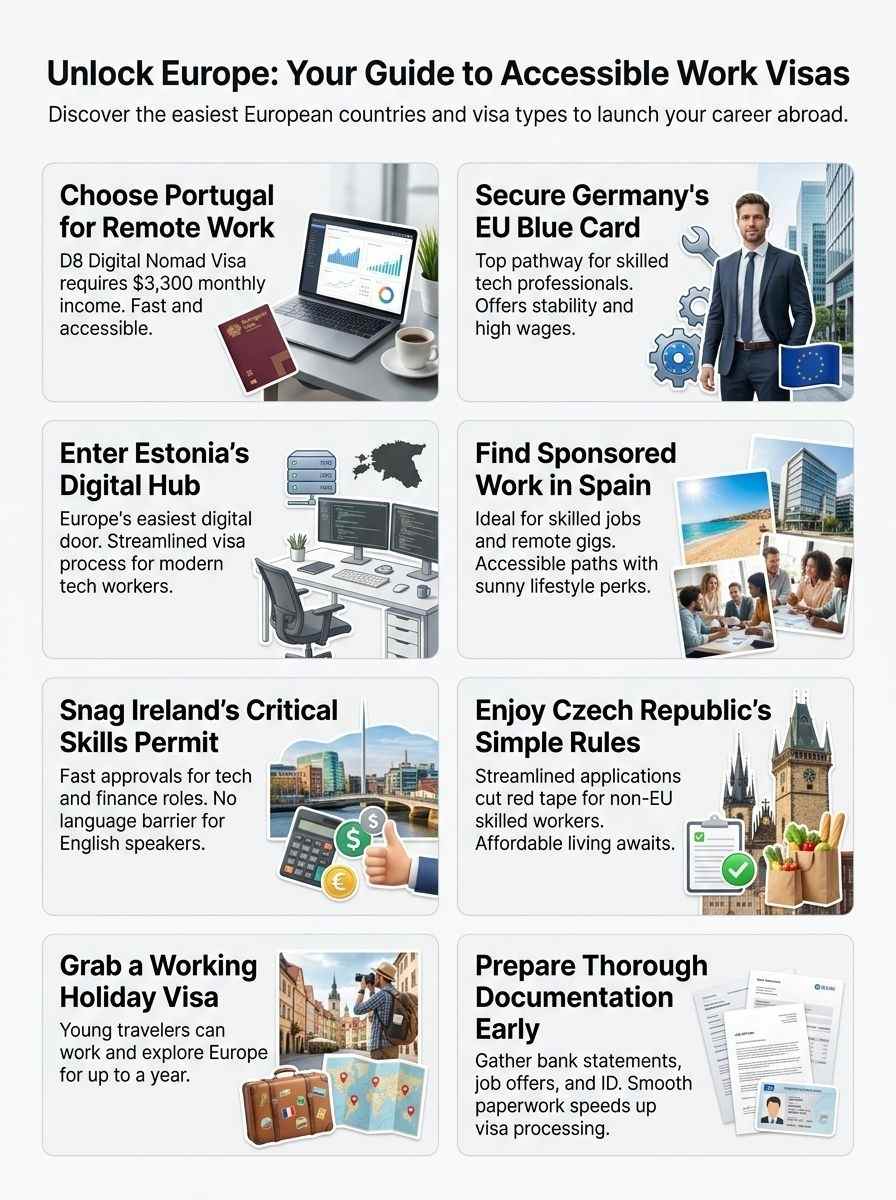
You want a spot in Europe where work visas flow like a smooth river, right? Picture landing a job in a place with fast approvals, like those offering the EU Blue Card or Chancen Karte, and suddenly your career takes off abroad.
Portugal
Portugal stands out as one of Western Europe’s easiest spots for snagging a work visa. Its setup caters to independent workers and freelancers, like a welcoming gate for folks chasing dreams abroad.
Imagine you earn at least $3,000 a month as a remote worker, and the Digital Nomad Visa, or D8, opens right up. It asks for about $3,300 monthly income, but hey, that fits many digital nomads just fine.
Countries create programs for skilled pros and remote folks, and Portugal leads with streamlined paths, unlike stricter spots elsewhere.
Think of Portugal as your friendly neighbor in the EU visa game, especially for abroad immigrations. Multiple nations, including this gem, focus on accessibility for categories like digital nomads.
Estonia might claim the easiest digital door, but Portugal’s system shines for Western Europe lovers. You find options here that beat waiting games in places like the USA or UK. Pair it with programs akin to the EU Blue Card, and you see why folks flock here for work chances.
Spain
Spain offers straightforward paths for non-EU folks chasing work visas, especially if you aim for skilled jobs or remote gigs. Imagine: you land a job offer, and the employer sponsors your visa, much like an intra-company transfer (ICT) visa setup.
Folks from outside the EU grab these employer-sponsored options with ease, thanks to Spain’s focus on filling job gaps in tech and tourism. EU nationals skip the work permit hassle altogether, jumping straight into opportunities across the country.
Self-employed pros enjoy the same freedom, running businesses without extra paperwork. Multiple spots in Europe, including Spain, offer programs for digital nomads, making it a breeze if you earn steady income remotely.
Job markets here buzz with chances in sunny sectors like hospitality and renewables, drawing in skilled workers via the EU Blue Card for high earners. Think of it as your golden ticket, similar to a general employment permit or even Australia’s subclass 482 for temporary skills.
Visa times vary, but Spain keeps things accessible compared to stricter neighbors, boosting your odds with solid docs. Remote workers flock here, eyeing that nomad life without heavy barriers.
Chat with ICC immigration experts for tips, or check Lithuanian labor exchange vibes for comparison, though Spain shines for its warm welcome. Quality of life soars with beaches and culture, easing your integration into daily rhythms.
Germany
Germany stands out as a powerhouse for work visas in Europe. Skilled workers eye its Blue Card program, which opens doors for high earners. This option ranks among the top paths for jobs abroad in 2026.
You need a job offer and qualifications to qualify. Think of it like an employment pass that boosts your career. Non-EU folks find it straightforward, with clear rules. EU nationals skip work permits altogether in member states.
That freedom feels like a golden ticket, right? Germany tailors visas for pros in tech and engineering. Intra-company transfer (ICT) visas help firms move staff easily. Imagine relocating without the usual headaches.
Picture yourself thriving in Berlin’s vibrant job scene. Germany focuses on skilled migrants to fill gaps. The Blue Card demands a salary threshold, but it pays off with stability.
Self-employed folks operate freely across the EU, no permits needed. You access financial perks through programs like this. Compare it to subclass 189 in other spots, yet Germany’s version shines for Europeans.
Start-up entrepreneur programmes exist too, fueling innovation. Processes vary, but Germany streamlines for accessibility. Skilled pros flock here for opportunities.
Ireland
Ireland draws in skilled workers with its straightforward work visa options, especially for non-EU folks chasing tech or finance jobs. Imagine, you land a role in Dublin, and the Critical Skills Employment Permit gets you sorted fast, often in weeks.
EU nationals skip the hassle altogether, no work permit needed to jump right in across member states. That Blue Card program, much like in Germany or Luxembourg, opens doors for high-earners pulling at least $50,000 a year in key fields.
Multiple countries offer these for remote pros too, but Ireland keeps things simple, with accessibility that beats stricter spots.
Think about visa perks here, they fit digital nomads and self-employed types who might eye spots like Estonia or the Czech Republic for ease. Freelancers from the UAE find Ireland’s setup a breeze compared to something like an S Pass elsewhere, no heavy red tape.
Quality life shines with friendly locals, green landscapes, and booming opportunities in sectors like pharma. You prepare docs, meet income thresholds, and bam, you’re set without endless waits.
Estonia
Estonia stands out as Europe’s easiest digital door for snagging work visas. This small Baltic nation takes a modern tack on immigration, drawing in skilled folks from afar. Picture it like a tech-savvy welcome mat, rolled out for remote workers and innovators.
They tailor programs for digital nomads, with streamlined steps that skip the usual red tape. Non-EU pros find quick paths here, thanks to Estonia’s focus on tech jobs and startups.
You earn enough? Doors swing open wide.
Multiple paths exist, from self-employment visas to those for remote gigs. Estonia represents that fresh vibe in Europe, where visa access feels like a breeze. Skilled workers grab opportunities in IT or business, fitting right into the vibe.
The country highlights simplicity, making it a top pick for easy entry. Chat with locals, and you’ll hear tales of fast approvals that change lives. Jump in if tech calls your name.
Czech Republic
The Czech Republic stands out as a top pick for folks chasing easy work visas in Europe. It focuses on simple steps that cut through the red tape. Imagine ditching the usual headaches, like endless forms, for a process that feels more like a friendly chat.
Non-EU workers find doors open wide for skilled jobs, especially in tech and engineering fields. This country has ramped up its appeal by streamlining applications, so you spend less time waiting and more time settling in.
Picture yourself landing a visa in months, not years, thanks to their push for accessibility.
Skilled professionals, listen up, the Czech Republic tailors options for you, from employer-sponsored permits to paths for freelancers. It joins other nations in offering programs that match your skills, like those for digital nomads or seasonal gigs.
EU folks breeze in without permits, but for others, the straightforward rules make it a breeze. Self-employed types operate freely across borders here, no extra hoops. With its mix of vibrant cities and strong job market, it draws people who want both opportunity and a good life.
Factors to Consider When Choosing a European Work Visa
Picking the right spot for your work adventure in Europe, like weighing Germany’s fast-track EU Blue Card against Portugal’s laid-back digital nomad permit, means thinking about how quick you can get approved, snag a solid job in tech or hospitality, enjoy sunny beaches or cozy pubs for downtime, and chat in English or pick up basic phrases to fit right in—hey, it’s like choosing ice cream flavors, but with passports involved, so stick around for the full scoop on making your move a winner.
Visa Processing Times
Visa processing times can make or break your move to Europe, folks. Think of them like waiting for your favorite pizza delivery, you want it fast and hot. Countries with streamlined systems, such as Portugal and Estonia, often wrap up approvals in weeks, not months.
Portugal’s D8 visa for digital nomads, for instance, demands proof of $3,300 monthly income and gets handled quickly for remote workers. Estonia shines as Europe’s modern gateway, speeding through applications for skilled pros.
Germany pushes its EU Blue Card option, a top pick for 2026 job seekers, with efficient timelines that draw in talent. Ireland and the Czech Republic keep things simple too, focusing on quick turns for non-EU folks.
Spain joins the list with accessible paths, like seasonal worker permits that process without endless delays. Luxembourg offers Blue Card perks in its stable economy, cutting wait times for experts.
Job market demands play a role here, pushing faster reviews in high-need spots. Quality of life factors in, as shorter waits let you experience new cultures sooner. Language skills help speed things along in places like Germany.
Multiple nations create programs for remote workers and freelancers, easing the path across the EU. EU nationals skip work permits altogether, zipping through without red tape. Self-employed folks operate freely too, no permits needed for business across borders.
Job Market and Opportunities
Europe’s job markets buzz with chances for skilled folks like you. Portugal draws independent workers and freelancers with its friendly setup, think of it as a welcoming front porch.
You can snag a Digital Nomad Visa there if you earn at least $3,300 a month, perfect for remote gigs pulling in $3,000 or more. Luxembourg stands out as one of the EU’s richest spots, stable and full of spots for non-EU pros through the Blue Card program.
Germany pushes its Blue Card too, a top pick for jobs abroad come 2026. Estonia opens digital doors wide, making visas a breeze for modern workers.
Spain, Ireland, and the Czech Republic keep things simple and accessible, like a straightforward path through a park. Many countries tailor programs for remote workers, digital nomads, and experts, but access differs a lot, some places streamline it while others stay strict.
EU nationals skip work permits altogether across member states. Self-employed folks in the EU run businesses freely without permits in those countries. Pick a spot where the job scene matches your skills, and you’ll thrive.
Quality of Life
Imagine moving to a place where daily life feels like a breath of fresh air, you know, with safe streets and top-notch healthcare. Countries like Portugal and Luxembourg stand out here.
Portugal draws in freelancers with its sunny coasts and laid-back vibe, plus that Digital Nomad Visa needs just about $3,300 a month to qualify. Luxembourg boasts one of the EU’s richest economies, offering stability that boosts your general well-being.
Think about Estonia too, it opens digital doors easily for work visas, and folks there enjoy modern perks like clean air and tech-savvy cities. Germany provides Blue Card options for skilled jobs, especially looking ahead to 2026, where high wages support a solid lifestyle.
Spain and Ireland add their own charm, with vibrant cultures and strong job markets that make settling in a joy. The Czech Republic keeps things simple for visas, and its affordable living lets you stretch your dollars further.
EU nationals skip work permits altogether, easing moves across borders for better opportunities. Self-employed folks run businesses freely without extra paperwork in the EU. Multiple nations offer programs for remote workers and pros, blending work with leisure in spots known for quality parks and community events.
Choose based on what lifts your spirits, like Spain’s beaches or Germany’s efficient trains.
Language and Integration
Europe’s countries differ a lot in language needs for work visas. Portugal draws independent workers with its friendly vibe, and many locals speak English, so you fit in fast. Picture chatting with a Lisbon cafe owner in broken Portuguese, they smile and switch to English, easing your move.
Spain offers chances too, but brushing up on Spanish helps you blend into daily life, like joining a tapas night with new friends. Germany pushes for skilled pros via the EU Blue Card, and while German rules the job scene, cities like Berlin buzz with English speakers, making integration smoother than you might think.
Ireland shines for English users, no big language wall there, you dive right into pub talks and work chats. Estonia leads as a digital hub, English works well in tech spots, perfect for remote folks earning over $3,000 monthly on their D8 visa.
Czech Republic keeps things simple, with growing English use in Prague, helping you settle without feeling lost.
Integration goes beyond words, it ties to culture and community. EU nationals skip work permits across member states, freeing them to roam and connect easily. Self-employed types run businesses freely in the EU, no permit hassle, so you build networks on your terms.
Luxembourg lures with its stable economy and Blue Card for non-EU skilled workers, where French, German, and English mix, like a language salad that boosts your social ties. Think of it as planting roots in fertile soil, you grow connections through local events or classes.
Multiple countries tailor visas for digital nomads and pros, so pick one matching your tongue and lifestyle, it makes the shift feel like a fun adventure, not a chore.
Tips for a Successful Work Visa Application
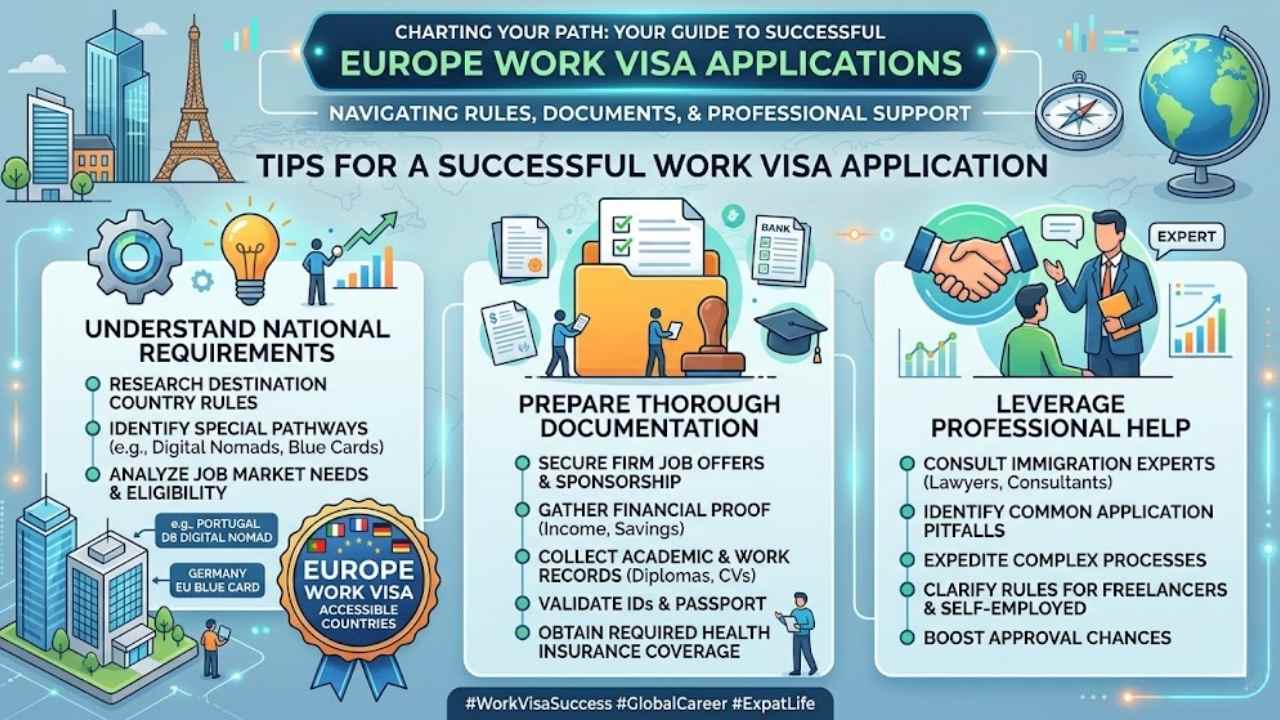
You know, applying for a work visa can feel like juggling flaming torches while riding a unicycle, but hey, with the right moves, you land that dream job abroad. Stick around, and we’ll share some down-to-earth advice on gathering your papers, like proof of employment and health checks, plus when to call in experts from immigration services for that extra edge.
Understand the Requirements
Grasping work visa requirements marks the first step in your European job hunt. It saves time and dodges headaches down the road.
- Portugal stands out with its D8 Digital Nomad Visa, which demands a monthly income of about $3,300, perfect for remote workers who pull in $3,000 or more each month; this setup, like an open gate for freelancers, fits Western Europe’s easy immigration for independent folks.
- Spain offers various work visas, including those for skilled pros and seasonal workers, but you must check specifics since multiple European countries design programs for categories like digital nomads and remote workers.
- Germany provides the EU Blue Card as a top path for skilled non-EU nationals seeking jobs abroad, especially in 2026; think of it as a golden ticket that opens doors to one of Europe’s powerhouse economies.
- Ireland makes work visas accessible through employer-sponsored options and the Blue Card program, yet keep in mind that EU nationals skip work permits altogether when moving within member states.
- Estonia shines as Europe’s modern entry point for work visas, with streamlined processes that feel like a quick digital handshake for skilled workers and self-employed types.
- The Czech Republic draws crowds with its simple immigration rules, focusing on easy access for non-EU folks; it’s become a go-to spot, much like finding a shortcut in a maze of paperwork.
- Luxembourg, one of the EU’s richest spots, eases in skilled workers via the Blue Card, but keep in mind that self-employed people across the EU never need work permits to run businesses in member states.
- Many European nations vary in visa ease, from Portugal’s freelancer-friendly system to Germany’s structured Blue Card; this mix, like a buffet of options, caters to everyone from seasonal workers to digital nomads.
- Factors like visa processing times differ by country, so dig into each one’s job market and requirements; for instance, accessibility swings widely, with some places offering quick paths while others stick to strict rules.
Prepare Thorough Documentation
You must gather all needed papers for your work visa application. This step can make or break your shot at moving to Europe.
- Start by collecting proof of your income, especially for visas like Portugal’s Digital Nomad Visa (D8), which asks for about $3,300 a month; show bank statements or pay stubs to prove you earn at least $3,000 monthly as a remote worker, and hey, it’s like packing an umbrella for a rainy day, you know?
- Grab your passport and any ID docs next; for spots like Estonia, known as Europe’s easiest digital door for work visas, include photos and birth certificates to match their modern, simple process that welcomes skilled folks.
- Include job offers or sponsor letters for employer-sponsored visas; in Germany, the Blue Card option stands out as a top path for 2026, so attach contracts that highlight your skills, much like a golden ticket to a stable economy.
- Don’t forget education and work history proofs, such as diplomas or resumes; the Czech Republic focuses on simplicity in its easy work visas, so organize these to show your qualifications without the hassle, almost like sorting puzzle pieces that fit just right.
- Add health insurance and medical records if required; Luxembourg uses the EU Blue Card for skilled non-EU nationals in its wealthy setup, so include coverage details to prove you’re set for their stable job market.
- Prepare financial statements for self-employment or digital nomad options; Portugal shines for independent workers with its system, and self-employed folks in the EU skip work permits to run businesses across countries, like a free pass to chase dreams.
- Collect any language proficiency tests or integration proofs; Ireland offers accessible paths, so toss in certificates that help with factors like language and quality of life, making your app feel like a friendly chat over coffee.
- Finally, double-check visa-specific forms for types like working holiday or seasonal worker visas; Spain offers programs for remote workers and pros, with varying accessibility across Europe, so fill them out accurately to avoid snags in processing times.
Leverage Professional Assistance
Hire an immigration lawyer or consultant to guide you through the process. They know the ins and outs of programs like Portugal’s D8 Digital Nomad Visa, which needs a monthly income of about $3,300.
Imagine: you’re a remote worker earning over $3,000 a month, and they help you prove it with solid paperwork. Experts spot common pitfalls, like missing docs for Germany’s Blue Card, one of the top paths for skilled jobs in 2026.
In Estonia, often called Europe’s easiest digital entry, they speed up your application. For the Czech Republic’s simple setup, they make sure you meet all rules without hassle. Think of them as your visa sidekick, turning a tough task into a smoother ride.
Talk to these pros early, especially if you’re eyeing Luxembourg’s Blue Card for non-EU folks in its rich economy. They explain how EU nationals skip work permits altogether, but you might need one.
Self-employed types across the EU? No permit required, yet consultants clarify that for your business moves. In Spain or Ireland, they customize advice to job markets and quick processing times.
“Hey, I’ve got this freelance gig in Portugal,” you might say, and they respond with tips on seasonal visas. Their help boosts your odds, keeps things legal, and saves time on complex requirements.
Final Thoughts
You’ve explored work visas that open doors to Europe, from employer-sponsored options to digital nomad paths in places like Portugal and Estonia. These strategies make the process straightforward and quick, so you can focus on your career without endless red tape.
What country sparks your interest for a fresh start? Grabbing a work visa here boosts job chances and life quality, turning dreams into real moves abroad. Check government sites for updates, or chat with immigration pros for extra help.
Go chase that European adventure; it’s closer than you think.
Frequently Asked Questions (FAQs) on Europe Work Visa: Accessible Countries
1. Which European countries offer the easiest work visas?
Hey, if you’re dreaming of working abroad, countries like Portugal and Estonia top the list for accessible work visas; they have straightforward rules that welcome skilled folks. Think of it as an open door, not a locked gate. Just check their specific job needs first.
2. What steps do I follow in this work visa guide for Europe’s most accessible countries?
Start by picking a spot like the Netherlands, gather your job offer and passport, then apply online. It’s like packing for a trip, but with more paperwork.
3. How long might the work visa process take in these accessible European spots?
In places like Germany, it can wrap up in a few months if your docs are spot on; delays happen if something’s missing, so double-check everything. Picture it as waiting for your favorite show to load, sometimes quick, sometimes not. Stay patient, and it’ll pay off.
4. Do I need special skills for work visas in Europe’s easiest countries?
No fancy degrees always required; many spots value practical experience in tech or healthcare. It’s like joining a club where your talents open the door.