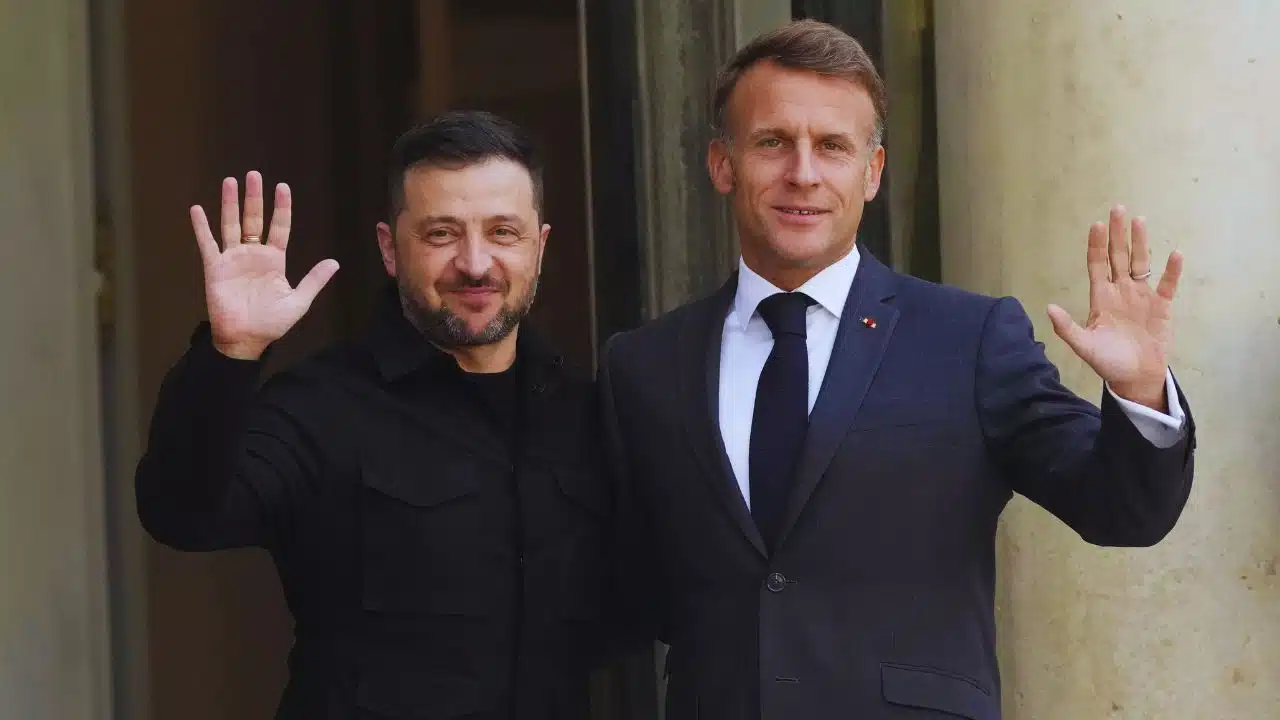
A group of senior European leaders has privately urged Ukrainian President Volodymyr Zelenskyy not to accept a peace arrangement on Donbas that involves withdrawing Ukrainian troops or making territorial concessions unless it is backed by firm, long-term security guarantees from the United States.
The warning comes as Washington, under President Donald Trump, leads intensive negotiations with Kyiv and Moscow over a draft peace plan that could reshape the front lines in eastern Ukraine and the wider security order in Europe.
Warning call from European leaders
According to diplomats cited in multiple reports, the message was delivered during a conference call on 1 December between Zelenskyy and European leaders including French President Emmanuel Macron, German Chancellor Friedrich Merz and European Commission President Ursula von der Leyen. These leaders urged Zelenskyy not to accept Russian demands over Donbas or a pullout of Ukrainian forces from still‑held areas unless Washington commits to clear, enforceable security guarantees for Ukraine’s future.
European officials fear a scenario in which a war‑weary and militarily stretched Ukraine comes under pressure from the United States to accept a rapid deal that trades territory for a reduction in fighting but leaves Kyiv without hard assurances against a renewed Russian offensive. Some European diplomats have warned that, without serious US backing, such a settlement could both weaken Ukraine and increase the long‑term security risks for the European Union and NATO’s eastern flank.
US peace push and the Donbas dispute
The European warning is unfolding against the backdrop of a US‑driven peace initiative in which American envoys have held marathon talks with Ukrainian negotiators in Miami, while also meeting Russian President Vladimir Putin in Moscow. Sources familiar with those discussions say Russia is pushing for Kyiv to withdraw its troops from parts of Donbas that Ukraine still controls, even as Washington and Kyiv try to craft a formula for US security guarantees and future military assistance.
American and Ukrainian officials have discussed a framework of security arrangements, but several key issues remain unresolved, including the exact status of Donbas, limits on Ukraine’s armed forces, and how binding any US pledges would be. US officials have indicated that a deal is close on some points, yet the Kremlin has publicly signaled that it wants major changes to the current peace outline, underlining how fragile the process remains.
Key recent milestones in the Donbas peace track
| Date (2025) | Event | Main actors |
| Late November | Leak of a draft US peace outline for Ukraine, including ideas on Donbas and security guarantees. | US, Ukraine, Russia |
| 1 December | European leaders hold a call with Zelenskyy and warn him against accepting Russian terms without US guarantees. | Macron, Merz, von der Leyen, Zelenskyy |
| 2 December | US envoys meet Putin in Moscow after several days of talks with Ukrainians in Miami. | US special envoys, Putin |
| 5–6 December | Miami talks between US and Ukrainian teams end with progress but no breakthrough on Donbas and guarantees. | US, Ukrainian negotiators |
| Early December | Putin reiterates that Russia will seek control of Donbas by force if its conditions are not met in talks. | Putin, Russian leadership |
Why Donbas and US guarantees matter for Europe
The Donbas region in eastern Ukraine has been at the heart of the conflict since 2014 and remains partly occupied by Russian forces, with Ukrainian troops holding heavily fortified positions in the remaining areas under Kyiv’s control. European governments argue that forcing Ukraine to withdraw from those areas without robust, enforceable guarantees could reward aggression, undermine the principle of territorial integrity and set a precedent that might encourage future Russian pressure elsewhere.
Analysts also note that earlier versions of US proposals contemplated not only Ukrainian territorial concessions but also limits on the size of Ukraine’s armed forces and constraints on NATO’s military posture in the region, moves that many in Europe see as crossing their security red lines. European officials fear that if the United States later scales back its involvement, they could be left managing an unstable settlement on their own, with a weakened Ukraine and a Russia that has gained ground without facing lasting consequences.
Core European concerns highlighted by diplomats
- A hasty Donbas deal without strong US guarantees could lock in Russian gains and encourage future offensives.
- Any limits on Ukraine’s military strength or NATO’s presence near Russia must not erode deterrence for the rest of Europe.
- Europe does not want to be sidelined in talks that will shape its own long‑term security environment.
Kyiv’s dilemma between Washington and Europe
For Zelenskyy, the European message adds to an already complex balancing act between military realities on the ground, domestic politics, and the competing pressures of his two main backers, the United States and Europe. Ukraine depends heavily on US military aid and on European financial assistance and political support, making it difficult for Kyiv to reject outright any proposal coming from Washington while also ignoring European warnings about long‑term risks.
Reports indicate that Ukrainian officials are scrutinizing multiple US drafts and will brief Zelenskyy on the latest ideas in meetings in London and other European capitals this week, ahead of further consultations with Macron, Merz and other leaders. At the same time, Ukrainian public opinion has been strongly opposed to territorial concessions, and Zelenskyy has repeatedly said any peace must not enable another Russian invasion, adding further political pressure on his negotiating team.
Pressures shaping Kyiv’s choices
- Military: Russia continues to demand a Ukrainian withdrawal from parts of Donbas and threatens to seize them by force if talks fail.
- Diplomatic: The US is driving the peace process, while Europeans want greater input and tougher safeguards for Ukraine.
- Domestic: Any perception of capitulation on territory could be explosive in Ukrainian politics after years of war.
What comes next
Negotiations are expected to continue in the coming days, with Ukrainian officials due to return from Miami to Europe to brief Zelenskyy and coordinate positions with key European capitals. European leaders have signaled that they plan further meetings with Zelenskyy to review US proposals and to press their case for strong, preferably US‑anchored, guarantees that would make any Donbas compromise more sustainable.
Diplomats say the outcome will hinge on two unresolved issues: whether Moscow, Kyiv and Washington can agree on the status of remaining Ukrainian‑held territory in Donbas, and what form US security guarantees will take in legal and military terms. If talks stall or produce a deal seen as too favorable to Russia, European states may have to decide whether to deepen their own security commitments to Ukraine, both to shore up Kyiv and to protect Europe’s eastern flank from new instability.