Elon Musk has launched a blistering attack on X, the platform he owns, accusing former U.S. Transportation Secretary Elaine Chao of actively trying to “kill NASA” during her tenure. The claim, posted late Tuesday, resurrects long-simmering tensions between the SpaceX CEO and the regulatory bodies that oversee the burgeoning private space industry.
Quick Take
- The Accusation: Elon Musk claimed on X that Elaine Chao, who served as Transportation Secretary from 2017 to 2021, “was the one trying to kill NASA!
- The Context: The attack appears linked to historical friction between SpaceX and the Federal Aviation Administration (FAA), which fell under Chao’s Department of Transportation, over launch licensing and environmental reviews.
- Regulatory Friction: During Chao’s tenure, SpaceX faced significant delays in obtaining launch approvals for its Starship program, particularly a lengthy environmental review process at its Boca Chica, Texas facility, which Musk publicly criticized as overly bureaucratic (Source: Reuters, The Wall Street Journal).
- NASA’s Dependence on SpaceX: NASA is heavily reliant on SpaceX for its core missions, including transporting astronauts to the International Space Station (ISS) via its Crew Dragon capsule under a $2.6 billion contract signed in 2014.
- Chao’s Stance: During her time as Secretary, Chao emphasized a balanced approach, focusing on streamlining commercial space regulations while ensuring public safety, a process some in the industry found slow and cumbersome.
The Spark: A Late-Night Broadside on X
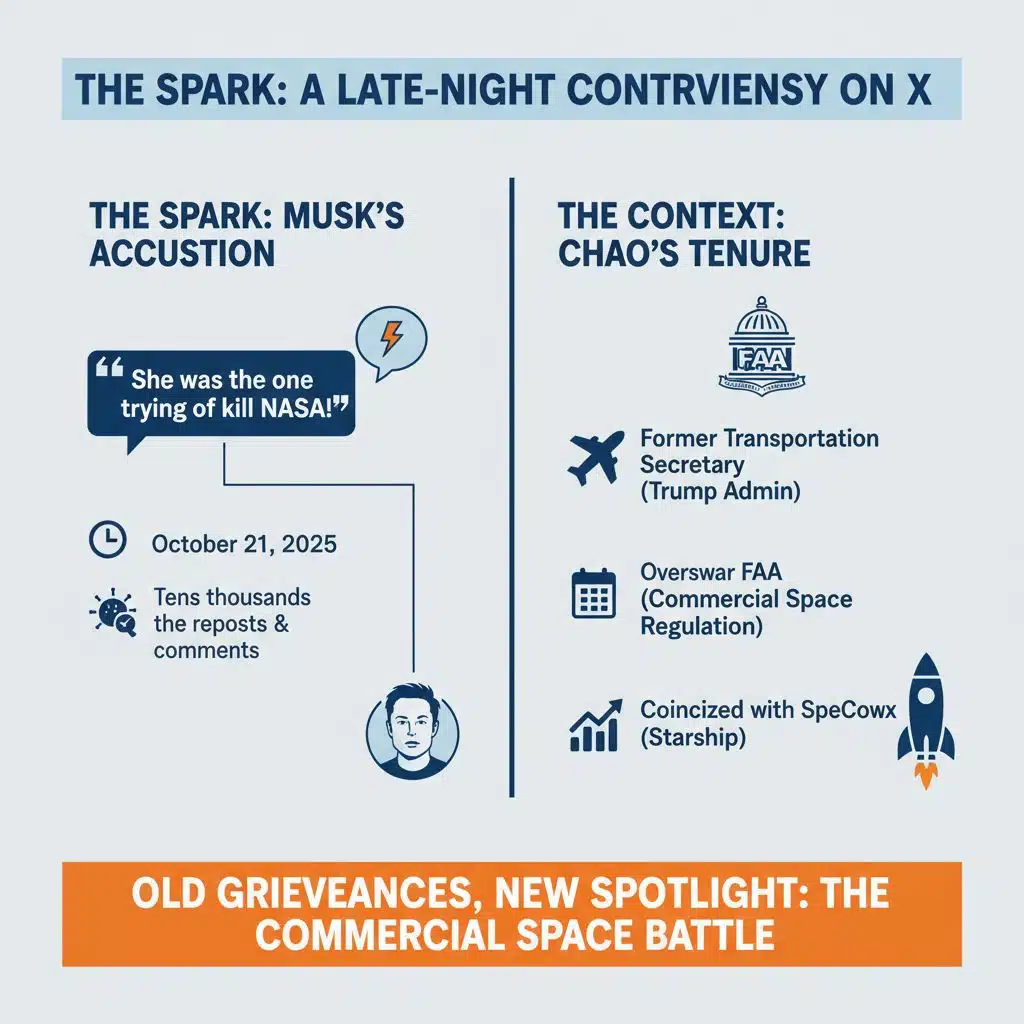
The controversy erupted late Tuesday evening, October 21, 2025, when Elon Musk posted a direct and startling accusation against Elaine Chao. In a reply to a thread discussing federal agency efficiency, Musk wrote, “She was the one trying to kill NASA! The FAA reports to the Secretary of Transportation. She did her best to crush the commercial space industry & give all the spoils to the old guard.
The post immediately went viral, drawing tens of thousands of reposts and comments within hours. It represents one of Musk’s most direct and personal attacks on a former cabinet secretary, bringing old grievances about regulatory oversight back into the public spotlight.
Chao, who served under President Donald Trump, oversaw the FAA, the agency responsible for licensing and regulating commercial space launches and re-entries in the United States. Her tenure coincided with a period of explosive growth for SpaceX, particularly the development and initial testing of its ambitious Starship rocket, designed for missions to the Moon and Mars.
A History of Regulatory Headwinds
Musk’s frustration with the FAA is well-documented. The core of the conflict centered on the licensing process for SpaceX’s Starship test flights from its Starbase facility in Boca Chica, Texas.
The Starship Standoff
Throughout 2020 and early 2021, SpaceX experienced multiple launch delays for its Starship prototypes, which Musk frequently blamed on the FAA’s regulatory framework. A pivotal moment occurred in December 2020 when the FAA delayed a high-altitude test flight of the SN8 prototype, citing safety concerns. Musk openly criticized the agency, stating on X that the FAA’s “space division has a fundamentally broken regulatory structure.
The most significant hurdle was a protracted programmatic environmental assessment (PEA) of the Starbase launch site. This review, which began under Chao’s leadership, took over 18 months to complete and involved multiple federal agencies. The FAA ultimately concluded the review in June 2022—well after Chao had left office—requiring SpaceX to take more than 75 actions to mitigate environmental impacts before a launch license could be issued.
Data on an Unprecedented Partnership
Musk’s claim that Chao sought to “kill NASA” is particularly pointed given the symbiotic relationship between the space agency and SpaceX. For over a decade, NASA has been SpaceX’s most important customer, a partnership that has been instrumental in revitalizing America’s human spaceflight capabilities.
- Commercial Crew Program: NASA awarded SpaceX a $2.6 billion fixed-price contract in 2014 to develop the Crew Dragon spacecraft to ferry astronauts to the ISS. Its first crewed flight occurred in May 2020, ending America’s nine-year reliance on Russian Soyuz rockets.
- Artemis Program: SpaceX holds a $2.89 billion contract, awarded in April 2021, to develop a lunar lander variant of its Starship rocket for NASA’s Artemis III mission, which aims to return humans to the Moon’s surface.
- Launch Cadence Growth: Under the Trump administration, where Chao served, SpaceX’s launch cadence grew dramatically. In 2017, the company conducted 18 launches. By 2020, that number had grown to 26, including the historic Demo-2 crewed mission.
This data illustrates a complex reality: while SpaceX faced regulatory friction under Chao’s DOT, its foundational and highly successful partnership with NASA flourished and expanded during the same period. Critics of Musk’s statement point to this as evidence that his ire is directed more at the FAA’s risk-averse processes than a coordinated effort to undermine the space agency.
Impact and What to Watch Next
Musk’s renewed attack injects a volatile political element into the ongoing relationship between SpaceX and its government partners. With the 2026 midterm elections approaching and space policy becoming an area of bipartisan focus, his alignment against a prominent Republican figure could have unforeseen consequences.
The immediate focus will be on any response from Chao or other figures from the Trump administration. Observers will also watch for any change in tone or procedure from the current FAA leadership, which continues to oversee the ever-increasing pace of SpaceX operations.
For now, the accusation hangs in the air—a stark reminder of the battles fought behind the scenes as humanity pushes further into the final frontier, and the powerful personalities driving that push.