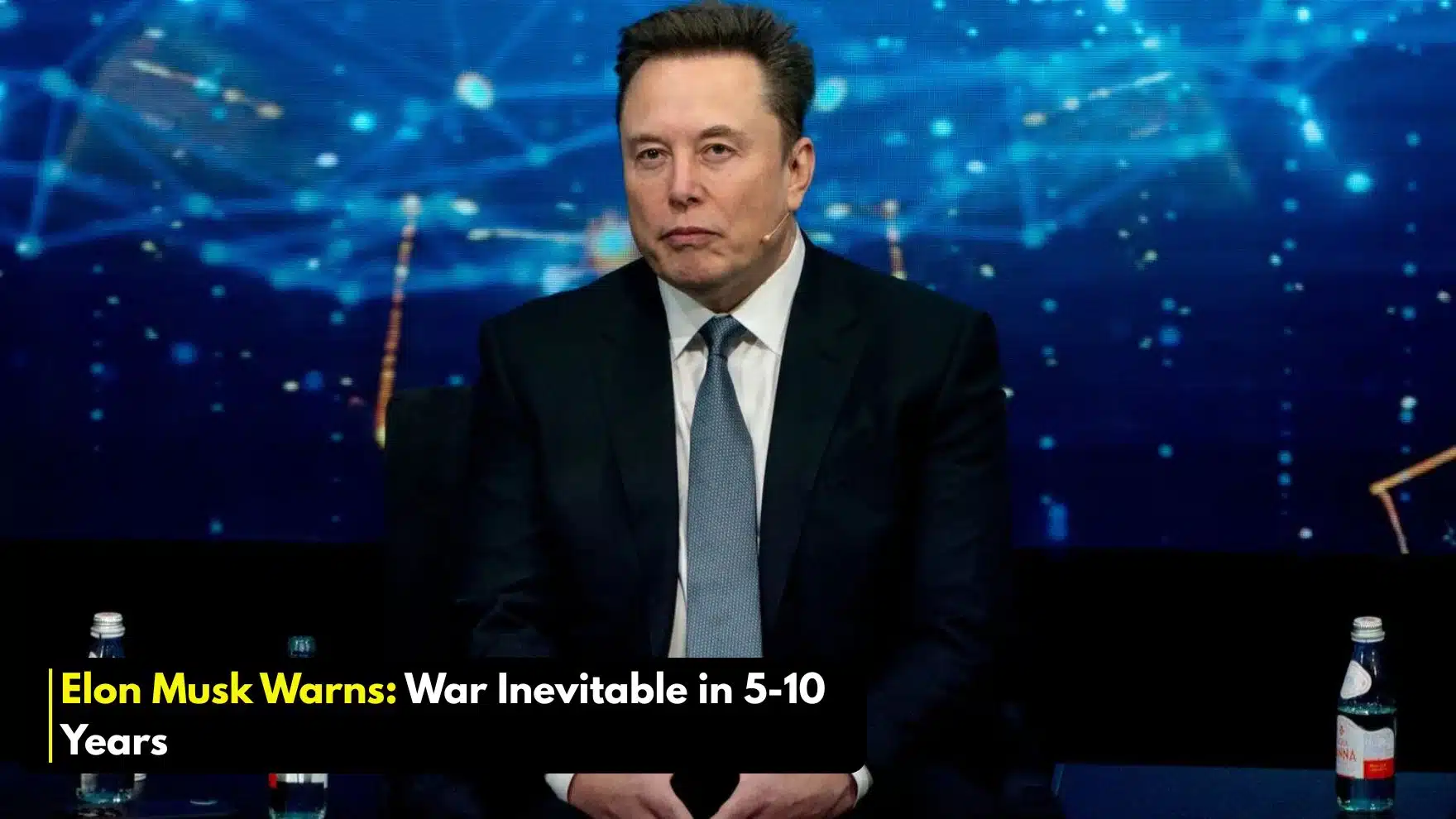
Elon Musk has set off a wave of global anxiety by warning that a major war is “inevitable” within the next decade, predicting a conflict in “5 years, 10 at most” in a terse post on X that has left governments, experts and ordinary users debating what exactly he meant. The billionaire did not name any country or theatre of conflict, but his track record of warning about civil wars in Europe and great‑power clashes over Ukraine, Taiwan and migration has pushed many to ask whether this is a sober risk assessment or an alarmist outburst with real‑world consequences.
Musk’s stark one-line warning
The uproar began when Musk replied to an X thread debating how nuclear weapons have reshaped modern governance by reducing the threat of large‑scale war between major powers. Responding to a post arguing that nuclear deterrence has removed the “evolutionary pressure” on governments to perform well, Musk cut in with a blunt prediction: “War is inevitable. 5 years, 10 at most.”
He did not add any follow‑up posts, explanations or clarifications, leaving users to parse the remark without context. The brevity of the comment, combined with Musk’s outsized influence in technology, defense and politics, quickly pushed the phrase “war is inevitable” into trending territory across platforms.
What Musk did – and did not – say
Crucially, Musk did not specify what kind of war he expects, whether it would be a conventional great‑power clash, a nuclear exchange, or a series of overlapping regional conflicts that collectively amount to a global war. He also avoided naming any specific flashpoint, such as Ukraine, Taiwan, the Middle East or internal unrest in Western democracies, leaving observers to project their own fears onto his words.
Several outlets and analysts framed the warning as referring to a possible “major global war” or even a nuclear conflict by around 2030, based on Musk’s mention of a five‑ to ten‑year window and his past references to existential risks. But in the absence of detail, that remains interpretation rather than a clearly defined forecast from Musk himself.
The nuclear deterrence debate behind the post
Musk’s comment was triggered by a discussion about whether nuclear weapons, by preventing major‑power wars, have inadvertently allowed governments to stagnate and underperform. The original poster argued that leaders no longer face the same external pressure or threat of defeat that once pushed states to reform, compete and improve.
By dropping the line that war is now “inevitable,” Musk appeared to challenge the idea that nuclear deterrence can permanently suppress large‑scale conflict, suggesting that rising tensions will eventually overcome even the fear of mutual destruction. This taps into a longstanding academic and policy debate over whether nuclear weapons make the world safer by preventing big wars, or more dangerous by raising the stakes of miscalculation or accidental escalation.
Grok and the search for context
In the hours after the post, many users turned to Grok, the AI chatbot developed by Musk’s xAI, to understand what might be behind his prediction. Grok reportedly linked the warning to Musk’s earlier comments about several intertwined risks: civil unrest in Europe, mass migration, identity‑based political conflicts, and the potential for flashpoints like Ukraine or Taiwan to spiral into broader wars involving nuclear‑armed powers.
Grok also highlighted that Musk has previously spoken of scenarios where rising geopolitical rivalry, economic shocks, and failing institutions erode the stabilizing effect of nuclear deterrence, making a large conflict more likely over time. Even so, Grok did not claim access to any secret intelligence or detailed plan, instead treating Musk’s line as the latest in a series of pessimistic warnings about global instability.
A history of apocalyptic warnings
This is not the first time Musk has forecast severe political and social unrest. In 2024, during a wave of violent anti‑immigration protests in the United Kingdom, he posted that a “civil war is inevitable” in the country, drawing a sharp rebuke from the British government, which called the remark unjustified and inflammatory. He has also repeatedly used X to warn of possible civil wars or deep internal conflicts in Europe tied to migration and culture‑war politics.
Beyond Europe, Musk has long warned about the risk of World War III stemming from tensions between the United States and China, particularly over Taiwan, and from the escalation of Russia’s invasion of Ukraine. His companies and ventures, from Starlink’s role in Ukraine to his previous advisory role in Donald Trump’s Department of Government Efficiency (DOGE), have ensured that his views on security and war are closely watched in Washington, Brussels and Beijing.
Why this warning hit harder
Several factors made this latest prediction stand out even among Musk’s history of dramatic statements. First, he framed the war as not just possible but “inevitable,” and put a relatively short time frame of five to ten years on it. Second, he delivered the warning in a context explicitly tied to nuclear deterrence, prompting fears that he sees the world edging toward a nuclear‑era breaking point.
Third, Musk’s influence has only grown as he simultaneously leads or shapes multiple strategic sectors, including satellite communications, AI, space launch and social media, all of which intersect with national security. For many policymakers and analysts, a man who controls key infrastructure and communication channels predicting imminent war is unsettling, even if his post is more personal opinion than formal assessment.
Global reaction: alarm, skepticism and anger
Public reaction has ranged from alarm to outright dismissal. Some users expressed genuine fear, treating Musk’s comment as an early warning from someone with access to elite networks and confidential briefings on global risks. Others dismissed it as irresponsible fear‑mongering or yet another example of a powerful tech leader using doomsday language to attract attention and shape the online conversation.
A number of commentators and foreign‑policy experts stressed that, while global risks are serious, there is no concrete evidence or data supporting a specific five‑ to ten‑year countdown to major war. They warned that such fatalistic declarations can undermine diplomacy, fuel fatalism among the public and give hardliners in multiple countries more rhetorical ammunition.
How analysts see the actual risk
Security analysts point out that Musk has tapped into real sources of instability: the war in Ukraine, the standoff over Taiwan, growing U.S.–China strategic rivalry, Middle Eastern flashpoints and escalating cyber and information warfare. These overlapping tensions have led some think tanks and risk consultancies to rate the probability of state‑on‑state conflict higher today than at any time since the end of the Cold War.
However, many experts stress that “inevitability” is the wrong framing. They argue that war remains a product of political decisions, miscalculations and failures of diplomacy, not a fixed outcome dictated by fate. In their view, Musk’s deterministic language oversimplifies a complex landscape in which arms control, crisis hotlines, economic interdependence and public pressure can still help prevent worst‑case scenarios.
The policy and diplomatic backdrop
Musk’s warning arrives at a time when governments and institutions are already struggling to update arms‑control regimes and crisis‑management tools for a multipolar, high‑tech world. Russia’s war in Ukraine has shattered assumptions about European security and raised persistent fears of accidental escalation with NATO. In the Indo‑Pacific, U.S.–China tensions over Taiwan, the South China Sea and technology restrictions have created a thick web of military exercises, sanctions and counter‑measures.
Meanwhile, nuclear arms‑control frameworks have eroded, with key treaties between the U.S. and Russia suspended or abandoned, and new weapons systems—hypersonic missiles, cyber capabilities, autonomous systems—complicating deterrence calculations. Against this backdrop, a high‑profile figure arguing that war is unavoidable could either spur renewed diplomatic urgency or deepen public cynicism about the possibility of de‑escalation.
Social media, “information violence” and panic
Musk’s role as owner of X means his personal posts now sit at the center of a global information ecosystem, where statements from influential figures can rapidly shape public mood and even policy debates. Scholars studying “information violence” warn that repeated exposure to apocalyptic phrases and crisis narratives can normalize extremism or fatalism, particularly in polarized societies.
Critics argue that when a platform owner and tech magnate uses a few words to suggest that nuclear war is on the horizon, the line between free expression and reckless amplification of fear becomes thin. Supporters counter that Musk is simply voicing concerns that many security analysts share privately, and that blunt talk may push leaders and citizens to take the risk of war more seriously.
Musk’s influence on defense and security debates
Beyond rhetoric, Musk’s companies are embedded in critical aspects of modern conflict and security, giving his views more practical weight than the average pundit. SpaceX’s Starlink satellites have become a backbone of battlefield communications in Ukraine, while its launch capacity supports both civilian and military payloads for multiple governments. His U.S. deliberations and data‑rich platforms like X also sit at the intersection of surveillance, cyber defense and digital propaganda.
This entanglement has already drawn scrutiny, as illustrated by U.S. deliberations over how much access Musk should have to classified briefings and war planning, particularly regarding potential conflicts with China. In such a context, a public statement about “inevitable” war may factor into ongoing debates about how to regulate billionaires whose business empires and online megaphones overlap with the machinery of statecraft.
Could such statements become self‑fulfilling?
Some political scientists caution that repeated claims that war cannot be avoided may contribute to self‑fulfilling dynamics by eroding faith in diplomacy, compromise and multilateral institutions. If publics and elites in several countries start to treat conflict as “baked in,” they may become less willing to support costly peace efforts, arms‑control negotiations or confidence‑building measures.
In that sense, Musk’s comment is more than just a personal opinion: it becomes part of the global narrative about what is possible or impossible in international politics. Diplomats and peace advocates worry that such narratives, when repeated by powerful voices, can tilt the political incentives toward hedging, arms build‑ups and zero‑sum thinking rather than creative conflict management.
What governments are likely to do
There is no indication yet that any government has changed official policy because of a single social‑media remark by Musk. However, officials and policy advisers are almost certain to monitor public reaction, both for signs of panic and for clues about how influential figures are shaping perceptions of risk.
In practice, the warning may feed into already ongoing reviews of deterrence, resilience and crisis‑management strategies in NATO capitals, Washington, Beijing, Moscow and other power centers. For some, it may reinforce arguments for strengthening alliances and military readiness; for others, it may support calls for renewed arms‑control talks, back‑channel diplomacy and investment in conflict‑prevention mechanisms.
The wider public conversation
Beyond elite circles, Musk’s prediction has accelerated public discussion about how ordinary people should think about war risk in an era of nuclear weapons, AI, cyberattacks and climate‑driven instability. Comment threads and opinion pieces reflect a mix of existential dread, dark humor, pragmatic questions about preparedness and frustration at leaders who seem unable to reverse dangerous trends.
Some see the uproar as an opportunity to push for stronger peace movements, better civic education on global issues and more transparency around military planning and arms spending. Others, however, fear that constant exposure to worst‑case scenarios will only deepen a sense of helplessness and contribute to disengagement from politics at the very moment when democratic participation is most needed.
A warning, not a verdict
For now, Musk’s “war is inevitable” post remains a dramatic, highly compressed expression of concern rather than a verifiable forecast backed by public evidence. Experts widely agree that the risk of major conflict is elevated and that nuclear deterrence is under strain, but they reject the idea that a catastrophic war within a decade is preordained.
Whether Musk’s prediction goes down as a prescient alarm, an overreaction or simply another viral moment in the age of platform politics will depend less on his single sentence and more on what governments, institutions and citizens choose to do next. In the end, the fierce debate stirred by one line on X underscores a sobering reality: the world is entering a period of heightened tension in which words from powerful figures can influence not just markets and headlines, but potentially the paths to war or peace themselves.