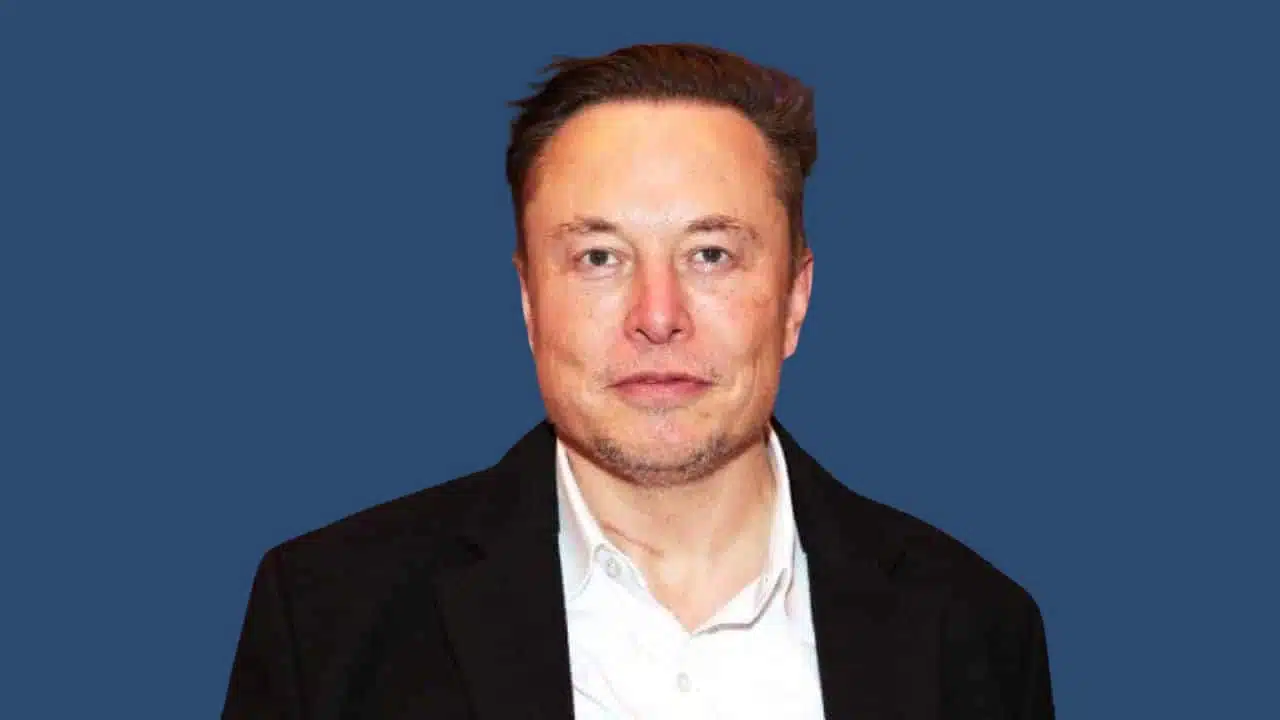
Elon Musk has once again highlighted the importance of skilled immigration in the United States, especially the contributions of Indian professionals, during a conversation on Zerodha co-founder Nikhil Kamath’s podcast, People by WTF. His remarks come at a time when thousands of Indian students and workers are increasingly worried about tightening U.S. visa rules, unpredictable policies, and rising restrictions that could affect their ability to study, work, and settle in America.
Musk, who leads Tesla, SpaceX, X, and xAI, offered a wide-ranging perspective on immigration, talent shortages, misuse of the H-1B system, and the political environment shaping U.S. immigration decisions.
America’s Talent Gap and the Role of Indian Professionals
According to Musk, highly skilled workers from abroad, especially India, have played a central role in strengthening America’s technology, research, and engineering ecosystem. In his view, the U.S. has always benefited from individuals with advanced skills who contribute to scientific innovation, business growth, and national competitiveness.
In the conversation, Musk emphasized that despite perceptions among some American citizens that foreign workers are replacing domestic labor, the reality inside high-technology companies is very different. Businesses working on complex engineering projects — such as electric vehicles, reusable rockets, space missions, artificial intelligence, and semiconductor technologies — face an ongoing shortage of qualified personnel.
His companies often struggle to find enough experts who can handle the level of technical complexity required. Because of this, access to the world’s best talent becomes critical. Musk believes that immigrants with advanced skills fill essential roles that cannot be easily replaced within the existing U.S. workforce.
This viewpoint aligns with long-standing data from the U.S. government, which shows that many American technology companies rely heavily on Indian and Chinese engineers, researchers, software developers, and scientists to fill gaps in fields like robotics, aerospace, biotechnology, chip design, and machine learning.
H-1B Visa: Opportunity for Talent, but Not Without Misuse
While Musk expressed strong support for bringing skilled individuals into the United States, he also acknowledged that the H-1B visa program has weaknesses. Over the years, several outsourcing and staffing firms have been criticized for exploiting loopholes in the program, especially by submitting large volumes of applications, underpaying workers, or using them to replace existing employees.
Musk believes that misuse of the visa system must be addressed, especially by companies that treat H-1B approvals as a numbers game. However, he made it clear that misuse should not be the reason to eliminate or restrict the program entirely.
The H-1B visa has long been viewed as the gateway to the “American Dream” for millions of young professionals in India, China, and other countries. Many students pursue master’s and doctoral degrees in the U.S. specifically in hopes of transitioning to an H-1B job, which may eventually lead to permanent residency.
But in recent years, growing political pressure has pushed American leaders to tighten immigration rules. Former President Donald Trump announced a proposal that new H-1B applications would cost employers up to $100,000 — a massive increase from the usual $2,000–5,000 range. He justified the change by calling for a crackdown on abuse and fraud, claiming that the program was being overused to hire low-cost labor at the expense of American workers.
Despite this, Trump has also stated that the U.S. still needs highly skilled immigrants, especially in industries such as semiconductors, aerospace, and defense manufacturing. He argued that companies cannot expand in advanced fields without workers who understand the complexities of technologies like integrated circuits, microprocessors, and missile systems.
Indians Are the Largest Beneficiaries of H-1B Visas
U.S. government statistics show that Indian nationals continue to dominate the H-1B program. In the previous year, Indians accounted for more than 70 percent of all approved beneficiaries. This dominance reflects India’s strong talent pool in engineering, computer science, data analysis, and emerging technologies.
China ranks second but at a much lower share of around 11 percent. Workers from other countries collectively make up the remaining portion.
The visa, which is issued initially for three years and can be extended for another three, has enabled American companies to hire millions of foreign workers in critical fields. These roles are particularly crucial in sectors experiencing severe talent shortages, including AI engineering, cybersecurity, robotics, cloud architecture, pharmaceutical research, and automation.
Musk’s View on U.S. Border Controls and Illegal Immigration
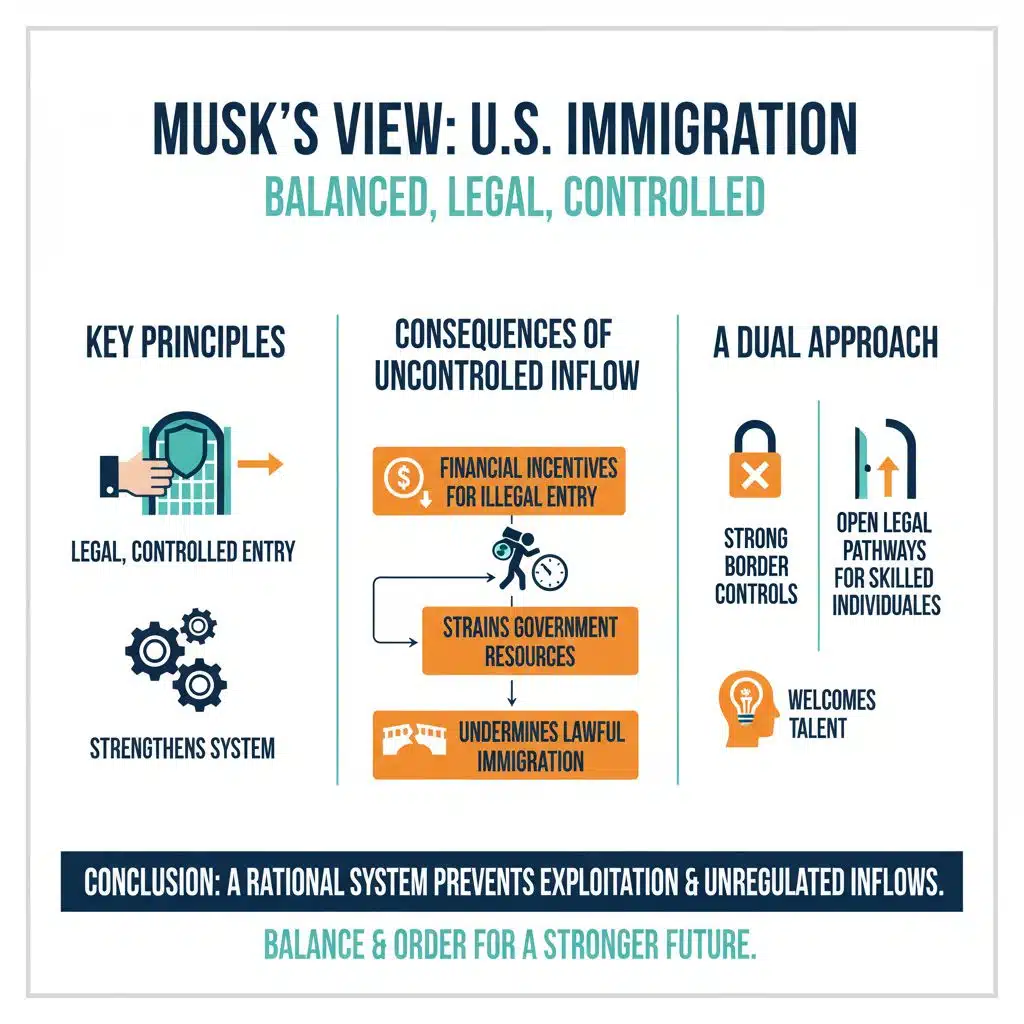
Beyond skilled immigration, Musk also spoke broadly about U.S. border policies and the rise in illegal immigration. He argued that immigration must be based on legal, controlled entry rather than unrestricted movement. According to him, the absence of firm border policies creates financial incentives for illegal entry, strains government resources, and undermines the structure of lawful immigration.
Musk suggested that strong border controls are essential for maintaining a functioning immigration system. At the same time, he emphasized that legal pathways for skilled individuals must remain open and protected.
His broader argument can be summed up as a call for a balanced, rational immigration system that welcomes talent but prevents exploitation and unregulated inflows.
Why Musk’s Comments Are Important Now
Elon Musk’s statements come at a time when the U.S. is undergoing a major shift in how it manages skilled immigration. The nation faces an aging workforce, rising competition from China, and an urgent need for specialists in AI, semiconductor manufacturing, clean energy, quantum computing, and advanced robotics.
American companies repeatedly report that the domestic talent pipeline is insufficient to meet these demands. Yet political pressure continues to push toward more restrictions.
For many Indian professionals, the tightening rules — including higher fees, more documentation, longer processing times, and unpredictable policy changes — are making the path to the U.S. more complicated than ever before.
Musk’s support for skilled immigration stands out because he represents both the employer’s viewpoint and the perspective of a global innovator. His message reinforces the idea that America’s leadership in technology has been built on openness to global expertise.
The Larger Picture: Immigration, Innovation, and Global Competition
The debate over the H-1B program is ultimately about more than visas. It reflects the United States’ struggle to maintain leadership in a rapidly changing global landscape. Countries like Canada, the U.K., Australia, Singapore, and Germany are actively competing for the same pool of Indian engineers and researchers. These nations are offering faster residency pathways, more predictable rules, and strong incentives for international talent.
At the same time, India itself is emerging as a global technology hub, reducing the need for its talent to seek opportunities abroad.
The future of the H-1B system — whether it becomes more restrictive, more merit-based, or more supportive of high-skill immigration — will shape global talent flows for years to come.
Elon Musk’s latest remarks underline a consistent theme: the United States thrives when it attracts the most talented individuals from around the world. While the H-1B system needs reforms to prevent exploitation, it remains a crucial channel for filling skill gaps and driving national innovation.
For thousands of Indian professionals, his comments offer both reassurance and a reminder of the growing complexities of U.S. immigration. As policy debates intensify, the future of skilled immigration in America will depend on striking a balance between national interests, economic competitiveness, and the aspirations of global talent.