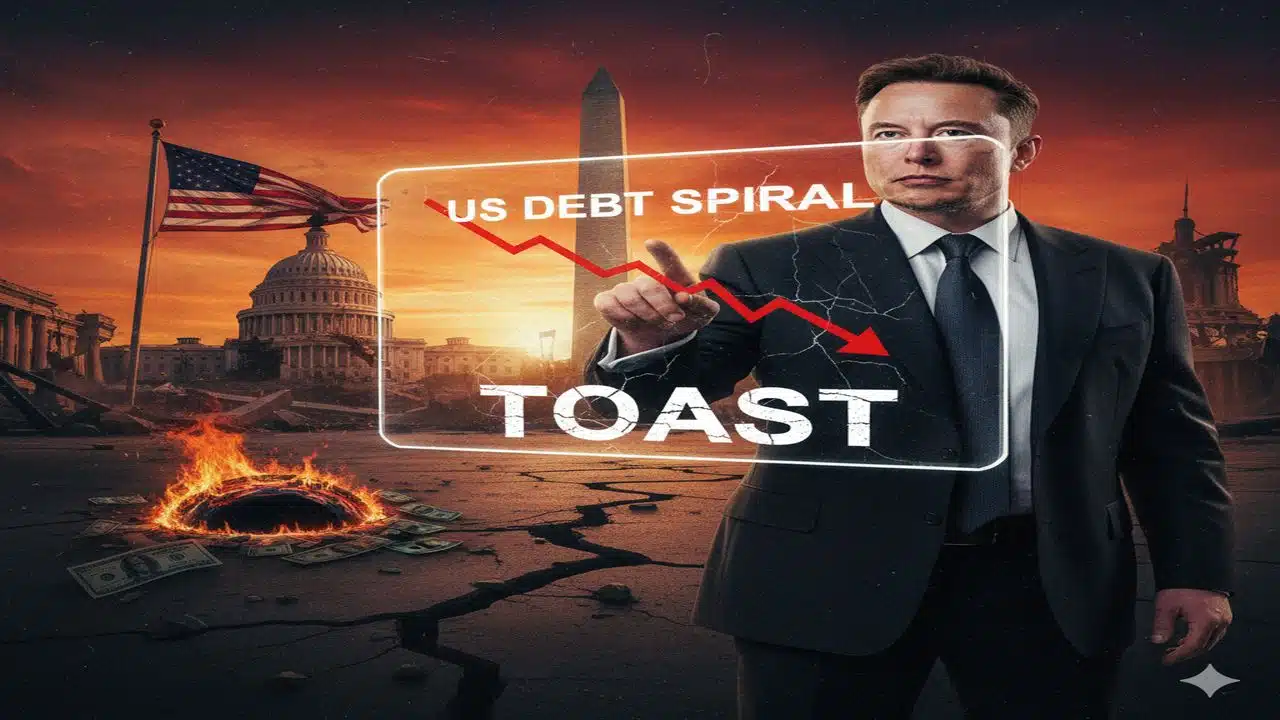
In a series of increasingly stark public declarations, technology magnate and investor Elon Musk has sounded a deafening alarm over the fiscal health of the United States, warning that the nation is on a direct path to economic catastrophe.
He argues that if the runaway national debt and rampant government spending are not brought under control, America will be “toast.” Going further, he has expressed profound skepticism about the government’s ability to self-correct, labeling the federal apparatus as “basically unfixable.”
Musk’s warnings, delivered across various platforms from high-profile economic summits to his social media network X, center on a problem that many economists have flagged for decades but which he believes has now reached a critical inflection point: the U.S. national debt.
The Mathematical Certainty of a “Debt Spiral”
At the core of Musk’s argument is not just the sheer size of the national debt—which has surpassed an eye-watering 34 trillion—but the terrifying velocity of its growth and the compounding nature of its interest. He has repeatedly pointed out the alarming fact that the debt is now increasing by approximately 1 trillion every 100 days.
“The numbers speak for themselves,” Musk explained during a recent technology conference. “This is not a matter of political opinion or ideology; it is a matter of arithmetic. When the interest payments on your national debt become the largest single item in the federal budget, you are entering a death spiral. That day is no longer a distant possibility; it is on the horizon.”
This “debt spiral” he describes is a vicious cycle:
Massive Debt Accumulation: The government consistently spends more than it collects in revenue, issuing Treasury bonds to cover the deficit.
Rising Interest Rates: To attract buyers for this ever-increasing supply of debt, and in response to inflationary pressures often caused by government spending, interest rates must rise.
Exploding Interest Payments: The interest owed on the massive 34 trillion principal explodes. Net interest payments are already projected to exceed defense spending and are on track to become the largest federal expenditure within the next decade, consuming over a trillion dollars annually.
More Borrowing to Pay Interest: As interest payments consume a larger share of the budget, there is less money for everything else. To avoid defaulting, the government is forced to borrow even more money simply to pay the interest on its old debt, accelerating the cycle and spiraling the total debt ever higher.
Musk contends that this mathematical certainty will eventually lead to a catastrophic outcome: either a formal default on U.S. debt, which would trigger a global financial crisis, or, more likely, the Federal Reserve will be forced to print massive amounts of money to finance the debt, leading to devastating hyperinflation and the collapse of the dollar’s value.
A Government “Basically Unfixable”
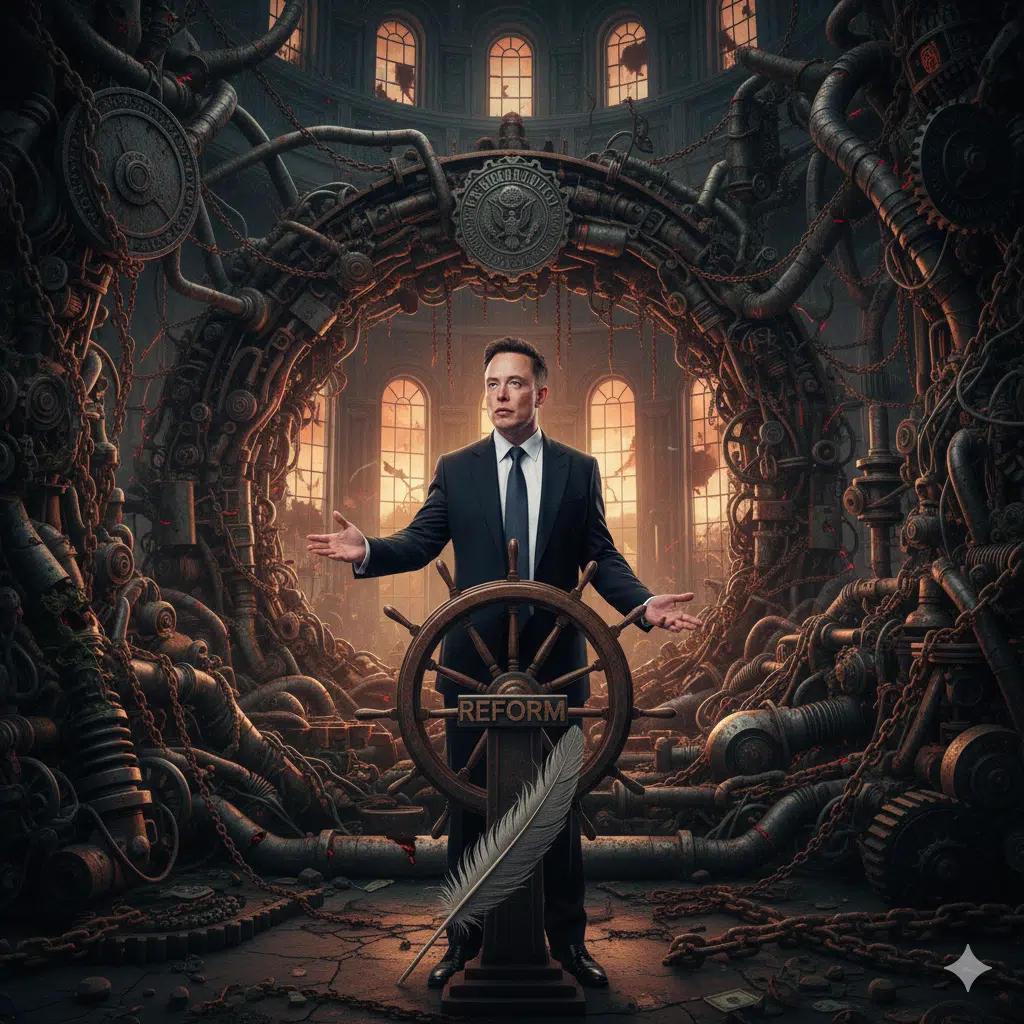
When pressed on potential solutions, Musk’s outlook turns even bleaker. His assessment that the U.S. government is “basically unfixable” stems from his diagnosis of a system crippled by political paralysis, bureaucratic inertia, and a complete lack of political will to make difficult choices.
“Both parties are responsible,” Musk has stated. “The issue is that any politician who stands up and says, ‘We must make significant cuts to Social Security, Medicare, and other entitlement programs’ is committing political suicide. These programs, along with interest on the debt, are the primary drivers of spending. To not touch them is to not solve the problem. It’s the third rail of politics, and no one dares to touch it.”
From his perspective as a CEO who has built companies like SpaceX and Tesla on principles of “first principles thinking” and radical efficiency, the federal government is anathema. He sees a sprawling bureaucracy incentivized not by efficiency or results, but by budget expansion and self-preservation. His attempts to advise on government efficiency, including his role in the nascent Department of Government Efficiency (DOGE), have, in his view, only confirmed the depth of the problem. “It’s like trying to turn a battleship with a feather,” he has remarked, highlighting the institutional resistance to any meaningful change that threatens established departments or special interests.
How to Prepare: “Own Physical Things”
Given his grim prognosis for the nation’s currency and fiscal stability, Musk has offered advice for how individuals can protect themselves. His counsel is rooted in the classic economic response to a coming wave of inflation.
“In times of high inflation, cash is trash,” Musk has advised. “The value of your dollars in a savings account will be eroded by the day. It is generally better to own physical things like a home or stock in companies you think make good products, than dollars.”
Expanding on this, his advice centers on investing in tangible, productive assets:
- Real Estate: Homes and land have historically served as a strong hedge against inflation.
- Well-Run Companies: Owning stock (equity) in companies that produce essential goods and services gives you a claim on their future earnings, which will rise in nominal dollar terms during inflation. He emphasizes companies with strong pricing power and real, physical assets.
- Commodities & Precious Metals: While he has been less vocal about them, assets like gold, silver, and other commodities also fall into the category of “physical things” that can retain value when a currency is debased.
The underlying principle is to move wealth out of assets denominated in dollars (cash, bonds) and into assets that have intrinsic value or the ability to generate value regardless of the dollar’s health.
Musk’s dire warnings place him at the forefront of a growing chorus of fiscal hawks. While his critics accuse him of hyperbole that could needlessly spook markets, his supporters see him as a modern-day Cassandra, speaking an uncomfortable but necessary truth about a mathematical reality that Washington continues to ignore at the nation’s peril.