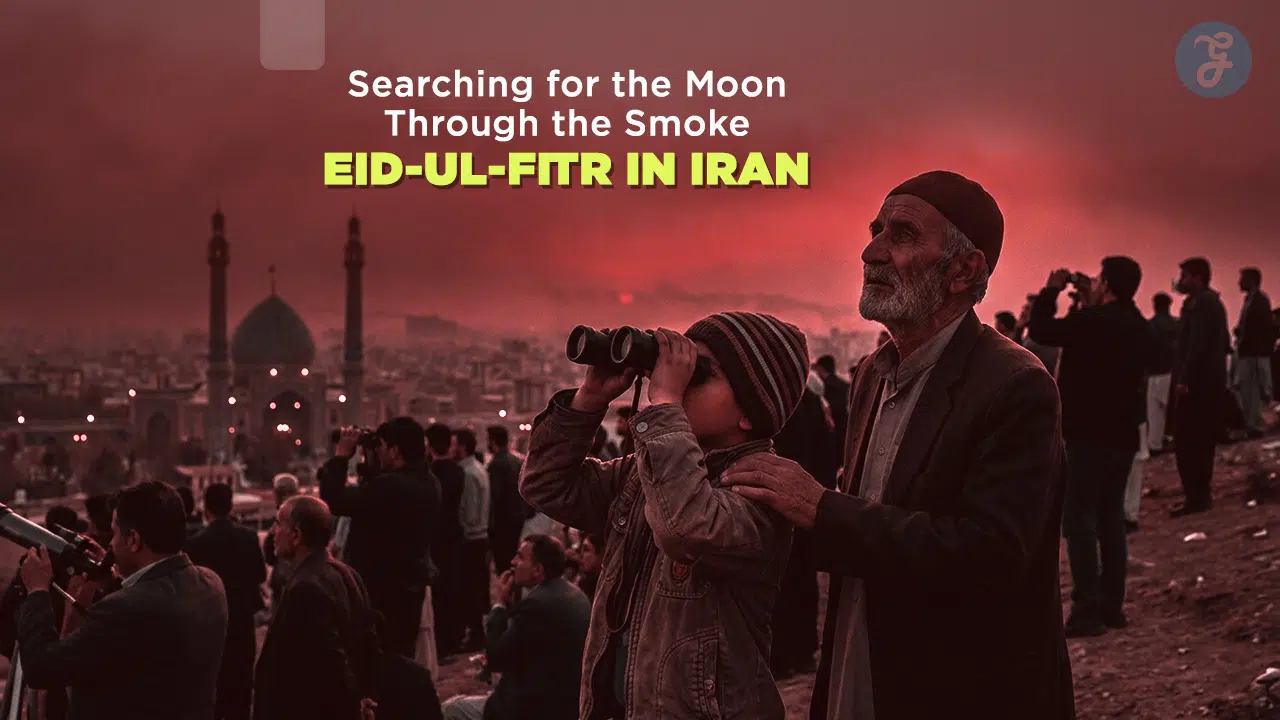
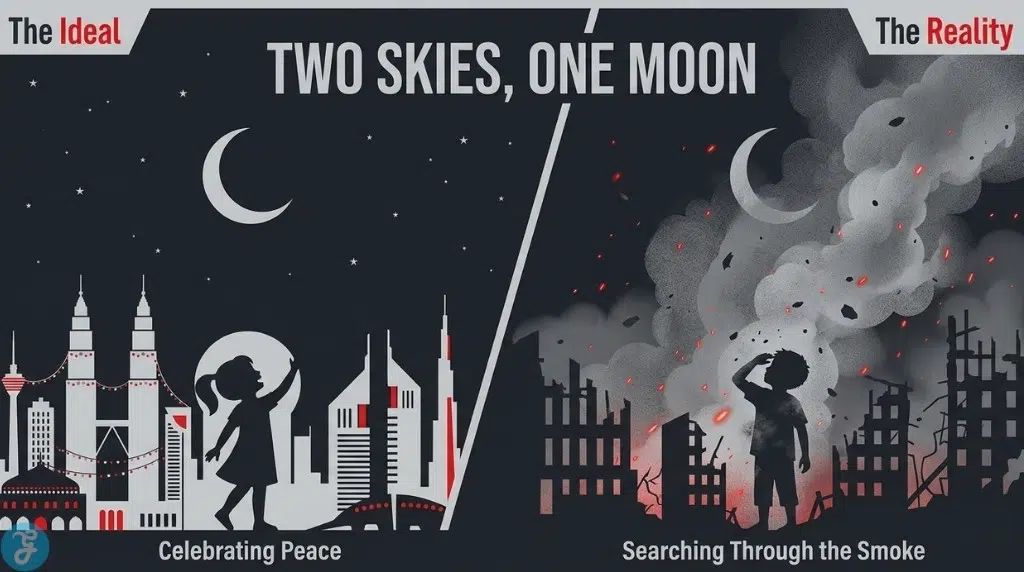
Tonight, somewhere in the world, a child will step out onto a quiet balcony or a grassy field. They will look up into a clear, velvet sky, squinting to catch that first, fragile silver glint of the Shawwal moon. When they find it, the night will erupt in cheers. There will be new clothes, the smell of sweet pastries, and the warm, unbroken promise of a peaceful Eid-ul-Fitr morning.
A few thousand miles away, a child in Iran will step out into the rubble and look up at the exact same sky. They are searching for the exact same moon.
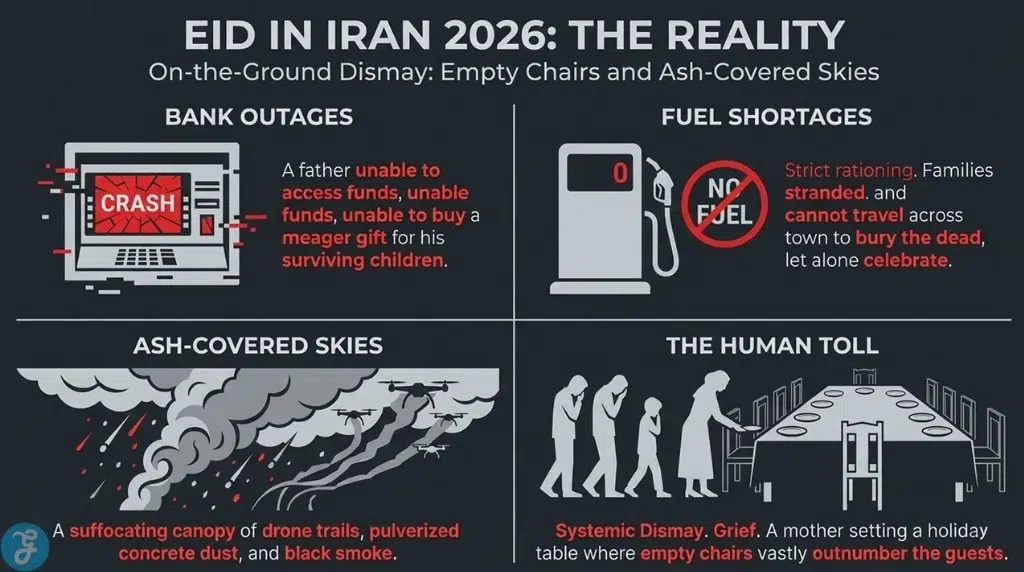
But their sky is heavily stained. It is a suffocating, unnatural canopy woven from drone trails, pulverizing concrete dust, and the black, oily smoke of burning infrastructure. The cruelest irony of modern geopolitics is that while humanity shares one moon, we certainly do not share one reality. For the children of Iran, the joyous anticipation of Eid has been violently replaced by the terrifying, deafening whistle of falling munitions.
It is a remarkably unfair world, isn’t it?
The Eid in Iran 2026 Reality: “Silent Eid” (Eid-e-Khamosh)
The “Situation in Iran” as we head into Eid is one of total systemic paralysis. Since the launch of joint U.S.-Israeli strikes on February 28, 2026—which saw the assassination of Supreme Leader Ali Khamenei—the country has been plunged into a state of “Silent Eid” (Eid-e-Khamosh).
Traditionally, the end of Ramadan is marked by the massive communal prayers at the Grand Mosalla of Tehran. In 2026, the silence there is deafening.
-
Banned Gatherings: The intervening coalition has declared “Active Engagement Zones” over major urban centers, effectively banning large outdoor gatherings. The message is clear: even prayer is a security risk.
-
Underground Defiance: Reports are surfacing of families holding “Underground Eid” in basements and parking garages—turning spiritual sanctuary into a clandestine act of resistance.
-
The Internet Wall: With the national gateway throttled, the millions of Iranians in the diaspora cannot reach their loved ones. The digital silence is perhaps the most painful part of Eid in Iran 2026.
- A Nation Without a Compass: The primary driver of the “Silent Eid” is the unprecedented decapitation of Iran’s entire leadership structure. The assassination of Supreme Leader Ayatollah Ali Khamenei on February 28, followed by the death of his designated successor, Ali Larijani, on March 18, has left the country in a state of terminal uncertainty.
Instead of the traditional festive sermons and leadership addresses that define the holiday, Iranians are met with a haunting silence from the seat of power. For the first time in the history of the Islamic Republic, Eid in Iran 2026 is being observed under a total vacuum of authority, turning a day of national unity into a period of profound communal mourning and anxiety.
The conflict has not just targeted military silos; it has shredded the daily life of 90 million people exactly when they were meant to be celebrating.
-
The Educational Tragedy: In Minab, the Shajareh Tayyebeh Elementary School was reduced to ash on the first day of strikes, claiming the lives of over 160 students. For these families, Eid in Iran 2026 is not a celebration; it is a funeral that never ends.
-
Internal Displacement: Nearly 3 million Iranians are currently displaced. Families from Tehran, Shiraz, and Isfahan are fleeing toward rural peripheral areas, trading their festive homes for tents and the uncertainty of the road.
-
The Infrastructure Collapse: Targeted strikes on a major desalination plant and multiple oil depots have created a “toxic environmental canopy.” In a country already struggling with water scarcity, the ritual washings of Eid are now a desperate luxury.
The Logistical Siege: Life in 2026 Tehran
The current situation is not just a military conflict; it is a calculated dismantling of civilian life timed to peak at the end of the fasting month. As Eid in Iran 2026 arrives, the capital is facing a paralysis that goes far beyond the battlefield.
-
The Energy Blackout: Rolling blackouts have plunged major cities into darkness. In the final nights of Ramadan, the Qadr prayers were held by candlelight, not out of tradition, but out of necessity.
-
The Zakat Dilemma: One of the core pillars of Eid is Zakat al-Fitr (charity to the poor). But with the national banking server hubs targeted in the “March Escalation,” ATM networks are dark. A father cannot withdraw cash to fulfill his religious obligation or buy a meager gift for his children.
-
Water and Sanitation: Infrastructure damage has led to severe water shortages in Shiraz and Isfahan. The ritual washing (Ghusl) before Eid prayers has become a luxury few can afford.
Rubble, Rations, and the Shawwal Moon
As Eid in Iran 2026 arrives, the suffering will not just be measured in decibels or blast radii. The true horror is in the quiet moments.
-
Bank Outages: A father staring at a screen, unable to buy even a meager gift for his surviving children.
-
Fuel Shortages: Families unable to travel across town to bury their dead, let alone celebrate.
-
Empty Chairs: A mother setting a table for a holiday feast, knowing intimately that the empty seats will vastly outnumber the guests.
The skies over Iran remain choked with debris. The people are enduring a suffocating, systemic dismay that rarely makes the front page of Western media. They are quietly suffering, fiercely surviving, and still looking up, hoping against hope to catch a glimpse of the moon through the smoke.
The Historical Blueprint: Why Now?
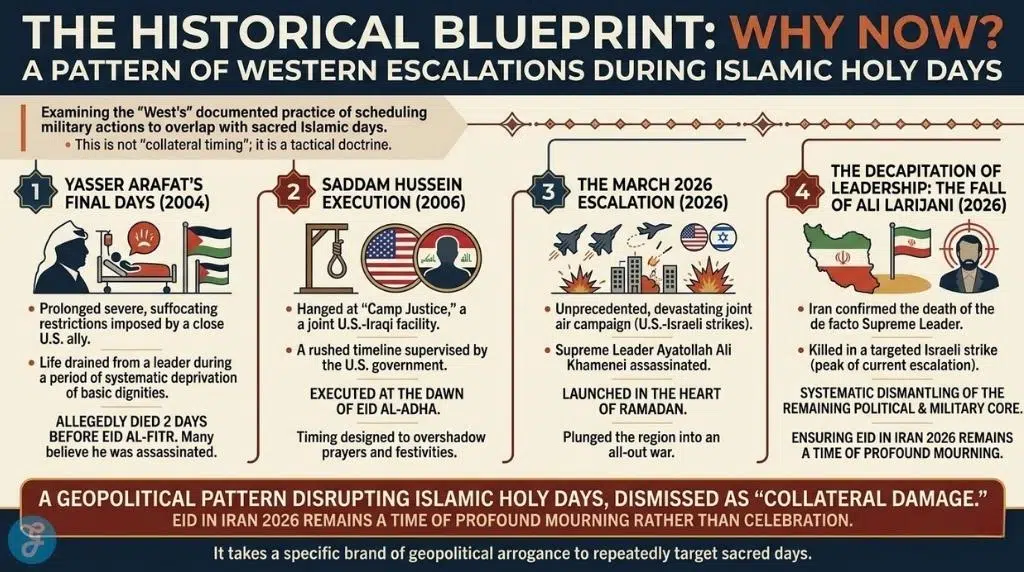
To understand the current crisis, one must look at the “West’s” bizarre, unwavering habit of scheduling military escalations to perfectly coincide with the most sacred days of the Islamic calendar. This is not “collateral timing”; it is a tactical doctrine.
- Yasser Arafat’s Final Days (2004): While he passed away in a French hospital, his death followed a prolonged period of severe, suffocating restrictions imposed by a close U.S. ally, draining the life from a leader during a time when his people were systematically starved of basic dignities. Even though he allegedly died 2 days before Eid al-Fitr that year, many believe he was actually assassinated
-
The Saddam Hussein Execution (2006): Remember the morning of December 30, 2006? It wasn’t just any Tuesday; it was the dawn of Eid al-Adha. Saddam Hussein was hanged at a joint U.S.-Iraqi facility literally named “Camp Justice.” While the U.S. government carefully avoided officially acknowledging the religious significance of the day, they certainly supervised the rushed timeline. Nothing says “happy holidays” quite like an execution perfectly timed to overshadow the prayers and festivities of over a billion people.
-
The March 2026 Escalation: Fast forward to today. An unprecedented, devastating joint air campaign that took out Iran’s Supreme Leader Ayatollah Ali Khamenei and plunged the region into an all-out war. The timing? Right in the heart of Ramadan.
-
The Decapitation of Leadership: On 18 March 2026, Iran’s Supreme National Security Council confirmed the death of Ali Larijani, the de facto Supreme Leader who assumed command following Ayatollah Khamenei’s assassination in February. Larijani was killed in a targeted Israeli strike along with his son. This effectively dismantled the nation’s remaining political and military core. His death at the peak of the current escalation deepens the national paralysis, ensuring that Eid in Iran 2026 remains a time of profound mourning rather than celebration.
It takes a very specific brand of geopolitical arrogance to repeatedly disrupt the holiest months of an entire demographic, only to have the evening news shrug it off as unfortunate “collateral damage.”
Why Would the “West” Mess with Muslims During Their Holy Month and Eid?
You would be forgiven for thinking that Western military planners keep a special calendar on their desks, with Ramadan and Eid circled in thick, bright red marker. The sheer frequency of these “coincidences” forces us to ask a deeply uncomfortable question: Why? Why consistently choose the holiest days of the Islamic year to drop bombs, orchestrate regime changes, or execute leaders?
The official press briefings will always feed you sanitized, bureaucratic answers. They will stand at podiums and talk about “brief windows of opportunity,” “actionable intelligence,” and “unavoidable strategic necessity.” But if we strip away the polished PR jargon, the reality is far more cynical.
-
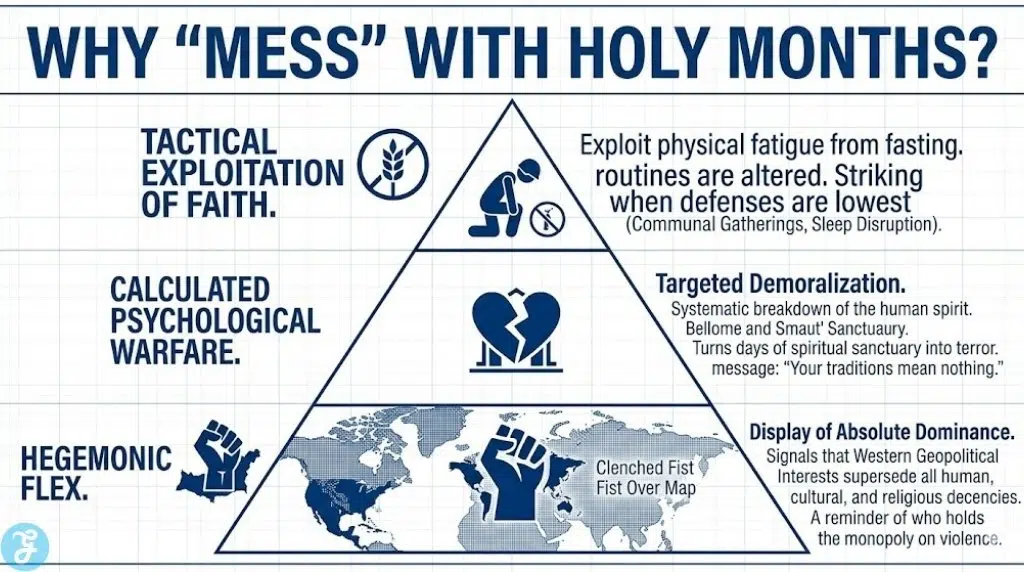
The Tactical Exploitation of Faith: There is a cold, predatory military logic at play. During Ramadan, entire populations are fasting. Routines are altered. There is a documented assumption in military doctrines that physical fatigue, disrupted sleep schedules, and communal gatherings lead to lowered defensive readiness. It is the tactical equivalent of attacking someone while their eyes are closed in prayer.
-
Calculated Psychological Warfare: This is not just about destroying physical infrastructure; it is about systematically breaking the human spirit. What better way to demoralize a nation than to turn their days of spiritual sanctuary into a literal nightmare? By striking during Eid, the message delivered from the sky is unapologetically clear: Your sacred traditions mean absolutely nothing to us. Your sanctuaries are not safe, and nothing is off-limits.
-
The Hegemonic Flex: It is the ultimate, arrogant display of absolute dominance. It signals to the rest of the world that Western geopolitical interests supersede all human, cultural, and religious decencies. It is a reminder of who holds the monopoly on violence.
If I am being entirely honest, the most chilling aspect is not even the military strategy itself—it is the profound, institutionalized lack of cultural empathy that allows the trigger to be pulled. It requires a very specific, deeply ingrained type of dehumanization to look at a satellite feed of a neighborhood preparing for an Eid festival and see only a grid of acceptable targets.
It is the arrogance of an establishment that expects the entire globe to mourn its tragedies and respect its holidays, while simultaneously treating the most sacred days of millions of Muslims as perfectly acceptable collateral damage.
The Polite Throat-Clearing of the Saviors
Where, exactly, is the outrage from our global watchdogs?
We are constantly sold the narrative that international bodies like the United Nations, Human Rights Watch, and Amnesty International are the fierce, impartial guardians of humanity. Yet, when faced with what looks remarkably like a systematic, communal attack against advocates of sovereignty—perpetrated by nations framing themselves as the sole arbiters of democratic governance—the response is usually a polite, bureaucratic throat-clearing.
Does this blatant disregard for the sanctity of Ramadan and Eid not constitute a targeted psychological assault? Or are we just supposed to quietly accept that the delivery of “free thought and expression” requires the slaughter of civilians while they are fasting?
Iran’s Eid-e-Khamosh and the Illusion of Global Decency
So, as the world prepares to celebrate the end of Ramadan, let’s offer a slow clap to the architects of global democracy. Once again, they have managed to deliver their explosive brand of “freedom” right on schedule. The ongoing devastation during Eid in Iran 2026 is not a tragic coincidence; it is a feature of a system that views the sacred months of millions as nothing more than a convenient operational window.
While the global watchdogs draft their uselessly polite memos, families in Iran are left sifting through the ashes, searching for a moon the rest of the world gets to enjoy in peace.
Disclaimer: Editorialge maintains a steadfast commitment to responsible reporting on the evolving conflicts in West Asia involving Israel, Iran, U.S., Gulf nations and non-state actors like Hezbollah, Hamas, Houthis, Islamic State, and others. In an environment where digital disinformation is widespread, we cannot independently verify every social media post or claim involving national and non-state actors. Our priority remains factual accuracy and the exercise of extreme caution when documenting all regional media.