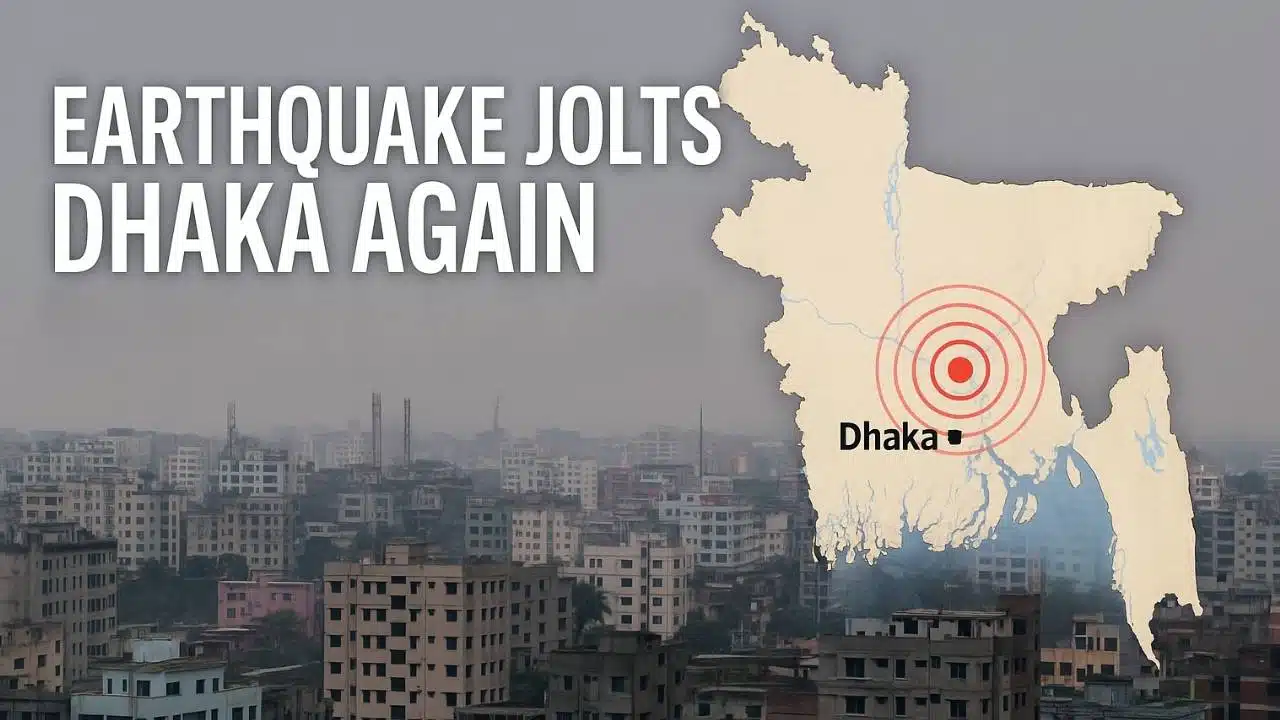
An earthquake was felt once again across Dhaka and nearby districts early Thursday morning, adding to a series of recent tremors that have unsettled residents in the capital and beyond. According to the Bangladesh Meteorological Department (BMD), the quake occurred at 6:14:45 am and registered a magnitude of 4.1 on the Richter scale, making it a mild but noticeable event across multiple parts of the city.
Meteorologists confirmed that the epicentre was located in Shibpur upazila of Narsingdi district, a region that has seen repeated seismic activity over the past several weeks. The distance of the epicentre from the Seismological Observation and Research Centre in Agargaon, Dhaka, was measured at 38 kilometres to the northeast, placing it relatively close to densely populated urban zones. Due to this proximity, residents in many neighbourhoods reported feeling a short but distinct shaking sensation, particularly in multi-storey buildings.
International seismic monitoring agencies also detected the tremor. Data from global observatories indicated that the epicentre lay roughly 33 kilometres east-northeast of Tongi in Gazipur and just three kilometres north of Narsingdi town, with the earthquake originating at a depth of approximately 30 kilometres beneath the Earth’s surface. Such depth is typically associated with brief but sharp ground movement, which aligns with witness accounts from Dhaka, Narayanganj, Manikganj, and portions of Gazipur where people felt a sudden jolt followed by light trembling.
This morning’s quake is the latest in a series of seismic events affecting Bangladesh in recent days. The most recent previous earthquake was recorded on Monday, 1 December, at 12:55:16 am, measuring 4.9 on the Richter scale. That tremor originated in Minzine, Myanmar, but was strong enough for residents in Chattogram, Cox’s Bazar, and other southeastern regions to feel shaking. Many described it as a longer, rolling movement compared to today’s sharper jolt.
Before that, on Thursday, 27 November, another quake shook Dhaka at 4:15:20 pm. That tremor had a magnitude of 3.6 and was traced to Ghorashal in Palash upazila, Narsingdi. On the same day, residents of Sylhet and Teknaf, Cox’s Bazar, also experienced mild tremors earlier in the morning, highlighting an unusual cluster of seismic activity within a short timeframe. Many experts note that such back-to-back mild quakes may indicate shifting stress along nearby fault lines.
The frequency intensified further in late November, when four earthquakes struck Dhaka and surrounding districts within roughly 31 hours, occurring between Friday, 21 November, and the following Saturday. Among these, the most significant was a 5.7-magnitude earthquake on Friday morning, whose epicentre was located in Madhabdi, Narsingdi, only about 25 kilometres from Dhaka. With a shallow depth of just 10 kilometres, the quake produced strong shaking across the country.
The 21 November event was particularly devastating. At least ten people were killed nationwide, and more than 600 were injured as a result of collapsing structures, falling debris, and panic-induced accidents. Many residential and commercial buildings in Dhaka developed cracks, and some older structures were deemed unsafe afterward. In several districts, people rushed out of their homes and workplaces, fearing aftershocks. The epicentres of most of the quakes during that period were located in or around Narsingdi district, raising concerns among experts about heightened stress in that tectonic zone.
Seismologists emphasize that while Bangladesh is not located directly on a major tectonic plate boundary, it sits near several active fault lines associated with the collision zone of the Indian and Eurasian plates. This geological positioning makes periodic tremors expected, but the recent concentration of earthquakes in a short span of time has prompted renewed discussions on urban safety, emergency preparedness, and the need for stricter enforcement of building codes in earthquake-prone regions.
Authorities have not yet reported any damage or casualties from today’s magnitude-4.1 quake, but they urge residents to remain cautious. Past incidents show that even mild tremors serve as reminders of the country’s vulnerability to seismic hazards. Urban planners and resilience experts continue to advocate for improved public awareness, regular earthquake drills, stronger infrastructure standards, and enhanced monitoring systems, especially in heavily populated cities like Dhaka where millions live and work in vertical structures.
With several quakes occurring in November and early December, many residents remain on high alert, recalling recent experiences where tremors arrived unexpectedly throughout the day and night. The government is expected to review the latest seismic data to determine whether the region is undergoing a temporary active phase and what further precautions may be needed. As authorities monitor the situation closely, the general public is encouraged to stay informed about safety protocols, avoid spreading rumours, and follow official updates from the Meteorological Department and disaster-management agencies.