The era of the sprawling, thirsty green lawn is fading. In its place, a more thoughtful, resilient, and visually stunning aesthetic has taken root. As we move into 2026, xeriscaping has evolved from a niche environmental practice into the gold standard for modern residential design.
It is no longer just about saving water—though that remains critical. It is about creating outdoor spaces that harmonize with the local climate, reduce maintenance drudgery, and offer year-round beauty. Whether you are battling rising water bills, strict HOA restrictions, or simply want a yard that doesn’t demand your entire weekend, this guide covers everything you need to know to master drought-tolerant landscaping.
What Xeriscaping Means (And What It Is Not)
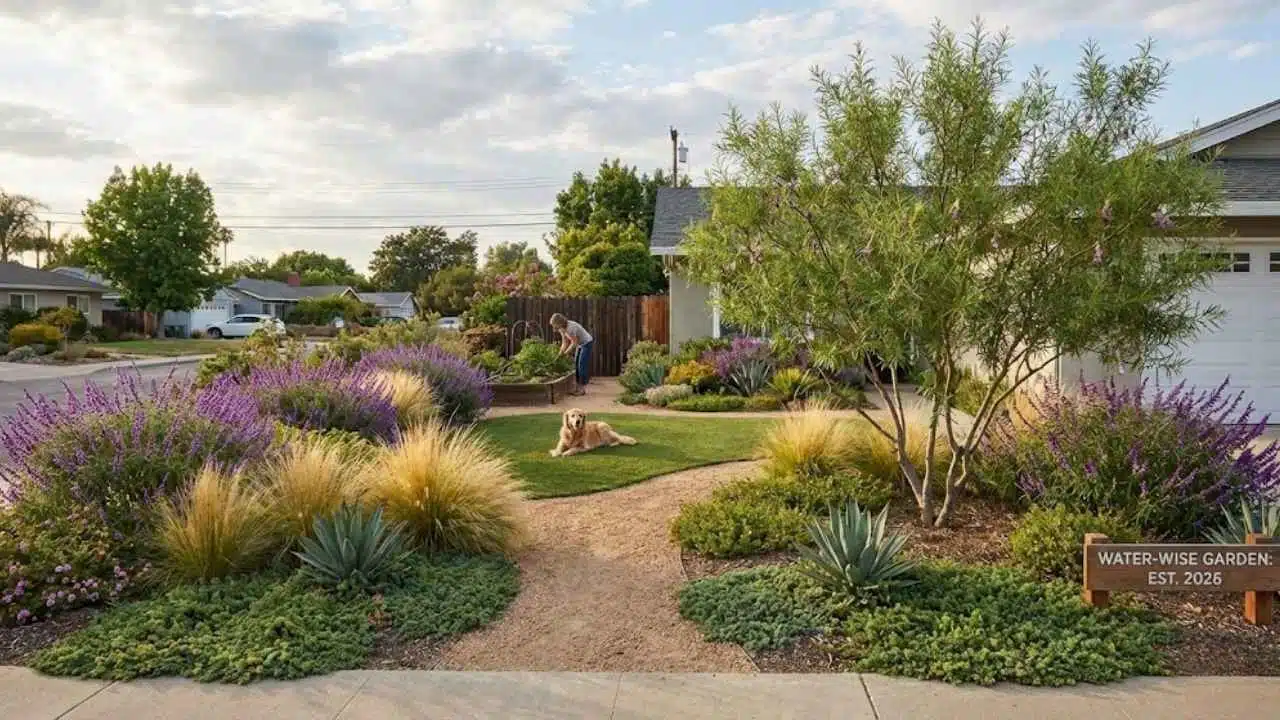
Before you break ground, it is essential to understand the philosophy behind the method. Misconceptions about this landscaping style often scare homeowners away, fearing their yard will look like a desolate moonscape. The reality of modern xeriscaping is quite the opposite.
Xeriscaping Definition In Plain English
The term “xeriscape” was coined in 1981 by Denver Water. It combines the Greek word xeros (meaning dry) with landscape.
In plain English, xeriscaping is a system of landscaping that reduces or eliminates the need for supplemental irrigation. It is not a specific “look”; it is a set of seven principles designed to conserve water while maintaining a healthy, visually appealing environment.
The original purpose was to help Western US cities cope with water shortages. However, the principles have proven universal. Today, xeriscaping is used in wet climates to manage drainage and in temperate zones to reduce maintenance costs. It is about working with nature, rather than fighting against it.
Common Myths (Rocks-Only, “Zero-Scape,” No Flowers)
The biggest hurdle to adoption is the “Zero-scape” myth.
- Myth 1: It’s just rocks and cactus.
- Reality: While you can use cacti, modern xeriscapes often feature lush ornamental grasses, flowering salvias, vibrant groundcovers, and shade trees. A well-designed xeriscape is full of life, color, and texture.
- Myth 2: It is “Zero-Scape.”
- Reality: “Zero-scaping” implies no landscaping at all—usually just gravel or dirt. That is an environmental hazard that increases heat. True xeriscaping involves soil preparation, mulching, and planting.
- Myth 3: No lawns allowed.
- Reality: Xeriscaping allows for turf, provided it is “practical turf.” This means keeping lawn only in areas where it serves a function (like a play area for kids or dogs) and using drought-tolerant grass varieties.
Xeriscaping vs. “Drought-Tolerant Landscaping” vs. “Water-Wise Gardening”
These terms are often used interchangeably, but there are subtle differences:
| Term | Definition | Primary Focus |
| Xeriscaping | A trademarked 7-step formal methodology. | Holistic water conservation via design, soil, and plants. |
| Drought-Tolerant | Refers specifically to plant traits. | Selecting plants that survive with little water. |
| Water-Wise | A broader gardening philosophy. | General habits like rain barrels, smart watering, and hose timers. |
In 2026, the best landscapes blend all three: they use the xeriscape framework, populate it with drought-tolerant plants, and maintain it with water-wise habits.
Why Xeriscaping Matters More In 2026
The landscape of 2026 is defined by two major pressures: economic necessity and aesthetic evolution.
Water Costs, Restrictions, And Outdoor Water Use Pressure
Across the globe, municipal water rates are climbing. In many regions, outdoor irrigation accounts for 50% to 70% of residential water use. As freshwater becomes scarcer, cities are moving from “voluntary requests” to strict tier-based pricing and hard restrictions on sprinkler use.
Designing a landscape that requires potable water just to stay alive is becoming a financial liability. By 2026, a drought-tolerant yard is not just an eco-statement; it is a smart financial hedge against rising utility costs.
2026 Design Trends That Fit Xeriscaping
Xeriscaping happens to align perfectly with the prevailing design trends of the late 2020s. We are moving away from the rigid, manicured “golf course” look toward “Soft Modernism” and “Naturalistic Planting.”
- Naturalistic Planting: Inspired by the “New Perennial Movement,” this style favors drifts of grasses and perennials that wave in the wind, rather than clipped boxwood hedges.
- Permeable Surfaces: Concrete slabs are out; gravel, decomposed granite, and permeable pavers are in. These materials allow rain to soak into the ground rather than running off into storm drains.
- Textural Contrast: 2026 design emphasizes the contrast between hard stone (boulders, pavers) and soft foliage (feather reed grass, lamb’s ear).
This convergence means you don’t have to sacrifice style for sustainability. The most fashionable yards on the block are now likely to be the ones using the least water.
The Core Principles Of Xeriscaping (The Framework)
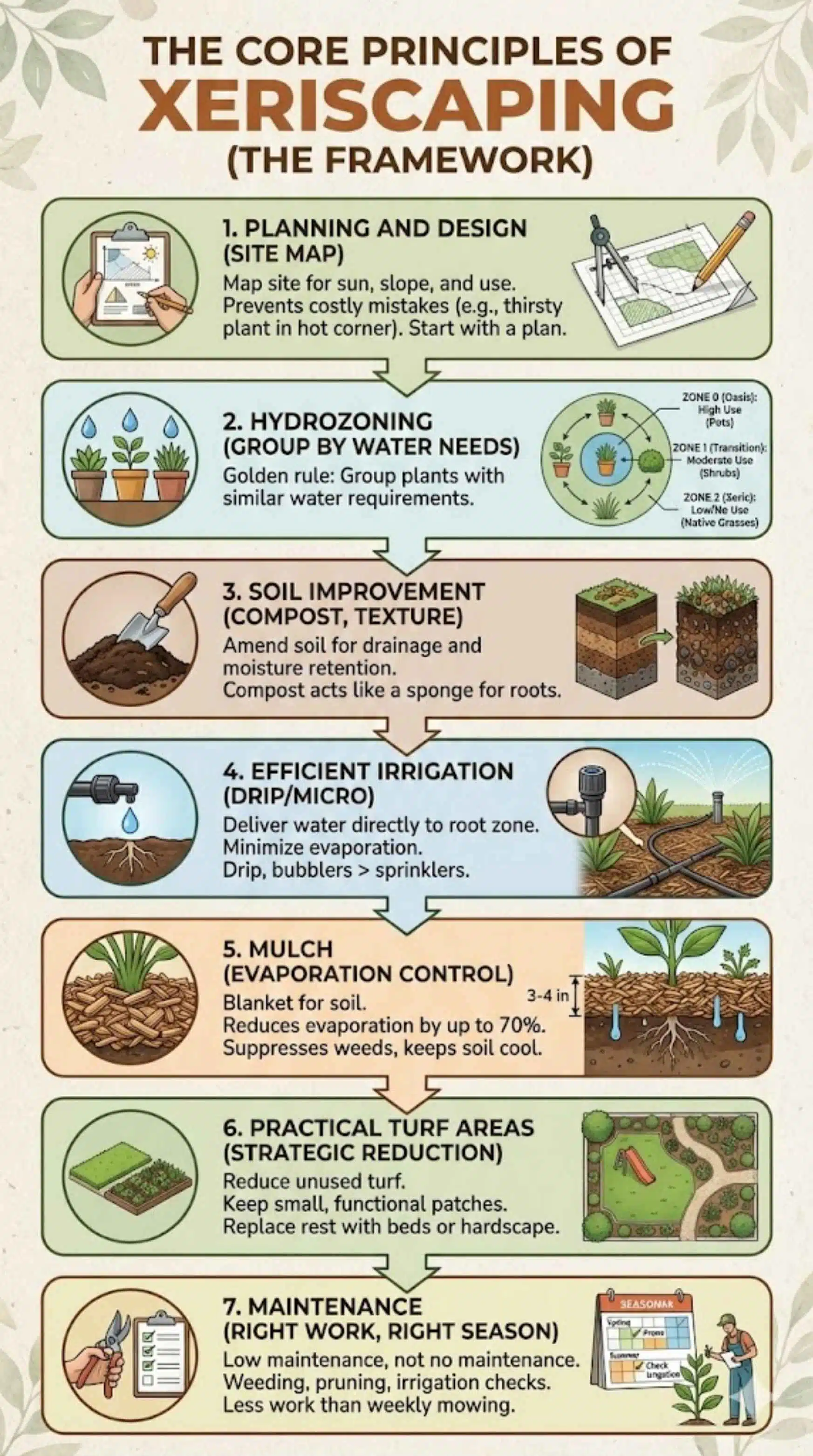
If you ignore everything else, memorize these seven principles. They act as the skeleton for your project. Without them, you are just planting flowers in dry dirt.
1. Planning And Design (Start With A Simple Site Map)
Never buy a plant until you have a plan. You must map your site to understand sun exposure, slopes, and how you actually use the yard. A plan prevents the costly mistake of putting a thirsty hydrangea in a baking hot corner.
2. Hydrozoning (Group Plants By Water Needs)
This is the golden rule of xeriscaping. Hydrozoning means grouping plants with similar water requirements together.
- Zone 0 (Oasis): High water use (pots, entryways).
- Zone 1 (Transition): Moderate water use (shrubs, fruit trees).
- Zone 2 (Xeric): Low/No water use (native grasses, established drought plants).
- Why it works: If you plant a rose (high water) next to lavender (low water), you will either kill the lavender with root rot or dry out the rose.
3. Soil Improvement (Compost, Texture, Drainage)
Many people assume native plants love poor soil. While they are tough, almost all plants establish better in soil that drains well but retains some moisture. For most xeriscapes, adding organic matter (compost) is vital. It acts like a sponge, holding water near the roots so you can irrigate less often.
4. Efficient Irrigation (Drip/Microirrigation Where Needed)
Xeriscapes are not “unwatered” landscapes; they are “efficiently watered” landscapes. The goal is to deliver water directly to the root zone, minimizing evaporation. Drip irrigation, bubblers, and micro-sprays are preferred over large oscillating sprinklers that throw water into the wind.
5. Mulch (Evaporation Control + Weed Suppression)
Mulch is the blanket that keeps moisture in the soil. A 3-to-4-inch layer of mulch can reduce soil water evaporation by up to 70%. It also keeps the soil cooler in summer and suppresses weeds that would otherwise steal water from your plants.
6. Practical Turf Areas (Reduce Lawn Strategically)
Turf is not the enemy, but unused turf is. If you only walk on your lawn to mow it, get rid of it. Practical turf involves keeping small, geometric patches of grass for recreation and replacing the rest with garden beds or hardscape.
7. Maintenance (Right Work, Right Season)
Low maintenance does not mean no maintenance. Xeriscapes require weeding, pruning, and irrigation checks. However, the workload is significantly lower than mowing and fertilizing a lawn weekly.
Step-By-Step Xeriscape Plan (Beginner To Confident)
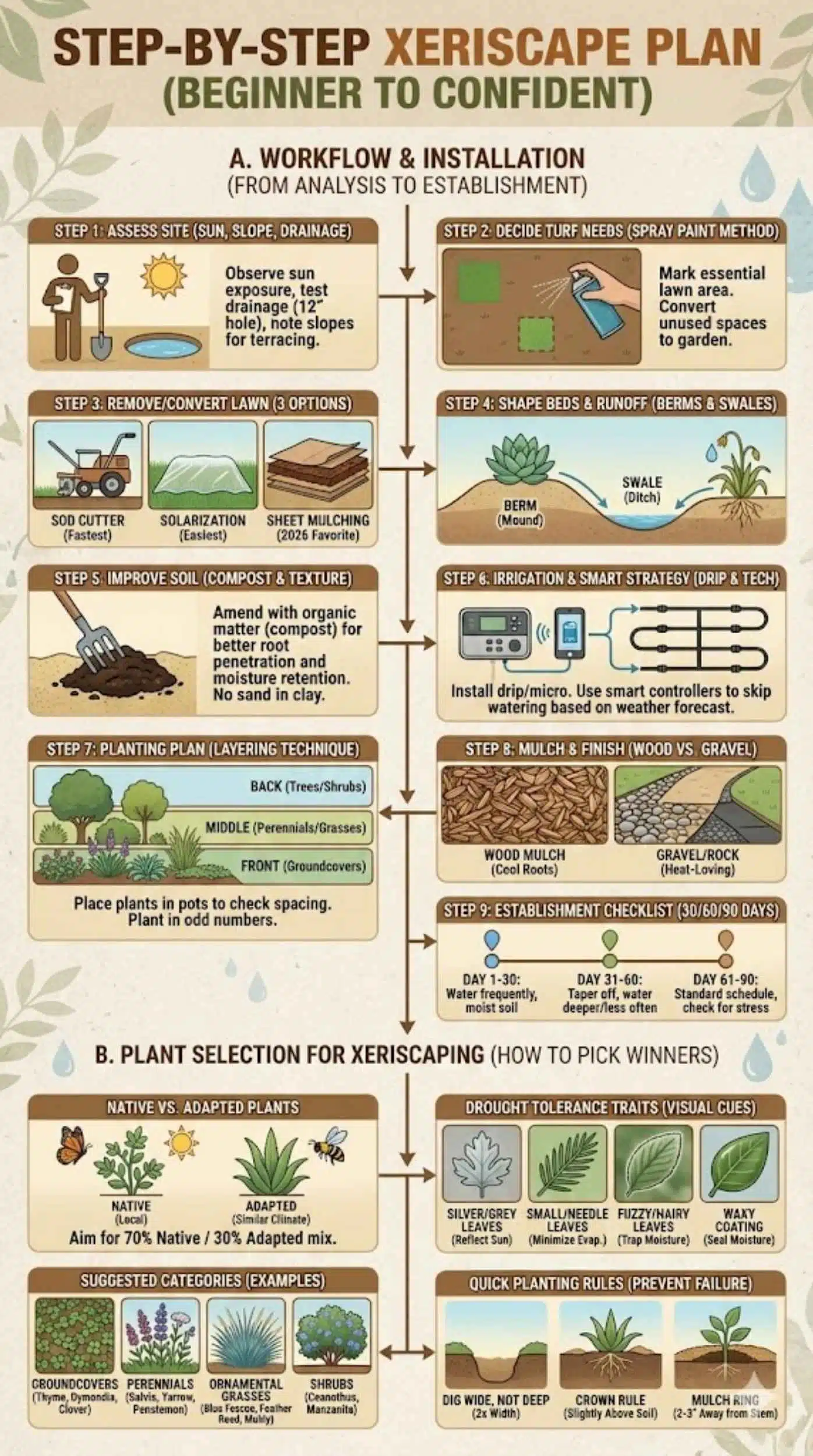
Ready to transform your yard? This workflow takes you from analysis to installation.
Step 1: Assess Sun, Shade, Slope, Wind, Drainage
Spend a weekend observing your yard.
- Sun mapping: Note which areas get morning sun (cool) vs. afternoon sun (harsh).
- Drainage: Dig a hole 12 inches deep, fill it with water. If it drains in less than an hour, you have sandy fast-draining soil. If it sits for 24 hours, you have heavy clay.
- Slopes: Water runs off slopes quickly. You will need to terrace these or use plants with deep roots to hold the soil.
Step 2: Decide Where You Truly Need Turf
Take a spray paint can (marking paint) and draw the outline of the lawn you actually need. Maybe it’s a 15×15 foot square for the kids. Everything outside that line is a candidate for conversion. Be honest: if you haven’t played frisbee there in 5 years, turn it into a garden.
Step 3: Remove Or Convert Lawn
You have three main options to remove grass:
- Sod Cutter (Fastest): Rent a machine that slices the grass off. Pros: Instant removal. Cons: Heavy labor, removes good topsoil.
- Solarization (Easiest for hot climates): Cover wet grass with clear plastic for 6 weeks in summer. The heat kills the grass and weed seeds.
- Sheet Mulching (Best for soil): This is the 2026 favorite. Mow the grass short, cover it with overlapping cardboard, wet it down, and cover with 4+ inches of mulch/compost. The grass dies and composts into the soil.
Step 4: Shape Beds + Manage Runoff
Before planting, look at the topography. Create swales (shallow ditches) or berms (mounds).
- The Swale Strategy: Dig a shallow depression where rainwater naturally flows. Plant your thirstiest plants here to capture runoff.
- The Berm Strategy: Build up mounds of soil to create visual interest and improve drainage for plants that hate “wet feet” (like lavender or succulents).
Step 5: Improve Soil Before Planting
Unless you are planting 100% native plants that specifically demand native dirt, amend your soil. Rototill or fork in 2–3 inches of compost into the top 6–8 inches of soil. This aeration is crucial for root penetration.
- Note: Do not add sand to clay soil; it creates concrete. Use organic matter instead.
Step 6: Install Irrigation + Smart Strategy
Install your hardlines (PVC pipe) and drip tubing after shaping the beds but before planting.
- Smart Tech: In 2026, smart irrigation controllers (like Rachio or Rain Bird) are essential. They connect to local WiFi weather stations and skip watering if rain is forecast.
- Grid Layout: Lay out a grid of drip tubing with emitters spaced every 12 inches for groundcover areas.
Step 7: Planting Plan (Layering)
Place your plants while they are still in their pots to check spacing. Use the “Layering” technique:
- Back Layer: Trees and large shrubs (structural anchors).
- Middle Layer: Perennials and ornamental grasses (color and movement).
- Front Layer: Groundcovers and low creepers (spills over edges).
- Tip: Plant in odd numbers (3, 5, 7) for a natural look.
Step 8: Mulch + Finish Materials
Apply mulch immediately after planting.
- Wood Mulch: Best for plants that need cooler roots and soil improvement.
- Gravel/Rock Mulch: Best for succulents, cacti, and heat-loving plants. Ensure you use landscape fabric under gravel paths, but avoid it under wood mulch beds (it prevents earthworms from mixing the mulch into the soil).
Step 9: 30/60/90-Day Establishment Checklist
- Day 1-30: Water frequently. Even drought-tolerant plants have small root balls right now. Keep the soil moist (not soggy).
- Day 31-60: Begin tapering off. Water deeper but less often to encourage roots to dive down.
- Day 61-90: Switch to the standard schedule. Check for signs of stress (wilting leaves).
Plant Selection For Xeriscaping (How To Pick Winners)
Choosing the right plants is the difference between a garden that thrives and one that struggles.
Native vs. “Adapted” Drought-Tolerant Plants
- Native Plants: Evolved in your specific region. They support local pollinators best.
- Example: California Poppy in the West; Purple Coneflower in the Midwest.
- Adapted Plants: From similar climates elsewhere (e.g., Mediterranean plants in California). They are tough and non-invasive but may not support specific local butterflies.
- Best Practice: Aim for a 70% Native / 30% Adapted mix.
Plant Traits That Signal Drought Tolerance
If you are at the nursery without a list, look for these physical traits:
- Silver/Grey Leaves: Reflect sunlight to stay cool (e.g., Sage, Lamb’s Ear).
- Small/Needle Leaves: Minimize surface area for evaporation (e.g., Rosemary, Pine).
- Fuzzy/Hairy Leaves: Trap moisture and shade the leaf surface.
- Waxy Coating: Seals moisture inside (e.g., Succulents, Agave).
Suggested Plant Categories (Not A One-Size List)
Groundcovers (Lawn Alternatives)
- Creeping Thyme: Can tolerate light foot traffic, smells great.
- Dymondia: Creates a flat, silver carpet. Very tough.
- Clover: Adds nitrogen to the soil, stays green with less water than grass.
Flowering Perennials (Pollinators)
- Salvia (Sage): Comes in red, purple, blue. hummingbirds love them.
- Yarrow: Fern-like foliage with flat flower heads. Very drought hardy.
- Penstemon: Tubular flowers perfect for bees.
Ornamental Grasses (The 2026 Look)
- Blue Fescue: Small, tidy blue mounds.
- Feather Reed Grass (Karl Foerster): Tall, vertical architectural drama.
- Muhly Grass: Explodes with pink/purple clouds in autumn.
Shrubs (Structure)
- Ceanothus (California Lilac): Evergreen with stunning blue flowers.
- Manzanita: Beautiful red bark and structural twisting branches.
Quick “Planting Rules” That Prevent Failure
- Dig Wide, Not Deep: Dig the hole 2x as wide as the pot, but no deeper.
- The Crown Rule: Ensure the plant’s crown (where stem meets roots) is slightly above the soil line to prevent rot.
- The Mulch Ring: Keep mulch 2–3 inches away from the stem of the plant. Mulch touching the stem causes rot.
Materials And Hardscaping That Support Low-Water Landscapes
Hardscaping (non-plant elements) reduces the square footage that needs watering, but it must be done carefully to avoid creating a heat trap.
Mulch Types And Where Each Works Best
- Organic Mulch (Bark, Wood Chips, Pine Straw):
- Pros: Breaks down to feed soil, keeps roots cool.
- Cons: Needs topping up every year.
- Best For: Trees, shrubs, perennials, vegetables.
- Inorganic Mulch (Gravel, River Rock, Crushed Stone):
- Pros: Permanent, fire-resistant, modern look.
- Cons: Absorb heat (cooks plant roots), hard to clean if leaves fall in it.
- Best For: Succulents, fire pits, driveways, drainage swales.
Permeable Surfaces
In 2026, Decomposed Granite (DG) is the king of pathways. It compacts hard enough to walk on or roll a wheelbarrow over, but water permeates through it.
- Stabilized DG: Contains a binder that makes it harder, almost like asphalt but permeable. Great for patios.
- Permeable Pavers: Concrete blocks with gaps filled with gravel to allow drainage.
Edging And Path Layout
To avoid the “messy” look, clear boundaries are key.
- Professional Tip: Use steel edging or distinct stone borders to separate your gravel paths from your mulch beds. This “crisp line” is what makes a xeriscape look high-end rather than neglected.
- Curved Paths: Add mystery and make small yards feel bigger.
Watering And Irrigation In A Xeriscape
Yes, you still water. But you water differently.
Establishment Watering vs. Long-Term Watering
- Year 1: Your main goal is survival. You must water regularly because the roots are still confined to the shape of the nursery pot.
- Year 2+: Your goal is resilience. Water deeply and infrequently. This trains roots to grow deep into the cool earth searching for moisture.
Drip/Microirrigation Basics
Drip irrigation is 90% efficient, compared to sprinklers which are often only 60% efficient due to wind and misting.
- Drip Emitters: Delivers water in gallons per hour (GPH) right to the root.
- Soaker Hoses: Good for dense planting beds, but less precise.
- The Mistake: Don’t put a high-water plant on the same drip line as a low-water plant. They need different schedules (Hydrozoning).
Simple Scheduling Guidance
- Time of Day: Always water between 3 AM and 8 AM. Midday watering loses water to evaporation; evening watering can promote fungus.
- The “Cycle and Soak” Method: Instead of watering for 20 minutes straight (which causes runoff), water for 5 minutes, wait an hour, then water for 5 minutes again. This allows the water to soak in deeper.
Maintenance Calendar (Low Maintenance, Not No Maintenance)
A xeriscape changes with the seasons.
Monthly/Seasonal Checklist
- Spring: Prune frost-damaged tips. Check irrigation system for leaks after winter. Apply fresh mulch before the weeds emerge.
- Summer: Monitor for heat stress. Weed control (pull them while they are small). Deadhead spent flowers to encourage new blooms.
- Fall: The best time to plant! The soil is warm, but the air is cool. Cut back ornamental grasses (optional—some like the winter look).
- Winter: Turn off irrigation in many climates. Let the garden rest.
Weed Control Without Overusing Herbicides
In a xeriscape, weeds are the enemy because they steal water.
- Prevention: The best weed control is a thick layer of mulch (3–4 inches).
- Corn Gluten Meal: An organic pre-emergent that prevents seeds from germinating. Apply in early spring.
Refresh Strategy
By Year 3, your plants will have grown significantly. You may need to edit. Remove plants that are overcrowding others. Refresh gravel that has thinned out.
Cost, ROI, And Common Budget Scenarios
Is xeriscaping expensive? The upfront cost can be higher than sod, but the long-term savings are massive.
What Drives Cost?
- Demolition: Removing sod and hauling it away is labor-intensive.
- Hardscape: Stone, pavers, and retaining walls are the most expensive line items.
- Plants: Mature plants (5-gallon pots) cost 3x more than starter plants (1-gallon pots).
- Irrigation: Retrofitting a system costs money upfront but saves immediately.
Typical Budget Tiers (Estimates)
- DIY Bed Refresh ($500 – $1,500): Sheet mulching a small area, planting 1-gallon perennials, spreading mulch yourself.
- Front Yard Conversion ($3,000 – $8,000): Renting a sod cutter, installing a drip kit, decomposed granite path, mix of 1-gallon and 5-gallon plants.
- Full Pro Installation ($15,000+): Design fees, major hardscaping, grading, boulders, mature trees, lighting.
Does Xeriscaping Save Money Over Time?
Yes.
- Water Bill: Savings of 50–75% on summer water bills.
- Maintenance: No gas for mowers, no fertilizer, no pesticides.
- ROI: A well-designed drought-tolerant landscape is a major selling point in 2026, often increasing home value by 10–12%.
Mistakes To Avoid (And How To Fix Them Fast)
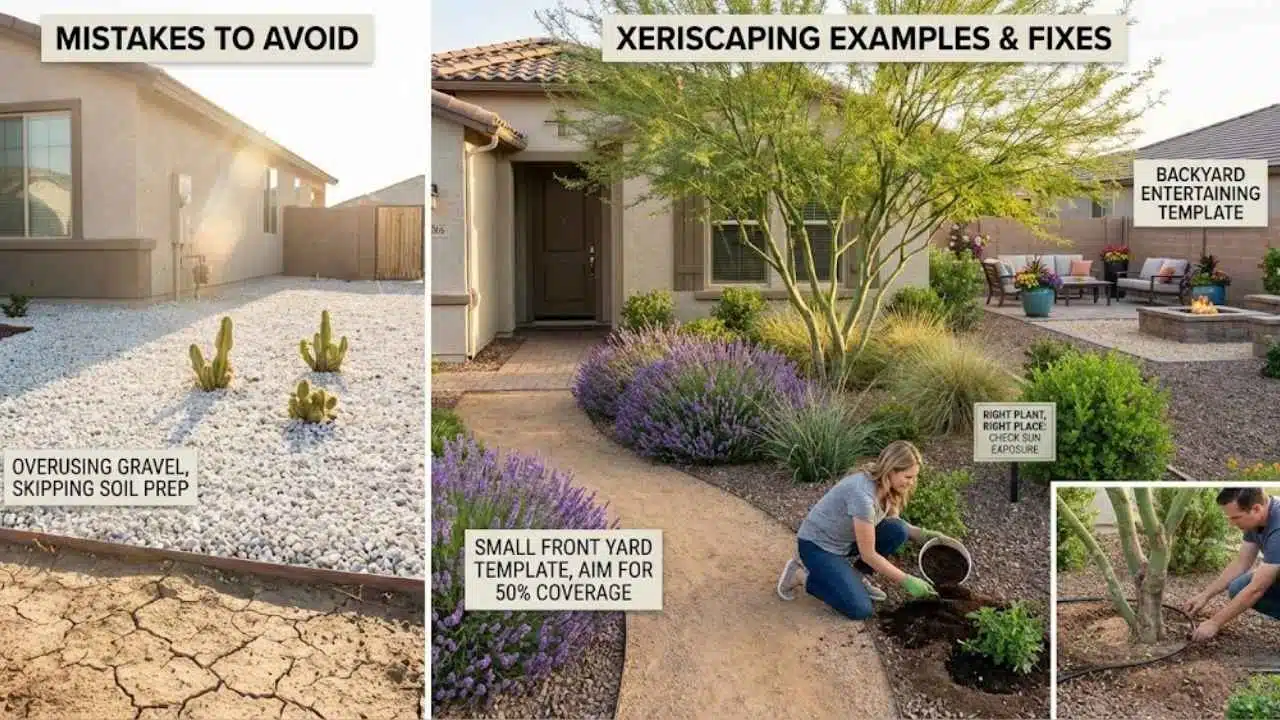
1. Overusing Gravel Without Planting Density
- The Mistake: Covering the whole yard in white rock with three tiny plants. This creates a heat island that cooks your house.
- The Fix: Use gravel only for paths. Use wood mulch for beds. Aim for 50% plant coverage at maturity.
2. Skipping Soil Prep
- The Mistake: “These plants like it dry, so I won’t add compost.”
- The Fix: Even desert plants need loose soil to establish roots. Always aerate and amend compact clay.
3. Wrong Plant, Wrong Place
- The Mistake: Planting a shade-loving fern in full afternoon sun because “it’s drought tolerant.”
- The Fix: Sun exposure is non-negotiable. Check the tag.
4. Poor Irrigation Layout
- The Mistake: Putting drip emitters right against the trunk of a tree.
- The Fix: Move emitters to the “drip line” (the outer edge of the branches) where the feeder roots are.
Xeriscaping Examples And Layout Ideas
Small Front Yard Template (Curb Appeal)
- Center: A curving path of decomposed granite leading to the door.
- Sides: Mounds (berms) with Lavender and ornamental grasses.
- Focus: A single structural tree (like a Palo Verde or Redbud) to frame the house.
Side Yard / Narrow Strip Template
- Challenge: Hard to water without hitting the house.
- Solution: Remove all grass. Lay down weed barrier and river rock. Place three large stepping stones. Plant tough, vertical plants like Snake Plant or Horsetail Reed (in containers to contain spread) against the fence.
Backyard Entertaining Template
- Zone 0: Paved patio for furniture (permeable pavers).
- Zone 1: Large pots with colorful annuals near the seating area.
- Zone 2: A perimeter of native shrubs for privacy.
- Feature: A gas fire pit surrounded by gravel (safe and low water).
Slope Template
- Base: Retaining wall of natural stone.
- Planting: Creeping Rosemary or Juniper to cascade down the wall (prevents erosion).
- Top: Deep-rooted native shrubs to hold the hill.
Final Thoughts
Xeriscaping in 2026 is about shifting your perspective. It is about realizing that a lush, green Kentucky Bluegrass lawn in a dry climate is an artifact of the past. The future of landscaping is textured, colorful, buzzing with pollinators, and respectful of our water resources.
By following the principles of hydrozoning, soil improvement, and smart plant selection, you can build a sanctuary that looks beautiful in the middle of a drought and saves you money every month.