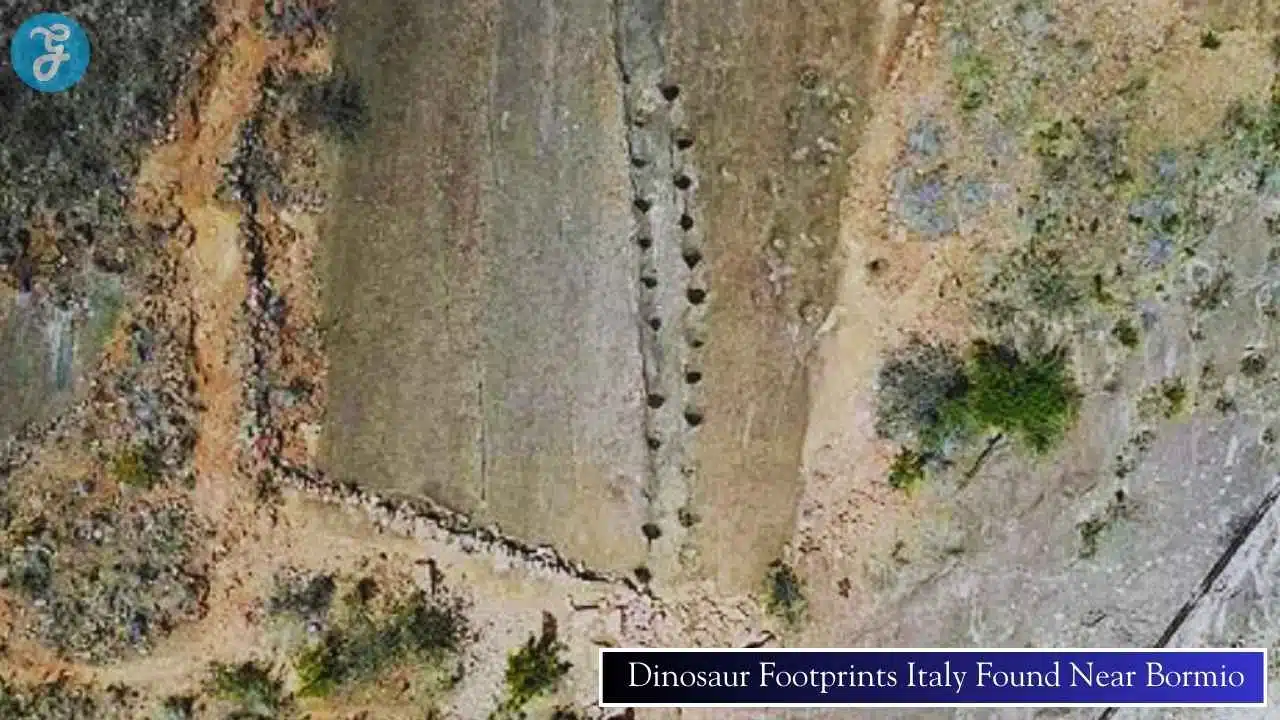
In northern Italy, a photographer’s September 2025 find—announced Dec. 16—revealed up to 20,000 Late Triassic dinosaur footprints in Stelvio National Park near Bormio, offering rare clues to ancient herd movement and alpine geology.
Discovery details: who found the tracks, where they are, and why it matters?
The discovery was made in the high mountains of Stelvio National Park, close to the Swiss border and not far from the Bormio area that will host events during the Milano–Cortina 2026 Winter Olympics. The setting is dramatic: many footprints appear on steep rock faces and exposed slabs at roughly 2,400 to 2,800 meters above sea level, in terrain that is difficult to reach for most hikers and essentially unreachable in winter without specialized equipment.
The initial observer was Elio Della Ferrera, a wildlife photographer. While working in the mountains in September 2025, he noticed repeating shapes on a distant rock wall that did not look like random weathering. He documented the marks with photographs and contacted experts, triggering scientific checks and early mapping.
Officials and scientists describe the find as exceptional for two main reasons. First is the scale: early estimates suggest as many as 20,000 individual footprints spread across roughly five kilometers (about three miles) of footprint-bearing surfaces. Second is the age: the prints are dated to around 210 million years ago, within the Late Triassic, making them among the oldest large footprint concentrations discussed publicly in Europe in recent years.
Location matters scientifically, not just visually. Triassic dinosaur footprints are known from parts of Europe, but this part of the Alps is not widely known as a classic dinosaur track hotspot. The Stelvio site’s unusual exposure—high altitude, steeply tilted rock, and wide spread—creates a rare chance to study many trackways at once, potentially from multiple animals moving through the same ancient landscape.
Quick facts about the Stelvio dinosaur footprint find
| Item | What is known so far |
| Country/region | Italy, Lombardy (Stelvio National Park area) |
| Nearby Olympic venue area | Bormio (Milano–Cortina 2026 territory) |
| Discovery timeline | Noticed Sept. 2025; publicly announced Dec. 16, 2025 |
| Estimated footprint count | Up to about 20,000 (early estimate) |
| Estimated age | About 210 million years (Late Triassic) |
| Elevation | Roughly 2,400–2,800 meters |
| Access | Remote, steep surfaces; limited access and visibility in winter |
What the footprints show: size, trackways, and possible herd behavior?
Footprints can preserve a type of evidence bones rarely provide movement. A skeleton tells scientists what an animal was; a trackway can show how it moved, where it went, and whether it traveled alone or alongside others. In this case, specialists examining the site report footprints with clear anatomical detail in some areas, including toe impressions and claw marks.
Track size and anatomy
Some of the largest prints are reported at around 40 centimeters across. That size supports the idea that the track makers were large-bodied dinosaurs. The clearest tracks show three forward-pointing toes typical of many dinosaur foot shapes, with claw impressions preserved where the original mud captured fine detail before hardening.
Likely track makers
Based on footprint shape, stride patterns, and the Late Triassic age, scientists have suggested the tracks were likely made by large herbivores similar to early sauropodomorphs often described as “prosauropods,” in the Plateosaurus-like group. Plateosaurus itself is widely documented as a Late Triassic European dinosaur, often reconstructed as a large plant-eater that could move bipedally, and it lived within the same broad time window (roughly 214–204 million years ago) cited in multiple references.
It is important to note a standard scientific caution: footprints are trace fossils, and assigning them to a specific species is often harder than assigning bones. The safest statements at this stage are about track type and likely group (large, early long-necked plant-eaters), not a named species.
Trackways and patterns of movement
The most striking claim attached to the Stelvio surfaces is that many tracks appear in trackways that run in similar directions, with repeated spacing that indicates steady walking rather than random wandering. If detailed mapping confirms multiple trackways aligned together, it strengthens the case that several animals moved through the same area at roughly the same time.
Some observers have also described circular or clustered arrangements of tracks on parts of the outcrop. If those clusters are verified through careful measurement (and not caused by erosion, partial exposure, or overlapping track layers), they could suggest animals gathered, turned repeatedly, or paused in groups. In modern ecology, circular grouping can serve several purposes: social cohesion, protection, or navigational behavior. For Triassic dinosaurs, scientists will need to be careful, because similar-looking patterns can also form when multiple animals traverse a soft surface repeatedly over days or weeks.
How researchers will test these ideas?
To move from compelling images to firm conclusions, researchers typically document:
- footprint length and width.
- toe angles and claw marks.
- pace length and stride length.
- trackway width and direction.
- depth and deformation of the sediment layer.
These metrics help estimate speed and gait, and they also help distinguish one individual trackway from another. Educational and research materials on ichnology commonly define and use measurements such as pace length and stride length to interpret movement.
Track evidence researchers prioritize at large footprint sites
| Evidence type | What it can reveal | Why it matters at Stelvio |
| Trackway direction | Shared travel routes and possible group movement | Many trackways appear aligned in similar directions |
| Stride and pace length | Walking speed and gait changes | Helps test whether animals were moving steadily or stopping frequently |
| Footprint detail (toes/claws) | Foot anatomy, substrate softness, preservation quality | Some prints preserve toes and claws, indicating fine-grained sediment capture |
| Clustering/turning patterns | Possible gathering points or repeated use areas | “Circular” groupings have been reported and need verification |
| Overprinting | Whether tracks were made in one event or over long periods | Determines if the surface records a single passage or a frequently used route |
How the tracks survived 210 million years: Triassic landscapes and Alpine geology?
The Stelvio tracksite looks like an alpine wall today, but it began as a flat, soft surface.
A muddy Triassic ground surface
Around 210 million years ago, the region was part of a very different world. During the Triassic Period, Earth’s continents were arranged differently, and the period itself spans roughly 252 to 201 million years ago. Many Triassic tracksites form where dinosaurs walked across wet mud or fine sediment near water—such as shorelines, tidal flats, river margins, or coastal plains. When conditions are right, a footprint depresses the mud, and later sediment quickly fills and seals that depression. Once buried, the print can survive long enough for the layers to turn into rock.
From sediment to stone
For footprints to fossilize, burial timing is critical. Too fast an erosion cycle destroys them. Too slow a burial cycle allows weathering and water to blur the shape. Fine-grained muds can preserve sharp details like toe edges and claw tips if they are moist enough to take an impression but cohesive enough to hold it.
Rock layers tilted into a wall
The biggest “how” question for many readers is simple why are footprints on a steep face? The answer is geology over millions of years. After the tracks were made and buried, the sediment layers hardened. Later, as the Alps formed, those layers were uplifted, folded, and rotated, changing what was once close to horizontal into surfaces that can be steeply inclined.
This is one reason the Stelvio site is unusual for public imagination it makes dinosaur behavior visible in a way that looks almost impossible—animals “walking” up a rock wall—until the long time scale is understood.
Why high altitude can help preservation and delay discovery?
High altitude does not automatically preserve fossils, but it can reduce human disturbance and development. A remote footprint wall can remain undocumented for decades simply because few people pass close enough to notice patterns, and fewer still have the training to recognize footprints rather than erosion marks. At Stelvio, the steepness and the winter conditions mean routine tourism is unlikely to reach the most footprint-dense surfaces.
What comes next: research plans, protection, and what the discovery could change?
The Stelvio footprints are now expected to move through a familiar sequence for major fossil and trace-fossil finds: documentation, protection planning, and public communication.
Scientific work likely to follow
At a site with thousands of footprints, the first priority is a complete map. Because many tracks are on steep and hard-to-reach surfaces, drones are expected to play a major role in photographing the wall from safe angles and generating detailed 3D models. These models allow researchers to:
- count prints more accurately.
- isolate individual trackways.
- measure stride patterns consistently.
- document fine details before weathering changes the surface.
After mapping, scientists can publish formal descriptions, including ichnotaxonomy (classification of footprints by form) and trackway statistics. The earliest “20,000” figure may change as repeated prints, partial prints, and indistinct depressions are filtered out.
Conservation and access questions
Large footprint sites often face an immediate challenge: public interest rises faster than protection measures. Even careful visitors can accidentally damage tracks by stepping on them, rubbing them for photos, or removing fragments. In a high mountain environment, added foot traffic can also increase erosion on fragile slopes leading to the outcrops.
Because the Stelvio surfaces are steep and remote, officials have signaled that there are no simple near-term plans for mass visitation. Any future access, if approved, would likely involve guided routes, viewing points that keep people off the track surfaces, and clear legal protection to deter collecting.
Olympics spotlight: opportunity and risk
The discovery’s timing places it in the same news cycle as ongoing preparations for the Milano–Cortina 2026 Winter Olympics, with Bormio’s Stelvio Ski Centre set to hostle in the spotlight for alpine events. That attention can help in two ways:
- it can accelerate funding and institutional support for surveying and protecting the site.
- it can create public education opportunities that connect natural history with landscape appreciation.
But it can also increase the risk of uncontrolled “geo-tourism” if exact locations circulate widely. For that reason, conservation-first communication is typically favored for newly announced sites.
The Stelvio National Park footprint surfaces may become one of Europe’s most significant Late Triassic track records, not because a single print is rare, but because the site appears to capture many animals moving across the same ancient ground. If mapping confirms long, parallel trackways and repeated group patterns, the site could strengthen scientific discussions about early dinosaur social behavior and migration-like movement. At the same time, the discovery highlights a practical lesson: trace fossils are fragile, and the most valuable next step is careful documentation and protection—before weather and curiosity rewrite the record.