
The clock in the kitchen struck two. Jim sat in the heavy silence of his London flat. The only light came from the cold, blue glare of his smartphone. It reflected in his bloodshot eyes like a modern haunting. He felt wired yet hollow. His mind was a jumble of unread emails and half-finished code. This was his nightly reality. He was a prisoner to the glow. He desperately needed to adopt Digital Disconnect Evening Rituals to save his health. Without these rituals, his brain remained in a state of permanent high alert.
Jim was a software architect. His world was built on binary logic and constant connectivity. He lived in an “always-on” culture that demanded his attention at every hour. Even when the phone was face down, he felt the itch. He suffered from phantom vibrations in his pocket. He would reach for a device that wasn’t there. His mental space was cluttered with a thousand open tabs. Each notification was a tiny spike of cortisol. It kept him hovering in a hyperactive state. He had forgotten how to simply be still.
The breaking point arrived on a Tuesday afternoon. Jim sat in a high-stakes board meeting. He was presenting a new architectural programme for a global client. His eyes failed to focus on the screen. A profound brain fog settled over him. He missed a critical logic flaw in the primary security layer. It was a basic error. It was the kind of mistake a junior developer would avoid. The room went silent as the lead director pointed out the gap.
Jim felt his face flush. His heart hammered against his ribs. The exhaustion was no longer just a private burden. It was a professional liability. He realised that his lack of sleep was eroding his talent. He was fading away in the light of his own screens. He walked out of the office into the biting London air. He knew something had to change. He could not keep living as a ghost in his own life. He needed to reclaim his nights.
The Science Behind Digital Disconnect Evening Rituals
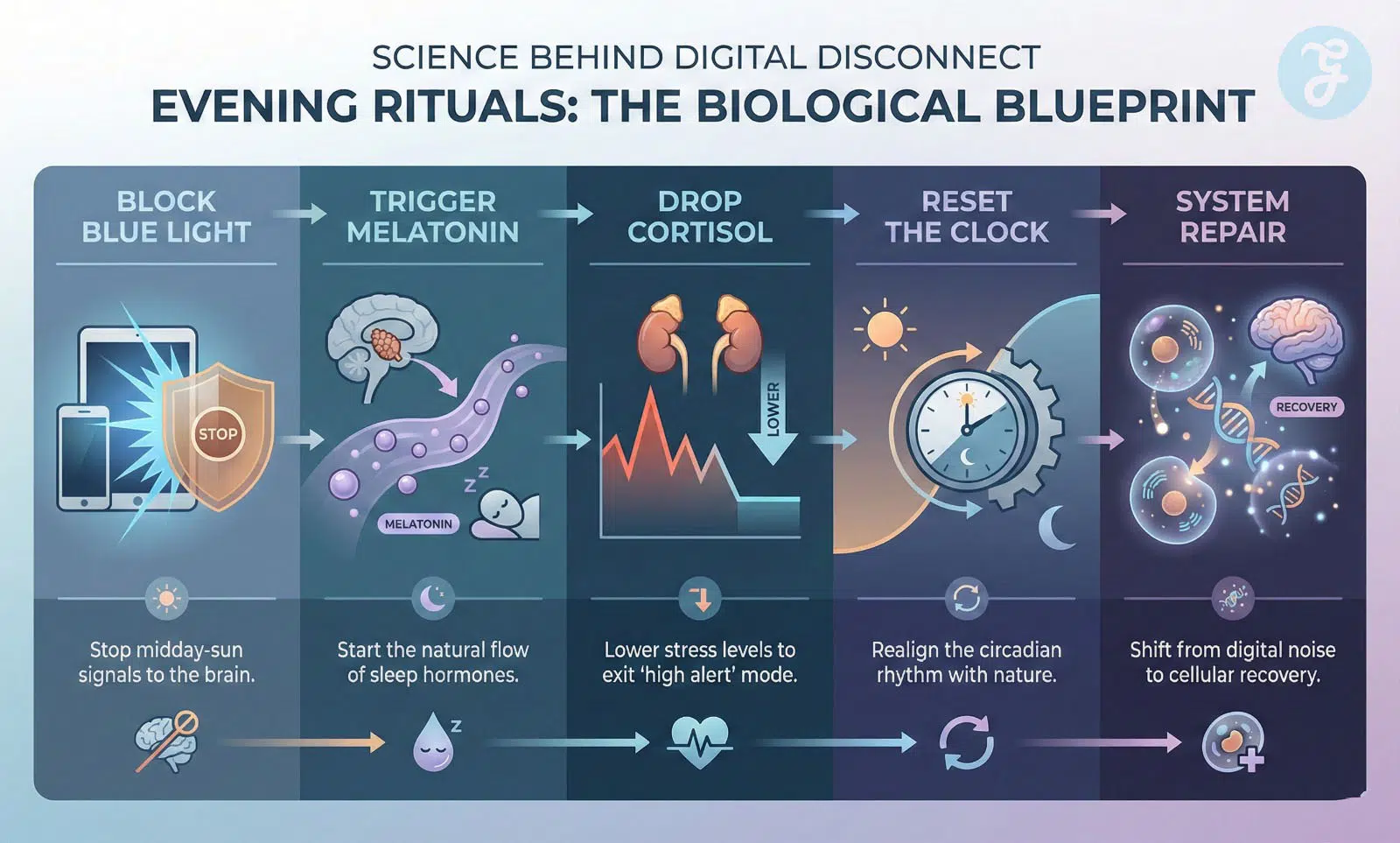
Jim walked through the heavy oak doors of a Harley Street clinic. The room was bathed in soft, amber light. It felt like a sanctuary from the frantic city outside. The specialist did not offer a pill. Instead, he offered an education. He spoke about the delicate chemistry of the human brain. He explained how modern life had severed the link between man and nature. Jim listened as the expert described the “vicious loop” of his sleeplessness.
Across the globe in Bengaluru, India, a software lead named Shalini faced the same invisible wall. She worked in a high-pressure office near Manyata Tech Park. Her nights were spent tethered to a glowing tablet. She suffered from the same chronic fatigue and cognitive decline. Her story mirrored Jim’s perfectly. Both were victims of a modern world that never sleeps. They both needed to implement Digital Disconnect Evening Rituals to survive. Their brains were trapped in a state of digital exhaustion.
The biological lesson began with light. The specialist explained that the human eye is sensitive to specific wavelengths. Screens emit a sharp blue light between $400\text{–}500\text{ nm}$. This is the same frequency as the midday sun. When Jim or Shalini scrolled at midnight, they were sending a false signal to the brain. They were telling the suprachiasmatic nucleus that it was noon. This triggered a state of hyper-arousal. It suppressed the release of melatonin. This hormone is the essential key to a restful night. Without it, the body stays in a state of high alert.
The expert spoke about the circadian rhythm. This is the internal clock that governs every cell in the body. Jim had spent years ignoring this rhythm. His lifestyle was completely out of synchronisation with his biology. He was living in a permanent state of jet lag. His cortisol levels remained high when they should have been falling. His body was confused. It was trying to digest food and solve problems when it should have been repairing tissue. The lack of alignment was exhausting his nervous system.
The specialist then introduced the solution. He called it a formal framework for Digital Disconnect Evening Rituals. This was not just about turning off a phone. It was about reclaiming the evening as a transitional space. It was a method to bridge the gap between the chaos of the day and the silence of the night. Jim needed to create a buffer zone. He needed to allow his brain to decompress naturally. The expert handed him a leather-bound journal. The journey toward a deeper sleep was beginning.
Mastering the Tactile Transition
The shift from a digital existence to an analogue one requires more than just willpower. It requires a replacement of habits. Once the devices are interred in their nightly resting places, the mind often seeks a new anchor. This is where the tactile transition begins. Successful Digital Disconnect Evening Rituals involve engaging the physical senses to ground the nervous system. Swapping a flickering screen for the weight of a physical book is a foundational step. The act of turning paper pages provides a rhythmic, haptic feedback that a touchscreen cannot replicate. It slows the heart rate and encourages deep, focused immersion.
The environment plays a critical role in this sensory recalibration. To optimise the bedroom for rest, one must address the “light hygiene” of the space. Replacing harsh overhead LEDs with warm, amber-hued lamps creates a sunset effect indoors. This subtle shift in colour temperature signals the brain to begin the transition from alertness to sedation. It is about creating a sanctuary that feels distinct from the high-pressure environments of the modern office. The goal is to move the body from a state of hyper-arousal into one of profound tranquillity.
Thermal regulation is another scientific pillar of this evening transformation. Biology dictates that the core body temperature must drop by approximately $1^{\circ}\text{C}$ to initiate deep sleep. A warm bath or shower taken one to two hours before bed facilitates this process, allowing the body’s ‘rebound cooling’ effect to peak exactly as one prepares for sleep. The heat causes blood vessels to dilate, allowing internal warmth to escape through the skin once the person exits the water. This rapid cooling acts as a biological trigger for sleepiness. When combined with a bedroom kept at a crisp 18°C, the body is primed for an uninterrupted night.
Ultimately, these rituals serve as a form of cognitive decompression. Writing in a physical journal allows the mind to externalise the “open loops” of the day. By recording a to-do list or a brief reflection on paper, the individual offloads mental clutter. This prevents the brain from ruminating on tasks during the night. The result is a clean slate. Through these deliberate actions, the evening is reclaimed. The frantic pulse of the digital world is replaced by the steady, restorative rhythm of natural rest.
Expert Perspectives: The Clinical Verdict on Rest
Overseeing operations at Vivekananda Hospital in Durgapur, Dr. Tirthankar Bagchi brings a seasoned perspective to the shifting landscape of modern wellness. From his vantage point as Chief Operating Officer and Wellness Expert, he observes:
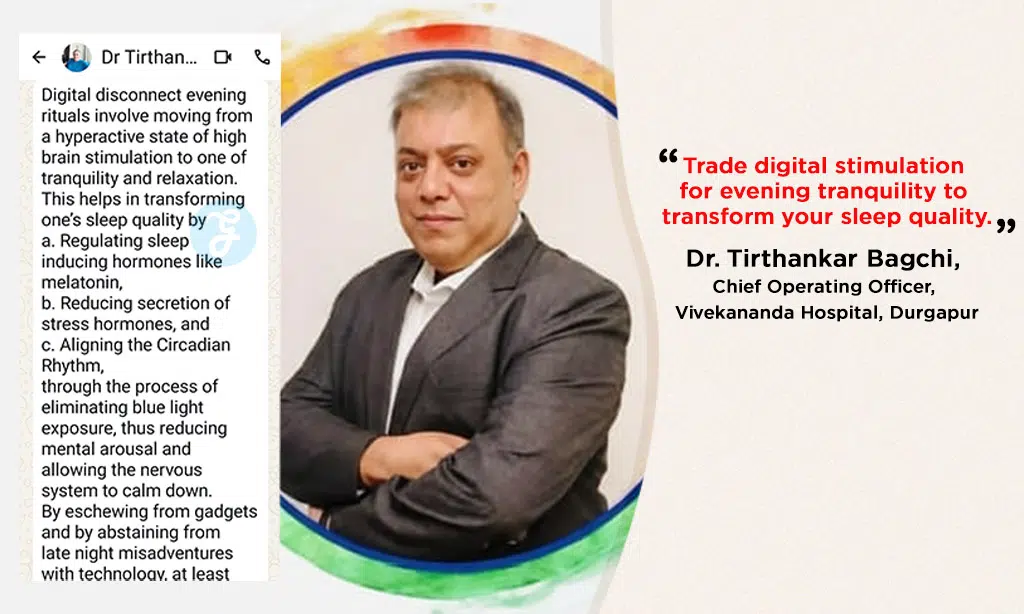
“Digital disconnect rituals are about transitioning the mind from a state of hyper-stimulation to one of tranquillity. By eliminating blue light exposure, we reduce mental arousal and allow the nervous system to settle. This process transforms sleep quality by regulating melatonin, lowering stress hormones, and ultimately realigning the body’s natural circadian rhythm.
In practice, this means sidelining gadgets and abstaining from late-night misadventures with technology at least 60 to 90 minutes before retiring to bed. By doing so, one can sink into restful sleep faster, enjoy deeper, more restorative recovery, and wake up more refreshed the next morning.”
How Digital Disconnect Evening Rituals Transform Your Biology
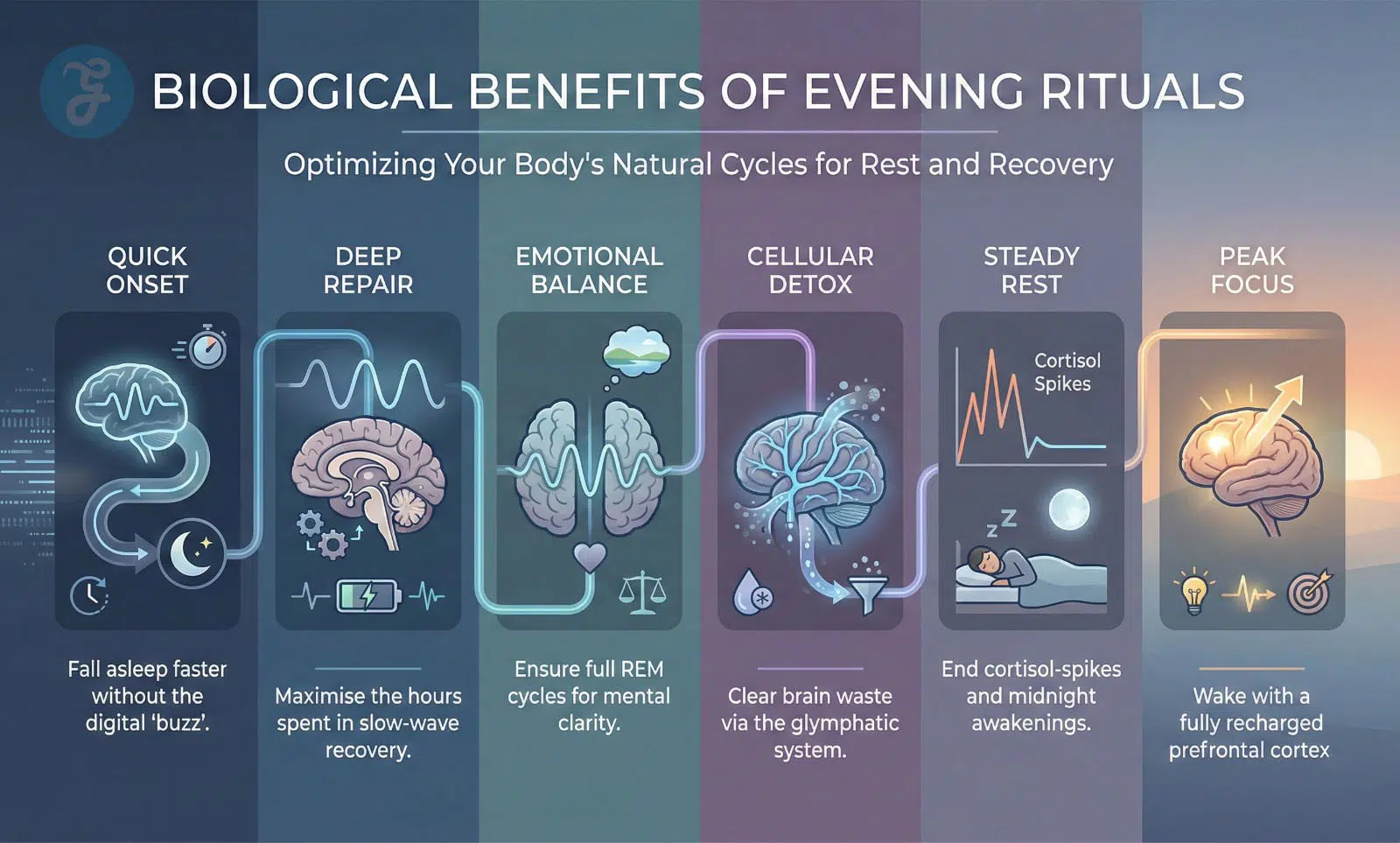
According to clinical observations, these rituals are not merely lifestyle choices but essential biological resets. When the nervous system is permitted to decompress without the interference of digital stimuli, the body undergoes a profound shift. Dr. Bagchi highlights that Digital Disconnect Evening Rituals transform sleep by fostering a series of critical health benefits:
- Faster Sleep Onset: Reducing the time it takes to transition from wakefulness to sleep.
- Deeper Sleep Stages: Increasing the duration spent in slow-wave sleep, which is essential for physical repair.
- Restorative Sleep Cycles: Ensuring the brain moves through the necessary stages of REM for emotional processing.
- Boosted Memory and Immunity: Allowing the glymphatic system to clear metabolic waste from the brain.
- Fewer Night-time Awakenings: Minimising the disruptions caused by high cortisol or alert-state lingering.
- Improved Mood and Cognitive Function: Ensuring the prefrontal cortex is fully recharged for the day ahead.
The Turning Point and the Ripple Effect
As the third week unfolds, the cumulative power of consistency begins to manifest in a profound physical breakthrough. For the first time in years, the morning does not begin with a desperate reach for the espresso machine or a battle against a fog-laden brain. Instead, there is a natural surge of vitality. Jim wakes up feeling truly energised rather than merely “caffeinated.” The heavy, leaden feeling of sleep inertia is replaced by a crisp clarity that starts at the moment of waking. This is the sign that the body has finally completed its first full cycles of restorative, deep-stage sleep.
This newfound energy creates a significant ripple effect that extends far beyond the bedroom. At the office, concentration becomes a sharpened tool rather than a flickering flame. The ability to engage in deep work, the kind of cognitively demanding task that requires hours of uninterrupted focus, becomes effortless. There is a noticeable shift in emotional intelligence as well. When the nervous system is well-rested, empathy increases. In high-pressure meetings, responses are measured and thoughtful rather than reactive or irritable. The short fuse that once characterised a tech-heavy lifestyle is replaced by a resilient, calm patience.
The mastery of these rituals brings a vital realisation: the world does not collapse when a screen is dark. The individual learns to prioritise rest over the relentless, artificial demands of the digital landscape. There is a quiet confidence in knowing that being “unavailable” is not a sign of weakness, but a modern superpower. It is a declaration of sovereignty over one’s own time and mental health. By guarding the evening hours, one ensures that the daylight hours are lived with maximum impact and presence.
Reclaiming Life Through Digital Disconnect Evening Rituals
In the final stage of this transformation, the focus shifts from a set of rules to a settled way of being. There comes a moment of quiet reflection, perhaps while standing on a balcony watching the sun dip below the horizon. The compulsion to reach for a phone to capture the moment for a digital audience has vanished. The need for external validation through social media is replaced by the raw, unmediated experience of the present. The sunset is no longer “content”; it is a personal connection to the natural world. This is the ultimate victory of the Digital Disconnect Evening Rituals.
The success of these rituals lies in a return to a more human pace of life. The transformation is complete when the silence of the night is no longer something to be feared or filled with noise, but something to be cherished. The digital world is finally recognised as a tool to be used, not a master to be served. This shift in perspective ensures that the recovery is permanent. The sanctuary of the home is restored, and the boundary between the public digital square and the private analogue life is firmly re-established.
By consistently honouring Digital Disconnect Evening Rituals, the individual moves from a state of mere survival to one of thriving. The constant “background noise” of the internet is replaced by a profound internal quietude. This isn’t just about avoiding a screen; it is about making a radical choice to prioritise human biology over technological demands. It is the understanding that the mind requires a slow, gentle descent into the night to perform its most vital restorative functions.
The end of this journey is a testament to the resilience of the human spirit when given the space to heal. Sleep is revealed not as a luxury to be optimised later or a nuisance that interferes with productivity. It is the very foundation of a life well-lived. By choosing to disconnect each evening, one chooses to reconnect with the self, with loved ones, and with the fundamental rhythms of existence. The true awakening happens not when the screen turns on, but when the mind is finally at peace in the dark.
Note: Case studies conducted in the UK and India. Participant identities have been withheld upon request.