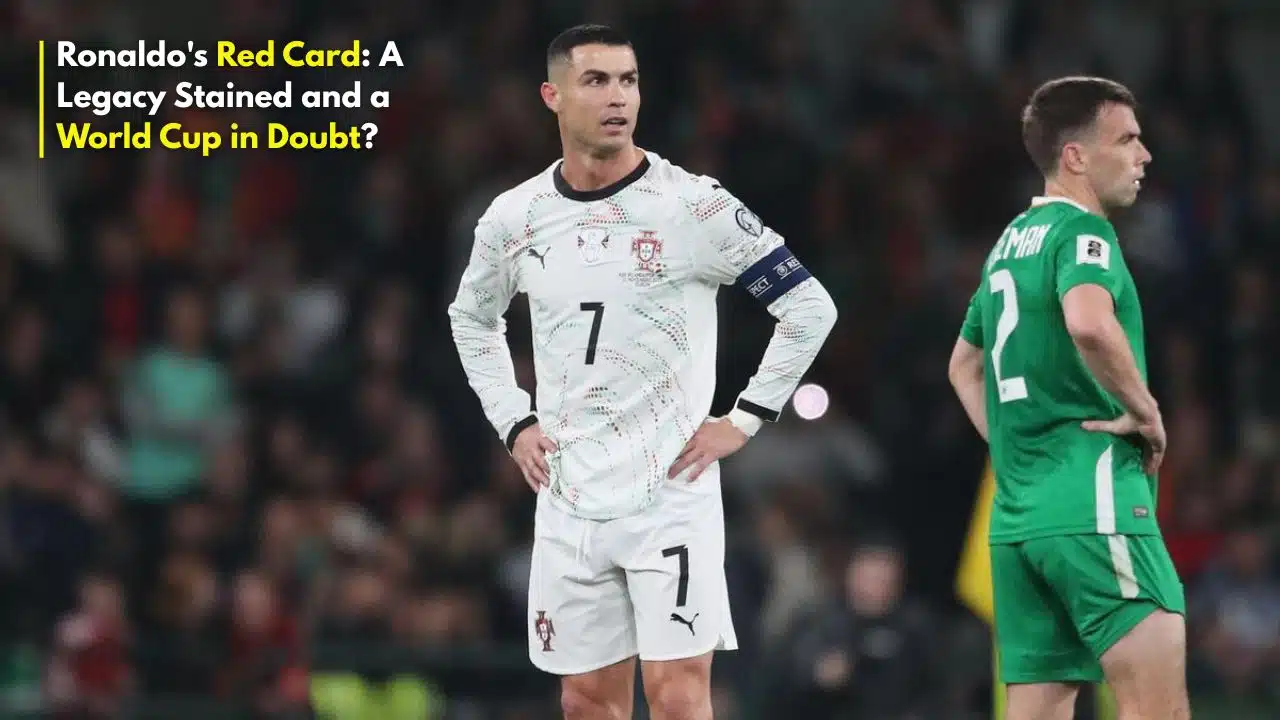
The greatest champions are defined not just by their victories, but by their composure in defeat. For Cristiano Ronaldo, a man whose career has been a monument to superhuman discipline, that composure shattered in Dublin. The 2-0 loss to Ireland was a setback; his petulant elbow was a self-inflicted wound. Now, the 40-year-old icon finds his final World Cup, the last chapter in his storied narrative, under threat—not from a rival, but from his own temper.
An Unraveling Narrative
For a man obsessed with his own narrative, Ronaldo has just penned a disastrous chapter. His first-ever red card in 226 appearances for Portugal—an off-the-ball elbow to an opponent’s back—is far more than a statistical anomaly. It is a calculated act of petulance that now casts a genuine shadow over what was meant to be his valedictory sixth World Cup.
The Anatomy of a Crisis
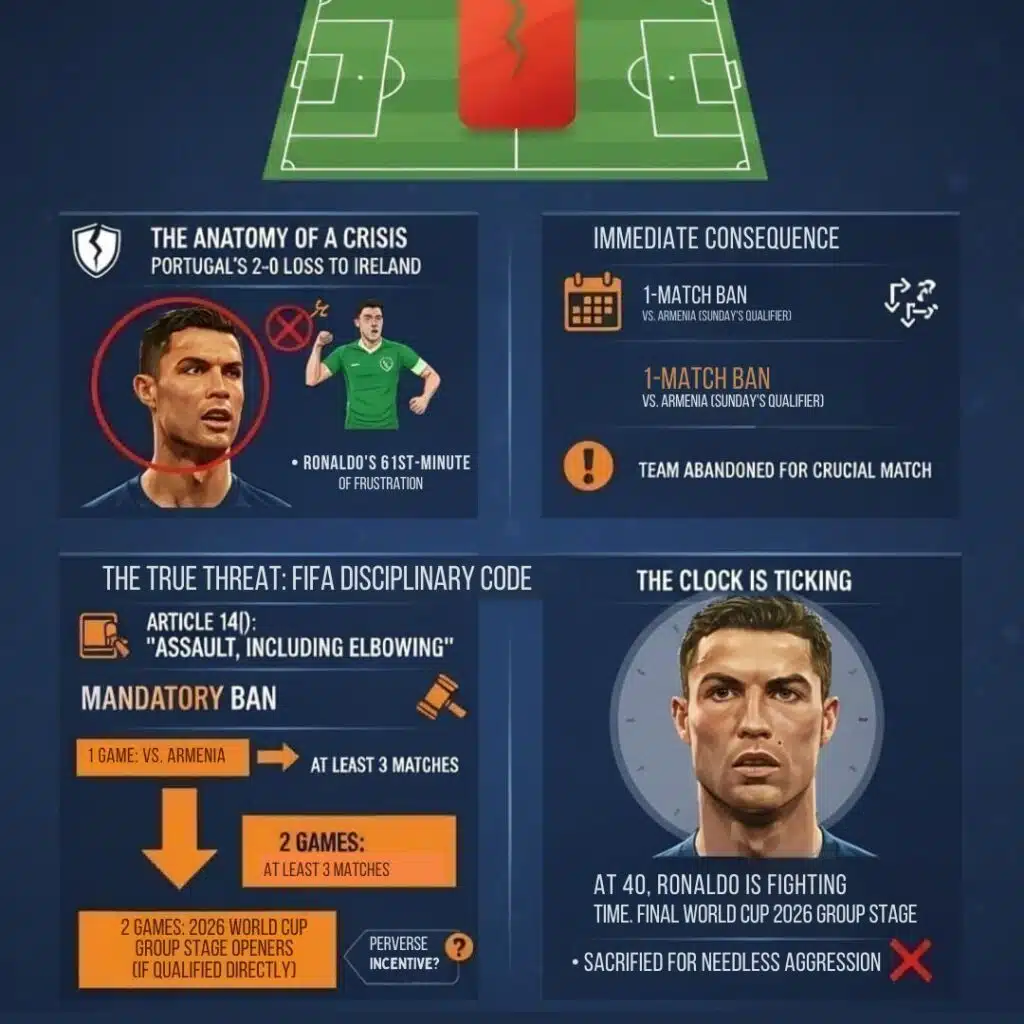
The 2-0 loss to Ireland, a tactical failure where Portugal looked disorganized and “out of attacking solutions,” was already a bitter pill. But Ronaldo’s 61st-minute act of frustration, lashing out at defender Dara O’Shea while trailing 2-0, has escalated a simple sporting setback into a potential crisis. The automatic one-match ban for Sunday’s qualifier against Armenia is the immediate, and lesser, of the consequences. The true cost is that he has abandoned his team for the single most important match of their campaign—a game they now must win to guarantee direct qualification, or risk the lottery of the March playoffs.
The true threat lies in the cold text of the FIFA Disciplinary Code. This was not a mistimed tackle. It was reviewed by VAR and deemed “assault, including elbowing” (Article 14(i)), for which the rules mandate a ban of “at least three matches.” Because these bans must be served in competitive fixtures, the math is simple and devastating. One game was against Armenia. The other two, should Portugal qualify directly, will be the first two group-stage matches of the 2026 World Cup. It even creates a perverse incentive: would Ronaldo prefer his team stumble into the playoffs, just so he could serve his ban there and keep his World Cup opener?
At 40, Ronaldo is no longer just fighting opponents; he is fighting time. He doesn’t have matches to spare. To sacrifice what could be two-thirds of his final World Cup group stage for a moment of needless aggression is a staggering miscalculation.
A Psychological Failure
What makes the incident all the more damning is its predictability. The Irish camp, led by coach Heimir Hallgrimsson, had spent the days before the match publicly warning the referee about Ronaldo’s potential for simulation and intimidation. As Irish legend Shay Given put it, Ronaldo’s “bonkers” reaction proved he was rattled. Pundits noted the Irish players “niggled away at him” and “didn’t cower,” tactics that “just ground him down.” When Hallgrimsson cheekily remarked post-match that it was “a moment of a little silliness” unless “I got into his head,” he confirmed the truth: the master of mental warfare had lost. Ronaldo’s sarcastic applause to the jeering crowd and his confrontation with Hallgrimsson as he walked off were not the dignified exit of a captain. They were the petulant flailings of a man who had been out-thought and out-fought.
A Gallery of Infamy
This act of self-sabotage places Ronaldo in a pantheon he never sought. Greatness in football is often shadowed by a singular, human flaw. For Diego Maradona, it was the “Hand of God,” a moment of divine cheating. For Zinedine Zidane, it was the 2006 World Cup final—a headbutt that etched his final image as one of tragic, provoked aggression.
Ronaldo’s elbow now joins this gallery. It’s a stark contrast to his great rival, Lionel Messi, whose own international disciplinary record is limited to two reds—one a bizarre, contested scuffle in 2019, the other on his debut. As the Irish fans chanted “Messi,” they highlighted this very point. Messi’s red cards are anomalies; Ronaldo’s, in this moment, felt like a culmination. It was the petulant, frustrated lashing out of an icon who, in the twilight of his career, refuses to accept that the game, the opponent, and the referee will not bend to his will.
Final Verdict
This narrative of denial was only amplified by his coach, Roberto Martinez. His defense was a case study in enabling a star. To claim “I don’t think it’s an elbow, I think it’s a full body” and “There’s no violence” is a pathetic denial of the video evidence. It’s a statement so absurd it undermines his own authority, proving he is a manager incapable of holding his icon to account.
For two decades, we have watched Cristiano Ronaldo defy time, physics, and his critics. But in Dublin, he was not defied by an opponent; he was defined by his own frustration. He has single-handedly jeopardized his team’s immediate qualification and, more profoundly, his own grand farewell.
The greatest threat to Cristiano Ronaldo’s final World Cup campaign is not his age. It’s the unshakeable belief that the rules, for him, should simply not apply.