Serious/debilitating injuries don’t just affect the victim—they ripple through their entire support system, particularly family, close friends, and romantic partners. That’s why non-economic damages include loss of consortium in most states.
Although laws vary from state to state, spouses, domestic partners, children, and even close family members can file a loss of consortium lawsuit. But what exactly is loss of consortium? And how can you file a loss of consortium lawsuit and win? Keep reading to find out.
What Is Loss of Consortium?
Loss of consortium/companionship/affection means the damage to crucial aspects of your relationships following an incident. Some of these aspects may include:
- Companionship
- Physical intimacy and affection
- Contribution to household chores
- Emotional support
- Parenting dynamics
These damages are especially common in personal injury cases. Severe injuries may hinder your ability to connect with or care for your loved ones emotionally. Imagine a scenario where you get involved in a car accident and become paralyzed. Such a life-altering injury completely changes how you engage with your spouse and loved ones.
That said, loss of consortium damages aren’t exclusive to personal injury cases. You can file for these damages in wrongful death cases as well. The surviving spouse and close family members are eligible for compensation should they lose their loved one due to someone else’s negligence or malice.
Domestic violence, sexual assault, and kidnapping can also be grounds for a loss of consortium claim. The psychological trauma caused by the offender may hinder the victim’s ability to have meaningful, concrete relationships with future partners. In fact, about 5% to 10% of trauma survivors develop post-traumatic stress disorder and have difficulties in their relationships.
Types of Loss of Consortium
Loss of consortium is also known as loss of companionship/affection. There are different types of loss of consortium, depending on your relationship with the victim and the extent of the injuries. Most judicial systems nationwide recognize three main types of loss of consortium.
1. Spousal/marital loss of consortium: As the name implies, this is a loss of consortium that the victim’s loved ones file for losing their matrimonial partners. The death or life-changing injury of their partners could affect them in several ways and could affect the victim’s ability to provide:
- Affection
- Solace
- Fellowship
- Companionship
- Conjugal life
- The contribution to a happy marriage
2. Loss of consortium of a parent: Imagine a scenario where a single parent gets injured in a work-related accident due to their employer’s negligence. In such cases, the child can demand compensation from the negligent party, citing the loss of parental services, companionship, and comfort.
3. Loss of filial consortium/companionship: Not all loss of consortium cases involve adults. Children sometimes end up hurt or lose their lives because of another party’s negligence. The parents of these children can receive loss of filial consortium damages after suing the negligent party. However, this only applies to legal minors and is applicable primarily in wrongful death claims and lawsuits.
How Does the Court Calculate Loss of Consortium Damages
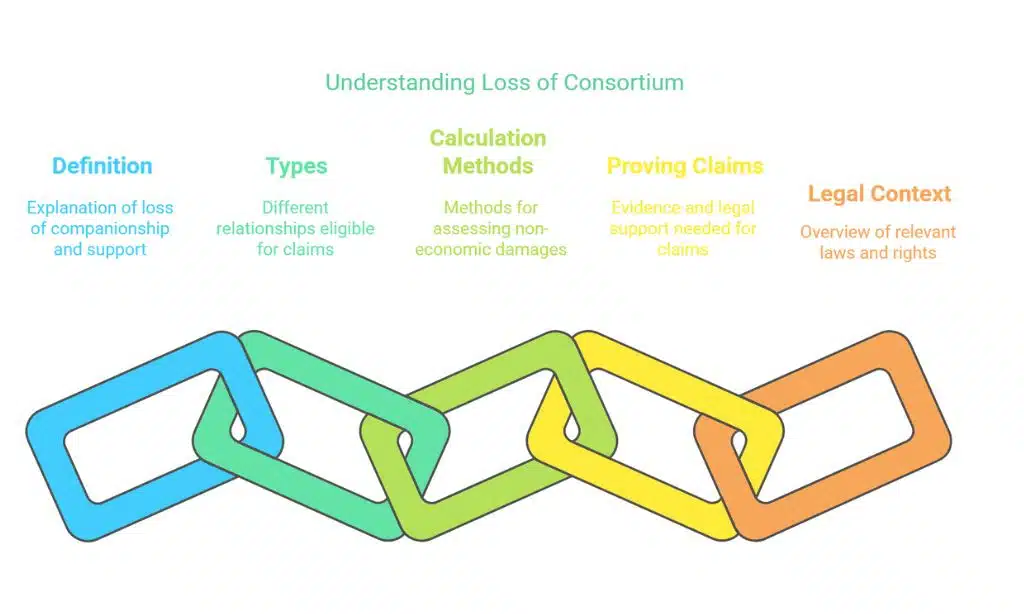
Loss of consortium falls under the category of non-economic damages. Unlike economic damages, non-economic damages are intangible and difficult to assign a monetary value. This begs the question, how are loss of consortium damages calculated?
There’s no standard formula for calculating these damages, so you and your attorney must assign a dollar value for these abstract damages. The main factors to consider when doing so include:
- How permanent your injuries are [permanent injuries attract larger settlements]
- The injuries’ impact on your household’s financial situation
- Your ability to participate in household chores
- Whether you can get physically intimate with your partner
- How well you can parent your children
- Emotional pain and anguish due to relationship problems
Regardless of what factors you use to estimate your claim’s value, it’ll always end in a fixed value or a specific range. You’ll use this range or value during trial or when negotiating with the other party’s insurance company. It’s also worth noting that these damages form part of your non-economic damages, calculated via the following methods:
Multiplier method: Here, the court multiplies your economic damages with a specific multiplier to give the total value of your non-economic damages. Suppose you receive $10,000 in economic damages, and the jury decides on X3 as the multiplier.
You’ll receive $30,000 [3 X $10,000] in non-economic damages, including loss of consortium. The multiplier can be higher than five for severe injuries or wrongful death cases.
Per diem method: The per diem method assigns a fixed value for the victim’s companionship and multiplies it by the number of days since the accident. This daily rate is estimated from the victim’s earning capacity, a subjective estimate of the degree of pain and suffering, and how long the loss is expected to last.
How Do I Prove Loss of Consortium?
Proving loss of consortium can be tricky. You may need evidence to show that your relationship with the victim was thriving before the accident. Some evidence that you might need include the following:
- Eviction notices, unpaid bills, and other proof of financial hardships
- Photos and videos of you spending quality time with the victim
- Testimonies from close family and friends
That said, having these pieces of evidence may not be enough to advance your claim. A skilled and experienced lawyer may be necessary to help you prove your case. They will defend you against insurance company lawyers who might try to diminish your compensation value.
Loss of Consortium Matters in Personal Injury Cases
The post-injury divorce rate is between 48% and 78%, which is more than enough proof that serious injuries ruin relationships. Fortunately, the United States legal system protects your rights to compensation for any emotional or financial suffering endured due to your loved one’s injuries or death.
Still, it’s worth noting that proving negligence and loss of consortium isn’t a simple process. That’s why you should seek the help of a competent lawyer to help fight for your rights.