Heat is becoming more than a seasonal inconvenience. In many parts of the Global South, extreme temperatures are colliding with high humidity, unreliable power, water stress, and rising food prices. For families who can plan ahead, the “climate exit” is the idea of reducing long-term exposure to dangerous heat by building a legal path to live elsewhere. One of the biggest strategic levers is citizenship, because it can unlock stable residence rights, healthcare access, schooling options, and the ability to move quickly when conditions deteriorate. This guide focuses on Best Countries To Escape Extreme Heat and explains how to evaluate “safer” passports without hype, fear, or false certainty.
A second citizenship is not a magic shield. Heat risk does not stop at borders, and several cooler countries still face climate threats like wildfires, storms, flooding, or drought. The right approach is to treat citizenship as one layer in a broader resilience plan that includes location choice, housing design, savings, skills, insurance, and community ties.
Why Heat Is Driving The Climate Exit Conversation
Heat has a unique ability to trigger chain reactions across daily life. It raises health risk, increases electricity demand, reduces labor productivity, and can destabilize basic services when energy grids or water systems fail. It also creates a “stacked risk” problem where multiple issues happen together.
Common heat-driven stress points include:
-
Higher rates of heat illness, dehydration, and cardiovascular strain
-
Greater dependence on cooling, and higher costs when power is expensive or unstable
-
Disruptions to schooling and work when temperatures cross safe thresholds
-
Reduced crop yields and higher food inflation
-
Rising migration pressure as people move within countries, often toward crowded cities
-
Social tension when water, power, and jobs become less reliable
For households with resources, the climate exit is often less about immediate danger and more about future optionality. People want a legal “off ramp” that allows them to relocate before crisis forces rushed decisions.
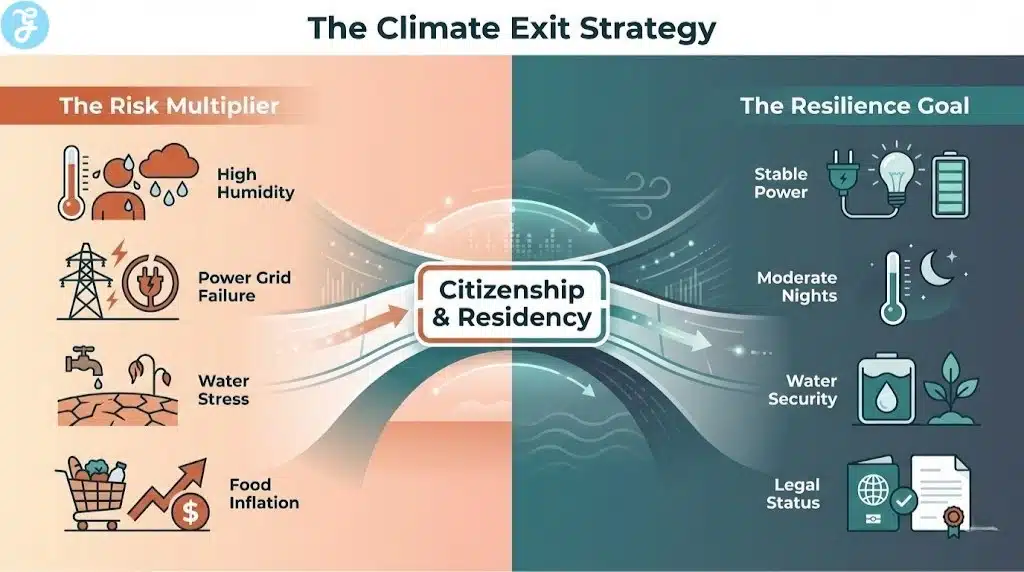
Citizenship Versus Residency: What Actually Changes Your Options
Many people jump straight to passports. In reality, residency can be the faster and cheaper first step, while citizenship is the long-term asset.
What Citizenship Gives You
Citizenship usually offers:
-
A permanent right to enter and live in the country
-
Stronger protection from rule changes compared to temporary visas
-
Easier access to public systems, depending on the country
-
Full labor rights and often broader family sponsorship options
-
A more durable plan across generations
What Residency Can Do Instead
Permanent residence, or long-term residence permits, can also deliver most practical benefits:
-
The right to live and work long-term
-
Access to public services in many systems
-
A pathway to citizenship later
If your goal is to reduce heat exposure quickly, residence pathways may be the main engine, with citizenship as the destination.
The Core Idea: Climate-Resilient Citizenship Selection
“Best” depends on your risk profile. A climate-resilient citizenship is not only about cooler weather. It is about whether the country can maintain livable conditions as climate pressure rises.
A strong climate-exit citizenship often combines:
-
Lower long-term extreme heat exposure in major population centers
-
Strong institutions and public service capacity
-
Reliable power systems and energy affordability
-
Water security and well-managed infrastructure
-
A strong healthcare system and social stability
-
A realistic legal pathway for immigrants
This is why many people prioritize temperate, high-capacity states even if they are expensive. The cost can be seen as paying for system reliability.
Key Criteria For Choosing Best Countries To Escape Extreme Heat
Here is a practical scoring lens you can use before you fall in love with any country.
1) Heat Profile And Humidity Risk
Heat becomes most dangerous when humidity is high because sweat evaporation slows down. In planning terms, “hot and humid” is typically harder to manage than “hot and dry” for human health.
Look for countries where:
-
Summer heat is moderated by latitude, ocean influence, or elevation
-
Major cities have cooler nights that allow the body to recover
-
Housing stock can be adapted for heat without extreme energy use
2) Water Security
A country can be cool and still face water problems. For climate exit planning, you want places with:
-
Stable freshwater supply and good management
-
Modern water treatment and distribution
-
Low political conflict over water
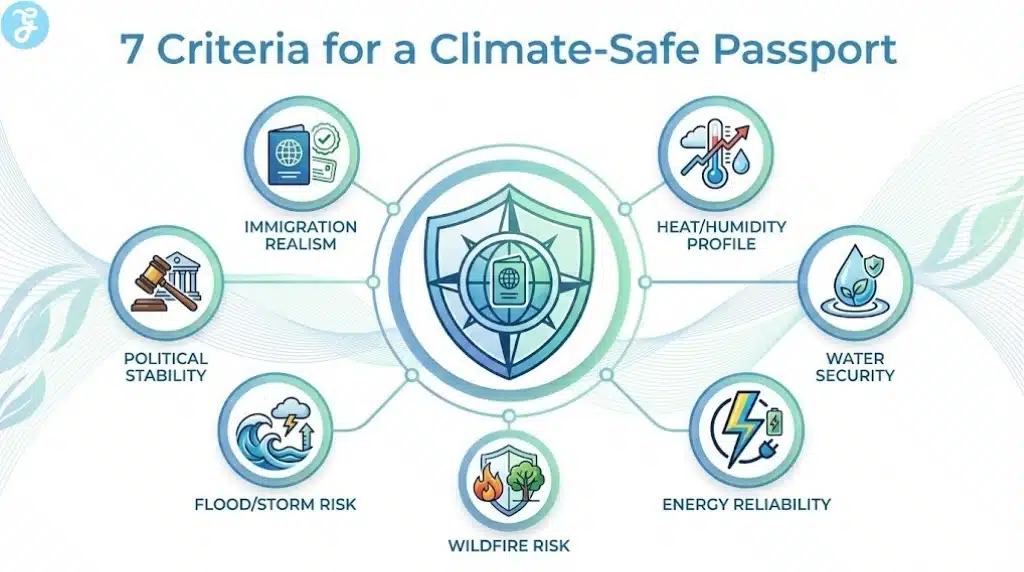
3) Energy Reliability And Cooling Economics
Even in cooler countries, heatwaves will happen. The question is whether people can cope.
Consider:
-
Grid reliability and emergency response capacity
-
Home insulation standards and building codes
-
Energy pricing stability and winter heating costs
-
Local readiness for heat shelters and public health messaging
4) Wildfire And Smoke Exposure
Several temperate regions face wildfire seasons. Smoke can become a serious health risk even if temperatures are moderate.
Evaluate:
-
Fire history and land management
-
Air quality during peak seasons
-
Housing and insurance risk in fire-prone zones
5) Flooding, Storms, And Sea-Level Risk
Some “cooler” places are coastal and face rising seas or stronger storms. For long-term safety, look at:
-
Urban flood protection and drainage systems
-
Building standards and insurance availability
-
Whether the country invests in climate adaptation
6) Economic And Political Stability
Your passport is only as useful as the country behind it. Focus on:
-
Rule of law and predictable governance
-
Social cohesion and low violence risk
-
A strong labor market, especially in essential industries
7) Immigration Realism And Pathway Clarity
A country can be climate-attractive but practically inaccessible. Consider:
-
Transparent pathways through work, family, study, or investment
-
Time to permanent residence and citizenship
-
Rules for spouses, children, and aging parents
-
Whether dual citizenship is permitted and how it is treated socially
Shortlist: Countries Commonly Considered Cooler And More Heat-Resilient
No list can fit every person. Still, certain countries are frequently shortlisted because their main population centers sit in temperate zones and they have strong institutional capacity. The categories below are meant to guide your research, not replace it.
Best Countries To Escape Extreme Heat: Top Citizenship Targets By Climate Profile
The countries in this section are grouped by the type of climate advantage they offer, plus the system capacity that supports livability.
Temperate “Island And Maritime Moderation” Options
Maritime climates often have milder summers, cooler nights, and fewer extreme heat spikes. Ocean influence can reduce heat intensity, although storms and sea-level risk can be a trade-off.
New Zealand
Why it is often considered:
-
Moderate temperatures in many populated areas
-
Strong governance and public systems
-
A culture of risk planning and emergency readiness in many communities
Watch-outs:
-
Housing quality varies, and heating can matter in winter
-
Some regions face flooding or storm exposure
-
Distance can affect travel and family logistics
Ireland
Why it is often considered:
-
Ocean moderation and generally mild summers
-
Strong ties to broader European mobility for some residents
-
High human development indicators
Watch-outs:
-
Housing costs can be high in major areas
-
Wind and rain patterns can be disruptive
-
Healthcare access can depend on residency details and local capacity
United Kingdom
Why it is often considered:
-
Many regions remain cooler than tropical or desert zones
-
Large and diverse labor market
-
Established institutions and infrastructure
Watch-outs:
-
Heatwaves can still be intense due to building stock not designed for heat
-
Housing affordability varies widely
-
Weather volatility and flooding risk exist in certain areas

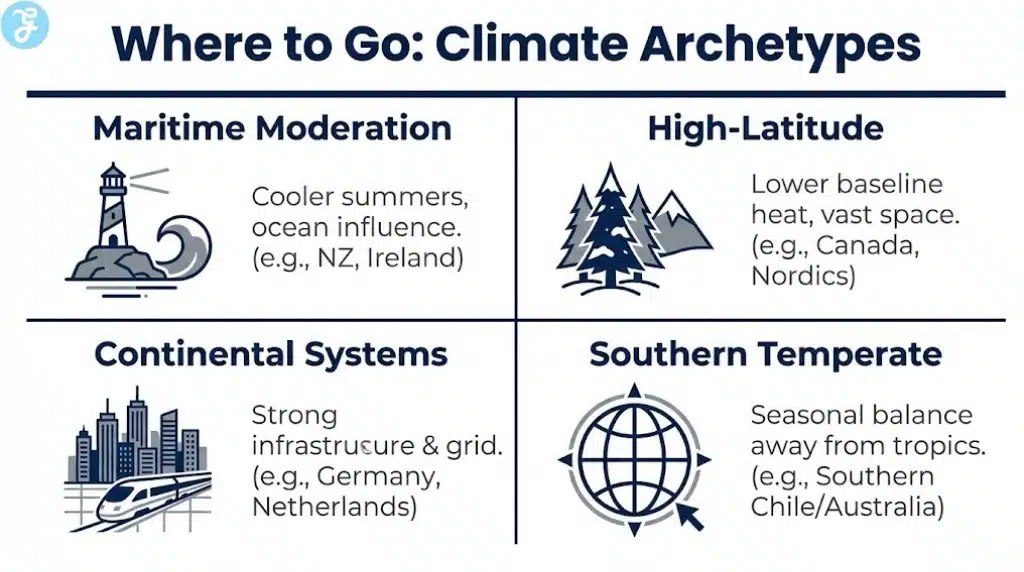
High-Latitude “Big Land, Lower Heat” Options
These countries are often seen as heat-resilient due to latitude, but they can have other climate issues such as wildfire, winter severity, and regional extremes.
Canada
Why it is often considered:
-
Many cities have cooler baseline climates
-
Strong institutions and stable economy
-
Large land area gives relocation flexibility within the same passport
Watch-outs:
-
Wildfire smoke in some seasons and regions
-
Winter heating costs and cold exposure can be serious
-
Housing affordability can be challenging in major urban centers
Nordic Countries (General Category)
Why they are often considered:
-
Cooler climates in many areas
-
Strong public services and high trust institutions
-
Robust infrastructure and safety nets
Watch-outs:
-
Access pathways can be competitive
-
High taxes can be a surprise if you do not plan well
-
Winter darkness and cold can affect wellbeing for some families
Continental Europe “Temperate With Strong Systems” Options
Parts of continental Europe offer temperate climates with strong infrastructure, but heatwaves are increasing in some regions. The key is to focus on cooler sub-regions and cities.
Germany
Why it is often considered:
-
Strong economy and healthcare capacity
-
High infrastructure reliability
-
Many mid-latitude areas remain manageable compared to hotter zones
Watch-outs:
-
Some summers can still be very hot, especially in urban heat islands
-
Housing rules and rental markets can be complex
-
Language and credential recognition matter for career mobility
Netherlands
Why it is often considered:
-
Maritime moderation and strong infrastructure
-
High-quality urban planning and public services
-
Deep experience with water management
Watch-outs:
-
Low elevation and flood management remains an ongoing national project
-
Housing shortages and high costs in key areas
-
Weather can be gray and windy for long periods
Switzerland
Why it is often considered:
-
Strong governance and high system reliability
-
Mountain regions offer natural cooling and high-quality living conditions
-
Stable economy and strong public services
Watch-outs:
-
High cost of living
-
Immigration pathways can be selective
-
Terrain and local integration can affect job access
“Southern Hemisphere Temperate” Options Outside The Tropics
Australia (Selected Regions)
Why it is often considered:
-
High institutional capacity and strong healthcare systems
-
Many cooler coastal zones compared to equatorial regions
-
Strong labor demand in certain skilled sectors
Watch-outs:
-
Heat and wildfire risk can be significant in some regions
-
Insurance and property risk in fire zones can be a major factor
-
Summers can still be intense in many areas
Chile (Selected Regions)
Why it is often considered:
-
Long geography with cooler southern zones
-
Some regions offer temperate climates and livable conditions
-
Potentially more affordable than many high-income options
Watch-outs:
-
Earthquake risk is part of the baseline risk profile
-
Regional differences are huge, country-wide generalizations fail quickly
-
Income opportunities and public service capacity vary by city

A Practical Comparison Table For Climate Exit Passports
Use this table as a starter. The right choice depends on where you would actually live inside each country.
| Country Type | Heat Advantage | Main Trade-Offs | Who It Fits Best |
|---|---|---|---|
| Maritime Islands | Mild summers, cooler nights | Storm exposure, housing costs, distance | Families prioritizing steady weather |
| High-Latitude Large Countries | Lower baseline heat, internal relocation options | Wildfire smoke, winter severity, long distances | People who want geographic flexibility |
| Temperate Europe | Strong systems, urban infrastructure | Heatwaves in some regions, housing pressure | Professionals seeking stable services |
| Temperate Southern Hemisphere | Seasonal balance, strong institutions in some cases | Fire risk, regional extremes | Skilled migrants with flexible city choice |
How A Second Citizenship Actually Reduces Heat Exposure
Even if you choose a cooler country, you still need an execution plan. The passport is the key that unlocks the move, but the move is what reduces risk.
Here are the real-world mechanisms.
Geographic Flexibility When Conditions Shift
Climate risk is not static. Heat zones expand, drought patterns shift, and cities become hotter as they grow.
A strong citizenship gives you:
-
A place to relocate without reapplying for permission
-
The right to re-enter after traveling or temporary stays abroad
-
Long-term stability to buy property or invest in home retrofits if you choose
Better Access To Heat-Resilient Infrastructure
In higher-capacity countries, you are more likely to find:
-
Buildings with insulation and ventilation standards
-
Reliable water and sanitation
-
Strong emergency services during heatwaves
-
Healthcare systems that can handle climate-linked stress
Income Stability And Insurance Access
A climate exit is easier to sustain when you can earn well and insure your assets. Many “cooler” passports are attached to economies with stronger insurance markets and more predictable legal systems.
Heat Safety Is Local: City Choice Matters More Than Country Choice
Many people get stuck at the country level. That is a mistake. Within the same country, heat exposure can vary dramatically.
When comparing cities, evaluate:
-
Summer high temperatures and night-time lows
-
Humidity patterns and ventilation potential
-
Urban heat island intensity, tree cover, and green space
-
Proximity to water, but also flood exposure
-
Housing quality, insulation, and cooling options
-
Healthcare access and distance to hospitals
A helpful mindset is to choose a country for its systems and legal stability, then choose a city for its microclimate.
The Legal Pathways People Use For Climate Exit Planning
Most people do not obtain citizenship overnight. Planning usually follows a pathway sequence.
Work Pathway
If you have in-demand skills, this is often the most sustainable route. It can lead to long-term residence and later citizenship.
Strong profiles include:
-
Healthcare, nursing, medical support roles
-
Engineering, trades, and construction management
-
Software, data, cybersecurity, and infrastructure roles
-
Education and special needs support in certain regions
Study Pathway
Studying can be a bridge, but it is expensive and not always a direct route to staying. It works best when paired with:
-
A clear post-study work path
-
Strong employability in the local labor market
-
Financial planning that avoids high-interest debt
Family Pathway
If you have family ties, this can be the most direct. It may also allow you to relocate older relatives, which matters in heat-risk planning.
Investment And Business Pathway
This route can be effective for entrepreneurs, but it can be costly. If you choose it, treat it as a long-term mobility decision, not only a climate decision.
At around this point, it is worth returning to the focus phrase because it captures the practical intention behind most planning: Best Countries To Escape Extreme Heat are usually those where both climate and institutions work together, and where you can realistically build lawful long-term status.
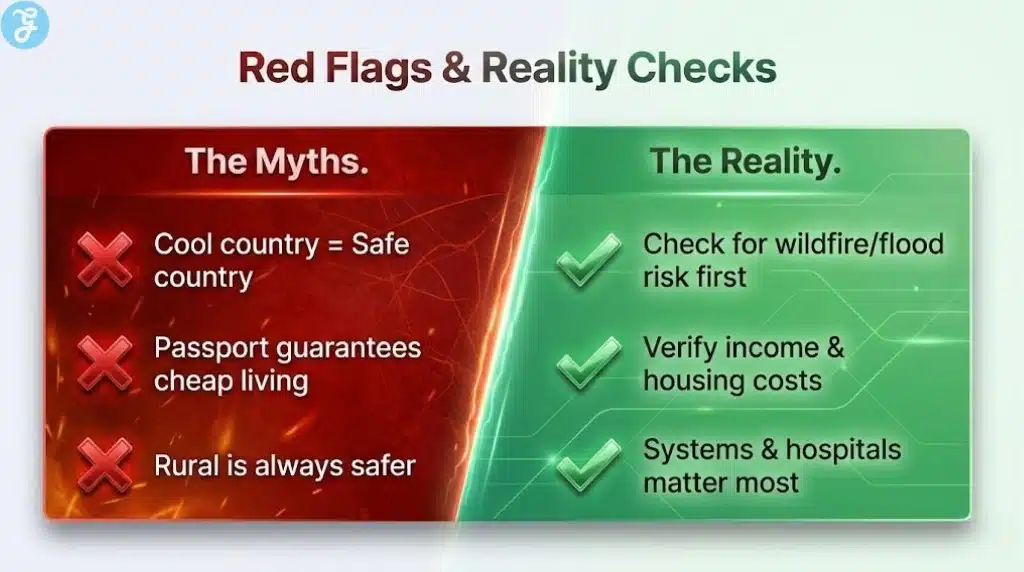
Red Flags And Myths In Climate Exit Citizenship Shopping
The climate exit space attracts marketing that can distort your decision-making. Watch for these red flags.
Myth 1: “Cool Country Equals Safe Country”
Cooler regions can still face:
-
Wildfires and smoke
-
Flooding and storms
-
Water shortages
-
Infrastructure stress during unusual extremes
Safety is a portfolio, not a single factor.
Myth 2: “A Passport Guarantees Low Cost Living”
Several climate-attractive countries are expensive. If you move without a sustainable income plan, cost stress can become your main risk.
Myth 3: “You Can Buy A Perfect Passport Fast”
Fast options exist in some contexts, but the “perfect” passport rarely exists. Most people do best with:
-
A realistic residency path
-
A clear timeline
-
A plan that fits their career and family structure
Myth 4: “Rural Life Is Always Cooler And Better”
Rural areas can be cooler and safer in some cases, but they can also have:
-
Limited healthcare access
-
Weak job markets
-
Fewer schools and services
-
Greater exposure to wildfire or isolation risks
A balanced approach is often a smaller city near a larger service hub.
A Step-By-Step Climate Exit Plan You Can Actually Use
Step 1: Choose Your Heat Risk Threshold
Write down what you want to avoid:
-
Hot and humid conditions
-
Long heat seasons
-
Night-time heat that prevents recovery
-
Unreliable electricity during heat peaks
This helps you avoid vague planning.
Step 2: Pick Two “Anchor Countries” And One Backup
Anchor countries are where you would genuinely live, not just park a passport. Your backup is the second-best option that still reduces heat risk.
Step 3: Build A City Shortlist
For each anchor country, list 3 to 5 cities or regions and compare:
-
Summer heat patterns
-
Housing quality and cost
-
Healthcare access
-
Job market fit
Step 4: Select The Legal Pathway
Choose the pathway that matches your profile:
-
Skilled work if you can qualify and want income stability
-
Study if it is a strategic career investment
-
Family if you have legitimate ties
-
Business if you can create local value and sustain compliance
Step 5: Create A Two-Layer Timeline
Layer one: the move timeline, how soon you can live there legally.
Layer two: the citizenship timeline, how long until you can naturalize, if you choose that route.
Step 6: Build A Heat-Ready Household Plan
Even after relocating, you should be prepared for heat events:
-
Choose housing with insulation, ventilation, and shade
-
Plan air filtration if wildfire smoke is a risk
-
Maintain emergency savings and backup power planning where feasible
-
Prioritize healthcare access and community networks
How To Decide If You Need A Second Citizenship Or Just A Strong Residency
Ask yourself:
-
Do you need permanent re-entry rights and long-term protection from policy shifts?
-
Are you planning for children and future generations?
-
Do you need the ability to sponsor family members later?
-
Do you want the option to relocate internally within a large country?
If your answer is mostly yes, citizenship is a strong long-term play. If your answer is mostly no, long-term residence may deliver most benefits with less cost and complexity.
The Bottom Line On Climate Exit Passports
The climate exit is about reducing exposure to dangerous heat while increasing your family’s ability to adapt. The “best” citizenship is rarely the one with the flashiest marketing. It is usually the one tied to a country with cooler baseline conditions in the places you would actually live, strong institutions, reliable infrastructure, and a realistic pathway you can complete.
If you want the simplest rule of thumb, it is this: Best Countries To Escape Extreme Heat tend to be temperate, maritime, or high-latitude states with strong governance and service capacity, but your final answer should be made at the city and pathway level, not just at the flag level.