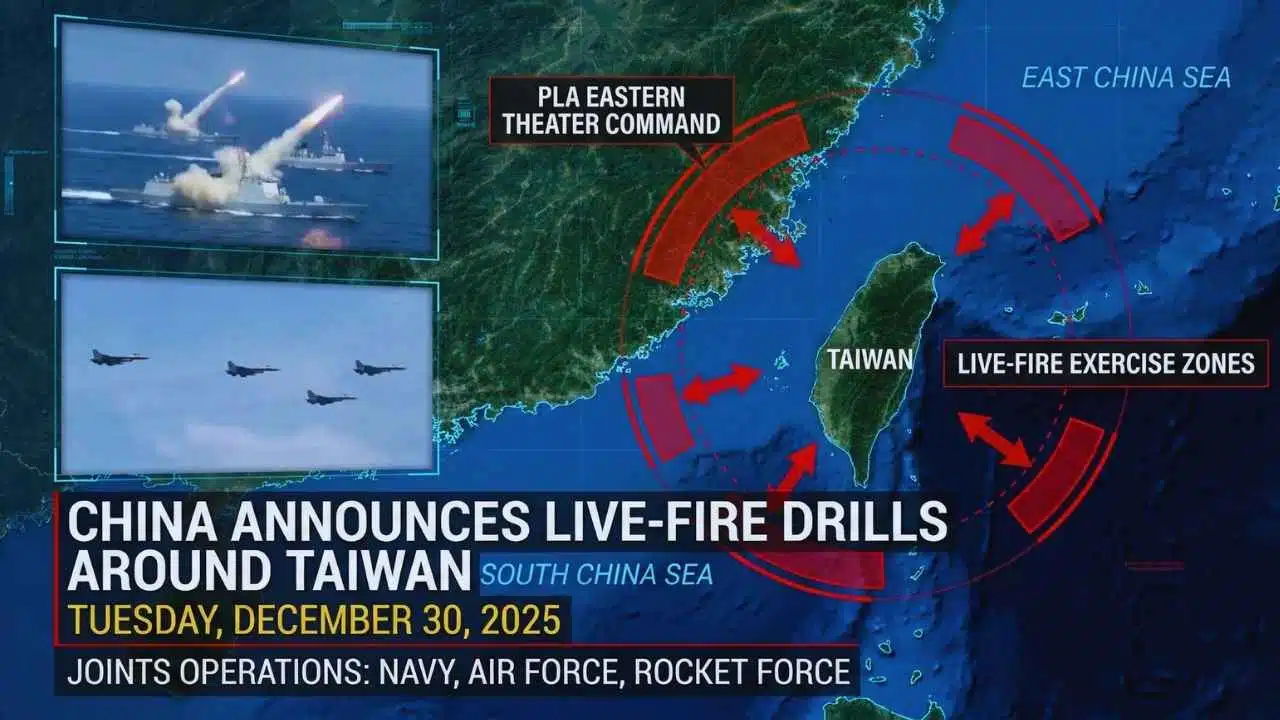
China live-fire drills around Taiwan began Monday under a new PLA operation name, with a live-fire phase set for Tuesday and multiple restricted zones announced, prompting Taiwan to raise readiness amid fresh friction over U.S. arms sales.
What China announced and what the drills involve?
China’s People’s Liberation Army (PLA) said it launched a new round of large-scale joint military drills around Taiwan on Monday, December 29, 2025, using the label “Justice Mission 2025.” The PLA framed the operation as a warning against Taiwan independence activity and against what it calls “external interference” in the Taiwan issue.
A key feature of this round is the planned live-fire phase. Public notices described a 10-hour live-fire window on Tuesday, December 30, starting in the morning in the region’s local time. Alongside that live-fire plan, authorities announced sea and airspace restrictions covering multiple areas around Taiwan. These restrictions are typically communicated to reduce risks to civilian shipping and aviation when military firing or high-tempo maneuvers are expected.
China described the training as multi-service and joint in nature—meaning different branches operate together as a single force package rather than running separate drills. In recent years, such joint training around Taiwan has often included combinations of:
- Aircraft conducting patrols and simulated strikes,
- Naval movements that demonstrate sea-control or blockade-like positioning,
- Rocket/artillery forces that practice long-range fire coordination,
- Drone and electronic activity that supports targeting and surveillance.
While official descriptions vary, the purpose of joint drills in this setting is usually twofold: to improve operational coordination and to send political signals. In this case, the timing—within weeks of a major U.S. arms package announcement—made the signaling component impossible to miss.
Drill at a glance (publicly described elements)
| Item | Details |
| Operation label | “Justice Mission 2025” |
| Start date | Monday, Dec. 29, 2025 |
| Live-fire phase | Tuesday, Dec. 30, 2025 (10-hour window) |
| Restricted areas | Multiple zones around Taiwan for sea/air activity |
| Stated intent | Warning to Taiwan independence forces; deterrence against outside involvement |
| Operational emphasis | Joint, multi-service coordination; pressure around the island |
Where the drills are happening and what it means for routes and ports?
Public descriptions placed activity around the Taiwan Strait and the waters and airspace north, southwest, southeast, and east of Taiwan. That geographic spread matters because it suggests “multi-direction” pressure—an approach that can complicate response planning by forcing defenders to watch multiple sectors at once.
Another notable detail in the public messaging was attention to major ports, including Keelung in the north and Kaohsiung in the south. Those ports are among Taiwan’s most important gateways for trade and logistics. When an exercise narrative highlights ports, it is often interpreted as a reminder that maritime access routes can become central in crisis scenarios, including coercive measures such as inspections, partial disruption, or blockade-like pressure. Any such interpretation, however, depends on what forces do in practice and how long activity lasts.
For everyday people and businesses, the most immediate concern is not strategy but safety and disruption. Military restrictions can cause ships to reroute and airlines to adjust flight paths, especially if the zones overlap with common commercial corridors. Even if disruptions are limited, repeated restrictions can create uncertainty for carriers, insurers, and supply chain planners.
Why “restricted zones” matter?
| Sector | What restrictions can affect | Typical short-term impact |
| Commercial aviation | Flight paths and timing | Detours, minor delays, congestion on alternate routes |
| Shipping | Sea lanes near the island | Rerouting, scheduling changes, higher operating costs |
| Fishing | Access to certain waters | Temporary loss of fishing time/income in affected areas |
| Insurance/logistics | Risk pricing and planning | Cautious adjustments if drills repeat or expand |
Taiwan and its neighbors have experience managing limited disruptions during drills. The risk rises when activity becomes prolonged, spreads across more zones, or involves higher-intensity live-fire or close encounters at sea and in the air.
Taiwan’s response and the immediate security posture
Taiwan’s authorities denounced the drills as destabilizing and said they took steps to monitor the situation and adjust readiness. In practical terms, Taiwan’s response in these situations often centers on:
- Tracking aircraft and vessels operating near the island,
- Activating rapid-response procedures for units on standby,
- Increasing surveillance and command readiness to reduce reaction time,
- Communicating with civilian agencies when air/sea safety zones may affect traffic.
Taiwan’s messaging repeatedly emphasizes defensive intent and a commitment to maintaining normal life and economic activity, while still showing it can respond quickly if an exercise shifts into a more dangerous posture.
This balancing act matters because drills can create “gray-zone” pressure—persistent military activity that stays below the threshold of open conflict but increases stress on personnel, equipment, and decision-making. The more often forces operate in close proximity, the greater the chances of incidents such as unsafe intercepts, near-misses, or misread maneuvers.
Taiwan’s broader preparedness discussion in 2025 has also included resilience planning beyond the armed forces. That includes civil defense readiness and continuity planning designed to keep government services and critical infrastructure functioning under stress. Those measures are typically presented as precautionary—meant to reduce vulnerability rather than escalate tensions.
What is driving the timing: U.S. arms sales, China’s sanctions, and escalating messaging?
The drills came shortly after the United States announced a major package of potential arms sales to Taiwan valued at about $11.1 billion, described by multiple reports as among the largest packages in scale. The package includes systems and munitions designed to strengthen Taiwan’s ability to deter or resist attack, including long-range precision strike capabilities and artillery modernization.
Major items publicly listed in the U.S. package (as described in reporting)
| Item | Reported quantity/value highlights |
| HIMARS rocket launchers | 82 launchers |
| ATACMS missiles | 420 missiles |
| M109A7 self-propelled howitzers | 60 units (with reporting indicating phased procurement and potential additional quantities discussed) |
| Drones / autonomous air vehicles | Approximately $1+ billion category-level value in reporting |
| Anti-armor missiles | Javelin and TOW munitions included in reported components |
| Networking/software | Tactical networking and mission software included in described packages |
Beijing strongly opposes U.S. military support for Taiwan and has consistently argued that arms sales undermine stability and violate its “one China” positions. In response to the latest package, China announced sanctions on 20 U.S. defense-related companies and 10 executives, including measures such as restrictions on dealings and asset-related penalties involving China.
The sequence—arms sale announcement, sanctions, and then a high-profile military drill—fits a pattern seen repeatedly in recent years: political and military signaling layered together to show resolve and impose costs, at least symbolically, on actions Beijing opposes.
At the same time, Washington’s approach is anchored in long-standing policy: maintaining unofficial ties with Taiwan, supporting Taiwan’s self-defense capacity, and managing deterrence in the Taiwan Strait. Each side frames its steps as stabilizing, while the other side describes them as provocative—creating a cycle where actions and counteractions feed an escalating narrative.
Regional and global context: Japan’s debate, market signals, and what comes next?
The regional reaction is shaped not only by Taiwan and China, but also by the growing role of nearby partners—especially Japan—whose security planning increasingly treats a Taiwan crisis as a serious concern. Public comments from senior Japanese leadership in late 2025 drew attention because they suggested Japan could respond under certain circumstances if a Taiwan-related conflict threatened Japan’s security.
China’s public line continues to warn outside countries against involvement and to characterize the Taiwan issue as an internal matter. Meanwhile, many regional governments emphasize de-escalation, freedom of navigation, and the need to avoid unilateral moves that increase the risk of conflict.
One notable element during this round of drills has been market behavior. Despite the military tension, reporting described Taiwan’s financial markets showing resilience, with key indices holding up and even reaching new highs during the period. Markets do not predict security outcomes, but they can reflect how investors judge immediate disruption risk. When markets remain calm, it often suggests expectations that drills will remain limited and time-bound. That said, investor sentiment can change quickly if activity expands, if civilian routes are disrupted for longer, or if an incident occurs.
What observers typically watch during drills like this?
| Watch point | Why it matters |
| Duration | Longer drills increase operational stress and civilian disruption risk |
| Geography | Wider spread around the island suggests broader pressure and complexity |
| Live-fire intensity | Higher intensity increases safety risks and signals stronger intent |
| Close encounters | Unsafe intercepts or near-misses can trigger rapid escalation |
| Follow-on messaging | New sanctions, warnings, or additional drills indicate a longer campaign |
China’s live-fire drills around Taiwan are both a military event and a political message. The immediate practical impacts hinge on how tightly the restricted zones are enforced, whether commercial routes must divert, and whether forces operate safely while in close proximity. The strategic impact depends on what comes after the live-fire window: a quick end to activity would point to a contained demonstration, while extended or repeated drills—especially those emphasizing ports and all-direction pressure—would deepen uncertainty and raise the stakes for all parties operating in and around the Taiwan Strait.