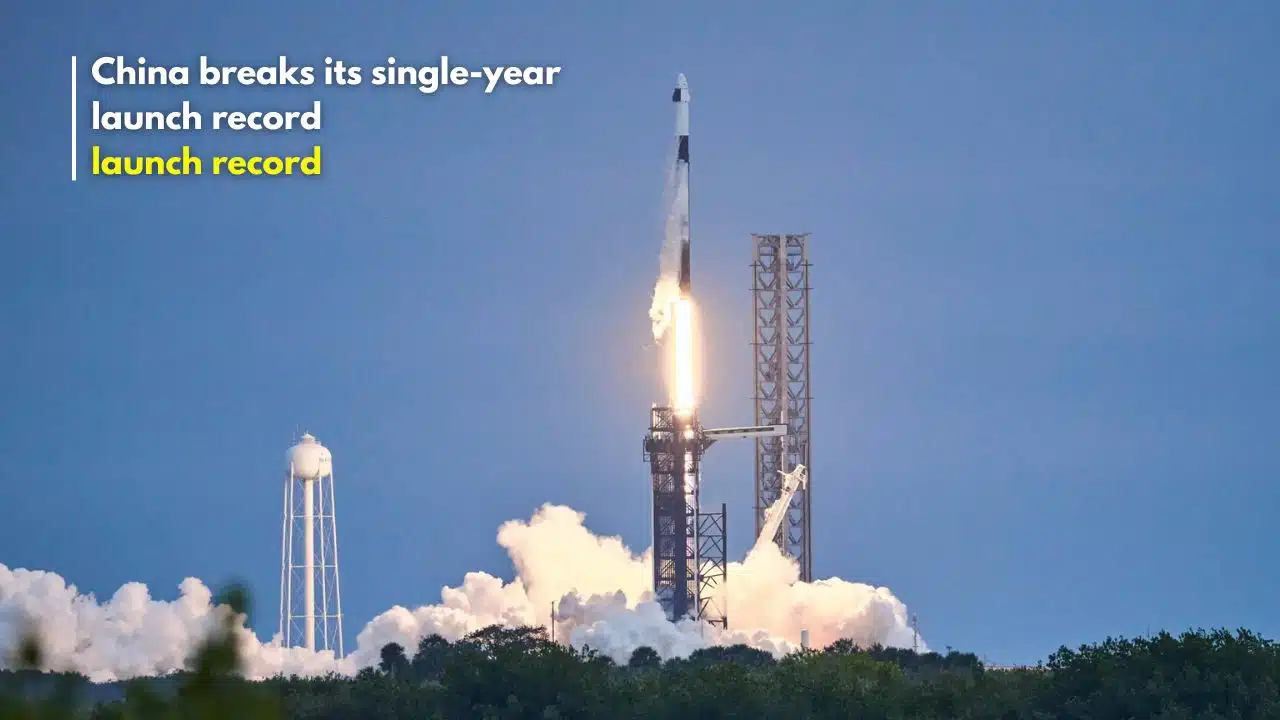
China has shattered its own national record for orbital launches in a single year, completing its 72nd mission on Monday with nearly two months still remaining in 2025. This blistering pace, culminating in the launch of a new Long March 12 rocket, demonstrates a powerful and accelerating state-backed strategy to dominate the next phase of the space economy, even as it continues to chase the colossal launch cadence of the United States.
The record-breaking 72nd launch, confirmed by the China Aerospace Science and Technology Corporation (CASC) and reported by state media (China Daily, Nov 10, 2025), lifted off from the coastal Hainan International Commercial Aerospace Launch Center. The payload consisted of a new batch of satellites for “Guowang,” China’s state-owned satellite internet constellation, a direct competitor to Western systems like SpaceX’s Starlink.
This new high-water mark of 72 launches surpasses the 68 missions China flew in all of 2024. It cements a dramatic, multi-year acceleration that is transforming the global space landscape. Just three years ago, China’s national record stood at 64 launches. Now, it has firmly established itself as the world’s number two space power by launch volume, eclipsing Russia’s historically significant program, which has logged only 13 launches this year.
However, this national achievement is set against the staggering backdrop of American launch dominance. The United States has already flown more than 160 missions in 2025 (PayloadSpace, Nov 10, 2025), with private firm SpaceX alone accounting for over 140 of them.
Analysts argue this disparity misses the point. China’s 72 launches are not a fluke but the first major dividend of a deliberate, dual-pronged national strategy: pairing the reliability of its state-owned Long March rocket family with the explosive, state-fostered growth of a new commercial space sector.
A New National Cadence, Fueled by Policy
The acceleration in recent years has been methodical. China’s launch numbers illustrate a clear, upward trajectory, moving from a challenger to a major industrial power in space.
China’s Orbital Launches: Year-Over-Year Growth
| Year | Total Orbital Launches |
| 2022 | 64 |
| 2023 | 67 |
| 2024 | 68 |
| 2025 (as of Nov 10) | 72 (New Record) |
This growth is no accident. It is the direct result of a 2014 policy decision to open the space industry to private capital, a move that was supercharged in the 2024 national government work report. In that report, commercial spaceflight was officially designated a “new engine of economic growth.”
The results have been profound. As of 2025, China’s commercial space market is projected to exceed 2.5 trillion yuan (approximately $348 billion), according to official Chinese projections (Xinhua, June 19, 2025). The nation now boasts over 500 commercial space companies, many clustered in “aerospace enterprise” zones in cities like Beijing and Shanghai.
These companies are not just experimenting. They are building, and building fast.
“In satellite manufacturing, the advantages of commercial aerospace companies in low-cost, mass production are becoming increasingly evident,” said Zhang Shijie, chief scientist at the commercial firm GalaxySpace, in a statement earlier this year (Xinhua, June 19, 2025). “The ability to build satellites like assembling computers is no longer a vision; it has become a reality.”
This new commercial-industrial base provides the manufacturing and launch capacity to rapidly build out China’s primary strategic assets in orbit: the satellite megaconstellations.
Analysis: The ‘State-Steered’ Race to Orbit
The 72nd launch from Hainan is a perfect microcosm of this new strategy.
The rocket was the Long March 12, a new-generation, state-developed vehicle making one of its first flights. Its 3.8-meter diameter core is a significant engineering upgrade, breaking from the decades-old 3.35-meter standard that was limited by the width of China’s railway tunnels (SpaceDaily, Nov 10, 2025). This allows for wider, more powerful, and more efficient rockets.
The launch site was the Hainan International Commercial Aerospace Launch Center, China’s first facility built specifically to cater to the new commercial sector.
The payload was for the Guowang constellation, the 13,000-satellite state-owned answer to Starlink.
This is what experts refer to as China’s “state-steered” model. It combines state-led infrastructure development (new rockets, new spaceports) with state-directed commercial competition to accelerate innovation and capacity.
“China views space power as a critical component of its comprehensive national power,” notes a recent analysis from Modern Diplomacy (Modern Diplomacy, Jan 22, 2025). This is not a race for prestige alone; it is an integrated strategy to achieve economic, defense, and foreign policy goals.
By fostering a domestic commercial launch market, China aims to:
- Rapidly Deploy Megaconstellations: Build its Guowang and G60 (Qianfan) networks to provide global broadband and secure, sovereign communication channels.
- Capture Global Market Share: Compete with SpaceX and other Western companies for international satellite launch contracts.
- Secure Strategic Autonomy: Ensure it is not reliant on Western technology for its military, economic, or scientific access to space.
The Global Context: Chasing First, Eclipsing the Rest
While China’s 72 launches are a national triumph, they also highlight the new realities of the 21st-century space race.
The View from First Place
The United States’ 160+ launches in 2025—more than double China’s new record—are almost entirely attributable to the singular success of SpaceX. The reusability of the Falcon 9 rocket has created a launch cadence that no other company or country can currently match.
This places China in a clear, and distant, second place. Its launch capacity is growing, but it has not yet solved the reusability puzzle at the same scale as SpaceX. This “reusability gap” remains a key technological hurdle for Chinese state and commercial firms, though multiple are testing prototypes.
The New Space Hierarchy
The more dramatic story is China’s absolute displacement of Russia. For decades, the space race was a two-way competition between Washington and Moscow. In 2025, that is definitively over.
2025 Orbital Launches (as of Nov 10, 2025)
- United States: 160+
- China: 72
- Russia: 13
China’s 72 launches are more than five times Russia’s 13. This shift redefines global space power, positioning China as the sole “peer competitor” to U.S. dominance, a fact that underpins the strategic goals of U.S. programs like Artemis.
What to Watch Next
With this new record achieved, China’s space program is focused on its long-term strategic objectives. The high launch cadence is a means to an end.
- Megaconstellation Rollout: The priority for the remainder of 2025 and 2026 will be to use this launch capacity to continue the high-speed deployment of the Guowang and G60/Qianfan satellite networks.
- Deep Space Ambition: Beyond Earth orbit, China is pushing ahead with landmark science missions. The Tianwen-2 mission is scheduled to launch in 2025 to sample a near-Earth asteroid (Modern Diplomacy, Jan 22, 2025).
- The Race to the Moon: All of this rocket development—both state and commercial—is a proving ground for the ultimate goal: landing Chinese taikonauts on the Moon by 2030 (The SpaceInfo Club, Sep 5, 2025).
The 72nd launch of 2025 is not just a new number in a record book. It is a statement of industrial capacity and a clear signal that China’s long-term, state-steered space ambitions are accelerating, right on schedule.