You need capital to pay bills or buy new gear, but banks often want a formal business structure. You wrote a thin business plan and face strict credit checks. High interest rates and big down payments keep you locked out of small business loans.
Many nonprofit groups or online lenders let you apply with just a personal credit score or a credit report, no entity needed. This post shows nine loan application options, from a personal loan to a merchant cash advance, from lines of credit to invoice factoring.
You will learn how to fill each form, check your credit report, and compare interest rates and loan repayment terms. Keep reading.
Key Takeaways
- You can get a personal loan without an LLC. Lenders check your FICO score (650–680; some accept 550–600) and bank statements. SBA-backed deals often ask for 10% owner equity.
- Peer-to-peer sites like Funding Circle need a 650–680 credit score, two years in business, and fund you in two days for working capital or equipment.
- Crowdfunding on Kickstarter (60-day pre-sales), Indiegogo, GoFundMe, Patreon or Kiva costs no entity or credit check. Kiva offers up to $15,000 at 0% APR with 5–35 endorsements.
- Freelancers can finance invoices to borrow up to 85% of their value or factor them for a 2%–5% fee. Merchants can get a cash advance up to $100,000 and repay by sharing a slice of card sales.
- Business credit cards and lines of credit need just one day of operation. Bluevine offers up to $250,000 at 6.2% APR. Fundbox lends up to $150,000. OnDeck issues lines up to $100,000 at about 52.6% APR.
What Are Personal Loans for Business Use?
Personal loans help cover working capital needs, such as equipment financing, rent or marketing strategy, without an LLC. Lenders review FICO credit scores and bank statements at Equifax, Experian and TransUnion.
Most require scores between 650 and 680; some accept 550 to 600 when revenue stays strong. AnnualCreditReport.com offers one free report from each credit reporting agency every year.
Entrepreneurs draw cash advances or a credit line and treat loans like unsecured small business loans.
Borrowers must outline their loan purpose in a clear business plan. SBA-backed deals usually ask for ten percent owner equity, for example fifty thousand dollars on a five hundred thousand dollar project.
Credit history drives loan repayment terms and APR. Founders with limited operating history often choose personal loans over small business loans. Tax or legal impacts may appear, so talk with an accountant before signing.
How Do Peer-to-Peer Lending Platforms Work?
Peer-to-peer lending sites link business borrowers with investors. Platforms run an online loan marketplace that can offer lower annual percentage rate than banks. Many platforms need a FICO score between 650 and 680.
Borrowers submit loan applications, credit reports, bank statements, and profit and loss statements.
Funding Circle offers an online application and delivers funds in two days. It asks for two years of operation, a checking account, and a personal guarantee on three to five year terms.
Borrowers use working capital and equipment financing to cover debts and invest in growth.
What Are Popular Crowdfunding Options?
Crowdfunding helps small business owners fund projects without a formal business entity. It relies on rewards or pre-sales instead of equity or debt.
- Kickstarter uses a 60-day campaign window. It lets entrepreneurs pre-sell products for working capital. It does not need an LLC, business license, credit checks, or bank statements.
- Indiegogo offers flexible funding with no equity stake. It works for hardware, apps, or social causes. It uses PayPal or Stripe to process credit card payments and charges platform fees.
- GoFundMe hosts donation drives for business expenses or equipment financing. It skips credit reporting agency checks and loan approval steps. It suits sole proprietors who lack a line of credit or formal business structure.
- Patreon creates a subscription model for fans. It supplies steady working capital for creative entrepreneurs. It avoids loan repayment terms, personal guarantees, and credit bureaus.
- Kiva issues micro loans of up to $15,000 at 0% APR in 77 countries. It runs a 35-day fundraising window and needs 5–35 endorsements. It sets clear loan repayment terms and requires no collateral.
How to Get Microloans from Nonprofit Organizations
Nonprofit lenders serve startups with low credit scores. These loans cover working capital, inventory, supplies, and equipment.
- Locate a community development financial institution (CDFI), these nonprofits often join the Small Business Administration microloan program which offers up to fifty thousand dollars.
- Check Small Business Administration microloan rules, average award runs thirteen thousand dollars, applicants must operate in the U.S. and share bank statements with credit reporting agencies.
- Gather bank statements, a simple business plan and sole proprietor revenue records, clear docs speed loan approval.
- Use the Kiva platform for a zero percent interest loan of up to fifteen thousand dollars, collect five to thirty-five endorsements from customers or peers.
- Write a spending plan for working capital, inventory or equipment, lenders value detailed use cases.
- Review repayment terms and prepare a personal guarantee, many microloans are unsecured but may need limited collateral.
Using Business Credit Cards Without a Registered Entity
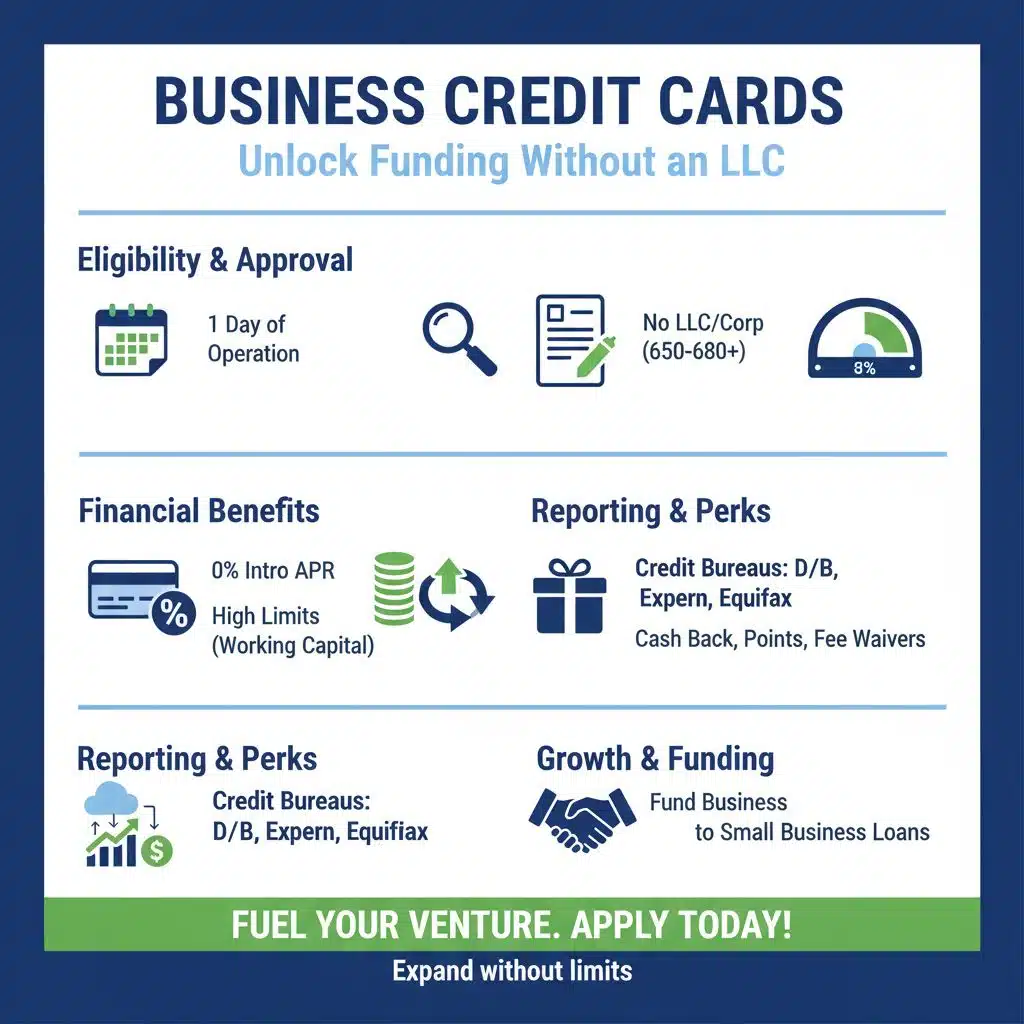
Most business cards need no llc or corporation. You need only one day of operation. Issuers check your FICO score for loan approval. They favour scores near 650 to 680. Some cards offer zero percent intro APR and flexible loan terms.
Others give high limits for working capital.
Applicants separate business from personal finances. They charge expenses to an account and track them with bank statements. Credit card activity flows to Dun & Bradstreet, Experian and Equifax.
Card perks include cash back, points and fee waivers. This tool helps entrepreneurs fund growth without small business loans.
How Does Invoice Financing Work for Freelancers?
Freelancers can borrow against their accounts receivable, using unpaid invoices as collateral. Lenders usually ask for a three-month track record before approving funds. Approval depends on invoice quality, client credit and a fair loan-to-value ratio.
Owners keep invoices and handle client collection themselves. They can secure up to 85% of invoice value, which acts like an unsecured loan for working capital.
Factoring lets freelancers sell invoices to a finance company, then it collects payment directly from clients. The finance firm pays cash right away, minus a discount fee that runs from 2% to 5% per invoice.
This method covers slow-paying spells or funds new projects without needing collateral or guarantees.
What Is a Merchant Cash Advance and How Does It Work?
A merchant cash advance gives you a lump sum in exchange for a slice of future card sales. You lock in a fixed share of debit and credit receipts until you repurchase the full amount plus a fee.
Applicants need a solid sales record, at least six months of business tenure, and a decent credit score. Online lenders such as OnDeck will push funds in less than a day on deals up to $100,000.
This revenue-based financing route skips collateral but might ask for a personal guarantee or a blanket lien.
Approval moves faster than most small business loans and needs just a few bank statements. Firms with heavy card terminal traffic tap this source of working capital. Borrowers repay in daily or weekly chunks tied to sales volume, bypassing fixed loan repayment terms.
High rates mean you should weigh these loan terms next to equipment financing or a line of credit. Sole proprietorships, llcs and Shopify shops use this tool to smooth cash flow swings.
What Are Lines of Credit Available for Sole Proprietors?
Solo owners often run low on cash when bills pop up. They tap credit lines for working capital.
- Bluevine offers up to $250,000 in revolving access, with 6 or 12 month terms and rates from 6.2 percent, requires 12 months in business, LLC status, $120,000 annual revenue, 625–650 credit score, charges 1.7 percent per week or 7 percent per month draw fees, and can fund in 24 to 72 hours.
- Fundbox lets you borrow up to $150,000, with repayment in 12 or 24 weeks, asks for 6 months of operation, $100,000 annual revenue, and reviews bank statements and balance sheets.
- OnDeck grants lines up to $100,000, fixes a 12 month term and averages 52.6 percent APR, pulls cash flow data and personal guarantees, and can fund in as little as one business day.
How Can You Get Cash Advances from Online Lenders?
Online lenders examine bank statements and revenue data. Quickbridge gives cash advances with no credit score floor and no collateral. It asks for few documents but adds origination fees and strict loan repayment terms.
National Funding OKs applicants in 24 hours and gives early payoff discounts. It needs solid revenue history and demands daily or weekly payments.
OnDeck can fund up to $100,000 the same day in some states. Funding Circle may send funds in two days after approval. Many advance working capital for short-term cash flow needs. Approval hinges on time in business and stable sales.
These offers carry higher interest rates than bank or credit union loans.
How Can You Improve Your Chances of Loan Approval?
Bad credit can slam the door on your small-business plan. Lenders love to see steady revenue.
- Raise your credit score with on-time payments and paying down high balances. Lenders seek at least a 650 to 680 rating to approve unsecured loans.
- Show consistent revenue at $10,000 or more per month, or aim for $250,000 in gross sales to qualify for term loans. Bank statements back up each figure.
- Open a business checking account, separate from personal funds, and meet every IRS deadline. This move boosts credibility with banks and community development financial institutions.
- Update your financial statements each month using balance sheets, tax returns, profit and loss reports, and bank statements. A clean set of records can speed SBA 7(a) or small business administration funding.
- Form an LLC or corporation to signal a solid business structure. Lenders and investors recognize this step as proof of legal compliance and entrepreneurial resolve.
- Craft a detailed business plan that outlines working capital needs and loan repayment terms. A clear map to profit will charm equipment financing or commercial mortgage officers.
- Compare at least three lender quotes and review the principal, interest rates, fees, and APR. Smart number crunching here can save thousands in loan costs.
- Seek offers from community development financial institutions or explore U.S. Small Business Administration options. These sources often offer friendlier terms and lower personal guarantees.
What Risks and Considerations Should You Know?
Secured loans ask for collateral like inventory, equipment or real estate. Lenders often record these assets as UCC liens. Unsecured loans carry higher interest and sometimes a blanket lien on all assets.
Merchant cash advances may charge steep holdbacks on future sales. Legal rules demand compliance to avoid fines and missed payments. You must read loan repayment terms, checking for prepayment fees and personal guarantees.
You need clear bank statements to prove cash flow and support your business plan.
SBA rules bar real estate investment, money lending, gambling and pyramid schemes from its programs. Lying on an application can tank your loan approval. Lenders may ask for at least ten percent owner equity to back small business loans.
Startups face tougher hurdles in risky fields, like commercial real estate or equipment financing. You can boost your chances by tracking expenses with a bookkeeper and keeping social security records handy.
Community development financial institutions look at valuation and past returns before they offer working capital.
Takeaways
Accessing capital without a formal business entity is absolutely doable—but it’s not “free money.” The nine options above give freelancers, side-hustlers, and sole proprietors fast paths to funding, but the winners are those who treat every dollar like an investment. Compare true APRs (fees + interest), borrow only for ROI-positive uses (inventory with proven turnover, ads with CAC/LTV math, essential equipment), and map cash-flow so repayment never chokes operations. Keep clean records, use a dedicated bank account, and start building business credit from day one (EIN, vendor tradelines) so you can graduate to cheaper capital later.
Avoid stacking high-cost products, read prepayment and origination clauses, and watch for daily-debit terms that can drain liquidity. If a loan doesn’t improve profit within 90–120 days, it’s likely the wrong instrument. Make capital work for growth—not the other way around—and use today’s flexibility as a bridge to a formal entity and lower rates tomorrow.
FAQs on Capital Loan Applications with No Business Entity
1. What can I buy with these no-entity loans?
It gives you working capital fast. It funds equipment financing or moves you into commercial real estate. It can weld your ideas to cash, so you can leverage new growth.
2. What documents do I need to apply?
Just bank statements and a simple business plan. You do not need proof of a business structure or an LLC. It is as easy as sending a few files.
3. What loan terms and repayment options exist?
Loan terms often span six to twenty-four months. You pick loan repayment terms that match your cash flow. You can even refinance later to trim your bottom line.
4. Will I need a personal guarantee and how do I avoid predatory loans?
Some apps ask for personal guarantees, others do not. Read every fee line to dodge predatory loans. Ask questions until you feel safe.
5. Where do I look for these loans?
You can tap SBA-backed lenders or community development financial institutions, called CDFIs. You can also find offers in the Denver metro area and San Luis Valley.