
The world of work is currently trapped in a psychological stalemate. Despite the widespread adoption of “Quiet Quitting” as a defense mechanism and the billion-dollar boom of corporate wellness apps, global burnout rates have not plateaued, they have intensified. This contradiction lies at the heart of the burnout paradox: even as workers retreat, set boundaries, and are encouraged to rest, exhaustion has only deepened. As we navigate 2026, it is clear that we have mistaken rest for recovery and boundaries for belonging.
The term “Quiet Quitting” first captured the zeitgeist as a radical act of reclamation. It was supposed to be the antidote to the “hustle culture” that defined the pre-pandemic era. By doing only what was strictly required by their job descriptions, workers hoped to preserve their sanity and reclaim their time. Yet, data from 2024 through early 2026 suggests a troubling trend: the “Quiet Quitter” is often more exhausted than the high-performer.
This paradox exists because burnout has evolved. It is no longer just a physical response to long hours; it is an existential response to a lack of agency, a deficit of meaning, and a “performative care” culture that treats systemic institutional failures as individual wellness problems.
Key Takeaways: The Burnout Paradox
- Rest is not Recovery: Setting boundaries (the “how” of work) does not solve the lack of meaning (the “why” of work).
- Moral Injury: Burnout is increasingly caused by being forced to work in systems that violate one’s ethics or value.
- Algorithmic Management: The rise of AI-driven surveillance and automated performance metrics has stripped workers of autonomy.
- Performative Wellness: Mental health apps and “Wellness Wednesdays” are often seen as “band-aids” on deep organizational wounds.
The Shift from Physical Fatigue to Existential Fatigue
The modern worker is not just tired; they are disillusioned. While previous generations faced burnout characterized by physical overexertion, the 2026 workforce faces “existential fatigue.” This is driven by a profound mismatch between the self-care narratives pushed by HR departments and the cold reality of economic precarity.
Younger workers, specifically Gen Z and Millennials, report the highest rates of emotional exhaustion despite often working fewer hours than their predecessors. According to the Deloitte 2025 Gen Z and Millennial Survey, nearly 48% of Gen Zs feel financially insecure, and 40% report feeling stressed or anxious all or most of the time. For these workers, “Quiet Quitting” didn’t provide a sanctuary; it provided a vacuum. Without a sense of purpose or a clear career trajectory, the act of withdrawing effort led to a sense of “moral injury”, the psychological distress caused by acting in ways that transgress one’s deeply held moral beliefs or professional identity.
Gargi Bhattacharyya, GMBPsS, Consultant Counselling Psychologist at Mansitherapy and founder of the mental health service Ameliorating Unitedly, says, “As a person-centered therapist, I understand burnout less as a problem of overwork and more as the cumulative impact of emotional invalidation disguised as ‘professional expectations.’ I do not encounter indolent or disengaged employees in therapy. I see disillusioned individuals… people who once led with compassion until doing so became psychologically unsafe. Quiet quitting did not cure burnout; it merely allowed exhausted nervous systems to stop hemorrhaging.”
The Rise of the “Invisible Manager” and Algorithmic Control
A primary driver of 2026’s burnout is the “technological shift” in how work is managed. We have moved from human-centric management to “Algorithmic Management.” In this model, algorithms, not people, assign tasks, monitor productivity, and even determine shifts.
Research from the Scandinavian Journal of Work, Environment & Health (2025) indicates that intensive use of algorithmic management systems is associated with a significant rise in psychosocial risks. When an algorithm is your boss, there is no one to negotiate with for a mental health day or to explain why a project took longer than the “estimated time to completion.” This lack of agency is a fast track to burnout because it removes the “control” element of the Job Demand-Control model, leaving workers feeling like cogs in a digital machine.
Comparative Shift: Workplace Management Models
| Feature | Traditional Management (Pre-2020) | Algorithmic Management (2025–2026) |
| Feedback Loop | Annual/Quarterly reviews with humans. | Real-time, data-driven notifications. |
| Autonomy | High (Discretionary task management). | Low (Standardized, timed task sequences). |
| Wellbeing Focus | Health insurance, gym memberships. | Mental health apps, “forced” mindfulness. |
| Worker Reaction | Traditional quitting or “Hustling.” | “Quiet Quitting” and Existential Apathy. |
| Primary Stressor | Long hours and physical presence. | Surveillance and lack of purpose. |
Moral Injury: When Work Violates Your Values
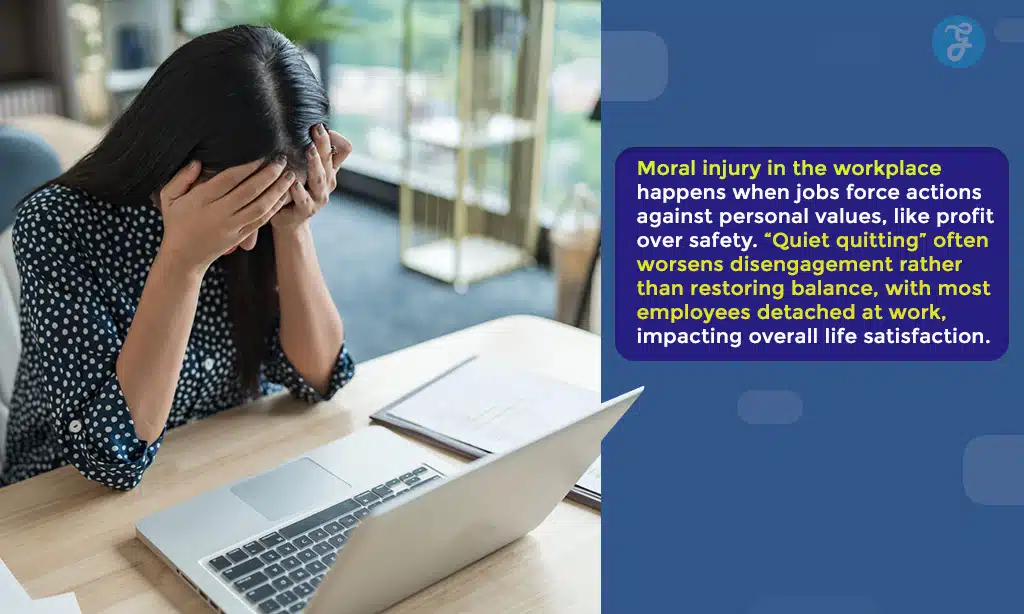
One of the most critical insights into the failure of “Quiet Quitting” is the concept of Moral Injury. Traditionally a term used in military and healthcare contexts, it now applies broadly to the corporate world. Moral injury occurs when employees are forced to witness or participate in acts that contradict their values, such as prioritizing profits over customer safety, or seeing colleagues laid off while executives receive record bonuses.
In 2026, many workers report that “Quiet Quitting” feels less like liberation and more like a quiet betrayal of professional identity. Rather than restoring balance, disengagement often produces stagnation. Gallup’s recent workplace assessments suggest that around one-fifth of employees remain engaged at work, while a clear majority fall into a broad category of disengagement where quiet quitting tends to reside. This detachment does not remain confined to the workplace; it spills into overall life satisfaction. Gallup’s life evaluation metrics similarly indicate that only about a third of global workers can be described as “thriving,” a decline that closely mirrors the rise of quiet quitting.
The Failure of Performative Care
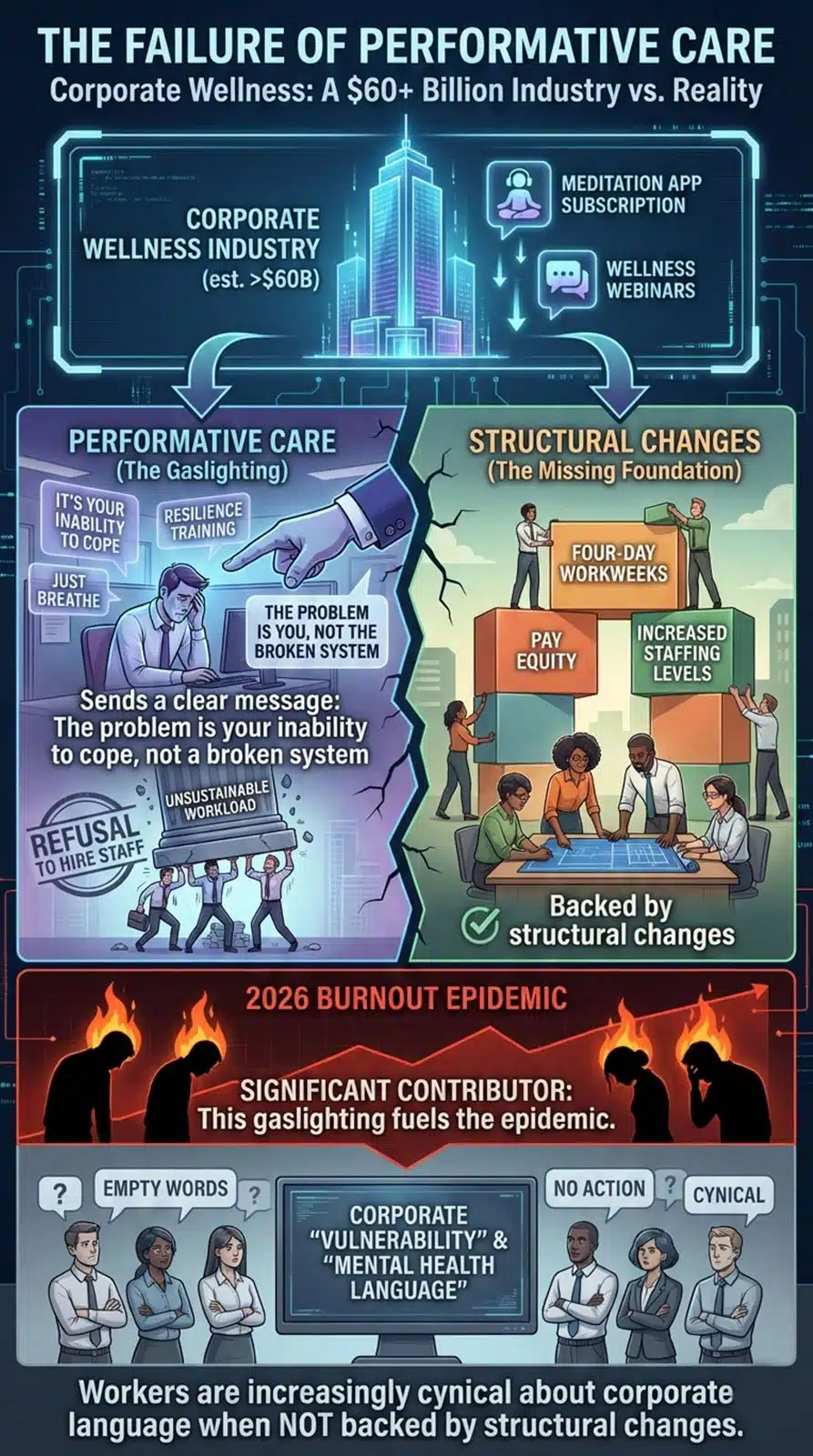
Corporate wellness has become an industry estimated at over $60 billion, yet much of it functions as “performative care.” When an organization offers a subscription to a meditation app but refuses to hire enough staff to sustain a reasonable workload, it sends a clear message: the problem is your inability to cope, not a broken system.
This gaslighting is a significant contributor to the 2026 burnout epidemic. Workers are increasingly cynical about corporate “vulnerability” and “mental health language” when it is not backed by structural changes like four-day workweeks, pay equity, or increased staffing levels.
The Cost of Disengagement (Global Data 2025-2026)
| Metric | 2024 Data | 2026 Estimates |
| Global Engagement Rate | 23% | 21% |
| Loss in Global Productivity | $8.8 Trillion | $9.6 Trillion |
| U.S. Workers Experiencing Burnout | 52% | Over 60% |
| Intent to Leave (Younger Workers) | 44% | 58% |
Expert Perspectives: The “Belonging” Counter-Argument
While many analysts fault workers for a perceived “lack of resilience,” organizational psychology points to a deeper structural issue: a growing belonging deficit. Quiet Quitting, in this view, was an attempt at self-preservation, but one that inadvertently weakened the very ties that make work psychologically tolerable: social connection, shared purpose, and collective identity.
The counter-argument, often voiced by traditional leadership, holds that remote work and strict boundary-setting have eroded the social fabric of the workplace. From this perspective, belonging cannot be built through Slack messages or filtered Zoom calls. Yet available data suggests a more uncomfortable truth: workers do want to belong, they simply do not want to belong to systems that treat them as disposable assets.
The Identity Collapse at the Center of Modern Burnout
What “Quiet Quitting” ultimately revealed is not laziness, entitlement, or generational fragility, but a deeper rupture between work and identity. For decades, professional identity served as a stabilizing force in adult life. Even exploitative systems offered a narrative bargain: sacrifice now, security and progression later. That bargain has collapsed.
In 2026, work no longer reliably provides coherence. Job titles change faster than skills can solidify. Career ladders have been replaced by lateral shuffles. Loyalty has been rendered irrational by constant restructuring, mass layoffs, and the normalization of “workforce optimization.” Against this backdrop, Quiet Quitting attempted to preserve the self by shrinking the role work plays in identity. But humans are not structured to operate indefinitely in a state of emotional detachment from a system that still consumes the majority of their waking hours.
This is where burnout intensifies rather than recedes. When effort is withdrawn but dependency remains, psychological dissonance grows. Workers still need income, healthcare, and status validation from institutions they no longer trust or emotionally invest in. The result is not rest, but chronic low-grade stress, a condition closer to learned helplessness than recovery.
The modern burnout crisis is therefore less about workload and more about identity incoherence. People are no longer sure what work is for, what it promises, or who it is meant to serve.
The Economics of Exhaustion: When Survival Mimics Choice
Quiet Quitting has often been framed as an empowered choice. In reality, for many workers it functions more like constrained adaptation within an unforgiving economic landscape. Rising housing costs, stagnant wages, inflation-driven erosion of purchasing power, and the precarization of white-collar labor have quietly narrowed the margin for genuine agency.
The appearance of choice masks structural coercion. Workers “choose” to disengage not because their needs are met, but because overperformance no longer yields proportional returns. Promotion cycles are slower. Bonuses are smaller or symbolic. Layoffs are indiscriminate. In such an environment, rational actors minimize energy expenditure. But humans are not purely rational systems. Emotional and cognitive costs accumulate even when behavior appears optimized.
This is why Quiet Quitting fails as a long-term coping mechanism. It stabilizes output but destabilizes meaning. The body may be less exhausted, but the psyche remains under threat. Economic precarity turns disengagement into a survival posture, not a healing one. And survival mode is neurologically incompatible with flourishing.
The Neuroscience of Disengagement and Apathy
From a neurological perspective, burnout in 2026 is increasingly characterized by apathy rather than anxiety. Earlier burnout cycles triggered hyperarousal—panic, urgency, overdrive. Today’s burnout is marked by emotional flattening, reduced motivation, and cognitive fog.
This shift matters. Apathy is harder to reverse than stress. Stress responds to relief. Apathy responds only to renewed meaning and agency.
Quiet Quitting unintentionally accelerates this neurological drift. By performing only the minimum required, workers reduce stimulation, challenge, and feedback loops that normally support dopamine regulation and motivation. Over time, this creates a feedback vacuum. The brain stops associating work with reward or growth, reinforcing disengagement even in contexts where effort might be worthwhile.
This is not a moral failure. It is a predictable biological response to environments that suppress autonomy while demanding compliance.
In short, Quiet Quitting treats burnout as an energy management problem when it is increasingly a purpose deprivation problem.
Boundary Culture Without Structural Change
One of the most seductive myths of the post-pandemic workplace is that boundaries alone can correct systemic dysfunction. “Log off on time.” “Protect your energy.” “Say no.” These mantras assume workers possess symmetrical power within their organizations. Most do not.
Boundaries without structural reinforcement become performative acts that quietly penalize those who enforce them. Employees who disengage often find themselves passed over for growth opportunities, excluded from informal influence networks, or subtly labeled as “non-essential.” The organization adapts around them, not with them.
This creates a secondary layer of burnout: reputational anxiety. Workers are left wondering whether their boundary-setting is being interpreted as professionalism or disposability. The psychological load of managing this perception erodes any restorative benefits boundaries were meant to provide.
Without workload redistribution, staffing increases, or incentive realignment, boundaries become symbolic gestures rather than protective mechanisms. They signal resistance, but do not reduce pressure.
The Emotional Labor of Pretending Things Are Fine
Another underexamined driver of burnout in the Quiet Quitting era is emotional labor, the effort required to appear functional, positive, and aligned in systems that workers no longer believe in.
Even disengaged employees must perform competence. They must attend meetings, respond politely to emails, and participate in rituals of enthusiasm that feel increasingly hollow. This emotional dissonance is exhausting. It demands constant self-monitoring and suppression of authentic response.
In many ways, Quiet Quitting increases emotional labor rather than reducing it. Workers are forced to conceal disengagement while maintaining surface-level compliance. The gap between inner truth and outward behavior widens, producing the very moral injury discussed earlier, not through overwork, but through prolonged self-betrayal.
Surveillance Capitalism and the Death of Trust
Algorithmic management does more than track productivity; it reshapes the psychological contract between worker and employer. Surveillance replaces trust. Metrics replace judgment. Context disappears.
When every keystroke, pause, and output is quantified, workers internalize a sense of permanent evaluation. Even those who disengage cannot escape monitoring. Quiet Quitting becomes visible, traceable, and potentially punishable.
This environment erodes one of the most important buffers against burnout: psychological safety. Without the ability to explain, contextualize, or negotiate performance, workers experience constant low-level threat. The nervous system remains activated even when workload is reduced.
Burnout thrives under surveillance because control without dialogue eliminates the human capacity for repair.
The Social Cost of Withdrawal
Work has historically served as a primary site of adult social connection. As Quiet Quitting spreads, these social bonds weaken. Collaboration becomes transactional. Informal mentorship declines. Collective problem-solving gives way to siloed task completion.
This social thinning intensifies burnout, particularly for younger workers who entered the workforce during or after the pandemic. Without strong relational anchors at work, disengagement amplifies isolation rather than relieving stress.
The paradox is cruel: workers withdraw to protect themselves, but the loss of connection removes one of the few remaining sources of resilience within organizational life.
Why Wellness Language Now Triggers Cynicism
By 2026, the language of wellness itself has become suspect. Words like “resilience,” “mindfulness,” and “balance” increasingly provoke skepticism rather than comfort. Not because these concepts lack value, but because they have been repeatedly deployed without accompanying structural reform.
Wellness initiatives that coexist with understaffing, opaque pay practices, and relentless performance optimization are perceived as manipulative. They individualize failure and privatize responsibility for systemic harm.
This dynamic deepens burnout by invalidating lived experience. When workers are told to meditate instead of being given manageable workloads, the message received is not care, it is deflection.
The Quiet Collapse of Professional Pride
Perhaps the most devastating consequence of Quiet Quitting is the erosion of professional pride. Many workers entered their fields with genuine aspirations—to contribute, to master skills, to matter. Over time, disengagement corrodes this internal narrative.
People do not only want rest. They want to feel competent, respected, and useful. When systems deny these needs, withdrawal preserves energy but destroys dignity.
Burnout intensifies not because people are doing too much, but because they are no longer allowed to do work they can stand behind.
The Unspoken Grief Beneath Burnout
At its core, the failure of Quiet Quitting reveals a collective grief. Grief for careers that promised meaning and delivered precarity. Grief for institutions that spoke of values while practicing extraction. Grief for a future that feels increasingly unstable.
Burnout in 2026 is therefore not merely exhaustion. It is mourning without ritual. Loss without acknowledgment. Withdrawal without resolution.
Until organizations confront this grief, and redesign work to restore agency, ethics, and belonging, no amount of quiet will heal the modern worker.
What Happens Next: Moving Toward “Loud Thriving”
As we look toward the remainder of 2026 and 2027, the trend is shifting from “Quiet Quitting” to what some are calling “Loud Thriving.” This movement emphasizes:
- Systemic Advocacy: Workers are moving beyond individual boundaries to collective action, demanding “Meaning over Perks.”
- Human-First Management: A return to mentorship. The Deloitte 2025 report shows that 50% of Gen Zs want managers to mentor them, but only 36% say it happens.
- The “Agency” Economy: Companies that offer genuine autonomy—not just “flexible hours” that still require 24/7 availability—will win the talent war.
- AI Transparency: New regulations are expected to demand transparency in algorithmic management, giving workers the right to understand how they are being measured.
The Burnout Paradox has taught us a hard lesson: you cannot “self-care” your way out of a broken culture. The future of work depends not on how much we can rest, but on how much we can matter.