The Brahmo Samaj lives on because it offers a clean and usable framework for public life. Conscience comes before custom. Ethics stands above ritual. Education is a civic right. In a world facing identity stress and rapid change, this mix works. It helps in classrooms, boardrooms, and community halls. The movement did not only argue for reforms. It modeled a civic method: study the evidence, speak in public, build alliances, and seek laws that protect dignity. You can see that method today. It appears in campaigns for girls’ education, interfaith harmony, and freedom of expression. The Brahmo legacy also shows a vital point for modern India. We can value tradition and still accept reform. That balance—heritage and critical reason—keeps the Samaj relevant in debates on faith, rights, and modernity.
At a glance
| Why it matters | Quick note |
| Ethical core | One God, reason, and moral duty |
| Social reform | Education, women’s rights, anti-caste stance |
| Policy echoes | Bans on sati; civil marriage framework |
| Method | Public debate, petitions, and schools |
Who Was Raja Ram Mohan Roy? A Quick Biography
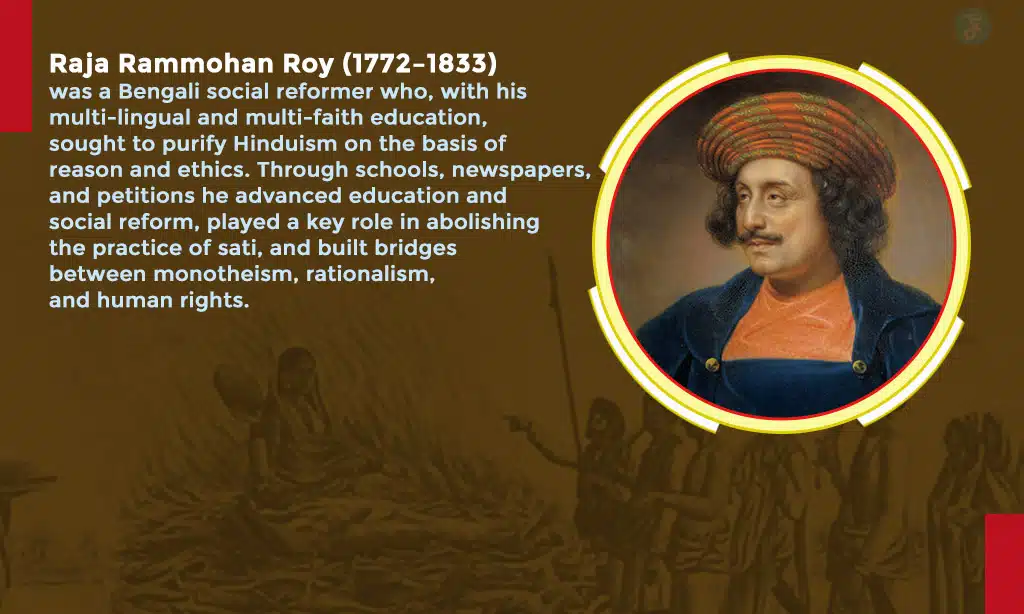
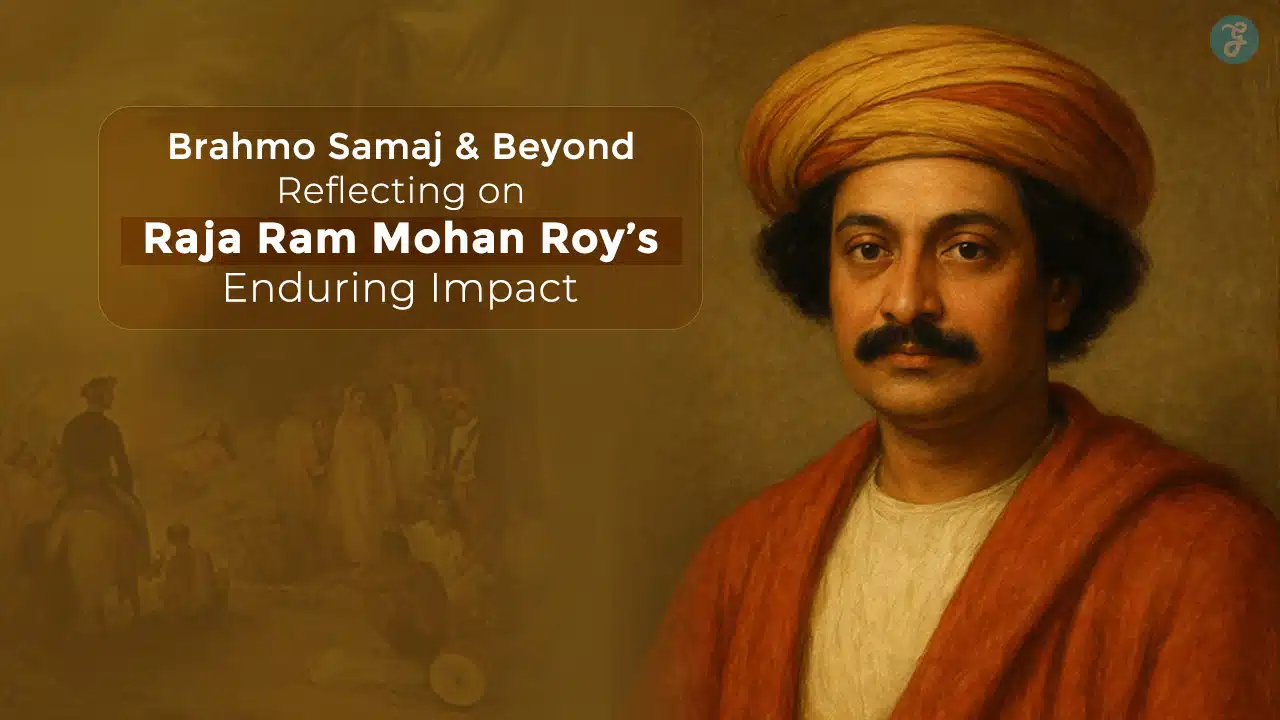
Roy’s life reads like a map of 19th-century India’s encounter with the world. He was born in Bengal in 1772. He learned Sanskrit, Persian, and Arabic. He later mastered English. This broad training freed him from echo chambers. He translated ideas for ordinary readers. He challenged harmful customs. He used reason to refine Hindu practice toward ethical monotheism. He was a bridge-builder: between East and West, scripture and reason, devotion and rights. His strategy was pragmatic—open schools, run journals, petition the state. His horizon was moral—reduce suffering and expand freedom. He died in 1833 in Bristol, England; his chhatri tomb in Arnos Vale stands today.
Early Life & Intellectual Influences
Roy’s early world was multi-lingual and multi-faith. He studied Hindu scriptures. He read Islamic and Christian texts. He made his own translations. He argued that the Upanishads point to a single Supreme Being. He promoted a faith guided by reason and ethics.
At a glance
| Element | Details |
| Birth | 22 May 1772, Radhanagar, Bengal Presidency |
| Languages | Sanskrit, Persian, Arabic, English |
| Key texts | Upanishads (translations), Precepts of Jesus |
| Core message | Ethical monotheism + reason |
Founding Ideas That Shaped His Reform Agenda
Roy linked faith to social duty. He believed scripture should meet the test of reason. He fought harmful customs with public arguments. He used print and schools to act, not only to preach.
At a glance
| Idea | Practical path | Result |
| Reason + faith | Compare texts with ethics | Clear, simple doctrine |
| Education first | Anglo-Hindu School (1822), Vedanta College (1826) | Modern curriculum |
| Public sphere | Newspapers and petitions | Wider public debate |
Brahmo Samaj: Beliefs, Practices, and Break from Orthodoxy
The Brahmo Samaj reimagined religion as ethical fellowship. It focused on a formless God, prayer, and moral living. It trimmed ritual and rejected idol worship. It opposed caste barriers. It welcomed women and lay leaders in worship. It also adopted some familiar congregational forms to make meetings more inclusive. In short, the Samaj made devotion compatible with learning, equality, and civic duty.
Monotheism & Rejection of Idol Worship
Brahmo worship centers on one Supreme Being. No images are needed. The goal is a clear ethical life. This keeps worship simple, sincere, and open to all.
At a glance
| Feature | Brahmo stance | Why it mattered |
| God | One, formless | Unified focus |
| Images | Rejected | Lowers barriers to entry |
| Ethics | Central | Links faith to conduct |
Scriptural Reasoning: Vedas, Upanishads, and Rational Inquiry
Intro. Brahmo thinkers read ancient texts with a critical eye. They held that truth must pass the test of reason. They favored Upanishadic monotheism and ethical living. They compared ideas across traditions to find common ground.
At a glance
| Source | Approach | Outcome |
| Upanishads | Emphasize unity of the divine | Basis for monotheism |
| Reason | Check every claim | Limits superstition |
| Dialogue | Learn across faiths | Shared ethical core |
Social Reform Mandate: Education, Caste, and Gender
The Samaj tied worship to social change. It opposed caste in worship. It promoted girls’ schooling. It argued for women’s dignity and legal protection. It encouraged temperance and civic responsibility.
At a glance
| Area | Stance | Significance |
| Education | Modern curriculum, women’s learning | Builds capacity |
| Caste | Opposed in worship | Affirms equality |
| Gender | Protect widows, educate girls | Expands rights |
Signature Reforms Led by Roy—and Their Outcomes
Roy treated reform like a chain of practical steps. First, define the harm. Second, marshal arguments from reason and texts. Third, use print to reach the public. Fourth, press for law. The process worked. It helped abolish sati. It aided women’s rights. It defended the press. It built schools that outlived him. The bigger result was a new public habit. Indians could argue policy in a modern moral language and expect the state to listen.
Abolition of Sati: Advocacy, Legislation, and Impact
Roy argued that sati was not a religious duty. He showed that many Hindus opposed it. He pointed to justice and humanity. In 1829, the Bengal Sati Regulation (Reg. XVII) banned the practice. This law set a strong moral precedent.
At a glance
| Item | Details |
| Key law | Bengal Regulation XVII of 1829 |
| Roy’s role | Printed arguments, petitions, public debate |
| Rationale | Not a duty; violates justice and humanity |
| Legacy | Legal end; model for future reforms |
Women’s Education & Rights: Schools, Widows, Remarriage
Reformers in Roy’s network pushed for widow remarriage and girls’ education. The Hindu Widows’ Remarriage Act of 1856 legalized widow remarriage. Ishwar Chandra Vidyasagar led that charge, which fit the Brahmo ethos of dignity and equality. Reform schools and new curricula raised literacy over time.
At a glance
| Focus | What changed | Why it mattered |
| Widow remarriage | Legal in 1856 (Act XV) | Protects rights and choice |
| Girls’ education | Growth of schools and support | Builds long-term agency |
| Social climate | Debates in press and pulpits | Erodes stigma |
Press Freedom & Education Reform: Journals and Modern Curriculum
Roy used the press to shape public opinion. He promoted Sambad Kaumudi in Bengali. It campaigned against sati. He also founded the Persian weekly Mirat-ul-Akhbar. When a licensing ordinance hit the press in 1823, he shut the Persian paper in protest and petitioned for press freedom. He also advanced English and science education through new schools and colleges.
At a glance
| Platform | Purpose | Outcome |
| Sambad Kaumudi (1821) | Reach the public; oppose sati | Sustained public pressure |
| Mirat-ul-Akhbar (1822–23) | Speak to elites and officials | Closed in protest vs licensing |
| Petitions | Defend press freedom | Early civil liberties template |
| Schools/College | Modern curriculum | English, science, reasoning |
Beyond Roy: Evolution of the Brahmo Samaj
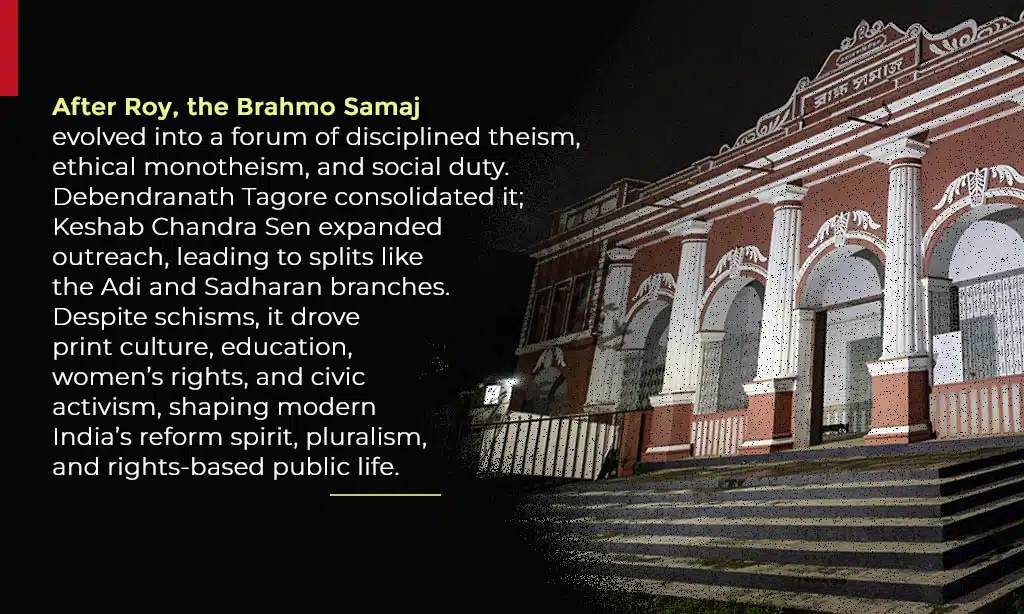
Movements mature when they absorb debate without losing their core. After Roy, the Brahmo Samaj became a workshop of ideas. Debendranath Tagore stressed disciplined introspection and rational theism. Keshab Chandra Sen widened the horizon and engaged the world. Schisms followed. They were not only personal rifts. They were real efforts to set the pace of reform and define doctrine. Yet the DNA stayed: ethical monotheism, social duty, and learning at the center of communal life.
Debendranath Tagore & Keshab Chandra Sen—Continuity and Schisms
Intro. Under Debendranath, the Samaj consolidated. In 1866, Keshab and his group formed the Brahmo Samaj of India; the older body became the Adi (Original) Brahmo Samaj. In 1878, after disputes—including an under-age royal marriage tied to Keshab—a third branch, the Sadharan Brahmo Samaj, emerged. The splits reflected different answers to one question: how fast and how far should a reform movement go?
At a glance
| Phase | Development | Why it mattered |
| 1850s | Debendranath’s leadership | Rational theism and discipline |
| 1866 | Keshab forms new branch | Push for wider outreach |
| 1878 | Sadharan Brahmo Samaj | Democratic and corrective turn |
The Movement’s Role in the Bengal/Indian Renaissance
Intro. The Samaj fed a broader culture of inquiry. It powered print, debate, and education. It inspired other reform groups and civic platforms. It touched literature, music, and politics. It helped set the tone for public argument in modern India.
At a glance
| Cultural thread | Link to Brahmo ethos |
| Print and debate | Sermons, journals, pamphlets |
| Arts and letters | Ethical, introspective themes |
| Civic life | Temperance, schools, women’s rights |
Influence on Nationalism, Social Policy, and Modern Pluralism
Brahmo ideas aided a new picture of India. A civic nation can be built on reason, equality, and rights. Education and legal reform shape public policy. Congregational models and voluntary associations teach citizens how to act together. This is a deep legacy of the Samaj.
At a glance
| Area | Lasting sign | Example |
| Law and policy | Rights-oriented reforms | Sati ban; civil marriage |
| Civic action | Associations and petitions | Reform societies, press drives |
| Public ethics | Reasoned debate | Less ritual, more conscience |
Comparisons & Critiques: Brahmo Samaj vs. Orthodox Currents
To many traditionalists, the Brahmo program seemed radical. It shifted authority from ritual specialists to informed conscience. It placed moral duty—toward women, the poor, and other faiths—above ritual rules. Still, there were points of contact: reverence for the sacred, respect for moral law, and deep engagement with classic texts. Critics worried about “Western influence.” Brahmos answered that reason is not foreign. They pointed to India’s own wisdom traditions. The real debate then and now is not whether tradition matters. It is how it matters: as a closed script or as a living conversation that can correct itself for the sake of justice.
Points of Convergence and Divergence
The Samaj and orthodox currents share ethical concerns but differ on practice and authority. The table makes the contrast clear and neutral.
At a glance
| Dimension | Brahmo Samaj | Orthodox currents (general) |
| View of God | Monotheism, formless | Diverse, often image-based |
| Ritual | Minimal; ethical focus | Rich ritual in many strands |
| Caste in worship | Rejected | Often aligned with custom |
| Authority | Reason + texts | Tradition + texts |
Global Footprints: Roy’s Dialogues with the West
Roy’s global work was not imitation. It was exchange among equals in conscience. He saw links between Upanishadic monotheism and Unitarian ethics. He used those bridges to argue for reform. His trip to Britain raised his platform. It put Indian voices into debates on rights, religion, and empire. It also let him test India’s case in front of skeptics and win allies. His tomb in Bristol’s Arnos Vale is a lasting sign of this exchange. It is a Grade II* listed monument in the UK.
Dialogues, Visits, and Memorials
Roy’s networks helped ideas move both ways. The result was new respect across borders and a modern Indian religious voice that surprised Europe.
At a glance
| Link | Significance | Note |
| Unitarian ties | Shared ethical monotheism | Early interfaith bridge |
| Visit to Britain | Lectures and advocacy | Raised profile of reforms |
| Arnos Vale chhatri | Grade II* listing | Annual remembrance events |
Enduring Impact in 2025: Policy, Education, and Civic Life
You can trace Brahmo influence across three threads. First, law: the ban on sati is foundational. Civil marriage laws grew out of 19th-century reform, including the Special Marriage Act of 1872 (linked to Brahmo campaigns), and then the broader Special Marriage Act of 1954. Second, education: the case for modern subjects and critical reasoning is now a default public expectation. Third, public sphere: journalism, petitions, and associations turn private concern into policy. Even when people disagree, they share Roy’s assumption that arguments should be made in public, with reasons and evidence.
Law and Policy: From the 1872 Act to Today
The 1872 Act offered a civil form of marriage. It later evolved and was replaced by the Special Marriage Act of 1954. The modern law enables interfaith and secular marriage without renouncing religion. Courts and civic groups still rely on this framework.
At a glance
Education & Public Reason
Modern curricula and the culture of debate are now common sense. This is part of Roy’s legacy. Schools and colleges make citizens who can argue with facts and ethics. Newspapers and petitions turn those arguments into action.
At a glance
| Domain | Legacy element | Why it matters |
| Schools | Languages, science, reasoning | Creates capacity |
| Press | Platforms for debate | Checks power |
| Associations | Civic habit of organizing | Sustains change |
Key Takeaways: Lessons for Reformers Today
The Brahmo experience is a playbook. Start with a moral intuition—human dignity is non-negotiable. Build a coalition that turns that intuition into classrooms, media, and law. Pair scholarship with storytelling. People change when ideas are sound and felt. Keep institutions close: schools, journals, and associations turn passion into staying power. Accept that reform is iterative. Disagreement can refine purpose when anchored in respect. Measure success not only by laws passed, but by capacities built. Teachers trained. Readers made. Citizens formed.
Four Action Principles
These four principles distill the method that worked for Roy and the Brahmo Samaj. They travel well across causes and countries.
At a glance
| Principle | Practical move | Example |
| Reason + faith | Test claims; keep ethics central | Use data + moral argument |
| Coalition-building | Bring allies across lines | Reform committees and forums |
| Media savvy | Write, publish, petition | Campaigns for legal change |
| Education | Invest in learning | Schools and public lectures |
Reform Is a Relay, Not a Sprint
Raja Ram Mohan Roy and the Brahmo Samaj asked India to think, to learn, and to act. They linked faith to ethics and public life. They used schools, newspapers, petitions, and law to make change. Some victories came fast, like the 1829 ban on sati. Others took decades, like civil marriage and wider gender equality. The lesson is simple. Reform grows when moral clarity meets practical steps. It grows when we pass the baton. Debendranath carried it. Keshab carried it. The Sadharan Brahmos carried it. Countless reformers across India did the same in their own ways. Today, we can carry it again—when we defend education, free debate, a free press, and the dignity of every person.