

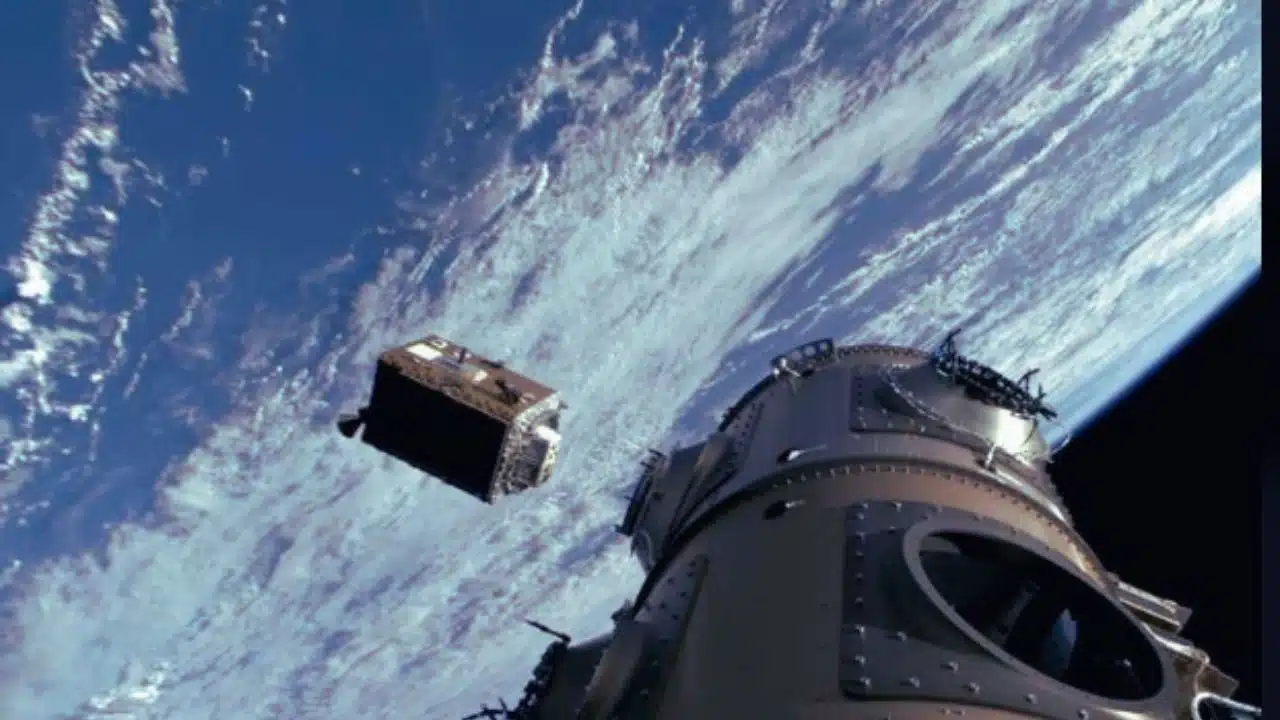
Bezos and Musk race to build AI data centers in space as the next phase of their two-decade space rivalry, responding to soaring energy demand from artificial intelligence models and the limits of data center expansion on Earth.
Recent reports indicate that Jeff Bezos’ Blue Origin and Elon Musk’s SpaceX are both developing orbital infrastructure that could host powerful AI computing payloads in low Earth orbit, moving parts of the cloud off-planet for the first time. The push comes as investors evaluate new financing rounds for SpaceX and as Bezos publicly predicts gigawatt-scale data centers in space within the next decade or two.
Bezos vs Musk in orbit
According to reporting based on people familiar with the plans, Blue Origin has maintained a dedicated team for more than a year to work on technologies for orbital AI data centers, extending earlier work on in-space “cloud-like” platforms such as its Blue Ring spacecraft. In parallel, SpaceX is pitching an upgraded generation of Starlink satellites—often described as “V3”—that would integrate substantial computing capacity for AI workloads, a concept being highlighted to investors in a stock sale that could value the company at around 800 billion dollars. The rivalry builds on existing projects like Amazon’s Project Kuiper satellite network and Starlink’s broadband constellation, but shifts the focus from connectivity to full-fledged in-orbit data processing.
Key orbital AI data center initiatives
| Player / project | Strategy in space | Key assets | Indicative timeline / signals | Notable points |
| Blue Origin / Bezos | Develop purpose-built orbital AI data centers and in-space cloud platforms | Blue Ring in-space platform, New Glenn heavy-lift rocket, ties to AWS cloud | Internal team working on orbital AI data centers “for more than a year” as of late 2025 | Bezos has argued gigawatt-scale data centers will move to space within 10–20 years, enabled by constant solar power. |
| SpaceX / Musk | Turn next-gen Starlink satellites into distributed AI data centers in low Earth orbit | Starlink constellation, planned Starlink V3 satellites, Starship launch system | Musk has said scaling up Starlink V3 with high-speed laser links could support AI computing in orbit, with plans framed around launches later this decade. | SpaceX is exploring raising capital at a valuation near 800 billion dollars, highlighting the orbital AI computing concept to investors. |
| Other early movers | Smaller firms testing GPU-equipped satellites and data-processing nodes | Startups such as Starcloud; stations planned by companies like Axiom Space | A startup mission with an Nvidia H100 GPU is scheduled for launch in late 2025 to test AI processing in orbit. | These experiments could validate core technologies that Blue Origin and SpaceX aim to scale. |
Drivers and obstacles for space-based AI
The central driver behind AI data centers in space is the enormous power consumption of cutting-edge models and the mounting pressure on land, water, and grids posed by conventional hyperscale facilities. Advocates say low Earth orbit offers nearly continuous access to solar energy, no need for cooling towers or vast real estate, and the potential to ease the environmental footprint of AI training and inference over the long term.
Yet the vision faces significant technical hurdles, including how to dissipate heat in a vacuum, shield electronics from radiation, and maintain reliable, low-latency connectivity as satellites constantly move relative to users on the ground. SpaceX’s concept relies on high-speed laser interlinks between Starlink satellites, which already support hundreds of gigabits per second in orbital mesh networks, but scaling that to full data center workloads will demand new engineering and regulatory approvals. Launch costs, servicing complex hardware in orbit, and managing orbital debris further complicate any near-term business case.
Impact, competition, and what comes next
If even part of this orbital data center vision is realized, it could reshape competition in cloud computing by tightly linking space infrastructure with terrestrial platforms like Amazon Web Services and other hyperscale providers. Blue Origin already works with AWS on mission operations, simulations, and ground systems, and analysts see a natural path to integrating in-space compute with cloud services, while SpaceX’s Starlink could evolve from a connectivity network into a distributed supercomputer in orbit serving AI customers.
The race is not limited to Bezos and Musk; reporting indicates other major technology chiefs, including leaders at Google and OpenAI, are also exploring orbital data center concepts, while policymakers warn that governance, security, and space-traffic management must keep pace. In public comments, Bezos has framed gigawatt-scale space data centers as a 10–20 year trajectory, while Musk has suggested that SpaceX could begin testing meaningful orbital AI computing with Starlink V3 satellites later this decade, making the next few years a crucial proving ground for both engineering feasibility and regulatory acceptance.































