Vlogging has changed. Gone are the days when you needed a heavy DSLR, a shotgun microphone, and a workout routine just to film a “day in the life” video. In 2026, the best action camera for vlogging fits in your pocket, survives a dunk in the ocean, and captures footage that looks like it came from a cinema camera.
For years, “GoPro” was just a synonym for action cameras. If you were filming a vlog, you bought a Hero and dealt with the headaches—subpar battery life, overheating during 4K recording, and dismal performance the second the sun went down. But that monopoly is officially over. Competitors like DJI and Insta360 haven’t just caught up; they’ve leapfrogged the competition with massive sensors, flip-up screens, and AI-driven editing that does the heavy lifting for you.
In this guide, I’m skipping the fluff. We are looking at the 10 absolute best GoPro alternatives available right now. Whether you need the low-light mastery of the new DJI Osmo Action series or the 8K clarity of the Insta360 Ace Pro 2, this list has the perfect tool for your story.
What Makes an Action Camera Good for Vlogging?
Before you drop your hard-earned cash, you need to know what separates a standard “crash cam” from a legitimate vlogging tool. Not all action cameras are built to handle dialogue and storytelling. Here is what matters most in the current landscape.
Front-Facing Screens
If you can’t see yourself, you can’t frame the shot. It’s that simple. Old-school action cams left you guessing, but for vlogging, a front-facing screen is non-negotiable. You need to know if your head is cut off or if that tree branch is blocking your face.
- Dual Screens: Cameras like the DJI Osmo Action series have screens on both sides, which is great for durability.
- Flip-Up Screens: The Insta360 Ace Pro 2 uses a flip-up design, which is often larger and easier to see than a tiny front square, making it superior for “talking head” shots.
Audio Quality & Mic Connectivity
Bad audio kills watch time faster than shaky video. While internal mics have improved with wind-reduction algorithms, the ability to connect an external mic is huge. You want a camera that connects seamlessly to wireless systems.
- Wireless Support: The latest DJI cameras connect directly to the DJI Mic 2 via Bluetooth—no receiver dongle needed. This is a massive advantage for keeping your setup small while getting professional audio.
Stabilization (RockSteady vs. FlowState)
Nobody watches shaky vlogs. Electronic Image Stabilization (EIS) clips the edges of your video to smooth out bumps. DJI’s RockSteady and Insta360’s FlowState are currently the gold standards. They often outperform legacy stabilization in low-light scenarios where older algorithms would create a weird, jittery “ghosting” effect that ruins the footage.
Low-Light Performance
This is the final frontier for small cameras. Small sensors struggle indoors or at sunset, resulting in grainy, muddy footage that looks unprofessional. Look for cameras with 1/1.3-inch sensors or larger (like the 1/1.1-inch on the Action 6). The bigger the sensor, the more light it grabs, and the cleaner your evening vlogs will look.
Battery Life & Overheating
Vlogging means long takes. You might talk for 15 minutes straight, and nothing is worse than a camera shutting down because it got too hot. The newest generation of cameras has largely solved this, offering 2 to 4 hours of recording time and improved heat dissipation that allows for continuous 4K shooting without the “thermal shutdown” panic.
| Feature | Why It Matters for Vloggers | Ideal Spec |
| Sensor Size | Better low-light & background blur | 1/1.3-inch or 1-inch |
| Screen Type | Framing your talking head shots | Front color screen or Flip-up |
| Audio | Clear voice capture | External Mic support / Bluetooth |
| Battery Life | Filming all day without swapping | 120+ mins at 4K |
| Heat Mgmt | No shutdowns during long takes | Continuous 4K/60fps support |
1. DJI Osmo Action 6 (The Heavyweight Champion)
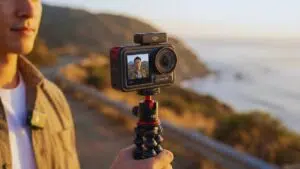
The DJI Osmo Action 6 has officially taken the throne as the best action camera for vlogging in 2026. DJI looked at every complaint vloggers had about action cams—bad low light, fixed focus, overheating—and fixed them all. It feels less like an action cam and more like a cinema camera that you can drop on concrete.
What sets this camera apart is the new 1/1.1-inch sensor paired with a variable aperture (f/2.0–f/4.0). This is revolutionary for this form factor. In bright sunlight, the camera stops down to keep footage sharp; in low light, it opens up to f/2.0 to flood the sensor with light. For vloggers, this means you can actually get a natural depth of field (blurry background) without software trickery, drawing the viewer’s eye to your face.
The magnetic mounting system remains the best in the business. You can snap the camera from a tripod to a chest mount in literally one second. Plus, the direct Bluetooth connection to the DJI Mic 2 means you can have professional lapel audio without plugging anything into the camera itself, keeping your vlogging rig incredibly stealthy.
| Specification | Details |
| Max Resolution | 4K at 120fps / 8K Photo |
| Sensor | 1/1.1-inch CMOS |
| Screens | Dual OLED Touchscreens |
| Waterproof | 20m (without case) |
| Best Feature | Variable Aperture (f/2.0-f/4.0) |
2. Insta360 Ace Pro 2 (The Vlogger’s Dream)
If you prioritize resolution and perfect framing, the Insta360 Ace Pro 2 is your best friend. Co-engineered with Leica, this camera features a massive 2.5-inch flip-up touchscreen. Why is this better than a front screen? Because it’s bigger, brighter, and lets you see your entire frame clearly without squinting, which is critical when you are walking and talking.
The Ace Pro 2 pushes 8K video at 30fps, giving you massive cropping ability in post-production. But the real magic is the Dual AI Chip. One chip handles image processing (denoising, HDR), and the other handles system performance. This results in the best “PureVideo” low-light mode we’ve seen. Even in a dimly lit restaurant or a city street at night, the footage is surprisingly noise-free.
It also features AI gesture control that actually works. You can hold up a palm to start recording, which is super handy when the camera is mounted on a selfie stick out of reach. The “Clarity Zoom” lets you tap twice to zoom in without losing quality, effectively giving you two lenses in one.
| Specification | Details |
| Max Resolution | 8K at 30fps / 4K at 120fps |
| Sensor | 1/1.3-inch 8K Sensor |
| Screen | 2.5″ Flip-up Touchscreen |
| Battery | 1800mAh (approx 100 mins 4K) |
| Best Feature | Dual AI Chip for Low Light |
3. DJI Osmo Action 5 Pro (The Value Powerhouse)
Don’t ignore last year’s flagship. With the release of the Action 6, the DJI Osmo Action 5 Pro has become the absolute best value-for-money premium camera on the market. It shares many of the same “pro” DNA as the 6, including the 4-hour battery life that totally changed the industry standard.
For vloggers on a budget who still want flagship quality, this is it. It features Subject Centering and Tracking, which uses AI to automatically crop and follow you if you move around the frame—eliminating the need for a gimbal in many shots. It also introduced the built-in pressure gauge and 47GB of internal storage, so if you forget your SD card, you aren’t out of luck.
The OLED screens on both the front and back are vivid and bright, making them easy to view even in direct harsh sunlight. If you don’t need variable aperture, this camera gets you 95% of the performance for a lower price.
| Specification | Details |
| Max Resolution | 4K at 120fps |
| Sensor | 1/1.3-inch CMOS |
| Battery | 4 Hours (1080p) / 2+ Hours (4K) |
| Storage | 47GB Built-in |
| Best Feature | Industry-leading Battery Life |
4. Insta360 X5 (The Immersive Storyteller)
Sometimes, the best action camera for vlogging isn’t a traditional camera at all. The Insta360 X5 is a 360-degree powerhouse that captures everything around you in 8K resolution. This is perfect for solo vloggers who don’t have a camera operator to follow them around.
You simply hold the camera on a selfie stick (which the software makes invisible) and walk. In post-production, you can “reframe” the video to point the camera at yourself, then pan over to the scenery, and then back to yourself—all from one single take. You never miss the action because you captured the whole world.
The X5 improves on the X4 with better low-light sensors and a larger touchscreen, making it easier to review footage on the go without needing your phone. It also has a “Single Lens Mode” that turns it into a standard 4K action camera, giving you the best of both worlds.
| Specification | Details |
| Max Resolution | 8K 360° Video |
| Sensor | Dual 1/2-inch Sensors |
| Waterproof | 10m |
| Feature | Invisible Selfie Stick |
| Best Feature | Reframing (Shoot first, point later) |
5. Insta360 Go Ultra (The Wearable POV Cam)
The Insta360 Go Ultra (successor to the Go 3S) takes the “tiny camera” concept to the extreme. This camera is the size of your thumb and weighs practically nothing. It’s magnetic, so you can stick it to a pendant on your chest for effortless hands-free POV vlogging.
The genius is the “Action Pod.” When the tiny camera is docked in the pod, it functions like a normal action camera with a flip-up screen and long battery life. But pop the camera out, and you can mount it in places no other camera fits—inside a coffee cup, on a cat’s collar, or on your hat brim.
For 2026, the “Ultra” model brings 4K 60fps recording and improved battery life in the standalone unit, addressing the biggest complaints of the previous models. It’s the ultimate B-roll camera for adding unique perspectives to your vlog.
| Specification | Details |
| Max Resolution | 4K at 60fps |
| Weight | ~35g (Camera only) |
| Mounting | Magnetic system |
| Screen | 2.2″ Flip Screen (on Action Pod) |
| Best Feature | Tiny size for POV shots |
6. DJI Pocket 3 (The Gimbal Hybrid)
Okay, it’s not technically a rugged action camera you’d throw off a cliff, but the DJI Pocket 3 is widely considered the king of vlogging cameras. It features a built-in 3-axis mechanical gimbal. Unlike electronic stabilization (which warps the edges), mechanical stabilization is physically smooth, giving your vlogs a cinematic “floating” look.
It sports a huge 1-inch sensor, which is larger than almost any standard action cam on this list. This gives you genuine background blur and incredible low-light performance. The 2-inch rotatable OLED screen lets you switch between vertical (TikTok/Reels) and horizontal (YouTube) shooting in a literal snap.
If you are a travel vlogger who stays mostly on land and wants the highest possible image quality, this beats everything else. The autofocus is lightning fast, locking onto your face instantly even if you move close to the lens.
| Specification | Details |
| Max Resolution | 4K at 120fps |
| Sensor | 1-inch CMOS |
| Stabilization | 3-Axis Mechanical Gimbal |
| Audio | Built-in 3-mic array |
| Best Feature | Mechanical Stabilization |
7. Akaso Brave 8 (Best Budget GoPro Alternative)
Not everyone has $400+ to drop on a camera. Enter the Akaso Brave 8. Akaso has built a reputation for delivering 80% of the GoPro experience for 50% of the price. The Brave 8 features a powerful 1/2-inch sensor and 4K 60fps recording.
Crucially for vloggers, it has dual color screens, so you get that front-facing view for framing. The stabilization, called “SuperSmooth,” is surprisingly competent in daylight. While it struggles a bit at night compared to the DJI Action 6, it’s perfectly usable for daytime travel vlogs.
It comes with a generous accessory kit in the box, saving you even more money on mounts and batteries. The user interface isn’t as polished as DJI or Insta360, but once you get your settings dialed in, the video quality is fantastic for the price.
| Specification | Details |
| Max Resolution | 4K at 60fps / 48MP Photo |
| Sensor | 1/2-inch CMOS |
| Screens | Dual Color Screens |
| Waterproof | 10m |
| Best Feature | High value for money |
8. Sony RX0 II (The Cinematic Tiny Cam)
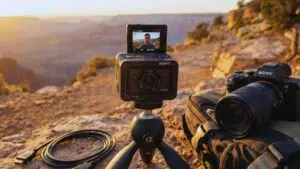
The Sony RX0 II is a unique beast. It looks like an action camera, but inside, it houses a 1-inch stacked sensor from Sony’s famous RX100 series. This gives it arguably the best color science and dynamic range of any camera this size. It’s less of an “action cam” and more of a “cinema crash cam.”
It features a tiny flip-up screen for vlogging, though it is quite small. The real selling point here is the image quality and the ability to shoot in S-Log2 for professional color grading. It is incredibly rugged and crushproof.
However, it has limitations: the continuous autofocus is not as good as the Pocket 3, and the menu system is complex. It is best suited for advanced vloggers who want to match footage with their main Sony Alpha cameras.
| Specification | Details |
| Max Resolution | 4K at 30fps |
| Sensor | 1-inch Stacked CMOS |
| Screen | 1.5″ Flip Screen |
| Durability | Crushproof / Waterproof |
| Best Feature | Professional Color Profiles (S-Log2) |
9. Insta360 One RS (The Modular Choice)
Indecisive? The Insta360 One RS is for you. It uses a modular design where the battery, processor, and lens are separate blocks that click together. You can snap on the 4K Boost Lens for traditional vlogging, and then swap it for the 360 Lens when you want to capture surround video.
This versatility saves you from carrying two cameras. While it’s slightly older tech compared to the Ace Pro 2, the flexibility is unmatched. It also features decent built-in flow state stabilization and crisp audio processing.
It is a bit clunkier to use than a dedicated unit, and you have to be careful with the connectors near water, but for the gear nerd who loves customization, it remains a top pick.
| Specification | Details |
| Resolution | 4K 60fps (Boost) / 5.7K (360) |
| Design | Modular / Interchangeable |
| Waterproof | 5m (when assembled) |
| Stabilization | FlowState |
| Best Feature | 2-in-1 Versatility |
10. Akaso V50 Pro (The Ultra-Budget Entry)
If you are buying a camera for a child, or you’re doing a stunt where the camera might get destroyed, get the Akaso V50 Pro. It’s the cheapest entry point that still delivers “usable” 4K video.
Don’t expect miracles in low light or perfectly smooth audio, but for basic b-roll, sunny beach days, or learning the basics of vlogging, it works. It lacks a front screen, which makes framing harder, but the wide angle lens is forgiving enough that if you point it at your face, you’ll usually be in the shot.
It includes Electronic Image Stabilization (EIS) which helps with walking shots, though it will crop the image slightly. It’s a great backup camera to have in your bag just in case.
| Specification | Details |
| Max Resolution | 4K at 30fps |
| Sensor | 20MP |
| Stabilization | Electronic (EIS) |
| Screen | Rear Touchscreen only |
| Best Feature | Extremely Low Price |
Comparison Table: Top Action Cameras for Vlogging
Here is how the heavy hitters stack up against each other.
| Camera Model | Sensor Size | Max Resolution | Screen Type | Best For |
| DJI Osmo Action 6 | 1/1.1″ (f/2.0-f/4.0) | 4K 120fps | Dual OLED | Overall / Low Light |
| Insta360 Ace Pro 2 | 1/1.3″ 8K | 8K 30fps | Flip-Up 2.5″ | Detail / Selfies |
| DJI Action 5 Pro | 1/1.3″ CMOS | 4K 120fps | Dual OLED | Value / Battery Life |
| Insta360 X5 | Dual 1/2″ | 8K 360° | Large Touch | 360° / Reframing |
| DJI Pocket 3 | 1-inch CMOS | 4K 120fps | Rotating | Cinematic Vlogs |
| Akaso Brave 8 | 1/2″ CMOS | 4K 60fps | Dual Color | Budget |
Final Thoughts
Choosing the best action camera for vlogging comes down to how you shoot. There is no single “perfect” camera, but there is definitely a perfect one for you. If you want the absolute best image quality in any lighting condition (restaurants, sunsets, caves), grab the DJI Osmo Action 6. Its variable aperture is a technological marvel that bridges the gap between action cams and professional cameras.
If you want the highest resolution and the convenience of a massive flip screen, the Insta360 Ace Pro 2 is unmatched. And if you just want to capture everything without worrying about pointing the camera, the Insta360 X5 will change how you create content forever.