

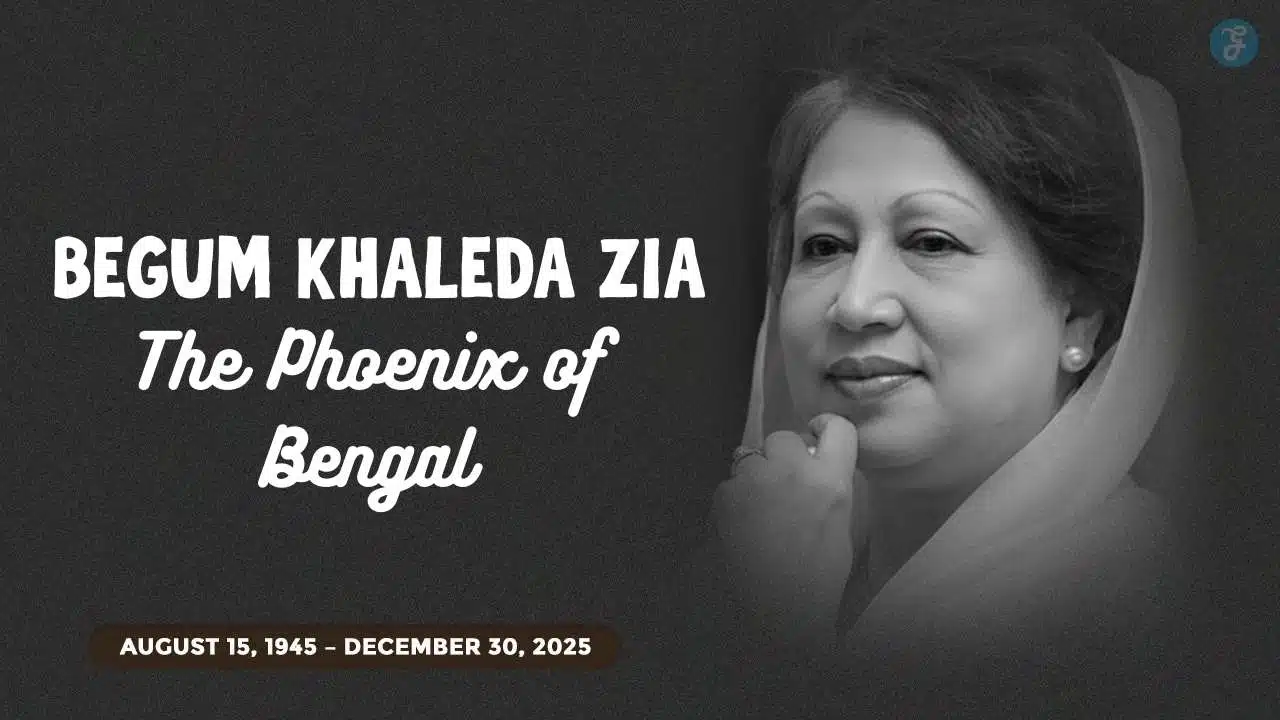
Khaleda Zia Legacy will forever be defined by the image of a phoenix rising from the ashes, a shy housewife who stepped out of the shadows to become the first female Prime Minister of Bangladesh and a titan of South Asian politics. Today, December 30, 2025, the nation stands still as the “Deshnetri” (Leader of the Country) takes her final rest at the age of 80.
Her journey was not merely a political career; it was a saga of resilience, marked by high tragedy, historic triumph, and an unyielding refusal to compromise on her principles.
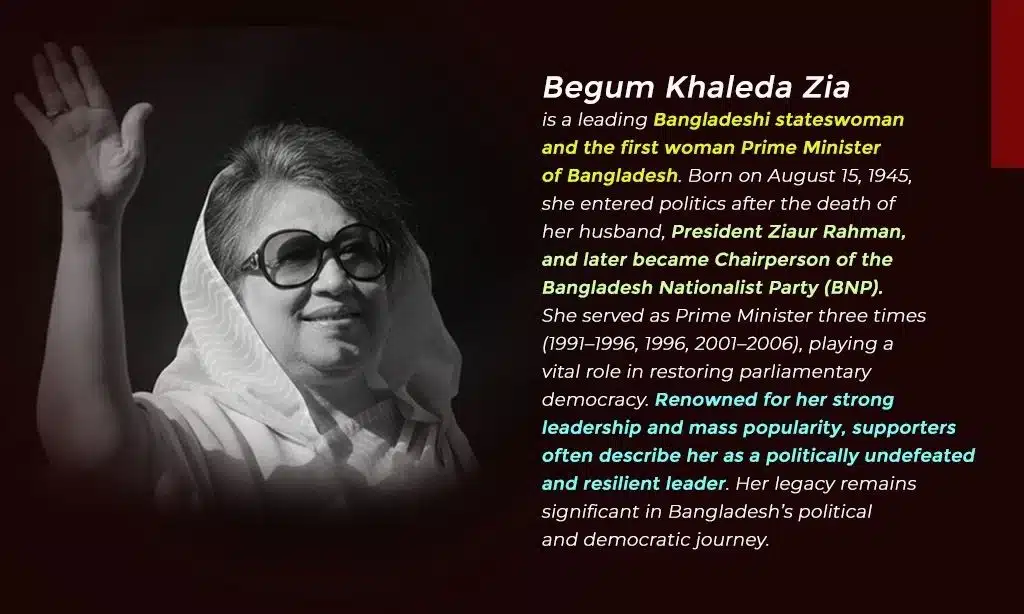
She was the first woman elected prime minister of Bangladesh and the chairperson of the Bangladesh Nationalist Party (BNP). For decades, her presence shaped how people understood power, opposition, compromise, and confrontation.
This is not only the story of a politician. It is the story of how one woman became a symbol of resilience for her supporters, of polarization for her critics, and of a political era that will now be remembered in the past tense.
A Nation’s Grief, and a Moment of Reckoning
News of her death moved quickly across Bangladesh and beyond. For many Bangladeshis, her name carried a familiar gravity, like a headline that had never truly left the front page.
In homes and tea stalls, in party offices and campuses, people spoke about her in the language reserved for historic figures. Some mourned a motherly leader who endured pain with dignity. Others reflected on a career that intensified political conflict and hardened partisan lines.
Both reactions can be true at once. Her life sat at the intersection of hope and anger, democracy and dysfunction, devotion and suspicion. If Bangladesh’s politics often felt personal, it is because leaders like Khaleda Zia made politics deeply human. She brought emotion into public life, loss, loyalty, pride, and grief, and turned them into political force.
Early Life: The “Putul” of Dinajpur
Born Khaleda Majumder in 1945 in Jalpaiguri, she was affectionately nicknamed “Putul” (Doll) for her quiet and gentle demeanor. Few could have predicted that this soft-spoken girl from Dinajpur would one day command the streets of Dhaka. In 1960, she married the dashing Army Captain Ziaur Rahman, beginning a life that would be inextricably linked to the birth and turbulence of a new nation.
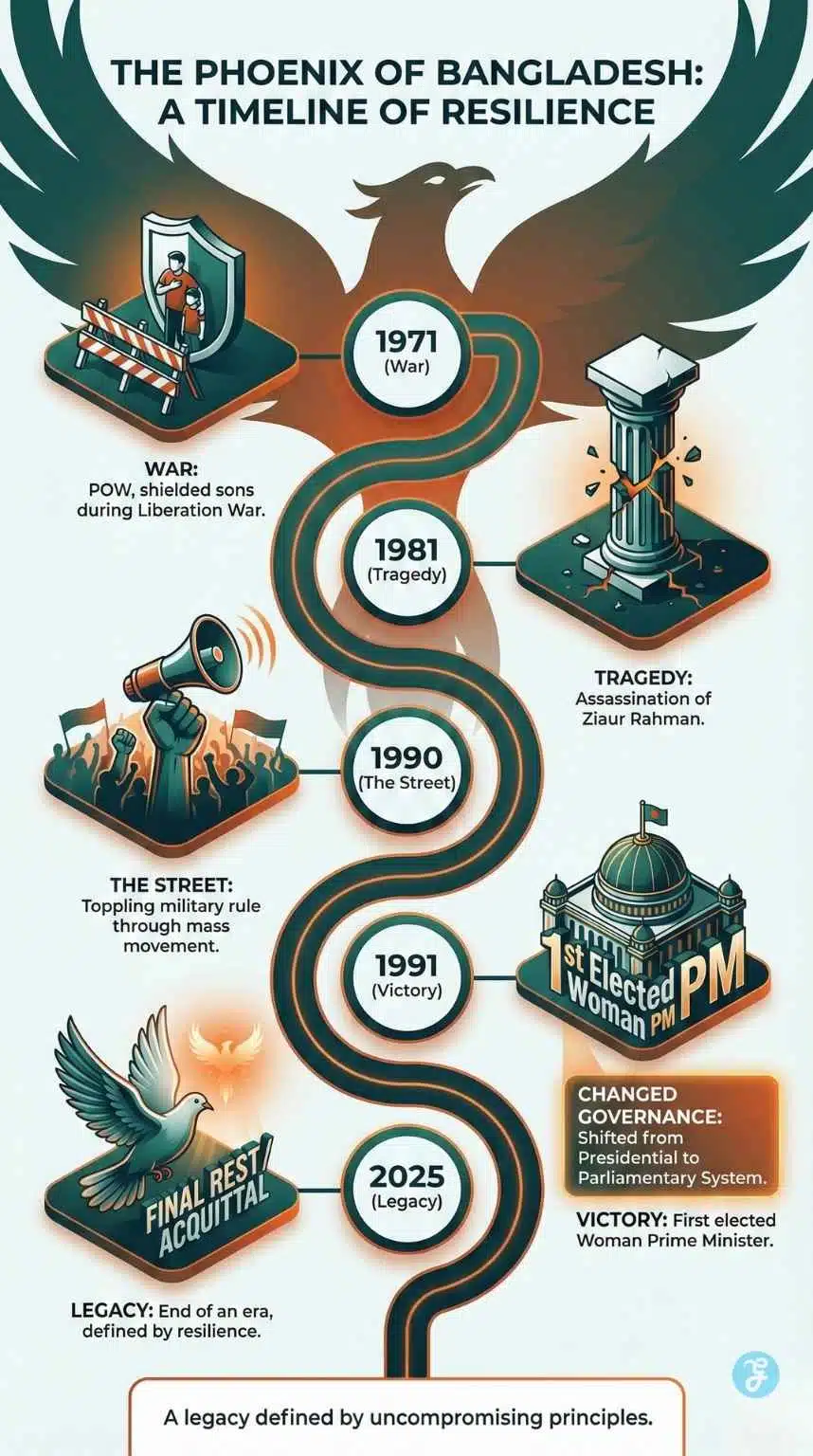
During the Liberation War of 1971, while her husband declared independence and fought on the front lines, Khaleda fought her own silent battle. Captured by the Pakistan Army, she spent nine terrifying months as a prisoner of war in the Dhaka Cantonment, shielding her two young sons, Tarique and Arafat. Even then, her quiet strength was her armor, a trait that would define her decades later. Her rise was not the typical career climb of a lifelong politician. History forced the door open, and she walked through it.
Marriage to Ziaur Rahman: Partnership, Power, and Tragedy
Her life changed profoundly after she married Ziaur Rahman, a military officer who later became a central figure in Bangladesh’s post-independence state. Their family life unfolded alongside a country still defining itself after 1971.
When Ziaur Rahman rose to national leadership, she entered a world where personal safety and political power lived side by side. Yet she did not immediately take on a political role of her own.
Everything shifted in 1981, when Ziaur Rahman was assassinated in an attempted coup. The assassination not only removed a president; it shattered a family and created a political vacuum.
That moment turned Khaleda Zia into more than the widow of a national figure. It made her a carrier of a legacy—one that supporters wanted her to protect and opponents wanted to dismantle.
From Private Life to Party Leadership
In the years after 1981, she moved from personal grief into public responsibility. She eventually took the leadership of the BNP, a party founded by her husband and already rooted in Bangladesh’s political imagination.
She did not enter politics as a fiery orator. She entered as a symbol first, then built the skills and alliances needed to survive. Her supporters often saw her as disciplined, traditional, and quietly resolute. They believed she spoke carefully because she carried the weight of the state’s history on her shoulders.
Her critics saw a different figure: a leader who relied too heavily on legacy, who treated power as inheritance, and who built a party culture that could be confrontational. But even critics acknowledged one thing. Once she arrived in politics, she stayed.
The Fight Against Military Rule and The Road to Democracy
Khaleda Zia became a major force in the movement that opposed military ruler H.M. Ershad. The struggle against Ershad demanded coalition-building, endurance, and public courage.
In that period, politics was not only a contest of speeches in parliament. It lived in street marches, strikes, arrests, and negotiation rooms filled with suspicion. She worked alongside other opposition forces, including Sheikh Hasina, who would later become her defining rival. Their cooperation helped build a mass movement that ultimately toppled military rule in 1990.
For many Bangladeshis, that victory still matters. It is one of the moments when the nation collectively pushed back against authoritarian power. It shows Khaleda Zia at her most historically significant, not as a ruler, but as a challenger who helped reopen democratic possibilities.
1991: The First Elected Woman Prime Minister
Bangladesh held elections in 1991 that many viewed as a return to democratic credibility. Khaleda Zia’s win placed her in history as the first woman elected prime minister of Bangladesh. Her rise carried symbolism far beyond party politics. In a society where political leadership had long been dominated by men, her victory broke a barrier that could not be restored.
Her government also presided over a critical institutional shift. Bangladesh moved away from a presidency-centered system and strengthened parliamentary governance, concentrating executive authority with the prime minister and cabinet.
To supporters, this period represented political normalization after years of coups and military influence. To critics, it became the start of another cycle of winner-takes-all politics. Still, the landmark remains. She reshaped what leadership could look like, and that change outlived her time in office.
A Pioneer Among Asia’s Early Women Prime Ministers
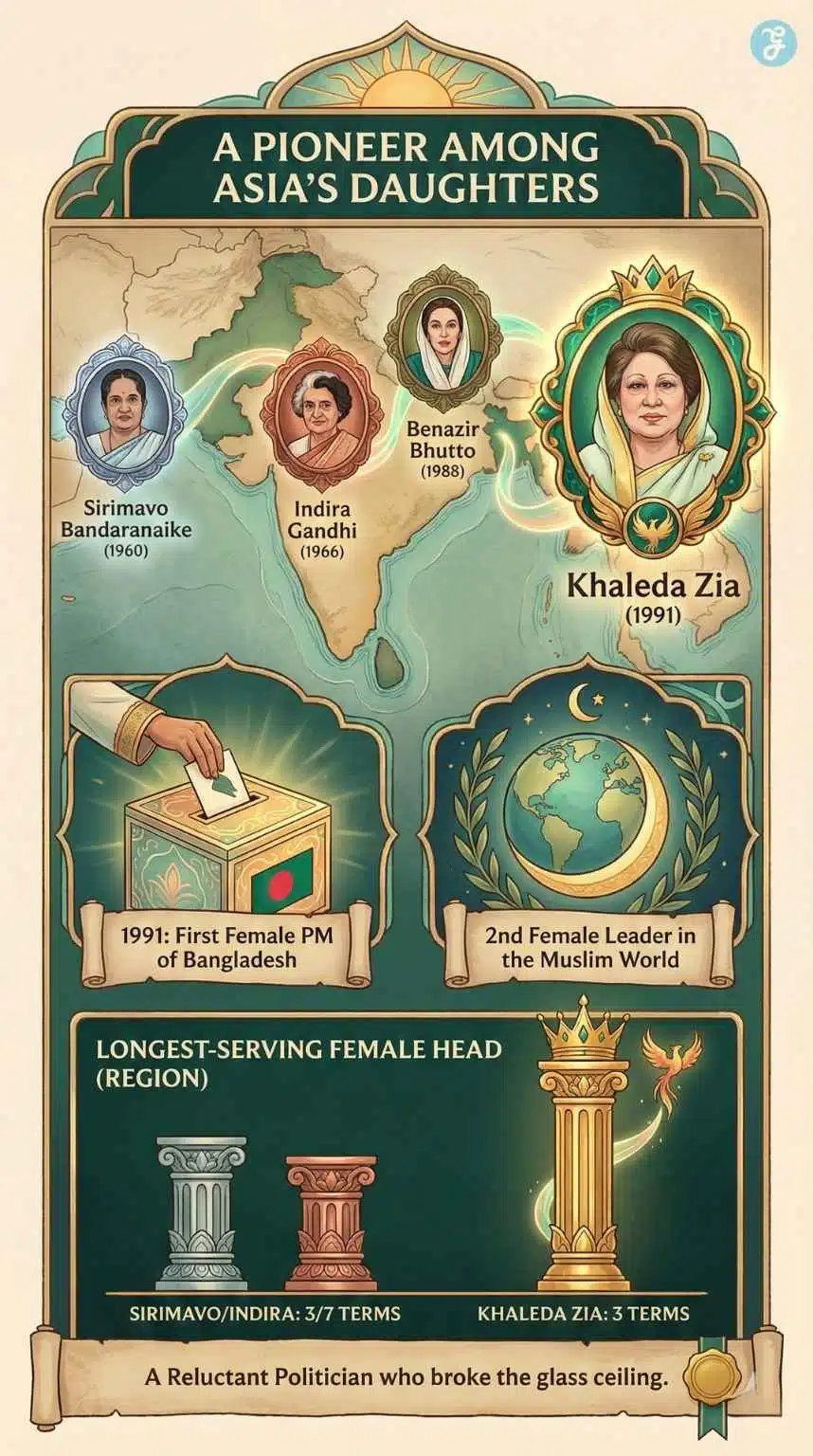
When Begum Khaleda Zia took her oath in 1991, she did not just change Bangladesh; she joined an exclusive pantheon of women who defined 20th-century Asian politics.
While often celebrated as a trailblazer, her historical ranking is precise and significant. She stands as the fourth female prime minister in South Asian history, following a lineage of formidable leaders:
- Sirimavo Bandaranaike (Sri Lanka, 1960): The world’s first female prime minister.
- Indira Gandhi (India, 1966): The “Iron Lady of India.”
- Benazir Bhutto (Pakistan, 1988): The first woman to lead a Muslim-majority nation.
- Begum Khaleda Zia (Bangladesh, 1991): The second woman to lead the Muslim world and the first for Bangladesh.
The Unique Distinction
What set Khaleda Zia apart in this illustrious list was the nature of her rise. While many Asian female leaders inherited established political machinery, Khaleda Zia’s journey was distinctively gritty. She was a “reluctant politician”—a housewife who was forced into the arena by tragedy, who then spent nine years on the streets fighting a military dictator to restore democracy before she could lead it.
Her victory in 1991 cemented South Asia’s unique status as the only region in the world where women broke the highest political glass ceiling repeatedly and decisively, decades before many Western democracies. By serving three terms, she also became one of the longest-serving female heads of government in the region’s history.
Governing Under Pressure: Achievements and Criticisms
Her first term unfolded in a Bangladesh that faced recurring challenges—economic strain, natural disasters, social unrest, and the difficult work of building institutions that could survive political conflict.
Supporters credit her government for opening parts of the economy, encouraging investment, and expanding social programs that mattered to ordinary families. They also highlight reforms in education policy and public-sector management as meaningful contributions.
Critics emphasize a different record. They argue that her government struggled to contain political violence and that institutions often bent under party pressure.
Both sides point to the same reality: Bangladesh’s democratic era did not become calm simply because elections returned. The state still carried the weight of instability, and every government faced the temptation to use power defensively.
Her premiership, then, should be understood as governance in a fragile democracy. She did not operate in a settled system; she operated in a system still learning to stand.
Political Conflict and The Election Trust Crisis
Bangladesh’s politics in the 1990s grew increasingly bitter. Rival parties fought not only for power, but for control over the rules of power. A major dispute formed around election credibility and the demand for neutral mechanisms to oversee voting. This conflict fueled boycotts, strikes, and cycles of street agitation that became recurring features of Bangladeshi politics.
Khaleda Zia’s era did not create this polarization alone, but it accelerated it. As politics became more zero-sum, trust collapsed. This is a painful part of her legacy because it shaped the national mood for decades. Many citizens grew cynical, believing politics served parties more than people.
A tribute does not need to sanitize this. It can name the damage while still honoring the human life behind the headlines.
Return to Power: 2001–2006 and a Harder Political Weather
Khaleda Zia returned to office in 2001 and served again as prime minister until 2006. Her second term unfolded in a more tense political environment, with intensified rivalry and higher stakes.
Supporters remember that period as one in which the BNP maintained close ties to business communities and projected a pro-market posture. They also remember her as a leader who strongly defended Bangladesh’s sovereignty in regional politics.
Critics remember the same period through a darker lens. They point to allegations of corruption and to the rise of violent extremist threats that challenged national security.
This period remains one of the most debated in her career because it raises a central question: how should history judge leaders who governed amid fear and instability? Her defenders argue she faced challenges that would have tested any administration. Her opponents argue that her political alliances and governance choices contributed to those challenges.
The truth likely lies in the tension between them—an administration trying to hold power in a turbulent environment while being judged by the consequences of its choices.
The Rivalry That Defined a Generation
No tribute can avoid what Bangladeshis often call the “two-leader era.” Khaleda Zia and Sheikh Hasina dominated national politics for decades, shaping not only elections but also the emotional identity of parties and supporters.
Their rivalry became a governing system of its own. When one ruled, the other resisted. When one spoke, the other answered. When one called for the street, the other called for the state. Supporters of both leaders often spoke about politics in personal terms—loyalty, betrayal, pride, and survival. This made political conflict feel intimate, not abstract.
That rivalry energized political participation, but it also deepened polarization. It encouraged a culture where compromise looked like weakness and dialogue felt like surrender. In the end, the rivalry became the era. Even people who disliked both leaders could not escape their influence.
Khaleda Zia’s legacy, therefore, is inseparable from a national story of two powerful women who carried Bangladesh through democracy’s promise and democracy’s pain.
Life Outside Power: Prosecution, Prison, and Conditional Freedom
After 2006, Khaleda Zia’s political life shifted from governing to survival. She faced multiple legal cases, including corruption-related charges that her supporters described as politically motivated.
Her opponents argued that accountability mattered and that courts should function independently. Her supporters argued the cases aimed to weaken opposition leadership and reshape politics through prosecution.
The state’s actions against her, arrest, imprisonment, and later restrictions, became part of a larger narrative about how Bangladesh treated dissent and opposition. In 2020, authorities released her from prison on medical grounds under conditions that limited her movement. From that point, her public presence became rare, and her health increasingly defined her daily reality.
These years changed her image. For supporters, she became a symbol of endurance, an aging leader facing the weight of the state. For critics, she remained a controversial figure, but even many critics recognized the harshness of her physical decline.
The Final Legal Turn: Acquittal and a Door that Reopened
In January 2025, the Supreme Court acquitted Khaleda Zia in the last major corruption case against her. That decision mattered not only legally but politically.
It reopened the debate about what the cases meant in the first place. It also revived the idea, at least in theory, that she could again be politically eligible, even if age and illness limited practical involvement. For BNP supporters, the acquittal felt like vindication. For others, it felt like another chapter in Bangladesh’s long story of law and politics colliding.
What matters in a tribute is the human meaning: she lived long enough to see a major legal barrier removed, even if her health prevented her from turning that moment into a public return.
Illness, Treatment, and The Quiet Last Chapter
Khaleda Zia lived with severe health problems in her later years. Reports from her medical teams and public statements described advanced liver disease, along with other chronic complications.
After political changes in 2024, an interim government permitted her to travel abroad for treatment. She went to London in early 2025 and stayed for months before returning to Bangladesh in May. Those final months carried a quiet dignity. She no longer fought rallies or led marches, but her name still moved crowds. She remained BNP chairperson, even as daily politics passed to others.
Her physical absence did not erase her political shadow. Bangladesh still argued about her, still remembered her, and still used her name as a banner. When she died on December 30, 2025, she left behind not only a party and a family but also a national memory shaped by decades of conflict and change.
What Khaleda Zia Legacy Really Means
Khaleda Zia Legacy is not one thing. It is a set of legacies layered together, sometimes conflicting, sometimes inseparable.
She leaves a legacy of democratic struggle because she helped challenge military rule and normalize electoral politics. She leaves a legacy of institutional change because her era strengthened parliamentary governance in a formative period.
She leaves a legacy of leadership for women because her premiership made it harder for society to claim that women could not govern. She also leaves a legacy of intense polarization because her rivalry-era politics trained her to treat opponents as enemies.
She leaves a legacy of loyalty because millions stayed with her and her party through defeat, prison, and illness. She leaves a legacy of controversy because her political alliances and governance years remain deeply debated.
To write about her honestly is to hold these truths together. A tribute can honor her endurance without pretending her era was easy. It can respect her achievements without erasing the costs.
The Human Portrait: Why People Loved Her
Her supporters saw a leader who carried herself with restraint. They admired her calm expression in moments when the nation seemed on fire. Many women, especially in conservative settings, saw in her a kind of representation that did not demand they abandon cultural identity. She looked like a leader who could be traditional and powerful at the same time.
Party workers often described her as someone who valued discipline and loyalty. Even when she was physically absent, her image remained present in party culture.
For these supporters, her life carried a clear moral arc: she entered politics through tragedy, fought through hardship, and endured punishment without surrendering her identity. That kind of story creates devotion. It creates a bond that outlives policy debates.
The Critics’ Argument: Why Her Era Still Divides
Critics point to the damage caused by prolonged political confrontation. They argue that the era of boycotts, strikes, and street battles weakened institutions and made governance unstable.
They also argue that her governments faced credible allegations of corruption and failed to stop political violence with sufficient resolve. They question her alliances and the way politics sometimes leaned on religious identity for electoral advantage.
Some critics also argue that her style of opposition politics normalized obstruction rather than constructive engagement. They believe this helped create a culture where politics rarely matured into policy-centered debate.
Khaleda Zia remained a national figure precisely because she generated powerful disagreement. In that sense, her divisiveness is also proof of her significance. Only the most influential leaders provoke such an enduring argument.
A Dynasty and a Party After Her
Khaleda Zia’s political story cannot be separated from BNP’s future. In her later years, day-to-day leadership increasingly rested with her elder son, Tarique Rahman, who served as BNP’s acting chair.
This transition reflects a broader pattern in South Asian politics, where parties often move through family lines as much as through internal elections. Supporters see continuity; critics see dynastic control.
What happens next will shape how history frames Khaleda Zia’s final chapter. If BNP renews itself into a more institution-driven party, her legacy may look like a bridge to modern opposition politics.
If BNP remains trapped in old confrontations, her era may be remembered as a cycle that never ended. Either way, her absence changes the party’s emotional core. A living leader can anchor loyalty; a departed leader becomes a symbol that others interpret and sometimes exploit.
A Farewell to a Defining Political Era
Bangladesh will now speak of Khaleda Zia in the past tense, but her influence will remain present. Her name will stay in speeches, in slogans, in arguments, and in the memory of those who grew up under the era she helped define.
She entered politics through loss, but she did not live as a footnote. She built a political identity powerful enough to survive prison, illness, and the shifting tides of the state. Khaleda Zia Legacy will be remembered through accomplishments and controversies, through supporters’ devotion and critics’ warnings. That is the mark of a leader who mattered.
Today, Bangladesh mourns a woman who carried the weight of history on her shoulders and never stopped being central to the nation’s story.
Frequently Asked Questions
Who Was Khaleda Zia in Bangladesh Politics?
Khaleda Zia was the chairperson of the Bangladesh Nationalist Party and the first woman elected prime minister of Bangladesh. She became one of the most influential political figures in the country’s modern history and remained a central opposition symbol for years.
How Many Times Was Khaleda Zia the Prime Minister?
She served as prime minister from 1991 to 1996 and again from 2001 to 2006. Her time in office shaped major debates about parliamentary governance, electoral trust, and the direction of democratic politics.
Why Is Khaleda Zia Legacy So Important?
Her legacy matters because she helped define Bangladesh’s post-military democratic era. She led mass opposition movements, governed during critical institutional changes, and shaped the country’s political culture through decades of rivalry and resistance.
What Major Challenges Did She Face Later in Life?
She faced serious health problems, long legal battles, imprisonment, and restrictions on movement. Despite these challenges, she remained BNP chairperson and continued to influence politics through her symbolic status and party structure.
What Happens to BNP After Khaleda Zia’s Death?
BNP’s leadership now rests more fully with its acting leadership, including her elder son, Tarique Rahman. The party’s next direction will influence how history frames her final years—either as a closing chapter of an old era or as a foundation for renewal.






























