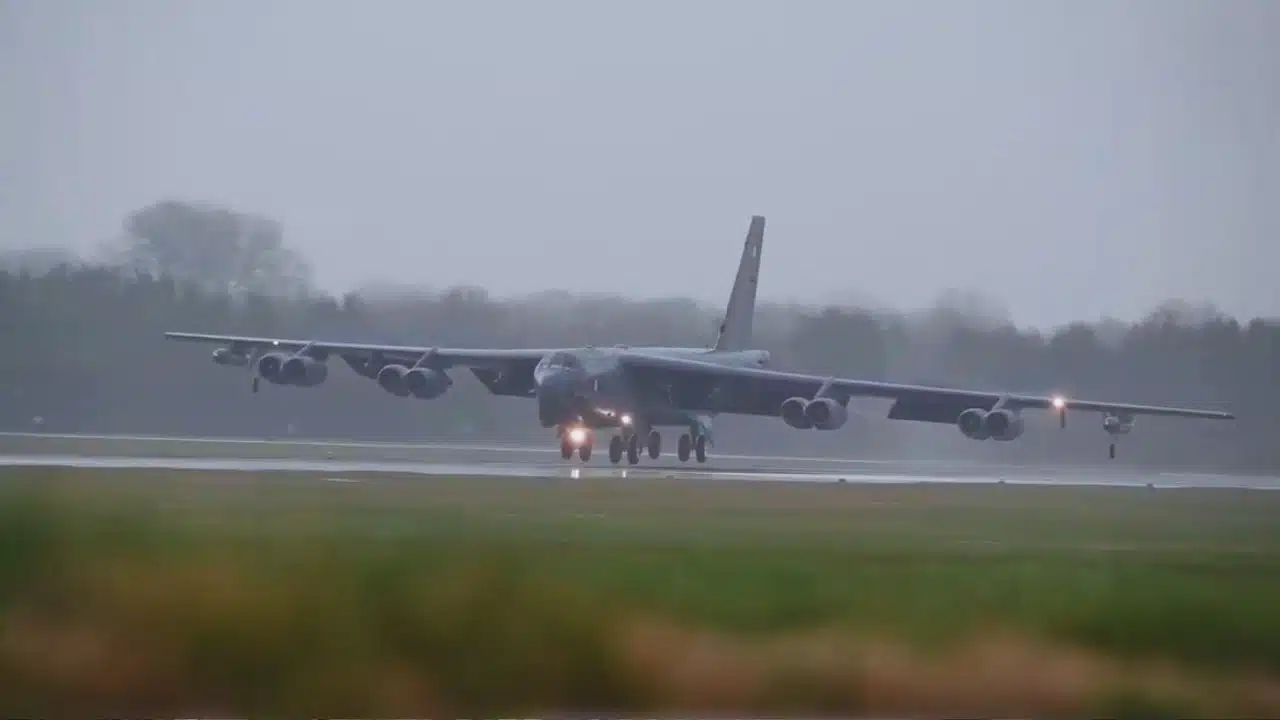
The United States Air Force has deployed several B-52H Stratofortress bombers from the 2nd Bomb Wing at Barksdale Air Force Base, Louisiana, to Morón Air Base, Spain, marking the beginning of Bomber Task Force Europe 26-1. The deployment officially began on November 8, 2025, as part of a larger U.S. Air Forces in Europe and Air Forces Africa (USAFE-AFAFRICA) initiative designed to strengthen deterrence, readiness, and interoperability with NATO Allies and partner nations.
This rotation is part of a recurring series of deployments under the Bomber Task Force (BTF) mission framework, which places U.S. strategic bombers in key theaters around the world for extended operations and training. These missions underscore America’s commitment to collective defense and its ability to project power rapidly across continents. The B-52s’ arrival in Spain reflects the United States’ ongoing investment in NATO’s operational readiness and highlights the crucial role of strategic bombers in maintaining a stable, secure, and prepared transatlantic defense posture.
During this rotation, B-52 bomber crews will train alongside air forces from Finland, Lithuania, Sweden, and other NATO Allies and partners, conducting a range of multilateral exercises designed to enhance coordination, communication, and tactical precision. This includes joint air missions that simulate complex combat scenarios, emphasizing collaboration between bomber, fighter, and support aircraft in contested airspace. The goal is to prepare forces for real-world contingencies, improve flexibility in command-and-control operations, and ensure a synchronized response capability to emerging threats across Europe and the Arctic region.
The B-52 Stratofortress, capable of carrying both conventional and nuclear weapons, remains one of the most enduring and versatile aircraft in U.S. Air Force history. Despite entering service in the 1950s, the platform has undergone multiple upgrades in avionics, radar systems, and weapon integration, enabling it to remain a cornerstone of global strike operations. Its participation in Bomber Task Force Europe missions demonstrates how legacy platforms can be continually adapted for modern warfare — particularly in integrated, networked environments where speed, precision, and interoperability are key.
The current deployment serves multiple strategic purposes beyond training. By conducting joint operations in European airspace, the United States and its Allies are reinforcing their ability to operate as a unified coalition force capable of rapid response in high-threat environments. These exercises include scenarios simulating advanced air-defense systems, electronic warfare interference, and dynamic targeting operations — all meant to mirror potential real-world challenges that NATO forces could face along Europe’s Eastern Flank and in the High North.
B-52 aircrews will focus extensively on the find, fix, track, and target (F2T2) process, a sequence of actions used to identify and engage hostile forces. Training missions will test aircrews’ ability to coordinate with fighters, intelligence assets, and command centers in real time. As they refine these skills, crews will be challenged by simulated threats, both airborne and ground-based, which are designed to disrupt radar tracking, restrict maneuverability, and test decision-making under pressure. These scenarios not only sharpen tactical capabilities but also strengthen psychological and procedural readiness for fast-moving conflict situations.
From a strategic perspective, Morón Air Base offers a crucial staging point. Its location in southern Spain allows the U.S. Air Force to project power across both Europe and North Africa while maintaining rapid access to the Mediterranean, the Atlantic, and the Arctic corridors. This geographical advantage makes it a key node in the U.S. global defense network and a vital hub for Agile Combat Employment (ACE) operations — a modern doctrine emphasizing dispersed, flexible deployments that complicate adversary targeting and enhance survivability of Allied forces.
The Bomber Task Force initiative also plays a symbolic and psychological role. Regular deployments of U.S. bombers to Europe serve as a visible demonstration of NATO unity and deterrence, reminding potential adversaries that the Alliance retains both the will and the capability to respond to aggression swiftly and decisively. Each rotation builds trust and shared operational experience among partner nations, reducing communication gaps and aligning tactical doctrines.
While in theater, B-52s are expected to conduct multiple long-range training missions that will integrate with Allied air forces operating out of Northern Europe, the Baltic region, and the Arctic. These missions often include aerial refueling, joint strike rehearsals, and precision targeting practice across vast distances — demonstrating endurance, flexibility, and the ability to strike from anywhere. This reinforces the concept that strategic bombers remain a key pillar of deterrence, complementing NATO’s defensive posture with both conventional and nuclear capabilities.
Ultimately, Bomber Task Force Europe 26-1 is about sustained readiness and credible deterrence. By maintaining a consistent presence and regularly exercising with partners, the U.S. Air Force ensures that its bomber fleet remains interoperable, adaptive, and fully prepared for any potential contingency. The ongoing deployment in Spain highlights the enduring importance of alliances, the evolving nature of airpower in the modern battlespace, and the unshakable commitment of the United States to safeguard peace and stability across the Euro-Atlantic region.
The Information is Collected from Defence Blog and usafe.af.mil.