
The freelance cloud market has shifted dramatically. In late 2025 and moving into 2026, the question isn’t just “which cloud is better?”, it is strictly about ROI. When you look at the data for AWS vs Azure Salary Freelance, a clear pattern emerges that separates the “high earners” from the “steady earners.”
This guide analyzes the latest 2026 market data, salary trends, and freelance demand to help you decide which certification path will maximize your income.
Key Takeaways
- For Maximum Hourly Rate: Choose AWS. The ecosystem is larger, the startups have urgent funding, and the “surge pricing” for emergency fixes is lucrative.
- For Maximum Stability: Choose Azure. The contracts are longer, the clients are wealthier (enterprises), and the integration with the Microsoft ecosystem ensures you are indispensable.
- For Future-Proofing: Innovative niches like AI/Machine Learning and FinOps (Cost Management) are growing faster than general cloud administration.
- The “Golden Ticket”: Don’t stop at one. A “Multi-Cloud Architect” who can speak both languages is the most valuable asset in the 2026 market.
High Rates vs. Income Stability
Before diving into the numbers, it is helpful to understand the fundamental difference in how these two clouds pay.
If you are looking for the raw “highest hourly rate” potential, AWS (Amazon Web Services) currently holds the crown. AWS architects are frequently hired by well-funded startups and “greenfield” tech companies that need rapid scaling, often paying premium “surge pricing” for experts who can solve complex infrastructure problems overnight.
However, if you are looking for “income stability” and long-term contracts, Microsoft Azure is the undisputed king. Azure dominates the Fortune 500 space, where banks, healthcare providers, and government agencies hire freelancers for 6-to-12-month migration projects. These contracts guarantee a massive Total Contract Value (TCV), even if the hourly rate is slightly lower than the peak AWS rates.
The Salary Breakdown: Hourly Rates vs. Annual Income
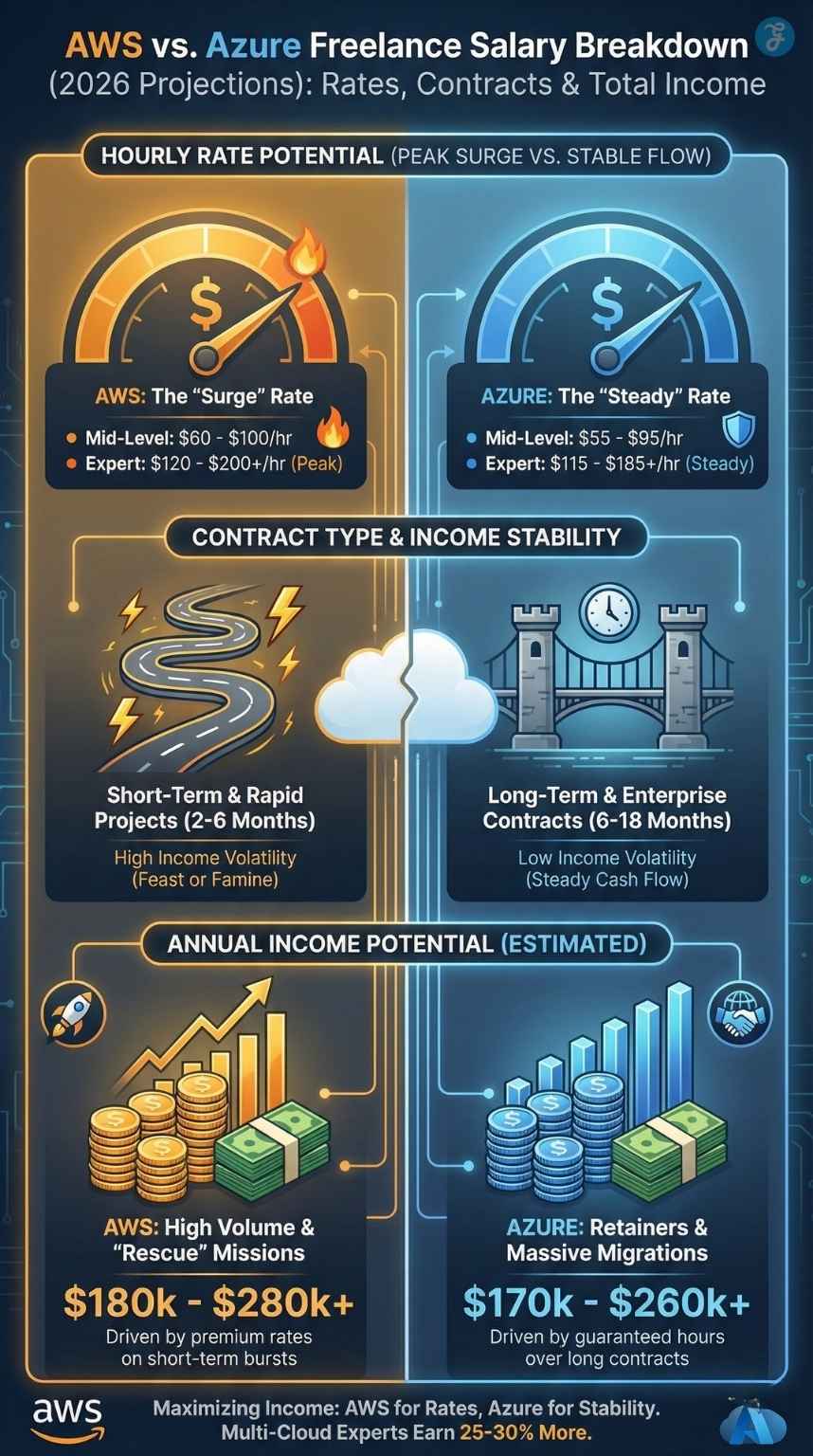
When analyzing AWS vs Azure Salary Freelance data, it is critical to distinguish between salary (full-time employment) and freelance rates (hourly or project-based). Freelancers take on more risk, and the market compensates them differently depending on the ecosystem they choose.
AWS Freelance Rates: The “Surge Pricing” Model
AWS commands the largest market share (approximately 30-31% as of late 2025), which creates a massive volume of “emergency” and “growth” work. Because AWS is the default choice for modern SaaS (Software as a Service) startups, these clients are often racing against competitors. They don’t just need a server; they need an auto-scaling, serverless architecture yesterday.
- Average Mid-Level Rate: $60 – $100 per hour.
- Expert Level Rate: $120 – $200+ per hour.
- The “Unicorn” Project: Short-term DevOps fixes or “Cloud Rescue” missions where a client’s production environment is unstable. These can command rates upwards of $250/hr for short bursts.
Why AWS Pays More Per Hour:
The complexity of AWS’s vast service catalog (over 200 services) creates a “knowledge gap.” Clients are terrified of “bill shock”—where they accidentally spend $10,000 in a month due to poor configuration. They will happily pay a freelancer $150/hr to prevent that $10,000 mistake.
Azure Freelance Rates: The “Retainer” Model
Azure has cemented itself as the backbone of the corporate world, holding roughly 20-22% of the market. Its growth is fueled by companies already using the Microsoft stack (Office 365, Active Directory, Windows Server).
- Average Mid-Level Rate: $55 – $95 per hour.
- Expert Level Rate: $115 – $185 per hour.
- The “Unicorn” Project: Enterprise Migrations. A bank moving 500 legacy servers to the cloud isn’t a two-week gig. It is a 12-month roadmap.
Why Azure Wins on Stability:
While an AWS freelancer might spend 20% of their time hunting for the next gig, an Azure freelancer often lands a “retainer” contract. Earning $125/hr for 20 guaranteed hours a week for a year is often more lucrative than chasing $175/hr short-term AWS gigs.
Comparative Salary Table [2026 Projections]
| Feature | AWS Freelancer | Azure Freelancer |
| Primary Client Base | Startups, SaaS, Tech-First Co. | Fortune 500, Gov, Healthcare |
| Contract Duration | Short to Medium (2-6 months) | Long Term (6-18 months) |
| Hourly Rate Peak | High ($200+/hr potential) | Medium-High ($185+/hr) |
| Income Volatility | High (Feast or Famine) | Low (Steady Cash Flow) |
| Top Paying Niche | Serverless (Lambda), AI/ML | Hybrid Cloud, Security, Identity |
To maximize your freelance income, you must understand the psychology of the client hiring you. The “AWS vs Azure Salary Freelance” debate is really a debate about who you want to work for.
The AWS Client: Innovation & Speed
The typical AWS client is a CTO or Lead Developer at a technology company. They value speed, scalability, and code-based infrastructure (Infrastructure as Code).
- Keywords they use: Terraform, Kubernetes (EKS), Lambda, DynamoDB, CI/CD pipelines.
- What they buy: They buy “modernization.” They hire freelancers to refactor a monolithic application into microservices.
- Pain Point: They are growing too fast, and their current infrastructure is breaking under the load.
- Your Value Proposition: “I can build an architecture that scales to 1 million users automatically.”
The Azure Client: Security & Integration
The typical Azure client is an IT Director or CIO at a non-tech company (e.g., a logistics firm, a regional bank, or a manufacturing plant). They care about compliance, security, and “making it work with what we already have.”
- Keywords they use: Active Directory (Entra ID), Hybrid Cloud, VPN Gateway, Azure SQL, Compliance (GDPR/HIPAA).
- What they buy: They buy “risk reduction.” They hire freelancers to securely connect their on-premise data center to the cloud without getting hacked.
- Pain Point: Their servers are end-of-life, and they need to move to the cloud without disrupting daily business operations.
- Your Value Proposition: “I can migrate your workloads to the cloud while keeping your data strictly compliant and secure.”
Where to Find the “Whales” [High-Paying Clients]
Knowing AWS or Azure is only half the battle; knowing where to sell that skill is the other half. In 2026, high-paying clients do not hang out on general job boards.
- Toptal & Arc.dev (The Top 3%): These are the “Ivy League” of freelance platforms. They vet you rigorously (coding tests, system design interviews), but if you pass, you get access to Fortune 500 clients who don’t haggle over a $150/hr rate. If you have your AWS SAP-C02 or Azure AZ-305, apply here immediately.
- Upwork (The “Expert-Vetted” Badge): Don’t just be a general freelancer on Upwork. Aim for the “Expert-Vetted” badge, which is distinct from “Top Rated.” Enterprise clients use a specific “Talent Scout” service on Upwork to find cloud architects. To get noticed, your profile must mention specific ROI achievements, e.g., “Saved client $15k/month on AWS EC2 bills.”
- Niche Communities:
- We Work Remotely: Good for finding long-term contract roles with tech startups.
- Cloud-Specific Slack/Discord: Communities like the AWS Community Builders or Azure Tech Groups often have “hiring” channels where leads are posted before they ever hit a public job board.
Top Paying Certifications for 2026
In the freelance world, certifications are your “trust badge.” They tell a stranger that you have the baseline competence to handle their data. However, not all certifications are created equal. In 2026, “Associate” level certs are the bare minimum; the real money is in the “Professional” and “Specialty” tiers.
1. AWS Certified Solutions Architect – Professional (SAP-C02)
This is widely considered the “Gold Standard” of cloud certifications.
- Estimated Salary Value: $160,000+ (Full-time equivalent).
- Freelance Value: Extremely High.
- Why: It tests your ability to design complex, multi-tier systems. It proves you understand cost optimization, which is the #1 pain point for AWS clients. If you can show a client that you can lower their monthly bill by 30%, you justify your high hourly rate immediately.
2. Microsoft Certified: Azure Solutions Architect Expert (AZ-305)
To get this, you generally need the Administrator associate cert (AZ-104) first.
- Estimated Salary Value: $155,000+ (Full-time equivalent).
- Freelance Value: Very High.
- Why: This certification focuses heavily on governance and security. Corporate clients pay a premium for architects who know how to set up “Azure Policy” to prevent employees from creating insecure resources.
3. The “Wildcard”: AI Certifications
The biggest trend for 2026 is the explosion of AI-related cloud roles like prompt engineering.
- AWS Certified AI Practitioner / Machine Learning Specialty: With companies scrambling to integrate Generative AI (LLMs) into their products, freelancers who can set up Amazon Bedrock or SageMaker are seeing rate hikes of 40%.
- Azure AI Engineer Associate (AI-102): Microsoft’s partnership with OpenAI (ChatGPT) means every enterprise wants “Private ChatGPT” on Azure. If you know how to deploy Azure OpenAI Service, you can practically name your price in 2026.
The “Tech Stack” Essentials: What Else Do You Need?
A certification gets you the interview, but your “tool belt” gets you the job. In 2026, no client hires a “ClickOps” engineer (someone who manually clicks buttons in the AWS/Azure console). To command top freelance rates, you need to master the tools that automate the cloud.
- Infrastructure as Code (IaC): You must know Terraform. It is the industry standard for both AWS and Azure. If you can write a Terraform script that spins up an entire environment in 5 minutes, you are infinitely more valuable than someone who builds it manually over 5 days.
- Azure Specific: Learn Bicep (Microsoft’s newer, cleaner alternative to ARM templates).
- AWS Specific: Learn CloudFormation or AWS CDK.
- CI/CD Pipelines: Freelancers are often hired to “fix the deployment.” You need to know how to set up automated pipelines so that when a developer pushes code, it automatically updates the server.
- Tools to know: GitHub Actions (universal), Azure DevOps (huge in the corporate world), and Jenkins (legacy but still common).
- Containerization: Docker and Kubernetes are non-negotiable. Even if you aren’t an expert, you must know how to containerize an app and deploy it to AWS EKS or Azure AKS.
The “Multi-Cloud” Multiplier: How to Earn 30% More
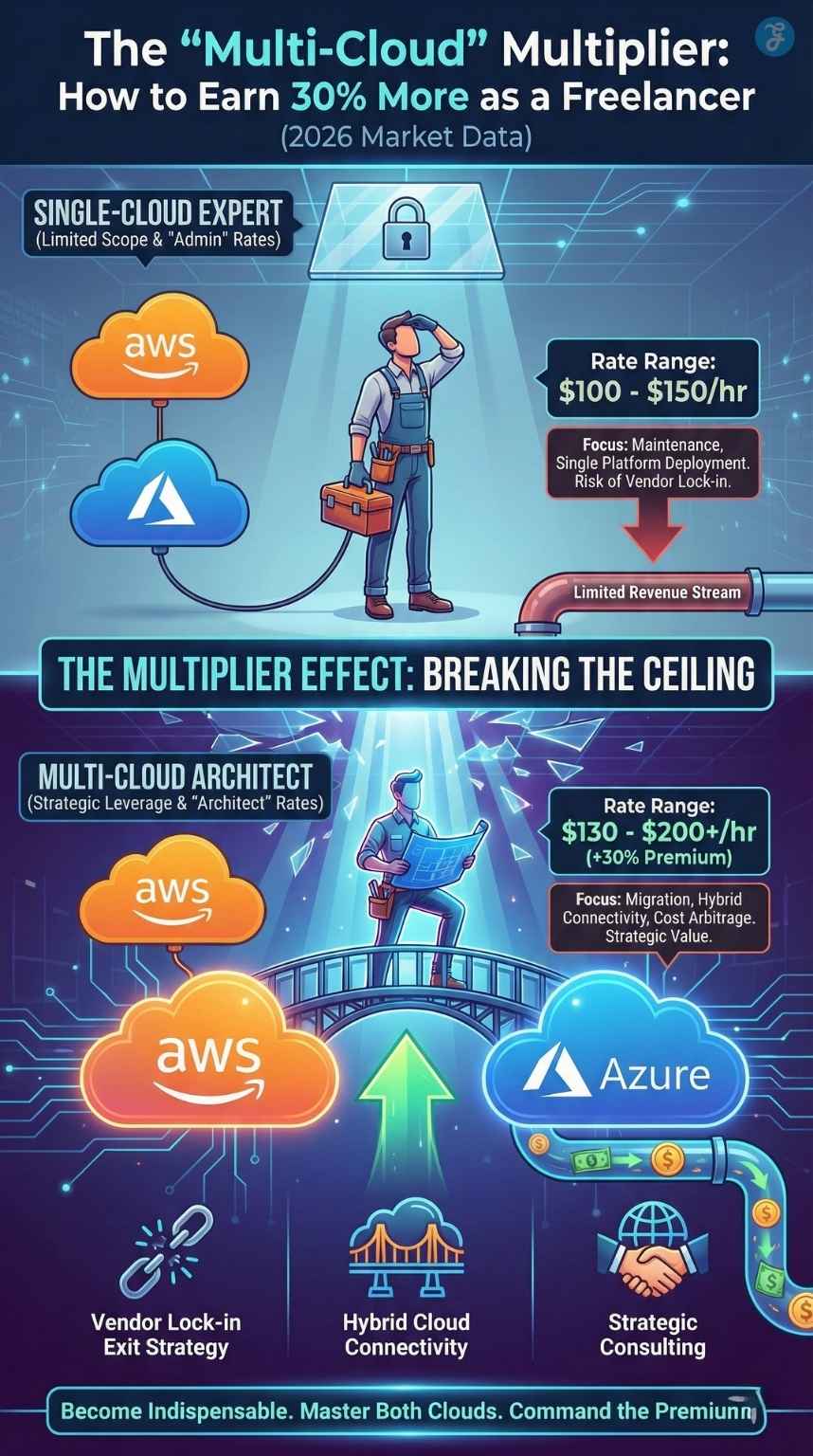
Here is the secret that most articles won’t tell you: The highest-paid freelancers are not loyal to one cloud.
Large organizations rarely use just one provider. They might use Azure for their internal corporate users (because of Office 365), but use AWS for their customer-facing website (because of better developer tools). This creates a massive demand for “Multi-Cloud Architects.”
The “Vendor Lock-in” Exit Strategy
Companies are terrified of “Vendor Lock-in”—being so dependent on AWS that they can never leave.
- The Opportunity: If you can position yourself as a “Cloud Agnostic” expert who can design systems that work on both clouds (or migrate between them), you become a strategic consultant, not just a technician.
- The Rate: Multi-cloud consultants often charge 25-30% more than single-cloud experts because they offer strategic leverage.
Hybrid Cloud is Azure’s Superpower
If you choose the Azure path, master Azure Arc. This tool allows you to manage servers that aren’t even in Azure (e.g., on-premise or in AWS) using the Azure interface. Mastering Hybrid Cloud puts you in a niche with very low competition and very high enterprise demand.
Essential Soft Skills for the High-Paid Cloud Freelancer
You cannot code your way to $200/hour. At the expert level, you are being paid for communication and business acumen as much as for your technical skills.
1. Cost Intelligence (FinOps)
The fastest way to get fired as a cloud freelancer is to spin up expensive resources and forget to turn them off. The fastest way to get promoted (or rehired) is to save the client money.
- Action: Learn AWS Cost Explorer or Azure Cost Management inside out. Make “Cost Optimization” a standard part of your service package.
2. Translation Services
You must be able to translate “geek speak” into business value.
- Don’t say: “I will refactor the monolith into serverless functions using Lambda.”
- Do say: “I will reduce your monthly hosting costs by 40% and ensure the site doesn’t crash during Black Friday sales.”
3. Documentation
Corporate clients (Azure) love documentation. Startups (AWS) often neglect it, but desperately need it. Providing beautiful, clear network diagrams (using tools like Lucidchart) separates the professionals from the amateurs.
The Boring (But Critical) Stuff: Liability and Contracts
When you are an employee, if you accidentally delete a production database, you get a stern talking-to. When you are a high-paid freelancer, you can get sued.
- Professional Indemnity Insurance (Errors & Omissions): If you are handling sensitive data or mission-critical infrastructure, smart clients will require you to have this. It protects you if a mistake you make causes financial loss to the client (e.g., your script accidentally deletes a backup). It costs a few hundred dollars a year but gives you the confidence to touch enterprise systems.
- The “Scope Creep” Clause: Cloud projects are notorious for expanding. A “simple migration” can turn into a “total re-architecture.” Your contract must have a clear Scope of Work (SOW). Anything outside that SOW should be billed at your hourly rate. Never agree to a “fixed price” for a migration project unless you have audited their environment yourself first.
Final Thought: Chase the Client, Not the Cloud
Ultimately, the winner of the AWS vs Azure Salary Freelance battle depends on your personality. Do you thrive in the chaos of a startup, wearing multiple hats and putting out fires? Go AWS. Do you prefer the structure of a large organization, working on massive systems with clear hierarchies? Go Azure.
The certification gets you the interview, but your ability to solve business problems gets you the check. In 2026, the cloud is no longer just about servers; it is about business agility. Position yourself as the person who makes the business run faster and cheaper, and you will never be out of work.